9 Reasons AI Initiatives Stall and How to Fix Them
Key Takeaways
- Most AI projects stall because the organization isn't ready, not because the technology failed.
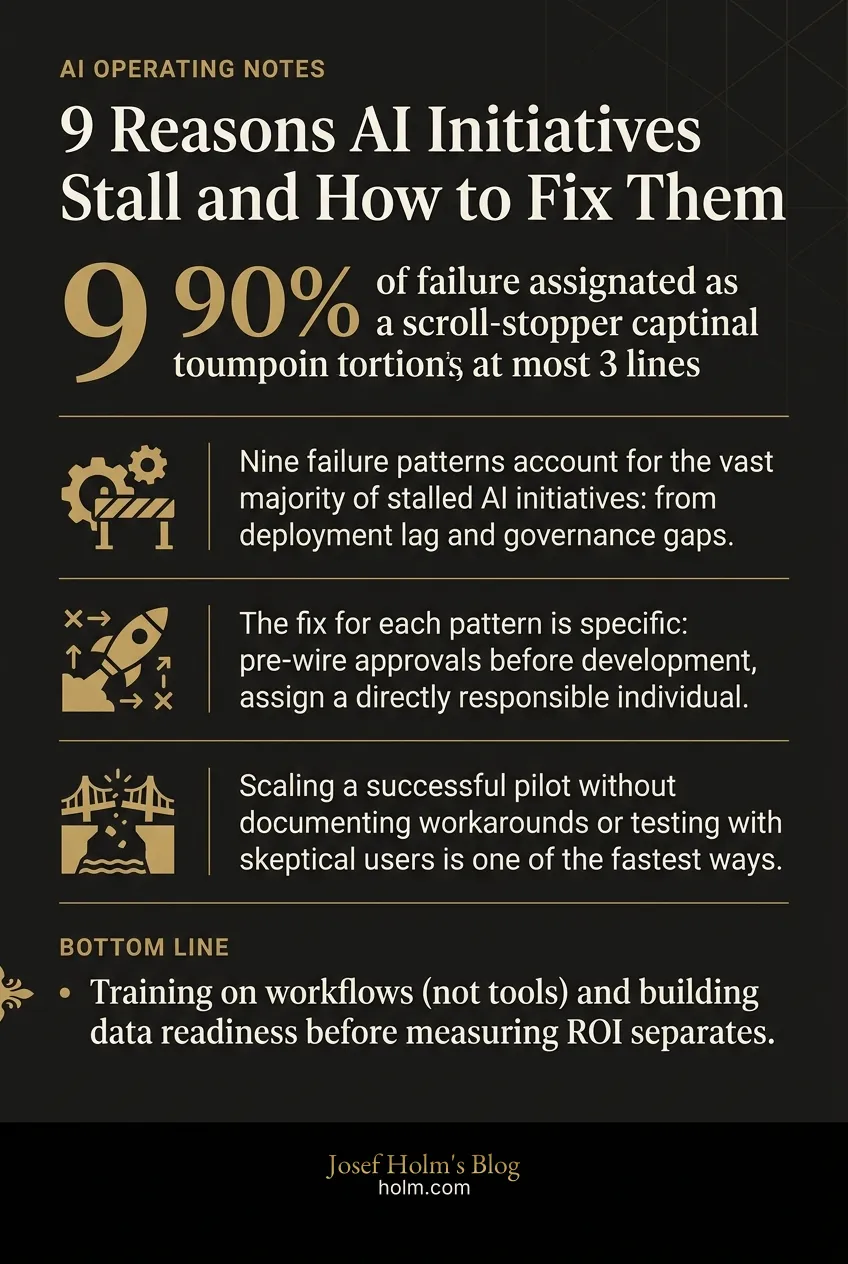
- Nine failure patterns account for the vast majority of stalled AI initiatives: from deployment lag and governance gaps to low adoption and automated inefficiency.
- The fix for each pattern is specific: pre-wire approvals before development, assign a directly responsible individual for AI risk, design for review burden from day one.
- Scaling a successful pilot without documenting workarounds or testing with skeptical users is one of the fastest ways to blow up an AI program.
- Training on workflows (not tools) and building data readiness before measuring ROI separates organizations that absorb AI from those that just buy it.
Most AI adoption failures aren't technical. They're organizational problems wearing a technology costume.
I've watched this play out across every major technology cycle for 25 years. A powerful new capability arrives. Organizations rush to adopt it. Then they stall, not because the technology doesn't work, but because they never prepared the organization to absorb it.
With AI in 2026, the pattern is repeating. Faster, and with higher stakes.
After working with leadership teams across industries, I've identified nine distinct failure patterns that account for the vast majority of stalled AI initiatives. Each one is preventable. Each one has a specific fix. And in every case, the responsibility sits with leadership, not with the technology.
Why does working AI code take months to deploy?
This is the one I see most often. It's also the one that confuses executives the most.
Engineering ships a working AI prototype in weeks. It demos well. Everyone's excited. Then deployment stretches into months. Cross-team meetings multiply. Legal has questions. Compliance has concerns. IT flags architecture issues. Sales wants to know how it affects their workflow.
What happened?
The organization budgeted for AI development in dollars and engineering hours. Nobody budgeted for coordination cost. A working prototype is not a system that fits your data architecture, compliance requirements, and organizational politics together. Those are entirely different problems.
This sticks because everyone assumes that if something works technically, deployment will be straightforward. Integration complexity only becomes visible after the build is complete. Executives can't figure out why a system that clearly works isn't being used. Meanwhile, committees and review policies make sense on paper but deliver no value.
The fix is straightforward but requires intention. Treat the human and organizational problem as seriously as the code problem. Assign a dedicated deployment PM, separate from engineering, whose sole job is confirming that all process requirements are in place: data approvals, legal clearance, compliance concerns, HR implications. Pre-wire approval and policy paths before development begins. Budget explicitly for the organizational side of deployment.
If you're not doing this, you're building software that works and then watching it sit on a shelf.
Who owns it when AI does something wrong?
Here's a question that stops most leadership teams cold.
Red teams find vulnerabilities. Security flags unapproved architecture. Something goes wrong. Who is responsible? Not which department. Which person?
If you can't answer that in under five seconds, you have a governance vacuum. That vacuum will freeze your entire AI program the first time something breaks.
The root cause is simple: nobody treats AI governance as a first-class responsibility. There is no directly responsible individual for AI-specific risk. Organizations try to address it through standard security or software review processes, which feel like bureaucratic slowdown and lack the right tools for the job.
Teams go hands-off. One incident freezes everything.
The fix requires embedding the right talent with the right tools and making security a day-zero problem. Think through what the AI agent can access, its blast radius, its failure modes, how security is architected into the system rather than delegated to the agent's own decisioning, and how to test in production against a range of inputs including prompt injection attacks. This is a distinct skill set from traditional IT security. If you're staffing it with your existing security team and hoping for the best, you're going to have a bad day.
Is your AI creating more work than it saves?
This one's subtle and extremely common.
AI generates output faster than humans can review it. Drafts pile up. Quality varies wildly. Engineers, analysts, and other skilled workers end up babysitting AI systems rather than doing higher-value work. The organization has technically "adopted AI" but the people using it are more burdened, not less.
Why? Because AI was bolted onto the generative part of the workflow, the part focused on production volume, rather than on judgment. Organizations measure success by how much is produced, so the instinct is to accelerate generation.
Impressive demos highlight speed. Review burden is invisible in a demo. The volume KPI looks good even as hidden costs accumulate in the background.
The fix is to design systems that are human-in-the-loop from the start. Expert humans should feel more connected to the work because of AI, not buried by it. Be explicit about the scope of what the AI handles. Take review burden seriously as a design constraint, not an afterthought.
Here's the test: if someone's entire job has become hitting "merge" on AI-generated pull requests, you haven't improved productivity. You've introduced security and quality vulnerabilities by refusing to think about review architecture.
When is a task not ready for AI?
I call this one "the unreliable intern" and it generates the most frustration at the team level.
AI handles 80% of a task perfectly and fails unpredictably on the remaining 20%. Supervision costs approach the cost of doing the work manually. But 80% feels close enough to keep trying. Teams assume one more tweak will fix the remaining failures.
It won't. The root cause is that AI lacks the judgment, memory, and context required for the task. The organization keeps deploying it on tasks that aren't AI-ready.
Before assigning a task to AI, run this mental test: would a smart but forgetful intern who cannot learn on the job be able to complete this task if given clear instructions, context, and a defined output structure?
If the answer is no, the task isn't AI-ready in its current form.
Break complex tasks into subtasks. Assign AI to retrieval, formatting, and sequential steps with clear structure. Assign humans to review and judgment. There is no substitute for going through tasks one by one. It's unglamorous work. It's also the only work that actually produces results.
Why did automating one step make the whole process slower?
This is one of the most counterintuitive failure modes, and I've seen it catch smart teams off guard.
AI handles one step in a multi-step process. That step gets dramatically faster. But handoffs between AI and humans are poorly designed. Overall cycle time barely improves, and sometimes gets worse.
The wrong part of the workflow was automated. One bottleneck was removed while two new ones were created on either side, because on-ramps and off-ramps weren't considered.
What makes this sticky is that per-step KPIs look impressive. A drafting stage might show a 200% improvement. Leadership sees that number and celebrates. But nobody is measuring full cycle time, so the problem only surfaces months later.
Map the full intended workflow before deploying AI. Redesign it so AI can handle the on-ramps and off-ramps of every component it touches. Measure cycle time for the entire process, not individual steps. If full cycle time isn't improving, the issue is at the edges of the AI system, not inside it.
This will also require training humans in new patterns of work. That part gets skipped almost every time. Which brings us to a later pattern.
What goes wrong when you scale a successful pilot?
A pilot succeeds. Leadership is excited. The decision is made to roll it out company-wide. Edge cases multiply immediately. Support costs explode. Quality degrades.
What happened? The pilot ran in a controlled environment with motivated users and clean data. By design. The pilot team understood AI limitations and worked around them in ways the broader organization can't. Leadership forgot this when deciding to scale.
Leadership is wired to capture value quickly. A gently staged rollout feels like unnecessary delay. It isn't.
Here's what a responsible scale path looks like:
- Document all workarounds the pilot team used. These become training material.
- Test with skeptical users, not just enthusiastic ones.
- Run a second pilot on a hard problem in the messiest part of the organization.
- Scale in stages: 25 to 100 to 500 to 50,000 users.
- Build support infrastructure at each stage: people, learning and development, clear feedback channels.
- Monitor support tickets per user as a scaling signal. If tickets per user are increasing at 500 users, resolve the issue before going further.
Every stage you skip costs you more than the time you saved by skipping it.
Are you just automating work that shouldn't exist?
This failure pattern requires the most intellectual honesty from leadership.
AI speeds up existing processes. Activity increases. Results don't. The organization has successfully automated inefficiency.
I think of this as the mechanical horse fallacy. When automobiles first appeared, early designs literally looked like horse-drawn carriages with engines attached. The instinct was to make new technology look like the old technology. It's easier to automate what already exists than to rethink work from scratch.
Approval workflows that shouldn't require approval get automated rather than eliminated. Reports that nobody reads get generated faster. Processes that exist because of organizational habit rather than business need get sped up when they should be removed.
Before deploying AI on any process, ask whether the process should exist at all. Identify outcome metrics that remain constant regardless of the process behind them: customer satisfaction, job efficiency, the business metrics that actually matter. Treat those as your north stars.
Prototype as close as possible to a zero-process version. Ask what would happen if AI dropped the workflow entirely. If the workflow is still needed, identify which parts AI can handle now and plan to revisit as capabilities improve. Treat AI agent systems as evolving. Set clear gates for when to take the next step.
This kind of thinking is where the AI readiness note becomes essential. You need a structured way to evaluate whether your AI investments are producing outcomes, not just activity.
Why can't leadership commit to an AI strategy?
This one sits at the executive level and trickles down to paralyze the entire organization.
Leadership debates whether AI will cannibalize the core business. Conflicting directives emerge from senior leaders. Strategy discussions loop without producing decisions. Meanwhile, competitors are shipping.
The root cause is real: AI's pace of change dramatically outstrips traditional corporate strategic planning cycles. By the time a careful five-year AI strategy is built, the conditions have already shifted. Organizations that built custom models in 2022, launched them in 2023 and 2024, and now regret it because cloud-provided models are far superior are a direct example of this dynamic.
Outcome unpredictability makes every decision feel high-stakes. More analysis feels safer than bold commitment. So leadership analyzes, debates, forms committees, and runs more analysis. Nothing ships.
For organizations not ready to make an all-in commitment, adopt a portfolio approach. Allocate budget across different time horizons: fast-payoff bets and two-to-three-year bets. You don't need to predict which will win. Set concrete speed targets across horizons. AI-answered questions in Slack within 90 days. Agentic CRM automation within eight months. Make the targets specific enough to be measurable.
Distinguish between learning investments and scaling investments with clear gates between them. Watch the trajectories of each bet and double down where results appear.
This requires a different decision-making cadence from leadership than traditional annual planning cycles. If your AI strategy runs on the same rhythm as your annual budget process, it's already too slow.
Why isn't anyone actually using the AI tools you deployed?
The last pattern is the most common and the least discussed.
Adoption is low despite tool availability. Users revert to old workflows. AI can't access the data it needs. Data quality issues only surface after deployment.
The tool was deployed. Users were taught how to use it. But nobody addressed the data infrastructure surrounding it. Data problems looked acceptable during training but surfaced in production. Data infrastructure work is slow, expensive, and unglamorous, so most organizations skip it if they can.
Training is treated as one-time onboarding rather than ongoing capability building. There's no sustained investment in helping employees develop the skills to solve real problems using AI tools connected to real data.
The fix requires patience and commitment:
- Allocate three to six months of expected training at enterprise scale before measuring ROI.
- Train on workflows, not tools. "How do I research competitive intelligence using AI?" is useful. "How do I use ChatGPT?" is not.
- Focus training on AI champions who can teach peers. This triggers network effects that accelerate adoption across the organization.
- Conduct a full data audit. Prioritize data access. Assign clear data ownership so someone is accountable for making data available to AI systems.
This is where organizations that work with us through Josef Holm OS tend to see the biggest difference. Having a structured approach to capability building, data readiness, and adoption tracking changes the trajectory entirely.
What ties all nine patterns together?
Every one of these failures shares a common thread. The technology worked. The organization wasn't ready.
And in every case, the gap between "the technology works" and "the organization benefits" is a leadership problem, not a technical one. It requires honest diagnosis: identifying which pattern you're stuck in, understanding why it persists, and committing to the specific fix that addresses it.
I've seen organizations waste millions on AI initiatives that failed for entirely preventable reasons. Not because the models were wrong or the engineering was bad, but because nobody took responsibility for the organizational side of adoption.
That's the job. Building great AI is important. Getting your organization to actually absorb it is the harder problem, and the one that determines whether any of this creates real value.
If you're seeing these patterns in your organization and want to talk through which ones apply, that's exactly what we do.
Infographic
Frequently Asked Questions
- Why does AI deployment take so long after engineering builds a working prototype?
- Because organizations budget for the code but not for coordination. Legal, compliance, IT, and HR all have requirements that only become visible after the build. The fix is to pre-wire approvals and policy paths before development begins, and assign a dedicated deployment PM whose job is clearing those paths.
- Who should be accountable when an AI system makes a mistake?
- One named person, not a department. If you can't answer that in five seconds, you have a governance vacuum. Assign a directly responsible individual for AI-specific risk and treat security as a day-zero design problem, not a review process bolted on later.
- How do you know if a task is actually ready for AI?
- Run the intern test: could a smart but forgetful intern with clear instructions and a defined output structure complete this task? If the answer is no, the task is not AI-ready in its current form. Break it into subtasks and assign AI to the structured, retrieval-based parts.
- Why does automating one step in a process sometimes make the whole thing slower?
- Because the handoffs on either side of the automated step were not redesigned. Removing one bottleneck often creates two new ones at the edges. Map the full workflow first, redesign the on-ramps and off-ramps, and measure full cycle time, not individual step performance.
- What is the right way to scale an AI pilot company-wide?
- Stage it: 25 to 100 to 500 to 50,000 users. Document every workaround the pilot team used and turn those into training material. Test with skeptical users, not just enthusiastic ones. Monitor support tickets per user at each stage. If tickets per user increase, resolve the issue before going further.
- Why are employees not using the AI tools the company deployed?
- Usually two reasons: the data infrastructure was not ready, and training was treated as one-time onboarding instead of ongoing capability building. Fix the data access first. Then train on workflows, not tools, and invest in AI champions who can teach peers. Expect three to six months before measuring ROI at enterprise scale.