
Why AI Agents Need Meaning, Not More Access
Key Takeaways
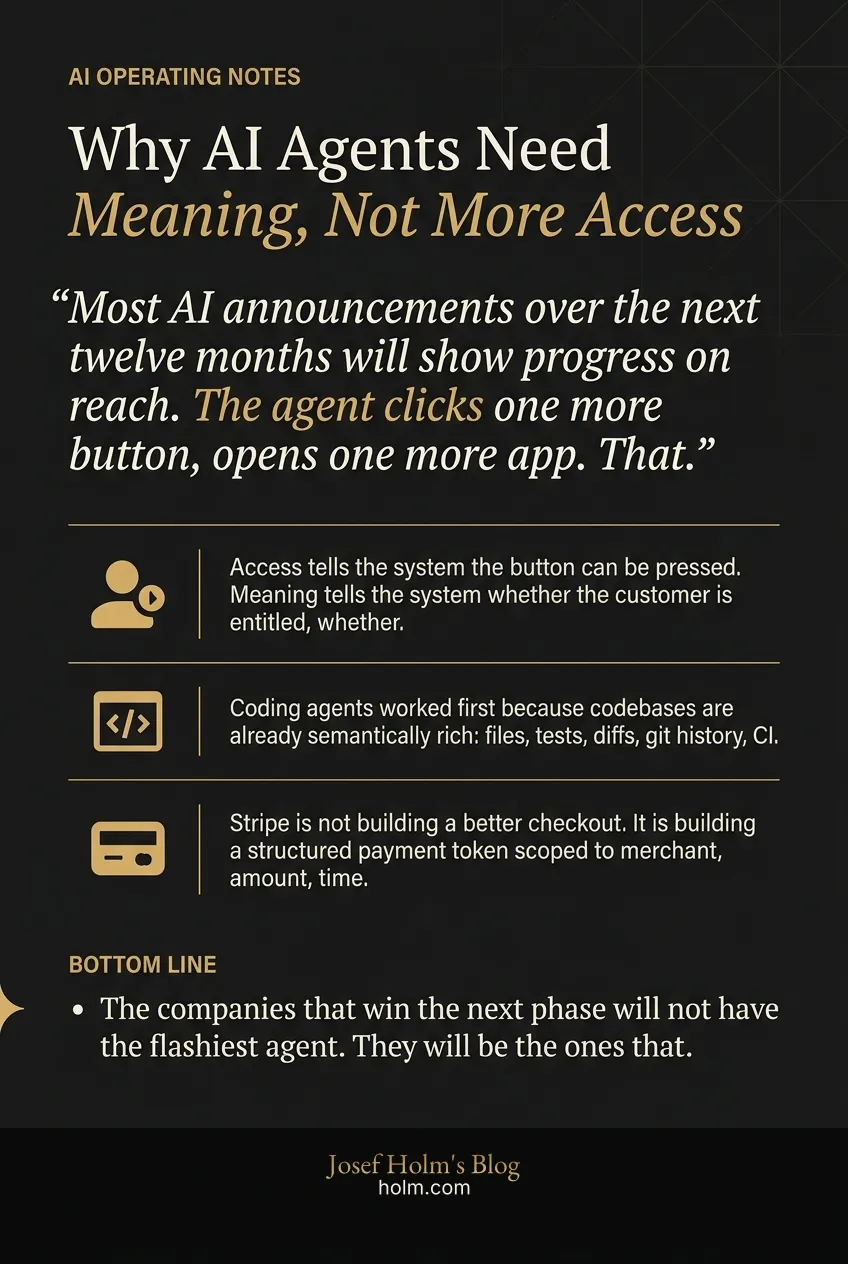
- Most AI announcements over the next twelve months will show progress on reach. The agent clicks one more button, opens one more app. That is not the fight that matters.
- Access tells the system the button can be pressed. Meaning tells the system whether the customer is entitled, whether the amount is in policy, whether a human needs to approve. No semantics, no scoped autonomy, no real deployment.
- Coding agents worked first because codebases are already semantically rich: files, tests, diffs, git history, CI checks. The agent does not have to ask a human every thirty seconds because the work surface answers.
- Stripe is not building a better checkout. It is building a structured payment token scoped to merchant, amount, time window, and user approval. That is the semantic layer of agentic transactions, and it is a stronger position than owning the clicks.
- The companies that win the next phase will not have the flashiest agent. They will be the ones that made work legible enough for an agent to do it without a human watching every step. Everything else is theater.
Access gets you to the work. Meaning lets you do it.
Most AI product announcements over the next twelve months will look like progress. Most will be progress on one thing: reach. The agent can click one more button, open one more app, fill one more form. That isn't the fight that matters.
The fight that matters is whether the agent understands what the button means. I keep watching companies confuse the two, and the cost shows up six months into a deployment, not on day one. By then you've already paid for it.
Nate wrote a useful piece breaking this down, and it sharpens something every operator buying AI right now needs to internalize: access without meaning is the most expensive mistake you can make in this category.
Why does computer use feel like the breakthrough?
Because it looks like one. An agent that can open a browser, move a calendar invite, run a command, or submit a form looks like a person doing work. The demo is real. The reach is real. And it has to exist, because the enterprise software stack is a graveyard of human-shaped interfaces. Internal dashboards. Procurement portals. Compliance tools. Excel files. Half-documented admin panels that three people in the company understand.
If an agent can't operate those visually, it can't reach most of the work. So computer use is necessary. It's a bridge across the messy middle period before software becomes agent-native.
But a bridge isn't the destination. Here's where most buyers get the call wrong: the broadest interface is almost always the least semantically rich. A screenshot shows the screen. It doesn't show the meaning of the objects underneath. A browser reaches every web app. It doesn't carry the domain meaning of the actions inside them. The agent can click the refund button. Whether the customer should have received the refund is a different question entirely.
What's the actual difference between access and meaning?
Access tells the system the button can be pressed. Meaning tells the system whether this customer is entitled, whether the amount is in policy, whether a human needs to approve, whether the action is reversible, and what happens after.
Those questions aren't theoretical. They decide whether an agent performs in a demo or operates inside a real company.
Think about what has to be true for an action to be safe:
- What is the object?
- Who owns it?
- Who is allowed to act on it?
- What happens if the action succeeds?
- What happens if it fails?
- Is it reversible?
- Does it touch money, customer data, or production?
- Does it create external obligations?
- Does it require human approval?
If the system can't answer those, it can't scope trust. Trust isn't a switch. It's an architecture. Draft but not send. Stage but not deploy. Spend under a threshold but not above it. Recommend but not approve. Each of those distinctions depends on semantics. No semantics, no scoped autonomy. No scoped autonomy, no real deployment.
This is the conversation I keep having with operators in our AI readiness note work. The tools they bought can act. They can't explain what they're doing. So the human is stuck supervising every step. The agent didn't reduce work. It moved the work from doing to watching.
Why did coding agents work first?
Because software development is already semantically rich. A codebase isn't text. It's files, modules, dependencies, tests, type systems, git history, branches, pull requests, CI checks, deploy targets, rollback paths. The environment itself tells the agent what's happening.
A failing test has meaning. A diff has meaning. A merge block has meaning. The agent doesn't have to ask a human every thirty seconds whether it's on the right track. The work surface answers.
Most knowledge work isn't like that yet. A calendar event's importance is hidden in politics and relationships. A procurement decision depends on budget timing, vendor history, and policy exceptions nobody wrote down. A compliance question depends on which precedent still applies. Agents can help here, but they don't get the same density of structure that a codebase gives them. The wedge wasn't coding because everyone will become a developer. The wedge was coding because it showed what happens when work is legible enough for an agent to participate without a babysitter.
That's the bar. Not "can the agent click." Can the work itself be understood.
What does Stripe actually understand that most people miss?
Money forces the semantic problem into the open. You can't give an agent a credit card and tell it to click carefully through a checkout page. That works once in a demo. It is not a foundation.
What Stripe is building, a structured payment token scoped to a merchant, amount, time window, and user approval, isn't a more polished checkout. It's a different primitive. The visual flow asks the model to imitate a person. The token creates a transaction the model can participate in without raw credentials and without improvising through a form.
That's the move worth studying. Stripe isn't trying to own every shopping interface. It's trying to own the semantic layer of agentic transactions. That position is far stronger than building an agent that happens to be good at clicking buttons.
The lesson generalizes. The real primitive isn't the mouse or the API. It's the meaningful unit of work. A refund. A reschedule. A pull request. A vendor comparison. A payment authorization. A compliance exception. The human UI hides these behind buttons. Agent-native software exposes them directly. Whoever owns the exposed primitive owns the platform layer underneath the agent.
Where does this leave browser agents and Perplexity?
Close to the user. Not necessarily close to the meaning.
The browser is a natural agent surface because so much modern work collapsed into it. Email, docs, dashboards, SaaS apps, calendars. An agent inside the browser sits beside the user and sees context as it happens. Real value. Atlas and Comet aren't wrong to chase this.
But the browser's strength is also its limit. It's horizontal. It sits across many domains. It doesn't automatically own the domain semantics inside each app. The browser sees the support dashboard. The support platform owns the meaning of a refund. The browser sees the calendar. The calendar system owns recurrence, attendees, notifications. The browser sees the pull request. GitHub owns merge authority.
If the underlying apps expose rich agent interfaces, the browser becomes a powerful orchestrator. If they don't, the browser becomes a clever operator of visual flows. Useful, but shallow.
Perplexity has the same problem one layer up. Its original strength is answering. Research is upstream of work, and the value migrates toward the system that lets you actually do the thing safely and repeatably. That's why the move toward Comet and Computer and Personal Computer is necessary. Staying in the answer layer wasn't going to hold. But proximity isn't a moat. If Perplexity becomes a highly capable shell over other people's tools, it gains reach without semantic authority. The hard question, the one that decides whether the company becomes a platform or a feature, is whether it can convert proximity into a durable work graph above the underlying apps.
I'd watch that conversion carefully before betting on either side.
What should buyers actually do with this?
Stop evaluating AI products by demo quality. Demos are impressive precisely because computer use makes agency visible. The better question is what new work primitive the product exposed.
When something lands on your desk, ask:
- Did it create a real action vocabulary? Read, draft, write, approve, publish, refund, deploy, cancel, delete, treated as distinct things?
- Did it encode permissions and thresholds?
- Did it expose risk classes?
- Did it create validation paths?
- Are actions reversible where they should be?
- Does it produce logs a human or another agent can review?
- Does it know which source of truth is authoritative?
- Does it separate user preference from team norm from company policy?
- Did it reduce supervision, or just create a more spectacular thing to supervise?
Under that test, a lot of flashy products look thinner. A model clicking through a website is useful and probably not defensible. A structured payment token is less cinematic and strategically deeper. A general computer-use agent reaches many tasks. A product that defines the semantics of one high-value task may own the platform those agents depend on.
This is also how the Salesforce vs SAP wager resolves. Salesforce is opening its data model to agents through structured interfaces. SAP is restricting how agents operate against its environments. Both positions look defensible on paper. I think Salesforce is more right. Locking agents out feels like protection. It reads to me like a posture that defends margin in the short term and erodes relevance faster than enterprise software companies are in. The long term is closer than they think.
What's the call for operators right now?
Three things.
First, when you audit your current AI tools, separate the ones that have access from the ones that carry meaning. Most stacks I've seen are heavy on the first and almost empty on the second. That imbalance is why the supervision burden never goes down. We do this work directly inside implementation notes engagements, and the pattern is consistent enough that you can predict it.
Second, when you buy new tools, refuse to be impressed by reach. Ask what the system understands once it gets there. If the vendor can't answer that in plain language, the answer is nothing.
Third, when you build internal AI workflows, design the semantic layer first. Action vocabulary, permission scopes, review paths, reversibility, audit trail. Build those before you build the agent. An agent without that scaffolding is a liability with a UI.
Computer use gives agents hands. Semantic control gives the system a way to know what those hands are touching. One is a bridge. The other is the moat.
The companies that win the next phase won't be the ones with the flashiest agent. They'll be the ones that made work legible enough for an agent to do it without a human watching every step.
That's the bet worth making. Everything else is theater.
If you're trying to figure out where your organization sits on that line, that's the conversation to have.
Infographic
Frequently Asked Questions
- What is the difference between AI agent access and meaning?
- Access means the agent can click the button. Meaning means the system knows whether the button should be clicked, who is allowed to click it, whether the action is reversible, and what happens after. Access gets you reach. Meaning gets you scoped trust. Without meaning, the human is stuck supervising every step.
- Why did coding agents work before other agents?
- Because a codebase is already semantically rich. Files, tests, diffs, git history, CI checks, merge rules. The environment itself tells the agent what is happening. Most knowledge work does not give an agent that density of structure yet, which is why agents in those domains still need a babysitter.
- What is Stripe actually building for AI agents?
- A structured payment token scoped to a merchant, amount, time window, and user approval. It is not a polished checkout flow. It is a new primitive that lets an agent participate in a transaction without raw credentials and without imitating a person clicking through a form. Stripe is going after the semantic layer of agentic transactions, not the UI.
- How should I evaluate AI tools my company is buying?
- Stop scoring them on demo quality. Ask what new work primitive the product exposes. Does it carry an action vocabulary, permissions, thresholds, risk classes, validation paths, reversibility, audit logs, and a clear source of truth? If the vendor cannot answer in plain language, the answer is nothing.
- What should operators do about AI agents right now?
- Three things. Audit your current tools and separate the ones with access from the ones that carry meaning. When you buy new tools, refuse to be impressed by reach and ask what the system understands. When you build internal workflows, design the semantic layer first: action vocabulary, permission scopes, review paths, reversibility, audit trail. Build that before you build the agent.
- Is Salesforce or SAP right about agent access?
- Salesforce is opening its data model to agents through structured interfaces. SAP is restricting how agents operate against its environments. I think Salesforce is more right. Locking agents out defends margin in the short term and erodes relevance faster than enterprise software companies are in.