The AI Context War Just Started, and Most Firms Will Lose
Key Takeaways
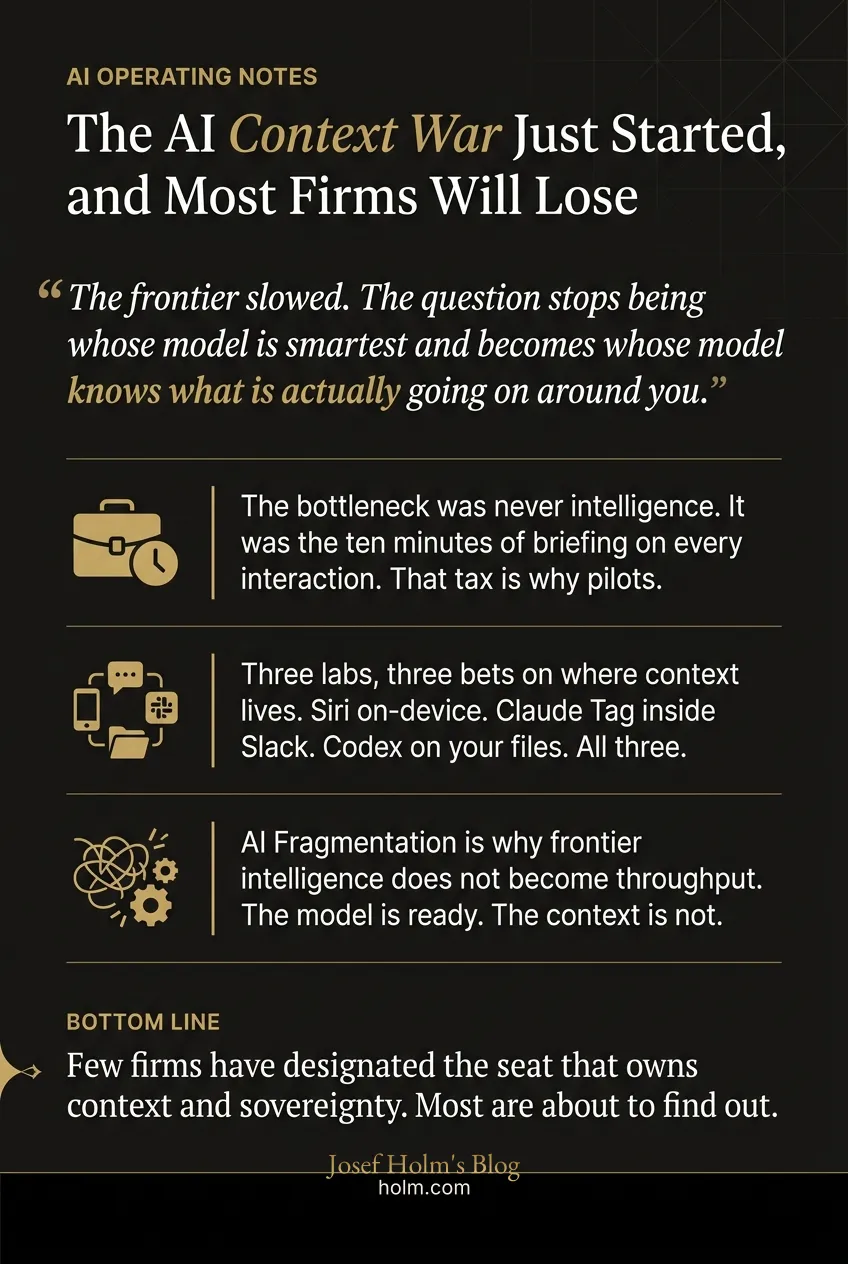
- OpenAI shipped ChatGPT 5.6 to a small group of government-approved partners while Washington reviews cybersecurity risks. The frontier just hit a speed bump, and the question stops being whose model is smartest and becomes whose model knows what is actually going on around you.
- The bottleneck in AI productivity was never intelligence. It was the ten minutes of briefing on every interaction: paste the thread, explain the counterparty, name the current version, remind the model what changed in Slack yesterday. That tax is why most AI pilots stall.
- Apple, Anthropic, and OpenAI are now placing opposing bets on where context lives. Siri pushes proximity on-device. Claude Tag wraps the human conversation inside Slack with scopes and permissions. Codex sits on the artefacts in repos and folders. All three will end up running inside your business.
- AI Fragmentation is the structural reason most mid-market firms cannot turn frontier intelligence into operational throughput. WhatsApp threads nobody can search, DMs nobody can audit, three SaaS tools holding three versions of the customer record, Copilot pasted into documents nobody knew it had access to. The model is ready. The context is not.
- The firms that win the next phase do not need the smartest model. They need an architecture that compounds operational throughput while keeping data sovereignty inside an enforced governance line. Few mid-market firms have designated the seat that owns that decision. Most are about to find out they needed one.
The frontier of AI just hit a speed bump, and almost nobody outside the labs noticed what it actually means.
OpenAI shipped ChatGPT 5.6 last week with a strange asterisk: access restricted to a small group of government-approved partners while Washington reviews cybersecurity risks. Not a cancellation. A slowdown. The kind of slowdown that changes which question matters next.
Because if the frontier stalls, even briefly, the question stops being "whose model is smartest" and becomes "whose model knows what's actually going on around me."
That's the war underneath the news cycle this week. And it has direct consequences for any operator running a real business on top of these tools.
Why a smart model can still be useless
Anyone who has actually tried to get work done with ChatGPT, Claude, or Gemini knows the bottleneck. It isn't intelligence. It's context.
Before the model can help you draft the email, build the model, brief the client, or untangle the dispute, you have to manually carry your entire situation into the chat window. Paste the thread. Explain who the counterparty is. Clarify which version of the document is current. Remind it that yesterday's Slack message changed the decision.
That ten minutes of briefing is the tax on every AI interaction in your business right now. It's also the reason most AI pilots stall: the model is smart enough, but the friction of feeding it the situation eats the productivity gain.
This is why "agents" is the word every lab is now leaning on. An agent, properly built, is supposed to gather its own context. Read the calendar. Check the inbox. Pull the file. Understand which channel the decision lives in. The moment that works, the productivity math changes.
So the slowdown at the frontier isn't a tragedy for OpenAI and Anthropic. It's a forcing function. If you can't ship a smarter model this quarter, you ship a model that's already inside the user's situation.
Apple's quiet move: proximity as a moat
Siri has been a punchline for a decade. But the new Siri isn't trying to be smarter than ChatGPT. It's trying to be closer to you.
A question like "when is my mom landing" doesn't need a frontier model. It needs access to your calendar, your email, your messages, and your photos, stitched together in a single private context. Apple's architecture pushes that work on-device wherever possible, with private cloud as fallback. Your context stays yours.
That isn't a chatbot feature. It's a different competitive position. Apple's moat is shifting from the App Store and the hardware to privileged access to personal context. The assistant gets better the closer it sits to you.
For operators, this is the personal-life preview of what's coming to your business. The winning assistant won't be the one with the highest benchmark score. It'll be the one that already knows what you're working on.
Anthropic's workplace play: Claude inside the conversation
Claude Tag launched in Slack this week. Teams grant Claude access to selected channels, tools, data, and codebases. Users tag Claude in, and it works through the task, responds in the thread, remembers what it needs to remember, and stays inside defined permission scopes and spend limits.
Slack has had bots for years. That isn't the move here. The move is putting an assistant inside the messy human conversation where the real work actually happens. Workplace context is shared, permissioned, political, stale, half-written, and scattered across systems. Most real decisions live there. AI has historically been locked outside of it.
Notice the language in Anthropic's launch though: scopes, permissions, admin controls, channel-defined memories. Anthropic knows what it's asking for. The more useful Claude becomes inside Slack, the more sensitive the information it touches. Engineering decisions. Customer tickets. debates. Personnel matters. A leak through an AI teammate doesn't read as a model bug. It reads as a corporate liability event.
This is the bargain on the table for every mid-market firm right now. Claude (or Copilot, or Gemini, or whatever lands next) becomes dramatically more useful the moment it can see your real context. And the moment it can see your real context, you've taken on a governance problem most firms haven't designed for.
How trust actually gets built: the Codex study
OpenAI published a study this week on how its own employees adopted Codex internally. Two things stood out.
First, usage wasn't mandated. Codex had to earn the trust of engineers, then earn it again with non-technical teams. Even at one of the most AI-native companies on the planet, trusting AI with real context wasn't a switch you flip.
Second, the adoption curve had a tipping point. After the 5.5 release, Codex usage shot up in legal, recruiting, and sales: the groups working with what the researchers called "dirty context." Messy, half-finished, human work. The tool earned trust with code first, then translated that trust into messier domains.
The lesson for any operator running an AI rollout: the question isn't "is the model good enough?" The question is "has the model earned the trust of the team that has to feed it the messy work?" That trust gets built workflow by workflow. It is not granted by the procurement decision.
Two product shapes, two theories of where context lives
Claude Tag and Codex represent opposing bets on where the work actually happens.
Claude Tag says: you live in Slack, so we'll meet you there. Claude wraps itself around the human conversation. Bring your work to the chat.
Codex says: your real work lives in files on your machine, in repos, in folders that matter. Point us at it. Codex acts as the headquarters.
Both companies will build the other shape eventually. Labs copy each other. Right now though, the difference reveals each lab's design instinct. Anthropic thinks context lives in conversation. OpenAI thinks context lives in artefacts.
For a mid-market firm, both shapes will end up running inside your business. The Slack-shaped assistant will live with your operations team. The file-shaped assistant will live with your engineers, your finance team, your legal team. And the routing between them, the question of which assistant sees which context under which permission, is where most firms will get into trouble.
The open-source pressure: GLM 5.2
Z.AI's GLM 5.2 made cheap, open, frontier-adjacent intelligence feel much closer to reality this week. With Washington slowing the closed labs, open models get room to close the public gap, even if the frontier labs still hold a six-to-eight-month private lead.
What this means for operators: betting your stack on a single model from a single lab gets harder to defend every quarter. The smart architecture treats the model as a swappable component and treats the context layer as the durable investment.
Most firms have this exactly backwards. They've built their AI strategy around which vendor they trust. They have not built it around which of their own data, workflows, and decisions the model is allowed to see.
What this means for your firm
The combined picture, if you operate a real business:
The lab race is shifting from intelligence to context. That's good news, because raw frontier intelligence was never your bottleneck anyway. Your bottleneck was always the friction between the model and your situation.
The bad news: the firms about to win this next phase are the ones who have already done the work to organise their context. Their client data is clean. Their internal documents are findable. Their communications are archived in something the model can read. Their permission structures are explicit, not implicit.
The pattern across mid-market AI rollouts is the opposite. Client conversations on WhatsApp threads nobody can search. debates in DMs nobody can audit. Three different SaaS tools holding three different versions of the customer record. Copilot pasted into a document nobody knew it had access to. A finance team running ChatGPT on company data, a marketing team running Claude on a different slice of company data, and no single platform manages the routing.
This is AI Fragmentation. It's the structural reason most firms cannot turn frontier intelligence into operational throughput. The model is ready. The context isn't.
As Claude, Codex, Siri, and whatever ships next get hungrier for context, the exposure surface widens in lockstep with the productivity gains. Every new assistant that can see your situation is also a new assistant that can leak your situation. Throughput and data sovereignty are the same conversation now, on the same page, under the same governance line.
The firms that figure this out first don't need the smartest model. They need an architecture that compounds operational throughput while keeping data sovereignty inside an enforced governance line. Few mid-market firms have designated the seat that owns that decision. Most are about to find out they needed one.
The context war is the operator's war. The labs just announced the rules.
If you're trying to figure out what your firm's context actually looks like, where it lives, what's exposed, and what's ready, that's the work an AI readiness note is built to surface.
Infographic
Frequently Asked Questions
- What is the AI context war?
- It is the shift in the AI race from which model is smartest to which model knows what is actually going on around you. With the frontier slowing, labs are competing on proximity to your data, your calendar, your inbox, your Slack channels, your files. The winning assistant will not be the one with the highest benchmark score. It will be the one already inside your situation.
- Why is context the real bottleneck in AI productivity?
- Because the model is already smart enough. The friction is in the ten minutes of briefing it takes to paste the thread, explain the counterparty, name the current version, and remind the model that yesterday's Slack message changed the decision. That tax eats the productivity gain on every AI interaction in your business right now.
- What is AI Fragmentation?
- It is the structural reason most mid-market firms cannot turn frontier intelligence into operational throughput. Client conversations on WhatsApp nobody can search. debates in DMs nobody can audit. Three SaaS tools holding three versions of the customer record. Finance running ChatGPT on one slice of company data, marketing running Claude on another. The model is ready. The context is not.
- What does the Codex adoption study tell operators?
- That trust gets built workflow by workflow, not granted at procurement. Even inside OpenAI, Codex had to earn engineers first, then translate that trust into legal, recruiting, and sales. The right question for an AI rollout is not is the model good enough. It is has the model earned the trust of the team that has to feed it the messy work.
- How should a mid-market firm respond to the context war?
- Stop building the AI strategy around which vendor you trust. Start building it around which of your own data, workflows, and decisions the model is allowed to see. Treat the model as a swappable component and the context layer as the durable investment. Designate the seat that owns that decision before the next assistant ships.