AI Is Making Companies Faster at Avoiding Decisions
Key Takeaways
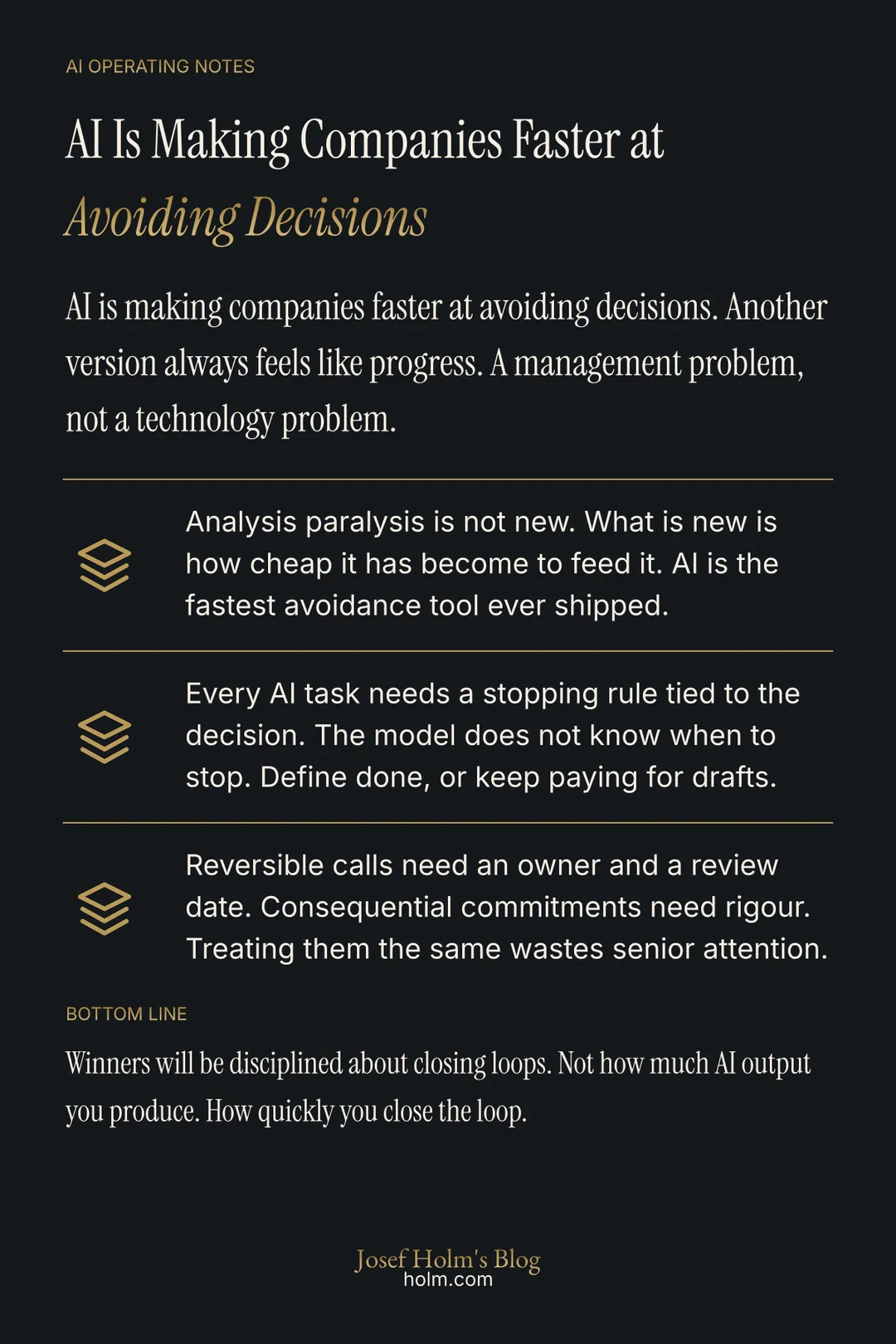
- Another version always feels like progress, documents keep improving, and the moment someone has to be wrong stays comfortably in the future. That is a management problem, not a technology problem.
- Analysis paralysis is not new. What is new is how cheap it has become to feed it. Offsite workshops, deck revisions, consultant reports: AI is the fastest version of that same avoidance tool ever shipped, and it dresses indecision up as output.
- Every AI task needs a stopping rule tied to the decision the work serves. The model does not know when to stop. If you have not defined done up front, you will keep paying for drafts and the founder becomes the integration layer for a growing pile of plausible options.
- Not every decision deserves the same review. Reversible calls need an owner, a bounded downside, a way to observe the result, and a date to reconsider. Consequential commitments need rigour proportionate to what could actually go wrong. Treating them the same wastes senior attention.
- The firms getting the most from AI will be the ones disciplined about closing loops quickly, from question to decision to result to sharper judgment. Not how much AI output a company produces. How quickly it closes loops.
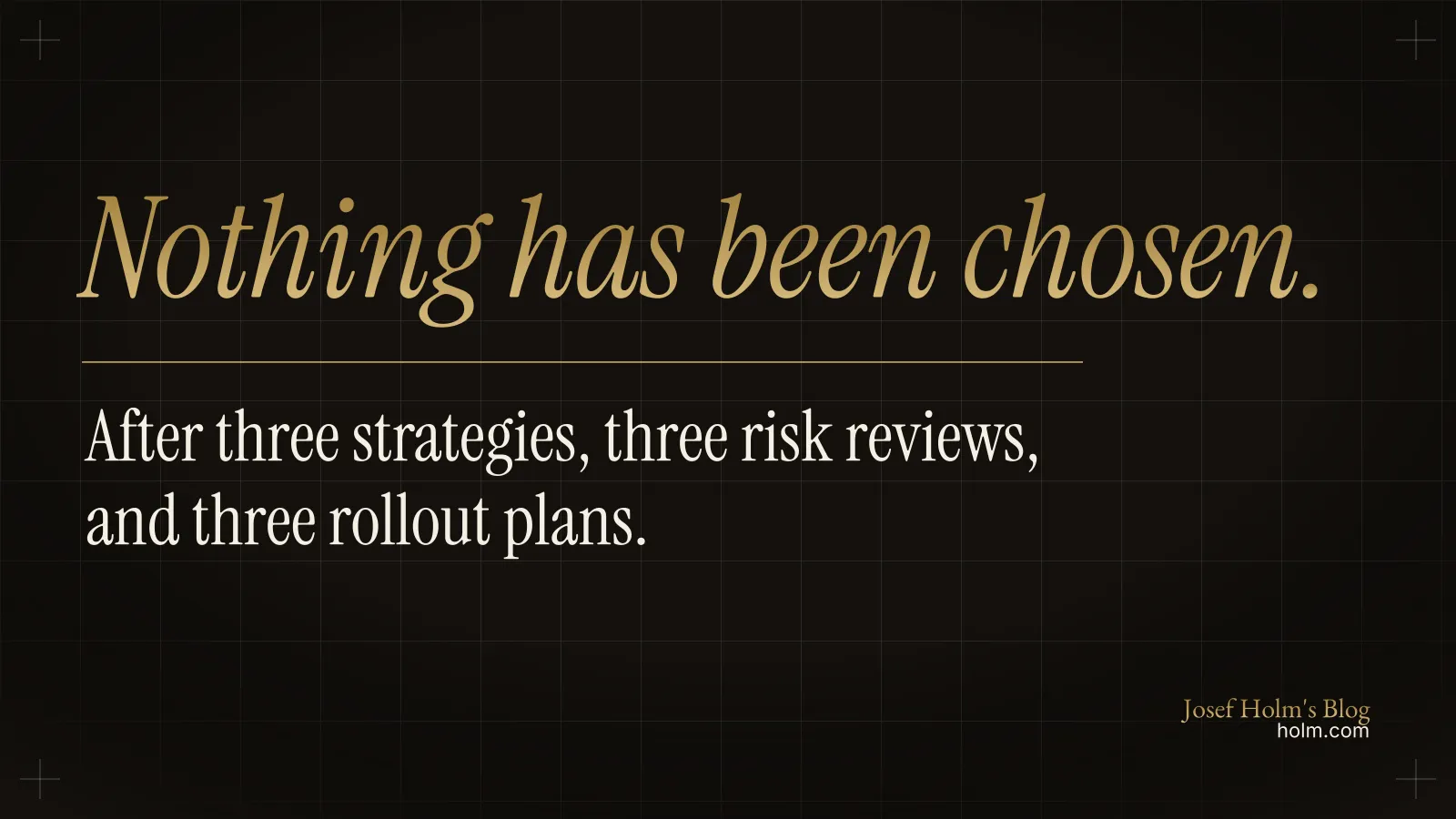
The research is finished. The presentation looks sharp. Someone has produced three alternative strategies, compared the risks, and prepared an rollout plan for each.
Nothing has been chosen.
AI makes this easier to produce, because another version always feels like progress. The team is working. Documents keep improving. Every round adds more detail. Meanwhile, the decision that would expose someone to being wrong stays comfortably in the future.
Here is the pattern I want to name. AI is making companies faster at avoiding decisions. [7]
That's a management problem, not a technology problem. And it's the one I would watch most closely over the next two years.
Why does more analysis stop reducing uncertainty?
Some decisions genuinely need more research. Missing information can make a commercial commitment reckless, a release unsafe, or an investment impossible to evaluate responsibly.
But there is a point where the uncertainty is no longer an information problem.
You know the plausible options. You understand the main risks. You have identified what could invalidate the choice. What remains is the possibility that your judgment will be wrong. Another report cannot remove that possibility. It can, however, postpone the moment somebody has to accept it. [1]
None of this is a new human weakness. Decision-science literature has documented "analysis paralysis" for decades: more information gathering that delays commitment without improving decision quality. [2] What is new is how cheap it has become to feed the paralysis. In 30 years of building companies, I have watched teams work around this constraint with offsite workshops, deck revisions, and consultant reports. AI is now the fastest version of that same avoidance tool ever shipped.
Which is where the data starts to get awkward.
McKinsey's 2026 State of AI survey shows wide individual productivity gains from AI, but much thinner signals on decision quality and on P&L impact. [6] A majority of surveyed organisations now use generative AI in at least one business function. [6] The gap between "we produced more analysis" and "we made a better call sooner" is where the leadership work hides.
Signals of AI-era decision friction
Executive surveys show widespread AI use in decisions coexisting with low decision-making maturity and data-driven paralysis.
Scroll the chart sideways to see every point.
| Label | Value | Unit | Period |
|---|---|---|---|
| Executives regularly using AI to support decisions (Deloitte 2026) | 60% | % of surveyed executives | 2026 |
| Leaders stopped from making any decision due to data volume/lack of trust (Oracle 2023) | 72% | % of surveyed business leaders | 2023 |
| Organizations at low decision-making maturity (Deloitte High Impact Decision Intelligence) | 57% | % of surveyed organizations | 2023 |
| Organizations considering themselves 'leading the way' on AI decision-making (Deloitte 2026) | 5% | % of respondents | 2026 |
Verified data from McKinsey & Company
Verified values from the cited source are shown below.
Scroll the chart sideways to see every point.
| Label | Value | Unit | Period |
|---|---|---|---|
| Any AI use, 2024 | 78% | % of respondents | 2024 |
| Regular gen AI use, 2023 | 33% | % of respondents | 2023 |
| Regular gen AI use, 2024 | 71% | % of respondents | 2024 |
Who actually pays the cost of a cheap draft?
When exploring an option is expensive, companies have a practical reason to limit how many they pursue. AI weakens that constraint.
A new proposal, campaign concept, prototype, or market analysis can be inexpensive enough to feel almost free. That creates more room to explore. It also makes it easier to leave every option alive.
The document may be cheap. The attention required to evaluate it is not. [3]
Every additional option creates work for somebody. Review it. Compare it. Discuss it. Reconcile it with earlier decisions. Explain why it was not selected. That work usually lands on the person whose attention is already the constraint. The founder becomes the integration layer for a growing pile of plausible outputs. The team produces more while the founder spends more time deciding what any of it means.
I would question any productivity claim that counts the extra output and ignores this review burden. The number that matters is how fast the organisation moves from a question to an accountable decision, not how many documents it generated along the way.
Which is why most "AI productivity" dashboards are measuring the wrong thing.
What is a stopping rule, and why does every AI task need one?
A request to "research the market" has no natural end. Neither does "improve the strategy," "make the product better," or "verify everything." There is always another source, another scenario, another possible improvement.
Before work begins, somebody needs to define what will be enough.
For a market decision, that could mean sufficient evidence to choose one customer segment for a bounded test. For a product change, it means specified behaviour working under defined conditions, with the relevant risks checked. For an investment, it means answering the questions that could materially change the commitment.
Executives report decision paralysis and distress from data overload
Oracle’s 2023 survey reports decision distress among business leaders, and decision abandonment and greater complexity among surveyed people
Scroll the chart sideways to see every point.
| Label | Value | Unit | Period |
|---|---|---|---|
| Experienced inability to decide due to too much data (2023, 14,000+ respondents) | 72% | percent of surveyed business leaders | 2023 |
| Experienced 'decision distress' (Oracle 2023) | 85% | percent of business leaders | 2023 |
| Gave up on a decision at least once due to overwhelming data | 70% | percent of surveyed people | 2023 |
| Say more data has made decisions more complex | 86% | percent of people | 2023 |
| Businesses reporting more data sources slowed decision-making | 36% | percent of surveyed business leaders | recent |
Enterprise AI scaling expands in 2026
Enterprise-wide AI scaling rose from 38% to 44% year over year, while large-organization agent scaling jumped from 27% to 40%, evidence that AI deployment is deepening rapidly.
Scroll the chart sideways to see every point.
| Label | Value | Unit | Period |
|---|---|---|---|
| Organizations scaling AI across the enterprise (2025) | 38% | percent of respondents | 2025 |
| Organizations scaling AI across the enterprise (2026) | 44% | percent of respondents | 2026 |
| Large orgs scaling AI agents (2025) | 27% | percent of large-org respondents | 2025 |
| Large orgs scaling AI agents (2026) | 40% | percent of large-org respondents | 2026 |
The stopping rule should be tied to the decision the work serves. Otherwise, completion becomes a matter of exhaustion, budget, or whoever finally loses patience. [2]
This matters doubly when you delegate to AI. An instruction to keep improving something can produce a growing body of work without producing a usable finish. The model does not know when to stop. It will keep going until you tell it the work is done. If you have not defined done up front, you will keep paying for drafts.
Thoroughness needs a purpose. Which brings us to the second filter most teams skip.
Should every decision get the same review process?
No. And treating them as if they should is one of the quieter ways companies waste senior attention.
Choosing which approved headline to test is not the same as changing a pricing model. Running a small experiment is not the same as making a promise to every customer. A recoverable internal change is not the same as an irreversible financial commitment.
If the organisation applies its most demanding review process to everything, routine work slows down and attention gets consumed by low-consequence choices. Apply too little scrutiny to consequential decisions and you create a different problem. The management job is to tell them apart. [2]
For a reversible decision, I want four things: a clear owner, a bounded downside, a way to observe the result, and a date to reconsider it. That's enough. Make the call, run the test, come back on the date.
For a consequential commitment, I want the evidence and the review appropriate to what could actually go wrong. More rigour, more owners, more scenarios where the decision could invalidate itself.
That distinction gives people room to act without pretending speed excuses carelessness. It also tells the AI, and the humans using it, how much work is enough on any given task.
Which still leaves one question. Who closes the loop?
What does it mean for the leader to close the loop?
AI can help investigate a question. It can make assumptions visible, identify contradictions, prepare alternatives. The organisation still has to choose. Someone has to say, out loud and on the record:
We have enough evidence for this decision. Here is what we are doing. Here is what we are not doing yet. Here is the result that would make us reconsider. [7]
That last sentence matters. A decision does not have to be permanent to be real. It needs to create action and a way to learn.
My read, after eight companies and three decades of this cycle, is that the firms getting the most from AI will become disciplined about closing these loops. [7] Their advantage will show up in how quickly they move from a question to a decision, from the decision to a real-world result, and from that result to a sharper judgment the next time.
They will still research. They will still verify. They will still change their minds. But they will know what the work is supposed to resolve, and when it has resolved enough to act.
That's the leadership test I would pay attention to. Not how much AI output a company produces. How quickly it closes loops.
The question I would ask your executive team this quarter
Is AI helping your company make better decisions? Or is it making the period before the decision look impressively busy?
The honest answer usually surfaces one or two meetings where the pattern is obvious once you look for it. A decision that has been "nearly ready" for two months. A segment choice that has been researched four times. A pricing change that keeps getting one more round of modelling.
Those are not information problems. They are ownership problems wearing analytical clothing. AI did not create them. It just made them cheaper to sustain.
If this is the pattern in your firm, tell me where I am reading it wrong. Or subscribe to The Operator's AI Brief and I will keep writing through what I am seeing from inside the work.
Research notes
Research checked 20 October 2026.
Sources
- www.allcommercejournal.com Retrieved 20 October 2026.
- Startup Anti-Pattern #8: Analysis Paralysis | Insights, not just posts, Insights, not just posts | Tech, Startup and VC insights. with a twist Published 11 February 2025. Retrieved 20 October 2026.
- www.diva-portal.org Retrieved 20 October 2026.
- The State of AI: Global survey | McKinsey, McKinsey & Company Retrieved 20 October 2026.
- The state of AI in early 2024 | McKinsey, McKinsey & Company Retrieved 20 October 2026.
- The State of AI: Global Survey 2026 | McKinsey, McKinsey & Company Retrieved 20 October 2026.
- Decision-making with AI | Deloitte Insights, Deloitte Insights Retrieved 20 October 2026.
- Oracle Decision Dilemma study (2023): original survey release, Oracle Published 19 April 2023. Retrieved 20 October 2026.
Infographic
Frequently Asked Questions
- Is AI actually helping companies decide, or just helping them avoid deciding?
- Both, and that's the problem. AI genuinely accelerates research, drafting, and option generation. But cheap output makes it easier to keep every option alive and postpone the moment someone has to be wrong. The pattern looks like progress because the team is working and documents keep improving. The decision stays in the future.
- What is a stopping rule and why does every AI task need one?
- A stopping rule defines what will be enough before work begins, tied to the decision the work serves. 'Research the market' has no natural end. 'Sufficient evidence to choose one segment for a bounded test' does. Without a stopping rule, completion becomes a matter of exhaustion, budget, or whoever loses patience first.
- Should every decision get the same review process?
- No. Choosing a headline to test is not changing a pricing model. Reversible decisions need a clear owner, a bounded downside, a way to observe the result, and a date to reconsider. Consequential commitments need rigour proportionate to what could actually go wrong. Treating them the same wastes senior attention.
- What does it mean for the leader to close the decision loop?
- Say out loud and on the record: we have enough evidence, here is what we are doing, here is what we are deferring, here is what would make us reconsider. A decision does not have to be permanent to be real. It has to create action and a way to learn.
- Why do most AI productivity dashboards measure the wrong thing?
- They count the extra output and ignore the review burden. Every additional option creates work for somebody to evaluate, compare, and reconcile. That work lands on the person whose attention is already the constraint. The number that matters is how fast the organisation moves from a question to an accountable decision.
- What single question would you ask an executive team this quarter?
- Is AI helping you make better decisions, or is it making the period before the decision look impressively busy? The honest answer usually surfaces a decision that has been nearly ready for two months, or a choice that has been researched four times. Those are ownership problems wearing analytical clothing.