AI Frees Your Best People to Leave
Key Takeaways
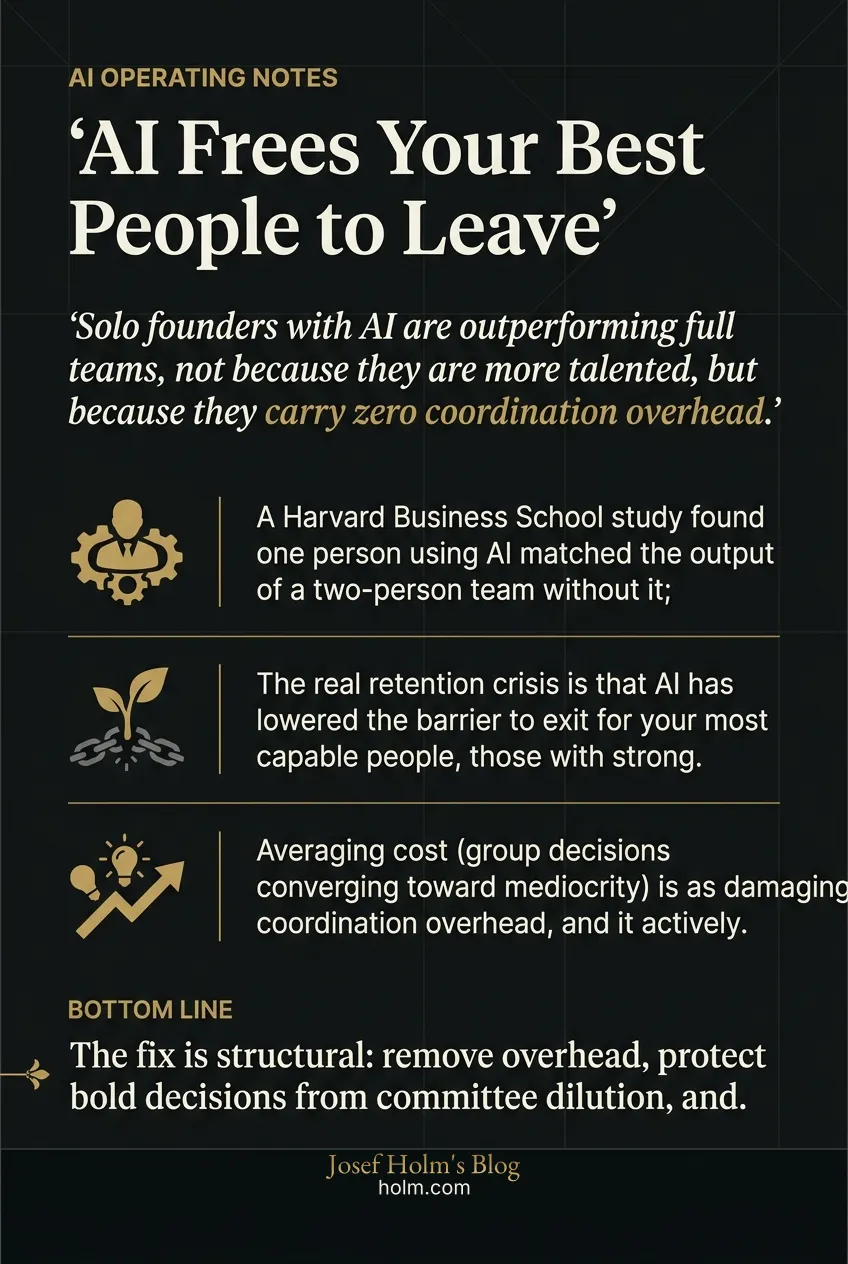
- Solo founders with AI are outperforming full teams, not because they are more talented, but because they carry zero coordination overhead.
- A Harvard Business School study found one person using AI matched the output of a two-person team without it; the mechanism is that AI proxies for missing functional perspectives.
- The real retention crisis is that AI has lowered the barrier to exit for your most capable people, those with strong judgment, conviction, and execution bandwidth.
- Averaging cost (group decisions converging toward mediocrity) is as damaging as coordination overhead, and it actively pushes high-conviction people out the door.
- The fix is structural: remove overhead, protect bold decisions from committee dilution, and evaluate your org through the lens of your most capable person's actual daily capacity.
She Quit, Picked Up AI, and Shipped in 30 Days What Her Team Had Planned for Q3
That's not a hypothetical. It's a pattern.
Across industries, the most capable people inside organizations are realizing something uncomfortable: the thing holding them back was never ability. It was overhead. Now that AI can absorb most of that overhead, the math on staying versus leaving has changed.
I've watched this play out across multiple technology cycles over 25 years. But this one is different. The gap between what a talented individual can do alone with AI and what that same person produces inside a typical organization has never been wider. That gap is a retention crisis hiding in plain sight.
Why Are Solo Founders Suddenly Outperforming Entire Teams?
Start with the data points that should make every leader uncomfortable.
Ben Sira built Pulsia, an AI company builder, to $2.5 million in annual recurring revenue. Solo. He went to $2.5M in four days because demand for the solo founding model was that strong. Mauromo bootstrapped Base44 to 300,000 users and roughly $3.5 million ARR independently. Peter Levels scaled a flight simulator app to $1 million as a one-person operation.
The instinctive response from enterprise leaders is to dismiss this. Solo founders work greenfield. No legacy systems, no cross-team dependencies, no integration complexity. That's all true.
But it leads to the wrong conclusion.
The right question isn't whether you can compare solo founders to enterprise teams. The right question is: what are these individuals demonstrating about the relationship between talent and overhead? What does it mean for the people inside your company who carry the same capabilities but produce a fraction of the output?
What Does the Research Actually Show About AI and Individual Performance?
A Harvard Business School field experiment studied 776 professionals at Procter & Gamble working on real product innovation challenges. Not a lab exercise. Real work, real stakes.
The findings were striking. Individuals using AI were three times more likely to produce ideas in the top 10% of quality, as judged by independent experts. AI broke down functional silos: R&D professionals produced more commercially viable ideas, and marketing professionals produced more technically grounded ideas.
Here's the line worth sitting with: a single person with AI matched the performance of a two-person team without it.
The researchers found that AI consumed the coordination cost previously paid by combining multiple human perspectives. That's the mechanism. AI doesn't just make people faster. It proxies for the missing functional perspectives that used to require meetings, alignment sessions, and cross-team negotiations.
Shopify's Toby Lütke has operationalized this. By making prototyping a requirement, he effectively stripped out coordination overhead. Instead of consulting six teams to validate an idea, individuals build a prototype. AI proxies for the missing perspectives. The prototype becomes the conversation starter, not the conclusion of a six-week alignment process.
Is Your Best Person Operating at 25% Capacity?
I think most extraordinary people inside organizations are operating at roughly a quarter of their actual capacity. Not because they lack ability. Because coordination overhead consumes their time and energy.
Think about the product manager with a decade of customer domain expertise. She could ship dozens of features. She has the judgment, the pattern recognition, the instinct for what customers need. But she's constrained by coordination burdens to one or two features at a time. The rest of her capacity gets absorbed by alignment meetings, stakeholder management, and waiting for other teams to unblock her.
AI removes that constraint. Not theoretically. Practically.
Sarah Gilliam was profiled by The Economist as a potential one-person unicorn. She had years of experience working with bereaved people, clear conviction about what they needed, and strong judgment. The only barrier was coding fluency. AI removed that barrier without changing her judgment, domain expertise, or decision-making ability.
The numbers back this up as a trend, not an anecdote. Carta data shows solo-founded businesses now represent one-third of all new US ventures, up from one-quarter. The share keeps rising. Solo-founded companies are increasingly receiving VC backing.
That PM with extraordinary customer instincts? She's now a candidate to solo found in a way she wasn't a year ago. If your organization is the thing standing between her and her full capacity, she will eventually do the math.
What Skills Actually Matter in an AI-Native World?
The popular framing is "80% AI, 20% taste." I think that's incomplete. It names one of the relevant skills but misses the others. And it misses the relationship between them.
Conviction Is Not the Same as Taste
Taste is the ability to evaluate whether something is good. Conviction is the willingness to act on that evaluation before anyone else confirms you're right.
They're related, but they're not the same thing. The distinction matters enormously.
Ben Sira's product decisions at Pulsia illustrate this. He chose a minimalist interface. He added an auto-playing Daft Punk track. He rejected the dark-mode sci-fi aesthetic common to AI products. No design committee approved these choices. He acted on conviction.
Here's what most people miss: taste and conviction form a feedback loop, not a checklist.
Taste provides the evaluative substrate that makes conviction reliable. Conviction drives shipping, which generates feedback that refines taste. Without conviction, good taste never produces output. Without taste, conviction produces the wrong output.
This flywheel is learnable. People who develop conviction tend to generate feedback that sharpens their taste, which builds more reliable conviction over time. But it only works if you're actually shipping. Most organizational structures slow the loop to a crawl.
Speed of Control Matters More Than Span of Control
The common framing around AI productivity focuses on span of control. Managing more agents, covering more ground. But the more important variable is speed of control: how quickly a person can make high-quality sequential decisions.
Ben Sira's workflow makes this concrete. An AI CEO agent emails him a compressed status update each morning covering all active work streams. He reads it, makes a series of judgment calls. Ship this. Don't ship that. Change direction here. Agents execute from those decision points until the next check-in.
The constraint on his output is not how many things he can hold in mind simultaneously. It's how fast he can make high-quality decisions once given the relevant information.
Think about it like editorial work. A good editor doesn't read every word with equal intensity. She develops a sense of where problems are likely to be and allocates attention disproportionately there. Ben's workflow follows the same pattern.
The 2017 paper "Attention Is All You Need" described transformer architecture. But the title applies equally to human workers in an AI-native world. The ability to direct attention to what matters most is the underlying skill that makes wide agent management possible.
Why Does Organizational Overhead Create a Talent Exodus?
Two forces are at work here. Most leaders only see one of them.
The first is coordination overhead. Meetings, alignment, cross-team dependencies, approval chains. This is the visible one. Leaders understand it exists even if they underestimate its cost.
The second is less discussed: averaging cost. The tendency for decisions made by larger groups to converge toward mediocrity unless strong measures are in place to preserve decisiveness and clarity of vision.
The more people involved in a decision, the more average the output tends to become. This isn't a failure of any individual. It's a structural property of group decision-making. And it actively discourages people with strong conviction and taste from staying in environments where their vision gets diluted.
Amazon's "disagree and commit" leadership principle is one of the rare organizational mechanisms that counteracts averaging cost. It enables individuals to make decisive choices without requiring full consensus, while remaining accountable for results. Most organizations have nothing equivalent.
Can you see why someone with strong judgment, real domain expertise, and access to AI tools would look at the averaging cost inside their organization and start doing the math on leaving?
How Do You Spot the People Most Likely to Leave and Solo Found?
Four observable qualities. These apply whether you're a leader evaluating your team or an individual assessing yourself.
Judgment density. How much relevant pattern recognition does this person carry? Are they calibrated to current conditions, not just historical ones? Can they reliably distinguish better from worse decisions as circumstances change? This is the foundation. It's the precursor to both taste and conviction.
Conviction velocity. The instinct to act quickly on a pattern. Not because action is required, but because the person believes they are right and is willing to stake something on it. This is the raw material that develops into the taste-conviction feedback loop over time.
Execution bandwidth. The capacity to manage enough moving parts to make high-quality decisions across multiple work streams. This is cultivatable, not fixed. And it's a prerequisite for effectively managing AI agents.
Low tolerance for averaging cost. Watch for people who visibly chafe when their ideas get diluted by committee. That frustration is a signal, not a character flaw.
If someone on your team scores high on all four, they are exactly the person most likely to leave. And they are exactly the person you can least afford to lose.
Does AI Actually Grow Talent, or Just Unleash It?
Both. The growth effect might be the more important one.
The taste-conviction feedback loop, when compressed by faster shipping cycles, accelerates the accumulation of pattern recognition. When you can ship in days instead of quarters, you get feedback faster. That feedback refines your judgment. Better judgment leads to better decisions, and the loop tightens.
I believe two years of AI-native building may produce more relevant pattern recognition than eight years of traditional execution. The iteration loop is that much faster.
Peter Levels learned TypeScript using AI tooling despite being a PHP developer. He didn't treat his existing expertise as a core identity to protect. His judgment and decision-making skills transferred. He used AI to level up the technical layer.
This has real implications for how we think about experience. The person with 10 years of domain expertise who starts building with AI isn't just unblocked. She's accelerating. Every cycle through the feedback loop makes her more capable than she was before. Every cycle that happens outside your organization is a cycle of growth you don't benefit from.
What Should Leaders Actually Do About This?
I'll be direct, because most leadership responses to this shift are inadequate.
Removing overhead is a talent retention strategy, not just a productivity play. If your best people can't say no to misaligned work, unnecessary meetings, and decisions that dilute their vision, they will leave to solo found. And they are increasingly right to do so.
This means four things in practice.
Create environments where individual ambition is welcomed. Not as a slogan. Structurally. Can a person on your team build and ship a prototype without asking permission from three other teams? If not, you have a structural problem that AI tools alone won't fix.
Protect bold vision from averaging cost. Give people the authority to make decisive choices and be accountable for results. If every decision requires consensus, your output will converge toward mediocre and your best people will notice.
Develop people aggressively, even if it increases the risk of departure. This feels counterintuitive. But the alternative is retaining people who are not developing and losing the ones who are. I've seen this play out repeatedly across 25 years. Organizations that invest in growth keep more of their best people than the ones that try to minimize departure risk through control.
Evaluate your organization through the lens of your most capable person. What does their day look like? How much of their capacity is consumed by coordination? How many decisions do they make per day versus how many could they make if overhead were removed? That ratio is your vulnerability score.
At Josef Holm, this is central to how we think about the AI readiness note. Not just what AI tools to adopt, but how to restructure the operating environment so that your best people can actually use those tools at full capacity. The technology question is secondary to the organizational design question.
The Real Risk Isn't That AI Replaces People. It's That AI Frees Them to Leave.
Solo founding is increasingly a symptom of organizational failure, not just individual ambition.
AI lowers the barrier to exit for the most capable people. The woman who quit and shipped in 30 days what her team had planned for Q3 didn't suddenly become more talented the day she left. She was always that talented. Your organization was the bottleneck.
The appropriate response is not to ignore what solo founders demonstrate. It's to internalize those lessons and build environments where extraordinary people choose to stay.
Because the people with the judgment density, conviction velocity, and execution bandwidth to thrive with AI are the same people who now have a viable alternative to working inside your company. Every quarter you don't address the overhead problem, the math tips further in favor of leaving.
That's not a prediction. It's already happening. The question is whether you're paying attention to who's doing the math.
Infographic
Frequently Asked Questions
- Why are solo founders suddenly outperforming entire teams?
- They carry no coordination overhead. No alignment meetings, no cross-team dependencies, no approval chains. With AI proxying for missing functional perspectives, a single person with strong judgment can now ship what used to require a full team. The output gap is real, and it is driven by structure, not talent.
- What does the research say about AI and individual performance?
- A Harvard Business School field experiment with 776 Procter and Gamble professionals found that individuals using AI were three times more likely to produce top-10% quality ideas. One person with AI matched the performance of a two-person team without it. AI absorbed the coordination cost that previously required combining multiple human perspectives.
- What skills matter most for working effectively with AI?
- Three things: judgment density (reliable pattern recognition calibrated to current conditions), conviction velocity (the willingness to act on a pattern before others confirm you are right), and execution bandwidth (the capacity to make high-quality decisions across multiple work streams). Taste matters, but conviction is what turns taste into output.
- How do you identify employees who are likely to leave and solo found?
- Watch for four signals: deep pattern recognition in a specific domain, a bias toward fast decisive action, the capacity to manage multiple work streams simultaneously, and visible frustration when their ideas get diluted by committee. Anyone who scores high on all four is both your highest flight risk and your most valuable person.
- What is averaging cost, and why does it drive talent loss?
- Averaging cost is the structural tendency for group decisions to converge toward mediocrity. The more people involved in a decision, the more the output gets diluted. People with strong conviction and taste find this actively discouraging. If your org has no mechanism to protect decisive individual vision from consensus pressure, your best people will notice and they will eventually leave.
- What should leaders actually do to address this retention risk?
- Four things: build structures where individuals can ship prototypes without three-team approval, protect bold decisions from consensus dilution, invest aggressively in people's growth even if it raises departure risk, and audit your most capable person's day to see how much capacity coordination actually consumes. That ratio tells you how exposed you are.