What an AI Native Business Actually Looks Like
Key Takeaways
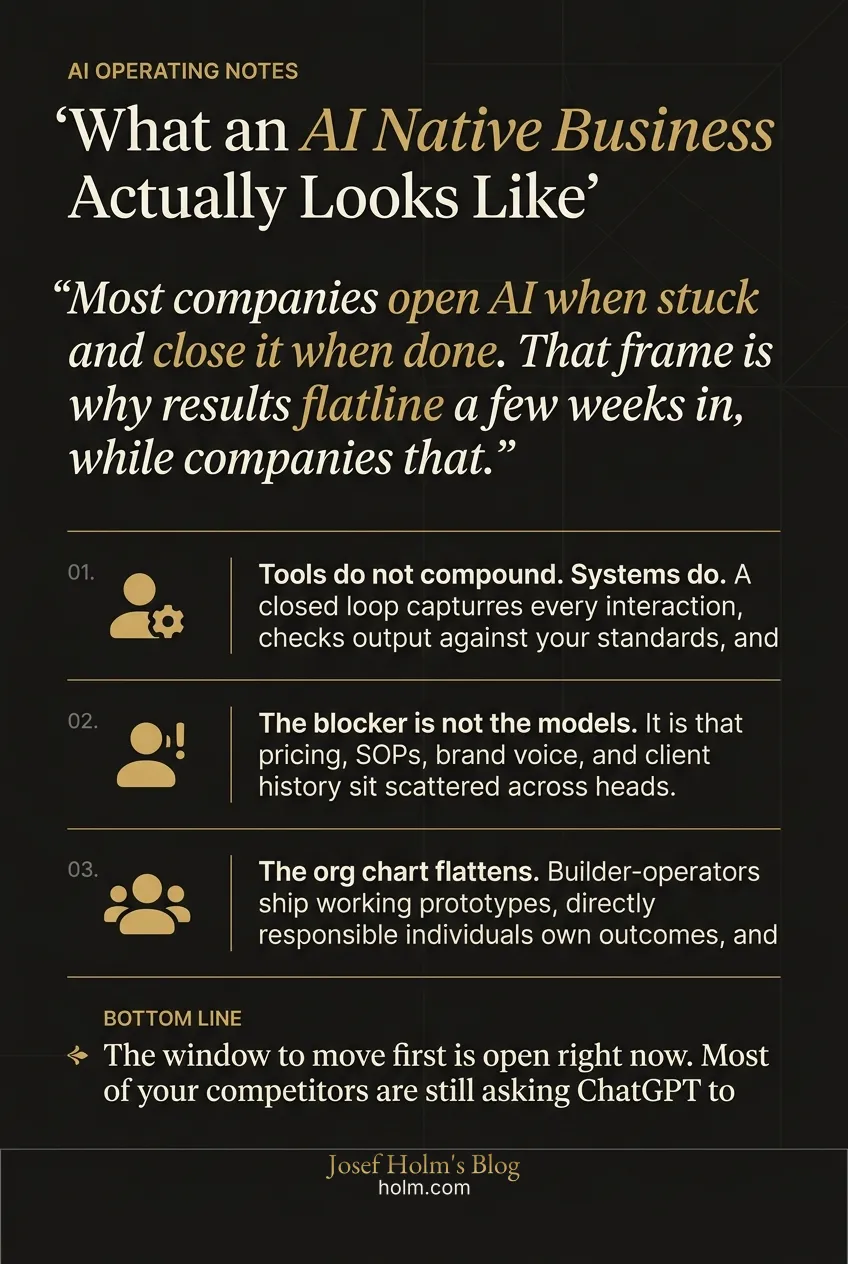
- Most companies open AI when stuck and close it when done. That frame is why results flatline a few weeks in, while companies that restructure around AI pull further ahead every quarter.
- Tools do not compound. Systems do. A closed loop captures every interaction, checks output against your standards, and gets sharper on the next pass. Six months in, the system knows more about your operations than half your team.
- The blocker is not the models. It is that, SOPs, brand voice, and client history sit scattered across heads, drives, and inboxes. Before you automate anything, you build a company brain the system can actually read.
- The org chart flattens. Builder-operators ship working prototypes, directly responsible individuals own outcomes, and the AI founder cannot outsource conviction. The system you build will reflect the quality of thinking you put into it.
- The window to move first is open right now. Most of your competitors are still asking ChatGPT to write subject lines. It will not stay that way forever.
Most companies are still treating AI like a tool. Open it when stuck. Close it when done. Wrong frame, and it's why their results flatline a few weeks after the initial excitement wears off.
The shift that matters is structural. AI stops being a tool you reach for and becomes the layer your company runs on. logic, client history, processes, sales motion, delivery standards. All of it readable by a system that gets sharper every week. That isn't a productivity boost. It's a different kind of company.
I've spent thirty years building tech businesses, and I've watched a few of these inflection points come and go. This one's different because the gap between companies that restructure around AI and companies that bolt it on widens every single day. If you run a small or mid-sized business, the window to move first is open right now. Most of your competitors are still asking ChatGPT to write subject lines for them.
Let me break down what an AI-native business actually looks like, and the framework we use at Josef Holm to get there.
Why does treating AI as a tool always plateau?
Tools don't compound. Systems do.
When you ask ChatGPT to draft an email, you get a draft. Useful. Repeatable. But it ends there. Nothing carries forward. Nothing learns. Your company's actual knowledge, the exceptions, the way your top closer handles objections, the reason a specific client churned, none of that feeds back in.
A system works differently. It captures every interaction, structures the output, checks it against your standards, and improves on the next pass. Six months in, the system knows more about your operations than half your team does. That's the compounding piece. It's the whole game.
The mental shift is simple. Before any new task, hire, or process, ask one question: why can't AI do this? Asked honestly across every department, that single question rewires how the business runs.
What's the difference between an open loop and a closed loop?
Most businesses run on open loops. You make a decision, you ship it, you check the dashboard later if you remember. No mechanism captures what happened, learns from it, and feeds it back into the next decision. Information leaks out of the company every day.
A closed loop regulates itself. Think of a thermostat. Measures, adjusts, measures again, never drifts far from target.
Apply that to a sales process. Every call gets transcribed. The system pulls out objections, what worked, what didn't. That analysis shapes how the next call gets prepped. Follow-up emails reference what was actually said, not a template. The CRM updates itself. Patterns surface over time and the system tells you what to test next.
Now run that across marketing, sales, delivery, finance, ops. Every department running as a closed loop, each one getting sharper. That's what an AI-native company looks like in practice.
What stops most businesses from getting there?
The blocker isn't the models. The models are already good enough.
The blocker is that critical business knowledge sits scattered everywhere. logic in the founder's head. SOPs across three different Google Drives. Sales templates in individual inboxes. Brand voice in someone's memory. Client history split between a CRM, Slack, and email threads.
This is normal. Every business operates this way to some degree. It's also the number one reason AI projects fail.
AI agents need structured, accessible, current information. They can't operate on fragments. So before you automate anything, you build a company brain. Identity, processes, team structure, client data, logic, goals. All of it captured in a form the system can actually read.
Once that's in place, you can ask your AI "draft a proposal for a dental clinic using our standard " and it knows. Knows the. Knows the format. Knows which dental clinics you actually want as clients because you've structured that context.
This is the heaviest lift in the whole transformation. It's also the one that creates the moat. We treat it as the foundation in our AI readiness note because nothing downstream works without it.
How does AI know when its own work is good enough?
You define it. That's the test use.
A test apply is a checklist the AI runs its own output against before showing it to you. Not complicated. Just specific.
Say you've built an AI skill that writes client proposals. The test put to work might be: includes the client's company name and industry, falls within standard range, references at least one relevant case study, stays under three pages, keeps a conversational tone. The AI writes, checks, revises whatever fails, and only then puts it in front of you.
You stop reviewing first drafts full of obvious mistakes. You review polished output that already clears your minimum bar. Your job shifts from doing the work to defining what good work looks like and making the final judgment call.
Apply this everywhere. Email campaigns. Reports. Sales follow-ups. Onboarding documents. Every output gets a standard. The AI iterates until it hits that standard. You move faster because you're not the bottleneck on every draft.
What does the org chart look like in an AI-native company?
Different. Flatter. Sharper.
Middle management exists largely to route information up and down. Collect status, summarize for leadership, relay decisions back. That's human middleware. If your company is queryable, the intelligence layer handles most of that routing on its own.
A few roles matter going forward.
The individual contributor. The builder-operator who makes and runs things. In an AI-native company this isn't only engineers. Sales builds. Ops builds. Support builds. People show up to meetings with working prototypes, not slide decks. I've never written a line of code, and I build dashboards, landing pages, and internal tools regularly. The barrier dropped.
The directly responsible individual. One person, one outcome, no hiding. Not a manager of people. An owner of a result. Revenue growth. Client retention. Pipeline quality. They focus on the outcome, not the process.
The AI founder. That's you. You can't outsource your conviction on these tools, and you can't outsource your understanding of what they can do. The system you build will reflect the quality of thinking you put into it. Delegate this to a consultant and stay disengaged, and you'll get a mediocre system. Every time.
That's why the first step in our work with clients is getting the founder hands-on. Not a demo. Not a deck. Real use. You can see how we structure that on the Josef Holm OS platform.
How do the economics actually change?
The old way to scale was headcount. More clients, more employees, more managers, more overhead. Linear and expensive.
The new way is output per person. One operator with the right system produces what used to take a team.
Run the math. Five hundred dollars a month on AI tools and API calls feels like a lot if you're used to spending nothing. But that AI is handling content, lead research, proposal drafting, data analysis, campaign execution. Hire humans for all of that and you're looking at fifteen to twenty thousand a month, minimum. The AI doesn't quit. Doesn't need onboarding. Works at three in the morning if you ask it to.
The flex used to be having two hundred employees. That signaled scale. That metric is dying. The companies that win from here will be the ones with the highest revenue per person, not the largest org chart.
Small businesses have a real edge in this transition. No legacy systems. No bureaucracy. No hundreds of people to retrain. You can redesign your operation from scratch this quarter. Large incumbents can't move that fast, and they know it.
What's the actual playbook?
Four steps. We use this with every client.
Learn. One to two weeks of the founder using the tools daily. Build small things. A landing page. A proposal generator. An email sequence. The goal is the moment where you realize what's actually possible. Until that lands, nothing downstream sticks.
Wire. Build the company brain. Take everything scattered across your business and structure it into a form AI can read. Identity, processes,, team, clients, goals. Connect live data sources. Call transcripts, CRM, revenue, support tickets. The system stays current on its own.
Automate. Map every department. Build agents and skills for each repeatable process. Lead generation. Content. Proposals. Onboarding. Each one runs as a closed loop. Each one has a test capture. You review output, not process.
Scale. Use the freed capacity to multiply output. More clients, more revenue, no proportional headcount. New initiative? Same playbook. New department, new skills, deploy.
That's the framework. Repeatable. It compounds.
What rules actually change day to day?
Old rule: come to meetings with ideas. New rule: come with working prototypes.
Old rule: hire people to execute processes. New rule: build skills that execute processes, hire people to improve them.
Old rule: scale by adding headcount. New rule: scale by adding skills and departments inside the system.
Old rule: knowledge lives in people's heads. New rule: knowledge lives in the company brain.
Old rule: review everything manually. New rule: define standards, let AI self-check, you make the final call.
Old rule: managers route information. New rule: the system routes information.
Old rule: speed is limited by team availability. New rule: speed is limited by how many skills you've built.
These aren't forecasts. It's happening now. The companies moving first are pulling away from the rest, and the gap widens every quarter they stay ahead.
If you run a real business and you want this set up properly, that's the work we do at Josef Holm. Start with the AI readiness note or apply directly. The window is open. It won't stay that way forever.
Infographic
Frequently Asked Questions
- What does it mean to be an AI-native business?
- AI stops being a tool you open when stuck and becomes the layer your company runs on. logic, client history, processes, sales motion, delivery standards, all readable by a system that gets sharper every week. That is not a productivity boost. It is a different kind of company.
- Why do most AI projects plateau after a few weeks?
- Because companies treat AI as a tool, not a system. Tools do not compound. You ask ChatGPT for a draft, you get a draft, and it ends there. Nothing carries forward, nothing learns, none of your real operating knowledge feeds back in. A system captures every interaction and improves on the next pass.
- What stops most businesses from going AI-native?
- Critical business knowledge sits scattered everywhere. in the founder's head, SOPs across three Google Drives, client history split between CRM, Slack, and email. AI agents need structured, accessible, current information. Before you automate anything, you build a company brain. That is the heaviest lift, and it is the one that creates the moat.
- How does AI check its own work?
- You define a test apply, a checklist the AI runs its own output against before showing it to you. The AI writes, checks, revises whatever fails, and only then puts it in front of you. Your job shifts from reviewing first drafts to defining what good looks like and making the final call.
- How do the economics of an AI-native company change?
- The old way to scale was headcount. The new way is output per person. Five hundred dollars a month on AI tools handles work that would cost fifteen to twenty thousand in salaries. The metric that wins is revenue per person, not the size of the org chart.
- What is the playbook to get there?
- Four steps. Learn, the founder uses the tools daily for one to two weeks. Wire, build the company brain. Automate, map every department and build closed-loop skills with a test apply. Scale, use the freed capacity to multiply output without proportional headcount.