What AI Cost Collapse Means for Creator Income
Key Takeaways
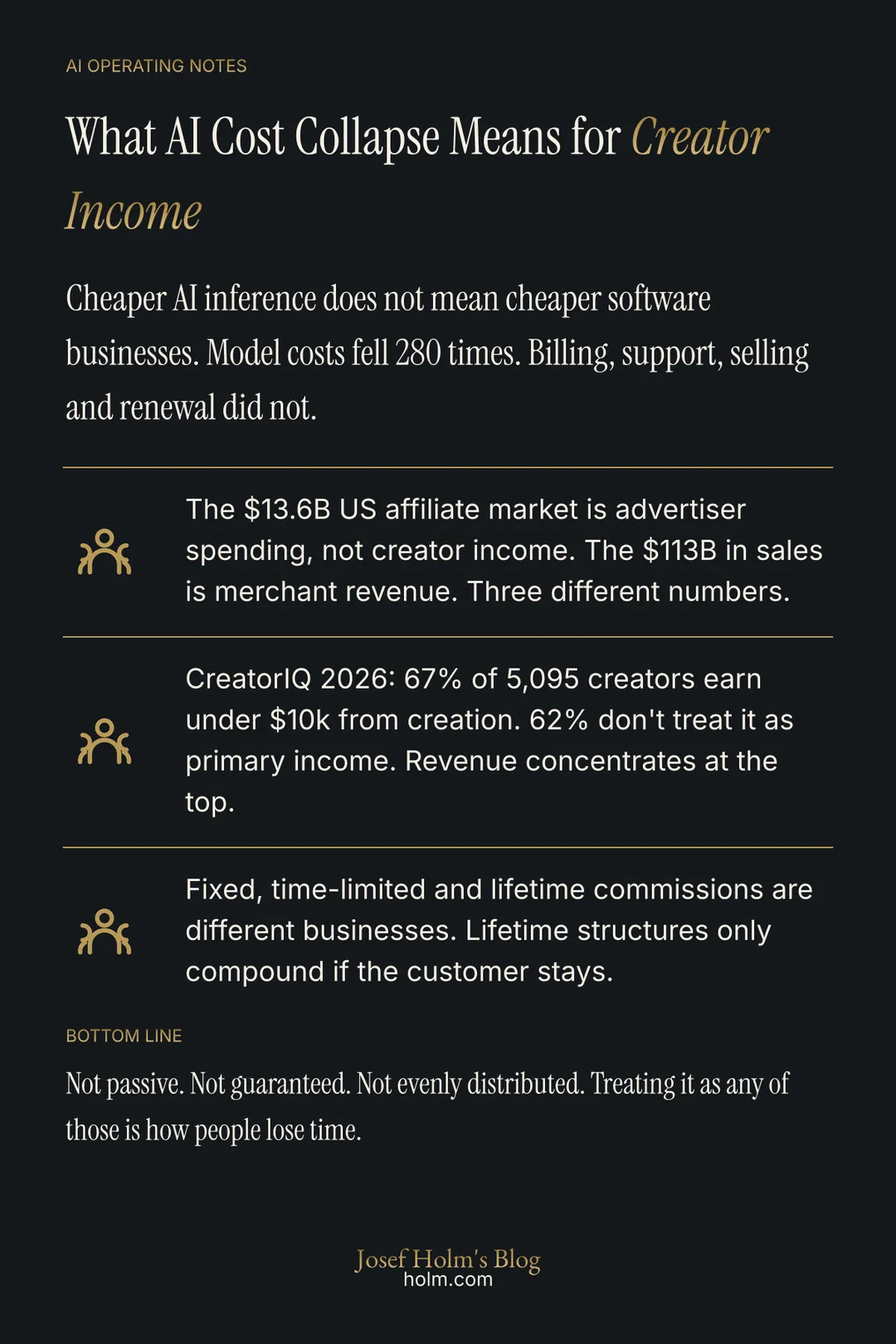
- Cheaper AI inference does not mean cheaper software businesses. Stanford's AI Index shows inference prices fell more than 280 times between late 2022 and late 2024, but billing, support, documentation, selling and renewal costs did not fall with them. The model layer commoditises. The operating layer does not. That's where the money sits.
- The US affiliate market grew from $9.1B in 2021 to $13.6B in 2024 per the Performance Marketing Association. That number is advertiser spending across cashback sites, coupon publishers and large portals. It is not creator income. The associated $113B in e-commerce sales is merchant revenue. Three different numbers, routinely conflated.
- CreatorIQ's State of Creators 2026 found 67% of 5,095 surveyed creators earn under $10,000 annually from creation and 62% don't treat it as their primary income. A growing affiliate category and a creator population mostly earning under $10k can coexist because the top of the distribution concentrates the revenue.
- Fixed, time-limited recurring, and customer-lifetime commissions are different businesses hiding behind the same word. HubSpot pays 30% monthly recurring for up to a year with a 180-day cookie. Fixed bounties reward volume. Lifetime recurring structures only compound if the customer stays, which lines affiliate incentives up with retention.
- Software affiliate income can be viable work for the right creator with the right audience and the right program. Not passive. Not guaranteed. Not evenly distributed across the creator population. Treating it as any of those three is how people lose time they won't get back.
The AI Opportunity Beyond Building Apps: What the Research Actually Shows
Cheaper AI inference does not mean cheaper software businesses. That's the first mistake I see operators and creators making right now, and it reshapes the question of where money will actually sit over the next few years.
Stanford's 2025 AI Index reports that inference pricing for a model at roughly GPT-3.5 performance level fell from $20.00 per million tokens in November 2022 to $0.07 per million tokens in October 2024. [6] A reduction of more than 280 times in under two years. See [6] for the underlying chart. [9]
That number measures one thing. The price of accessing a specific capability level through an API. It does not measure the cost of building a product someone will pay for, keeping it reliable, handling support tickets, managing billing disputes, writing documentation, selling it, or renewing the customer in year two. Those costs did not fall 280 times. In most cases, they did not fall at all.
So here's the question I keep coming back to. If the model layer is commoditising but the operating layer is not, where does commercially valuable work sit for people who are not going to build and run software themselves?
What work still has commercial value if you are not building the product?
My view, after thirty years building operating companies, is that a short list of activities is getting more valuable, not less, as AI capability goes cheap.
Understanding a customer problem well enough to describe it in the customer's own language. Evaluating products against that problem with real judgment, not feature lists. Explaining practical value to a buyer who has seen fifty tools this quarter and trusts almost none of them. Keeping a reputation intact across all of it.
None of those require writing code. None get automated by the next model release. All of them get harder for software vendors to do at scale, because every vendor sounds the same once the underlying capability is the same.
This is where creators, educators, newsletter publishers, and community operators have a real edge. Not because they are influencers in the generic sense. Because they sit next to a specific audience with a specific problem, and they've built the trust to be heard when they say "this one is worth your time."
The commercial question is whether that work can be monetised sustainably through affiliate arrangements. That's where the evidence gets more careful than most of the posts you see about it.
Is the affiliate market actually big, or is that number misleading?
The Performance Marketing Association's 2025 U.S. Industry Study estimates US affiliate marketing spending grew from $9.1 billion in 2021 to approximately $13.6 billion in 2024, a 49.8% increase, associated with roughly $113 billion in e-commerce sales. [2] [4] Full study at https://thepma.org/25industrystudy/.
Here's where people get this wrong. That $13.6 billion is spending by advertisers across the full US affiliate system, as measured through eight affiliate networks and a publisher survey. It is not creator income. It is not software commissions. It bundles in cashback sites, coupon publishers, large content portals, and plenty of activity that has nothing to do with an individual with a newsletter and a point of view. The $113 billion in associated sales is merchant revenue, which is a different number again from what any affiliate was paid.
PMA is an industry trade association, so treat the study as credible directional evidence of a growing category, not as a census.
What the number does tell us is that advertisers continue to pay for performance-based distribution, and they are paying more every year. Relevant. Not proof that any particular creator will earn a sustainable income from it. [4]
What does the creator-income evidence actually say?
Here's where the picture gets honest.
CreatorIQ and Influencers.club's State of Creators 2026, based on 5,095 surveyed creators across 100 regions, found that 67% earned less than $10,000 annually from content creation and 62% did not treat content creation as their primary income source. [10] [11] Report at [10].
That's a vendor-sponsored, self-reported survey, so weight it because of this. The directional finding is consistent with everything I've seen in the market. Most people who identify as creators are not making a living from creation, and audience size still tracks earnings more closely than the engagement-first narrative would like to admit.
So we have a growing affiliate category sitting next to a creator population where most participants earn under $10k from the work. Those two facts can coexist. They do coexist. The affiliate category keeps growing because the top of the distribution concentrates most of the revenue, and because much of the spending flows to publishers and platforms that are not creators in the sense this article means.
The real question is whether a specific kind of creator, the kind serving business operators with real problems to solve, can sit in a more productive part of that distribution.
Why business-software affiliate work is a different animal
A tech reviewer selling a $29 gadget on a 4% commission needs enormous reach to generate meaningful income. A business software affiliate selling a $500-per-month subscription on a 30% recurring commission is in a different economic model entirely.
That's before you look at the audience side. A consultant with 3,000 operators on a newsletter who recommends one well-fitted business tool per quarter is doing a different job than a lifestyle creator reviewing their twentieth productivity app. The audience is smaller. Qualified reach, measured as "people who could actually buy and benefit from this product," is often higher. The trust cost of a bad recommendation is also higher, which is a feature, not a bug.
But the economics only work if the commercial terms are right. This is where most people stop reading the fine print.
Fixed, time-limited recurring, and lifetime commissions are not the same business
HubSpot's affiliate program publicly advertises a 30% monthly recurring commission for up to one year with a 180-day cookie window. [3] [5] [8] See [3] for current terms.
HubSpot affiliate program: published terms
HubSpot publicly advertises a 30% monthly recurring commission for up to one year with a 180-day cookie window.
- Recurring commission rate
- 30%
- Cookie window
- 180 days
| Label | Value | Unit | Period |
|---|---|---|---|
| Recurring commission rate | 30% | percent monthly recurring | up to 1 year |
| Cookie window | 180 days | days | Not specified |
That's a time-limited recurring structure. The affiliate earns a percentage every month the customer pays, capped at twelve months. Compare that to a fixed one-time commission on a trial activation, where the affiliate earns a bounty when the referral converts and nothing after. Compare both to a customer-lifetime recurring structure, where the affiliate earns a percentage for as long as the customer pays.
Different businesses hiding behind the same word, "affiliate."
A fixed bounty rewards volume and acquisition skill. A time-limited recurring commission rewards fit, because customers who leave in month three leave money on the table. A customer-lifetime recurring commission rewards fit even harder, because the compounding only works if the customer stays. The affiliate's incentive lines up with retention, not just conversion.
None of these structures guarantees income. All of them sit at the mercy of the program's own continued existence, attribution rules, cookie windows, and the vendor's unilateral right to change terms. Verify current terms before you build any planning around them.
The conditions that actually matter
Based on what the evidence supports and what I've seen operating companies, here's what has to be true for software affiliate work to be commercially viable for a specific creator or community operator.
Audience fit. The audience needs to include people who buy business software and have budget authority. Operators, founders, consultants, agency owners, marketing leaders. A general audience converts at a rate that makes the maths impossible almost regardless of commission structure.
Qualified reach. Not raw follower count. The number of people in the audience who could actually use and pay for the product being recommended. A 2,000-person newsletter of CFOs is more qualified reach for a finance tool than a 200,000-person general audience.
Product-problem match that you can defend. The product has to solve a problem the audience actually has, in a way the creator can explain from use, not from a vendor deck. The reputational cost of a weak recommendation compounds faster than the commission on it.
Commission structure that rewards retention. Fixed bounties on sign-ups push you toward volume and away from fit. Recurring structures, especially lifetime ones, line the affiliate's incentive up with the customer actually getting value.
Program durability. The vendor needs to still be around in three years, with the program intact, honouring the attribution model that was in place when you did the work. Largely outside the creator's control, which is the honest answer.
A disclosed example, not a case study
I founded Marquorum, so take this as a founder's example rather than independent evidence. It's the business where I'm trying to apply what I just described, and I'd rather be transparent about it than reference it obliquely.
Marquorum runs subscription applications end to end, including billing, customer support, and ongoing development, while creators contribute audience understanding, product evaluation, and recommendations. The published economics are 30% recurring commission on eligible subscriptions for the customer's subscription lifetime, plus 5% of eligible customer revenue generated by referred affiliates. Terms at https://marquorum.com/commissions-and-payouts.
One of the products, Revenue Scout, searches and assesses public social conversations for relevant business opportunities and prepares included replies for manual review and posting. A reasonable fit for an audience of consultants, agencies, and small business operators who care about pipeline but won't post AI-generated replies without reading them first. That's the audience-product match question in a specific form. It is not evidence that the broader thesis works.
I share the structure because it illustrates a point, not because I am claiming outcomes I cannot prove. I do not have independent data on what typical small-creator earnings look like for business-software affiliate work. Nobody does, as far as I can see in the current research.
What the evidence supports, and what remains unproven
What the evidence supports:
AI inference costs have fallen dramatically, which lowers one component of software economics but not the full stack of building, operating, and selling. The US affiliate market is large and growing. Most creators do not earn major income from creation, with earnings concentrated at the top of the distribution. Software affiliate programs offer meaningfully different commercial structures, and the structure matters more than the headline rate.
Verified data from hai.stanford.edu
Verified values from the cited source are shown below.
- Annual hardware cost decline
- 30%
- Annual energy efficiency improvement
- 40%
| Label | Value | Unit | Period |
|---|---|---|---|
| Annual hardware cost decline | 30% | % per year | annual |
| Annual energy efficiency improvement | 40% | % per year | annual |
What remains unproven, at least from the public research:
Typical earnings for small creators specifically promoting business software. Retention curves for software customers acquired through creator recommendation versus other channels. Whether lifetime-recurring commission structures actually produce the compounding income their maths implies, once churn, attribution disputes, and program changes are accounted for.
The honest answer is that software affiliate income can be viable work for the right creator with the right audience and the right program. Not passive. Not guaranteed. Not evenly distributed across the creator population. Treating it as any of those three is how people lose time they won't get back.
If you want more operator notes like this one, The Operator's AI Brief is where I write them up. Tell me where you think I have this wrong.
Research notes
Research checked 14 October 2026.
Sources
- The 2025 AI Index Report | Stanford HAI, hai.stanford.edu Retrieved 14 October 2026.
- PMA Study: Affiliate Marketing Industry Grows 49.8% to $13.63 B, Outpacing E-commerce Growth by 2X - The PMA, The PMA Published 18 June 2025. Retrieved 14 October 2026.
- HubSpot Affiliate Program | Overview, www.hubspot.com Retrieved 14 October 2026.
- PMA Study: US Affiliate Spend Rose 49% to $13.6B as 4 Trends Reshape Industry - Martech Record, Martech Record Published 30 June 2025. Retrieved 14 October 2026.
- HubSpot Affiliate Program: Commission & Eligibility · AffiliPilot, AffiliPilot Retrieved 14 October 2026.
- AI Index 2025: State of AI in 10 Charts | Stanford HAI, hai.stanford.edu Retrieved 14 October 2026.
- Artificial Intelligence Index Report 2025, hai-production.s3.amazonaws.com Retrieved 14 October 2026.
- HubSpot Affiliate Program: 30% Recurring, 180-Day Cookie, wecantrack Published 26 March 2026. Retrieved 14 October 2026.
- Research and Development | The 2025 AI Index Report | Stanford HAI, hai.stanford.edu Retrieved 14 October 2026.
- CreatorIQ Study Reveals a Growing Authenticity Gap: Brands Value Engagement, but the Market Still Rewards Reach, www.creatoriq.com Retrieved 14 October 2026.
- State of Creators, www.creatoriq.com Retrieved 14 October 2026.
Infographic
Frequently Asked Questions
- Does cheaper AI inference mean cheaper software businesses?
- No. Inference pricing fell more than 280 times between late 2022 and late 2024 according to Stanford's AI Index. That's one component of the stack. Building, supporting, billing, selling, and renewing didn't fall at the same rate. In most cases they didn't fall at all. The model layer commoditises. The operating layer does not.
- Is the $13.6 billion US affiliate market a measure of creator income?
- No, and this is where most posts get it wrong. The Performance Marketing Association's 2025 figure measures advertiser spending across the full US affiliate system, including cashback sites, coupon publishers, and large content portals. It is not creator income. It is not software commissions. The associated $113 billion in e-commerce sales is merchant revenue, which is a third different number.
- What does the creator-income evidence actually show?
- CreatorIQ and Influencers.club's State of Creators 2026, based on 5,095 creators across 100 regions, found 67% earn under $10,000 annually from creation and 62% don't treat it as their primary income source. It's vendor-sponsored and self-reported, so weight so. The directional finding is consistent with what I see in the market.
- Why would a smaller audience of operators outperform a large general audience?
- Qualified reach, not raw follower count. A 2,000-person newsletter of CFOs is more qualified reach for a finance tool than a 200,000-person general audience. A $500-per-month subscription on a 30% recurring commission is a different economic model than a $29 gadget on 4%. But I'm not claiming small audiences automatically outperform large ones. The maths depends on fit, product match, and commission structure.
- Are fixed, time-limited recurring, and lifetime commissions really different businesses?
- Yes. A fixed bounty rewards acquisition skill. A time-limited recurring commission, like HubSpot's advertised 30% monthly for up to one year, rewards fit because churn in month three costs money. A customer-lifetime recurring structure rewards fit even harder because the compounding only works if the customer stays. Same word. Different incentives.
- What has to be true for software affiliate work to actually pay?
- Five conditions. Audience fit with people who buy business software. Qualified reach, not vanity reach. A product-problem match the creator can defend from use. A commission structure that rewards retention, not just conversion. And program durability, which is largely outside the creator's control. None of this makes the income passive or guaranteed.