The AI Perception Gap Is Costing You Deals
Key Takeaways
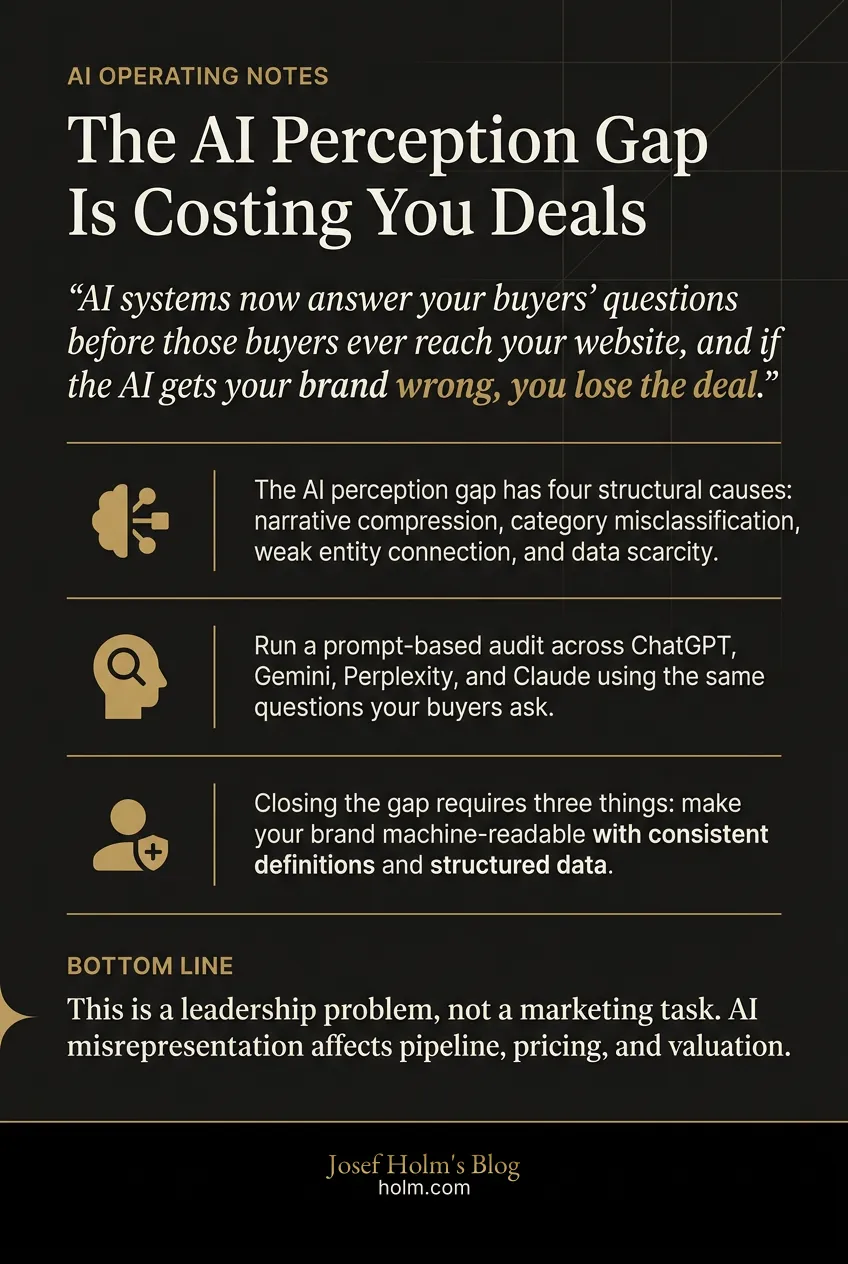
- AI systems now answer your buyers' questions before those buyers ever reach your website, and if the AI gets your brand wrong, you lose the deal before it starts.
- The AI perception gap has four structural causes: narrative compression, category misclassification, weak entity signals, and competitors being more legible to the machine.
- Run a prompt-based audit across ChatGPT, Gemini, Perplexity, and Claude using the same questions your buyers ask. The gap between what comes back and what you want buyers to hear is your problem to fix.
- Closing the gap requires three things: make your brand machine-readable with consistent definitions and structured data, build external validation from sources AI trusts, and monitor continuously because AI narratives shift.
- This is a leadership problem, not a marketing task. AI misrepresentation affects pipeline, power, and revenue directly.
Most brands don't know they've already been rewritten. Not by a competitor. Not by a journalist. By the AI that now answers their customers' questions before those customers ever reach the brand's own website.
That's the core problem. And it's not theoretical.
What happens when AI becomes the first impression?
For most of the internet's history, brands controlled the first touchpoint. Someone searched, clicked a link, and landed on a page the brand designed. The brand shaped the message. The brand set the context.
That model is breaking down.
Today, a growing share of potential buyers don't click links at all. They ask a question. ChatGPT, Gemini, Perplexity, or Claude answers it. The AI pulls from dozens of sources, compresses everything into a short summary, and delivers its version of who you are and what you do.
Notice what happened there. The brand lost control of the narrative before the conversation even started. The AI became the analyst, the storyteller, and the gatekeeper all at once.
If its version is accurate, great. If it's not, you have a problem you probably don't even know about.
What exactly is the AI perception gap?
The AI perception gap is the distance between what your brand actually is and what AI systems say you are.
It's not a branding concept. It's a measurable business risk.
Here's how it shows up in practice:
- The AI puts your product in the wrong category entirely
- It quotes you changed two years ago
- It leaves out the features that matter most to your buyers
- It recommends a competitor as the better option
Any one of those can end a sale before it starts. The buyer asks, the AI answers, and your brand gets filtered out of the consideration set before you knew you were in the running.
I've seen this happen to companies with strong products and sharp teams. They're doing good work, and the AI is telling a different story. The gap isn't about quality. It's about legibility.
Why does this keep happening?
Here's what most people miss. These aren't random AI hallucinations. They're structural problems, predictable and repeatable, rooted in how language models actually work.
There are four main causes worth understanding.
Narrative compression
AI models take large amounts of complex information and squeeze it into short, digestible answers. That compression process strips nuance first. The careful differentiation you spent years building gets flattened into a generic summary that could describe any of your competitors.
Your brand story might be rich and specific to a human reader. To a model trying to produce a three-sentence answer, it's just noise to be reduced.
Category misclassification
Because AI simplifies, it maps brands onto categories it already understands. If your positioning uses visionary or abstract language, the kind that resonates with human buyers, the model may not know what to do with it. So it guesses.
The result? A sophisticated enterprise platform gets described as "a chatbot tool." A premium product gets repositioned as a commodity. The AI isn't being malicious. It's just working with what it can parse.
Weak entity signals
If your brand doesn't clearly and consistently signal what it is across the web, the AI has very little reliable information to work from. It fills in the blanks. Sometimes it gets close. Often it doesn't.
This is especially common with companies that have evolved their positioning over time but haven't cleaned up the trail of outdated content, old press mentions, and inconsistent descriptions scattered across the internet.
Competitor narrative reinforcement
While your brand's signal may be unclear to AI, your competitors might be actively making their own signals stronger. They're not necessarily doing anything aggressive. They're just more legible to the machine. And in a system that ranks and recommends, legibility wins.
The AI doesn't have opinions. It has inputs. Whoever provides the clearest, most consistent inputs gets the most accurate representation.
What does misclassification actually cost?
This is where it gets concrete.
When an AI places your brand in the wrong category, the downstream effects compound quickly. An enterprise solution misidentified as a small-business tool gets filtered out of high-value queries entirely. Security features, compliance capabilities, and other premium differentiators disappear from AI-generated descriptions. The AI might quote a lower price than your actual, setting up failed sales conversations before they start.
And the worst part? You become invisible to your ideal customers. Not because they rejected you. Because the AI never surfaced you.
How many deals are you losing to a conversation you weren't part of? That's not a rhetorical question. It's a diagnostic one. Most companies have no idea what the answer is, and that's the real problem.
How do you see what AI actually says about you?
The first step is embarrassingly simple, and almost nobody does it systematically.
You get an AI Visibility score to see how your brand is perceived, then dive deeper with Akii's competitor intelligence tools. You ask AI systems the same questions your buyers would ask, and you document what comes back.
There are four categories of prompts that matter:
Brand understanding prompts. "What is [your brand]?" "What does [your brand] do?" These reveal whether the AI has a coherent picture of your company at all.
Product and feature prompts. Questions about specific capabilities, integrations,. These reveal whether the AI knows the details that matter to a buyer in evaluation mode.
Comparison prompts. "How does [your brand] compare to [competitor]?" These reveal how the AI frames you relative to alternatives, and whether it positions you favorably, neutrally, or as the weaker option.
Category prompts. "What are the best tools for [problem you solve]?" These reveal whether you show up at all when buyers are looking for solutions in your space.
Why you have to test across multiple AI models
Different AI systems tell different stories about the same brand. That surprises most people when they first see it.
ChatGPT tends to focus on community buzz and online conversation. Gemini leans heavily on Google's Knowledge Graph. Perplexity prioritizes real-time citations. Claude is more conservative, looking for strong authority signals before making claims.
You can be a category leader in one AI engine and a forgotten afterthought in another. Testing on just one platform gives you a dangerously incomplete picture.
How do you actually close the gap?
Seeing the problem is step one. Fixing it requires a structured approach across three areas.
Pillar 1: Make your brand machine-readable
I call this the technical clarity layer. The goal is simple: eliminate the need for AI to guess about your brand.
That means creating one unified brand definition and using it consistently everywhere. Not three versions on three pages. One definition, repeated clearly.
It means using structured data, things like schema.org markup, to label your and features as hard facts rather than marketing copy the model has to interpret. And it means writing concise, quotable summaries that AI can easily extract and use.
If your key differentiator is buried in paragraph four of a long-form page, the model probably won't find it. Put the answer where the machine looks first.
This isn't about dumbing down your message. It's about making your message legible to a system that processes language differently than humans do.
Pillar 2: Build external validation
Here's something fundamental about how AI models assess credibility. They trust third-party sources more than they trust what a brand says about itself. That's not a bug. It's by design.
So your own website, no matter how well-structured, isn't enough. You need external signals.
That means getting mentioned in trusted publications. Not vanity press. Real coverage in sources the AI models weight heavily. It means maintaining a steady stream of recent, positive reviews, because old reviews fade in relevance and the models care about recency.
When the model has strong external validation to draw from, it's far less likely to guess wrong about you.
Pillar 3: Monitor continuously
This is where most companies fall short, even the ones that do the first two pillars well.
AI models are constantly learning and updating. The narrative they tell about your brand today might shift next month based on new training data, new competitor content, or changes in the model itself.
Managing the AI perception gap is not a one-time project. It's an ongoing discipline. You have to monitor what AI says about you regularly and correct new misperceptions as they emerge.
This is the kind of continuous intelligence work that the AI readiness note was designed for. It's not about chasing every fluctuation. It's about catching the shifts that matter before they cost you business.
Why this is a leadership problem, not a marketing problem
Most companies are treating AI visibility as a marketing task. I want to be direct: it's not.
It's a strategic issue that affects pipeline, positioning, and revenue. When AI misrepresents your brand, it doesn't just hurt awareness. It actively misdirects your ideal buyers toward competitors. It sets wrong expectations that your sales team then has to correct. It undermines power by framing you in a lower-value category.
That's not a content problem. That's a business problem. And it requires leadership attention.
The companies that figure this out early will have a real advantage. Not because they gamed an algorithm, but because they took the time to make sure AI understood them correctly. That's the bar now.
What should you do this week?
If you've read this far, here's the practical next step.
Open ChatGPT, Gemini, Perplexity, and Claude. Ask each one: "What is [your company name]?" Then ask: "How does [your company] compare to [your top competitor]?"
Write down what comes back. Compare it to what you'd actually want a buyer to hear.
The distance between those two things is your AI perception gap. Now you know it exists.
From there, the question isn't whether to act. It's how fast. If you want help figuring out where to start, that's what we do.
Brands are no longer the sole authors of their own story. AI has become a co-author. The companies that win from here won't necessarily be the loudest or the most creative. They'll be the ones that AI understands correctly.
That's a different kind of work. And it starts with seeing the gap clearly.
Infographic
Frequently Asked Questions
- What is the AI perception gap?
- It is the distance between what your brand actually is and what AI systems say you are when answering buyer questions. It shows up as wrong category placement, outdated, missing features, or competitors being recommended instead of you.
- How do I find out what AI says about my brand?
- Run a prompt-based audit. Open ChatGPT, Gemini, Perplexity, and Claude. Ask each one what your company is, what it does, and how it compares to your top competitor. Write down the answers and compare them to what you actually want buyers to hear.
- Why do different AI models say different things about the same brand?
- Each model weights different sources. ChatGPT leans on community buzz, Gemini pulls from Google's Knowledge Graph, Perplexity prioritizes real-time citations, and Claude requires strong authority signals. You can be a category leader in one and an afterthought in another.
- Why does AI misrepresent brands in the first place?
- Four structural reasons: compression strips nuance from your positioning, category mapping forces your brand into buckets the model already knows, weak or inconsistent signals leave the model guessing, and competitors with clearer signals get more accurate coverage.
- How do I fix my brand's representation in AI outputs?
- Three areas. First, make your brand machine-readable: one clear definition used consistently everywhere, structured data markup for and features, and concise summaries the model can extract easily. Second, build external validation in publications and review platforms AI trusts. Third, monitor continuously because AI narratives shift as models update.
- Is AI brand visibility a marketing problem or a business leadership problem?
- Leadership problem. When AI misrepresents your brand, it misdirects buyers to competitors, creates wrong expectations your sales team has to correct, and undermines power by framing you in a lower-value category. That is a revenue issue, not a content issue.