Why an AI Prototype Is Not a Company
Key Takeaways
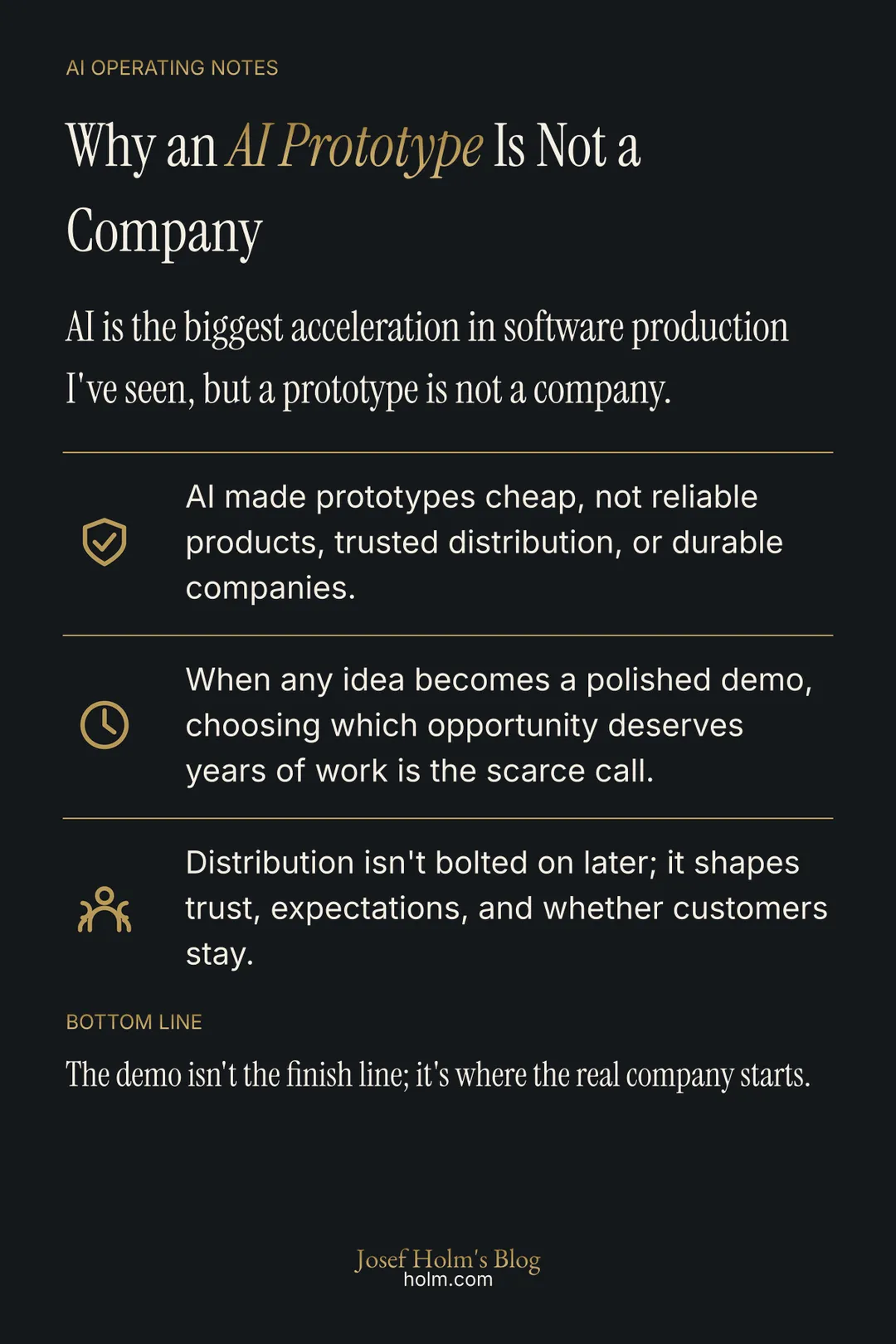
- AI is the biggest acceleration in software production I have seen. A small team can now research, position, design, code, generate assets, analyse feedback, and reach a convincing prototype at a speed that would have looked absurd a few years ago. That is a real change in the economics of software, and it is also producing a dangerous misunderstanding: a prototype is not a company.
- AI has made credible software prototypes dramatically cheaper. It has not made reliable products, trusted distribution, or durable companies cheap. Real products must survive authentication edge cases, billing failures, taxes, data integrity, support, monitoring, security, backups, maintenance, and third-party API changes long after the demo ends.
- When almost any plausible idea can become a polished demo, technical possibility stops being useful evidence on its own. The scarce decision moves upstream: which opportunity deserves years of operation. AI can make founders faster at building the wrong thing, and speed without selection just gets you to the wrong destination earlier.
- Distribution is not bolted on after the product is finished. It shapes who hears about it, what they expect, why they trust it, and whether they stay. Traditional affiliate programs only involve creators after product selection, wasting the market intelligence they already have from hearing which problems generate real discussion.
- The demo is no longer the finish line. It is where the real company starts. AI has made software more abundant, which increases the value of what stays scarce: judgment, accountability, customer understanding, reliable operation, trusted distribution, and time.
The internet was smaller when I started. Tools were primitive. Publishing a website, taking a payment, running a campaign, or serving a customer online required patience most people no longer remember.
I got my start in affiliate marketing almost thirty years ago. Since then I've built companies across online marketing, venture capital, crowdfunding, blockchain, and Web3, and every cycle showed up with the same pitch: company building was about to get easier.
Most of those promises were partly true. Each shift removed one old constraint and exposed the next one hiding behind it.
AI is the biggest acceleration I've seen. A small team can now research a market, test positioning, design an interface, write code, generate assets, analyse feedback, and reach a convincing prototype at a speed that would have looked absurd a few years ago.
That's a real change in the economics of software.
It's also producing a dangerous misunderstanding. A prototype is not a company. AI has made credible software prototypes dramatically cheaper. It has not made reliable products, trusted distribution, or durable companies cheap.
Which raises a question most founders keep skipping.
What does the demo actually prove?
A demo has one job. Show that an idea could work.
A product has to keep working. It needs authentication that doesn't lock out real users. Billing has to survive failed cards, cancellations, upgrades, refunds, and taxes. Data has to stay correct. Support needs to exist when the interface is unclear. The system needs monitoring, security, backups, maintenance, and a plan for every provider that changes an API without asking.
Real customers use products differently from the team that built them. They misunderstand what felt obvious. They combine features nobody tested. They show up with expectations formed by another product, another price, another promise.
Then they judge the whole company by what happens next.
AI can help with a lot of this work. It can help write tests, diagnose failures, draft support replies, inspect logs, and propose fixes. It cannot make the responsibility disappear. Somebody still owns the outcome.
The demo is the visible five percent. The company is everything that must still be happening on day 300.
Which means the harder question is no longer whether you can build it.
If everything can be built, what should be?
When software was expensive to produce, cost acted as a filter. A bad filter. Plenty of weak ideas got funded and plenty of strong ones never got built. But cost forced some degree of commitment before a product appeared.
AI weakens that filter.
Mostly a good thing. More people can test more ideas. Smaller teams can compete. Customers can get tools for narrow problems that were never large enough to interest a traditional software company.
But when almost any plausible idea can become a polished demo, technical possibility stops being useful evidence on its own. The scarce decision moves upstream: which opportunity deserves years of operation after the first version works?
Answering that takes more than enthusiasm. It takes evidence of a painful problem, a customer who recognizes it, a clear path to first value, workable economics, and a real route to distribution.
It also requires the willingness to stop.
AI can make founders faster at building the wrong thing. Speed without selection just gets you to the wrong destination earlier.
And even the right destination is invisible without one more thing.
Why did distribution never get cheaper?
Affiliate marketing taught me this lesson long before AI arrived.
A useful product can stay invisible. A mediocre one can spread because the people promoting it understand the audience. Distribution is not something you bolt on after the product is finished. It shapes who hears about the product, what they expect, why they trust it, and whether they stay.
Yet product building and distribution are still usually organized as two separate systems.
The company picks an idea, builds it, decides how to describe it, and only then goes looking for people with an audience. Creators enter after the consequential decisions have already been made. They get a link, a commission structure, and promotional assets for a product they had no role in selecting.
That wastes some of the most useful market intelligence available. Creators hear the recurring questions. They know which problems generate real discussion. They see what people tried and why it disappointed them. They understand the difference between a topic that gets attention and a problem that motivates action. Traditional affiliate programs only involve them after product selection.
The obvious alternative is for creators to build software themselves.
AI makes that look practical. A creator produces a demo, shows it to an audience, and collects encouraging reactions. Then the demo ends. The creator inherits billing, support, security, reliability, maintenance, compliance, and an open-ended roadmap. The audience relationship that created the opportunity now competes with the operational burden required to serve it.
Most creators shouldn't have to become software companies to influence which products get built.
Which is the problem I'm now trying to solve directly.
Can selection and distribution share a system?
I built Marquorum to address this. Marquorum is a creator-powered affiliate network and a partner-powered venture-selection and distribution platform. It's operated by Akii Technologies, the AI venture builder through which we directly build, own, and operate our products.
Akii doesn't spin up a separate company for every product. It provides the shared operating structure: product development, billing, licensing, funding, administration, support, and governance.
Marquorum provides the participation and distribution layer. Partners who have generated tracked traffic and/or sales during the prior 30 days can propose and vote on future products distributed through Marquorum. Akii qualifies which opportunities are suitable for a binding ballot, and once a qualifying result is certified, Akii builds and operates the selected product.
Akii can also stop a project if a previously unknown legal, technical, or economic problem emerges. That's not a discretionary escape from the result. It's a necessary boundary for responsible operation, and the original vote and the reason for the change are preserved through the governance process.
This isn't crowdsourced product management. Partners help select the opportunity. Akii remains accountable for turning that opportunity into a dependable product and operating it over time.
That model needs a first real test.
What does that first test look like?
Revenue Scout is the first new product brought to market through this model. It finds and vets public conversations about what a business sells, prepares a grounded reply for the strongest opportunities, and the user reviews, edits, and posts the reply manually from their own account.
The distinction is deliberate. The software handles repetitive discovery and preparation. The person remains responsible for the relationship.
Revenue Scout is a useful first test of the broader model because its value can be observed: did it identify a relevant conversation, was the opportunity worth answering, did the user reach first value, did the customer stay, did a partner refer a customer who stayed?
Those questions produce evidence. Evidence should decide what scales next.
Which is the whole point of calling any of this a venture builder in the first place.
What is a venture builder actually compounding?
Calling Akii an AI venture builder isn't a claim that we can manufacture successful companies on command. It describes the operating system we're building.
Akii.com remains an active GEO, SEO, and AI commerce business that helps agencies organise trusted client facts in a Commerce Graph and check how AI systems understand and present each business. Marquorum adds partner-led product selection and distribution. Revenue Scout addresses the public-demand problem directly.
Different products. Same operating lesson: useful software sits inside a larger system of facts, intent, judgment, trust, and distribution.
The advantage shouldn't come from producing the largest number of AI apps. That builds breadth without depth and complexity without compounding value. The advantage should come from learning faster across products and preserving what works.
Which problems create real customer urgency? Which partners understand those problems and can explain the products credibly? Which messages lead the right users to first value? Which customers stay, upgrade, and refer others? Which operating practices reduce support burden without cutting service quality? Which evidence should change what gets built next?
Every product should improve the system used to select, build, distribute, and operate the next one. That's compounding. Another pile of source code is not.
Which leaves one practical question for anyone sitting on a working prototype.
Seven questions before you turn a demo into a company
AI has made it tempting to treat every working prototype as an obligation to launch. I'd apply a harder test before doing that.
- Who experiences this problem often enough to pay for a solution?
- What observable event proves a new customer received value?
- Where will the first ten qualified customers come from?
- Who will still own reliability, support, and security in month nine?
- Why would a credible person recommend this product to an audience?
- Can the economics support the customer without hiding the real cost in founder time?
- What becomes stronger with every customer instead of just busier?
If the answers are vague, improving the prototype won't fix the company.
AI has made software more abundant. That increases the value of what remains scarce: judgment, accountability, customer understanding, reliable operation, trusted distribution, and time.
Josef
If you want more operator notes like this one, The Operator's AI Brief is where I write them first.
Infographic
Frequently Asked Questions
- Why isn't a working AI prototype the same as a company?
- A prototype shows an idea could work. A company has to keep working: billing that survives failed cards and refunds, authentication that doesn't lock out real users, support, monitoring, security, backups, maintenance, and third-party APIs that change without asking. AI helps with a lot of that work but does not remove the responsibility. Somebody still owns the outcome on day 300.
- If AI makes almost anything buildable, how do founders pick what to build?
- When cost stops filtering out weak ideas, technical possibility is no longer useful evidence on its own. The scarce decision moves upstream: which opportunity deserves years of operation after the first version works. That takes a painful problem, a customer who recognises it, a clear path to first value, workable economics, and a real route to distribution. Speed without selection just gets you to the wrong destination earlier.
- Why did distribution never get cheaper the way software did?
- Distribution is not something bolted on after the product is finished. It shapes who hears about the product, what they expect, why they trust it, and whether they stay. Product building and distribution are still usually organised as two separate systems, which wastes the market intelligence creators already have from hearing recurring problems inside their audience.
- Should creators just build their own software now that AI makes it easy?
- The demo ends and the creator inherits billing, support, security, reliability, maintenance, compliance, and an open-ended roadmap. The audience relationship that created the opportunity now competes with the operational burden required to serve it. Most creators shouldn't have to become software companies to influence which products get built.
- What should an AI venture builder actually compound over time?
- Not the largest number of AI apps. That builds breadth without depth. The advantage should come from learning faster across products and preserving what works: which problems create urgency, which partners can explain them credibly, which messages lead users to first value, which customers stay and refer. Every product should improve the system used to select, build, distribute, and operate the next one.
- What are the seven questions to ask before turning a demo into a company?
- Who experiences this problem often enough to pay for a solution. What observable event proves a new customer received value. Where the first ten qualified customers come from. Who will still own reliability, support, and security in month nine. Why a credible person would recommend it to an audience. Whether the economics work without hiding cost in founder time. And what becomes stronger with every customer instead of just busier.