
AI Roadmap for UAE Real Estate Margins
Key Takeaways
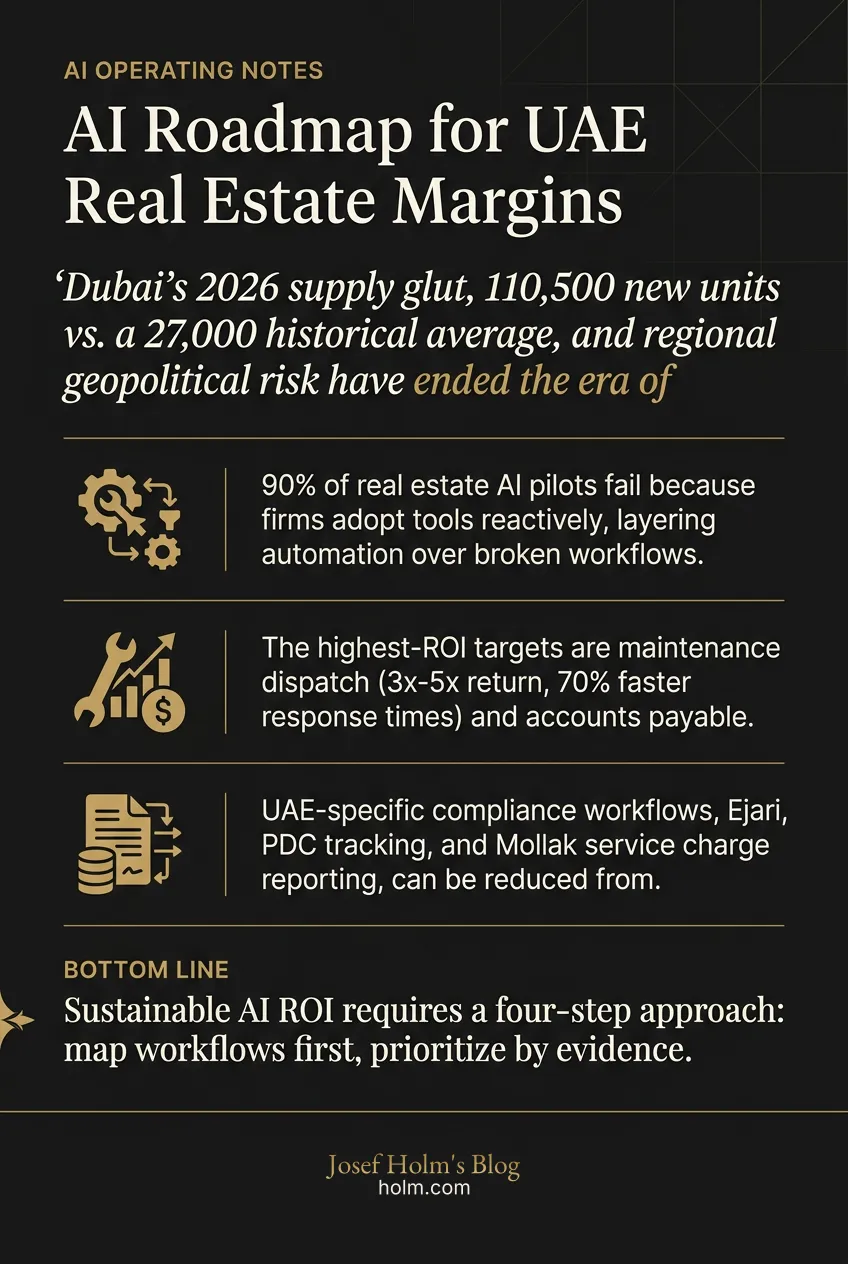
- Dubai's 2026 supply glut, 110,500 new units vs. a 27,000 historical average, and regional geopolitical risk have ended the era of appreciation-driven margin forgiveness.
- 90% of real estate AI pilots fail because firms adopt tools reactively, layering automation over broken workflows instead of diagnosing operational bottlenecks first.
- The highest-ROI targets are maintenance dispatch (3x-5x return, 70% faster response times) and accounts payable automation (60-85% faster processing, 25% cost reduction).
- UAE-specific compliance workflows, Ejari, PDC tracking, and Mollak service charge reporting, can be reduced from weeks of manual effort to 48-hour automated pipelines.
- Sustainable AI ROI requires a four-step approach: map workflows first, prioritize by evidence, build human-in-the-loop governance, and roll out sequentially to build organizational trust.
What Happens When the Market Stops Covering Your Inefficiencies?
Between 2022 and early 2025, Dubai real estate prices surged 60%. Abu Dhabi residential prices climbed nearly 32% year-on-year by end of 2025. That kind of appreciation forgives a lot of operational sins.
Those days are over.
The escalation of the US-Israel versus Iran conflict in March 2026 didn't just rattle geopolitical nerves. It fundamentally rewrote the risk parameters governing capital flows into the region. Strait of Hormuz crossings dropped by more than 70%, with over 200 oil and LNG vessels anchored outside the strait due to war-risk insurance complications. Oil prices spiked to $82 per barrel, and tail-risk scenarios project possible spikes toward $130. Regional airspace closures introduced severe friction into aviation, logistics, and tourism sectors that form the backbone of Dubai's economy.
But here's the thing. A 2008-style crash isn't coming.
The UAE's fundamentals remain strong: non-oil GDP growth projected at 5.0% for 2026, an S&P AA/A-1+ sovereign credit rating, and a population that has officially beat 11 million residents. Transaction volumes still maintain 60% to 70% of baseline levels during regional uncertainty. The market is active. It's just no longer forgiving.
Then there's the supply side. Over 110,500 residential units could be delivered into Dubai throughout 2026, a staggering figure when the 10-year historical average sits at roughly 27,000 annual deliveries. This is part of a broader trajectory expecting 300,000 to 400,000 new units by 2028. Combined with affordability pressures where rising ownership and rental costs have greatly outpaced resident income growth, the math is brutal. A modest 10% decline in selling prices, assuming flat construction and operational costs, compresses major listed developer margins from 44% down to 38%, and from 38% to 31% for others.
So where does profit come from now? Not from blind momentum. Not from speculative off-plan absorption. It comes from yield protection and margin expansion. For every property management firm, community manager, and brokerage operating in the UAE, the mandate is unambiguous: decouple your service capacity from your headcount.
Why Are 90% of Real Estate AI Projects Failing?
Here's a statistic that should make every real estate executive uncomfortable. Between 2023 and 2026, the proportion of real estate companies piloting AI solutions skyrocketed from 5% to 90%. Yet roughly 90% of those AI initiatives fail to deliver any meaningful ROI. Only a marginal 5% of firms report successfully achieving all their stated AI and automation objectives.
Is it the technology that's broken? No.
The problem is strategic. Companies are adopting AI backward. They start with vendor pitches, chase competitor actions, and deploy disjointed software tools before ever diagnosing their actual operational bottlenecks. They're scaling their existing manual inefficiencies at machine speed.
This "panic adoption" shows up in several predictable ways. The most pervasive failure is layering AI over broken workflows. When organizations add advanced AI tools on top of fragmented WhatsApp threads, disorganized Excel spreadsheets, and paper-based check processing, they don't achieve any real change. They create digital systems that are infinitely more complex and fragile. Automation applied to an inefficient operation simply scales the inefficiency.
Then there's the symptom-chasing trap. Firms deploy AI to accelerate outputs without questioning whether their underlying data is reliable. Generating automated property underwriting models is entirely futile if the market data feeding those models is fabricated or outdated. Vendors frequently exploit this gap, selling "automated analysis" to firms that lack standardized data repositories.
The in-house build distraction deserves its own warning label. Seduced by low-code environments and the perceived accessibility of generative AI, non-technical real estate firms attempt to build proprietary AI platforms internally. This diverts immense capital and executive attention away from the firm's core competency toward complex software engineering problems they're fundamentally unequipped to solve. The result is a substandard tool that employees refuse to adopt.
What Do the Top 5% Do Differently?
The elite firms achieving 3x to 5x ROI on AI investments don't start by selecting software. They follow a disciplined, workflow-first diagnostic methodology. They map the exact daily actions of property managers, leasing agents, financial controllers, and maintenance coordinators to identify precisely where highly paid professionals are losing thousands of hours to repetitive administrative drag.
By categorizing operational friction into distinct, modular problems, these organizations deploy highly specific AI agents that embed directly into existing property management systems like Yardi, MRI, or UAE-specific platforms like Elate, which already handles VAT compliance, Ejari registration, and Post-Dated Cheque tracking. That targeted approach reclaims wasted hours and grows operating capacity without adding a single new hire.
Where Is the Biggest Margin Leak in Property Management?
Maintenance dispatch. Full stop.
The daily coordination, triage, and dispatch of property maintenance represents the single largest source of administrative drag and margin erosion within residential management portfolios. Traditional coordination relies on a chaotic web of unstructured WhatsApp messages, disconnected email threads, and phone logs. Human coordinators must manually interpret a tenant complaint, estimate job duration, identify an available technician, cross-reference vendor SLAs, and dispatch the worker. As the day progresses, traffic congestion across Dubai, unexpected repair difficulties, and emergency requests destroy the manual schedule.
The result? Missed appointments. Massive technician downtime. Inflated labor costs. Compromised tenant satisfaction.
AI rewrites these economics entirely. Modern NLP models instantly categorize faults, assess severity, and autonomously verify tenant lease obligations regarding maintenance cost-sharing. Dynamic scheduling algorithms process real-time variables including technician proximity, predicted job duration from historical datasets, and live traffic patterns to sequence jobs intelligently without human intervention.
The predictive maintenance angle is where the returns compound most dramatically. AI analyzing continuous IoT sensor data and historical breakdown frequencies can predict equipment failures before they occur. In the UAE, where HVAC systems operate under extreme, continuous climate stress, predictive systems reduce critical equipment breakdowns by 30% to 50%, preserving asset longevity and eliminating catastrophic emergency repair costs.
Mid-sized property management firms automating the full triage and dispatch sequence can eliminate up to 1,200 hours of manual routing annually. Portfolios grow by hundreds of units without requiring a single additional coordinator. The measured ROI is 3x to 5x within 12 months, achieved primarily by reducing coordinator payroll allocations by 50% to 70% and cutting maintenance response times by 70%.
What About the Financial Back Office?
If maintenance is the logistical bottleneck, accounts payable is the financial one. Managing a scaled portfolio generates an avalanche of disparate vendor invoices spanning landscaping, HVAC servicing, plumbing, deep cleaning, security, and capital projects. Human accountants must visually inspect every document, cross-reference it against the original Purchase Order, verify against negotiated contracts, and input data keystroke-by-keystroke into accounting software. This analog process is susceptible to error, undetected double billing, and fraud.
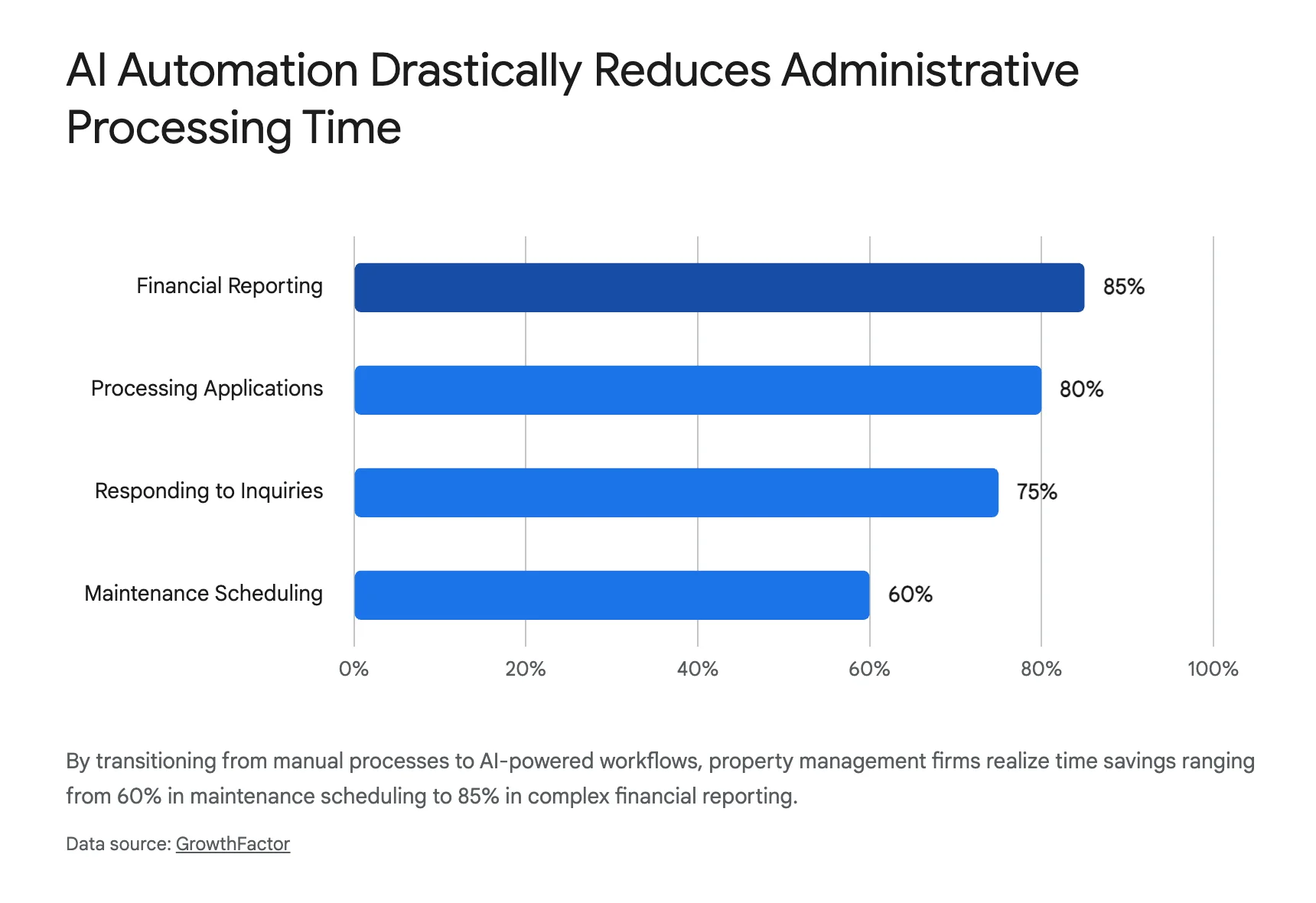
AI agents built for vendor invoice matching eradicate this friction. Advanced OCR paired with LLMs that understand context autonomously extract line items from unstructured PDF invoices, match them against approved POs, flag discrepancies or unauthorized markups, and code expenses to the correct property ledger. Organizations adopting these systems process invoices 60% to 85% faster, experience a 70% reduction in manual errors, and achieve 93% accuracy in predicting supplier payment preferences.
For UAE-based SME operations, this translates to saving 15 to 20 hours per week, a 70% reduction in data entry time, and an average 25% reduction in overall operating costs.
How Does AI Change the Ejari and PDC Nightmare?
Every property manager in the UAE knows the pain. Track lease expirations. Issue legally compliant renewal notices adhering to RERA's 90-day rules. Calculate permissible rent increases based on the dynamic RERA rental index. Manage PDC collection and clearing. Process mandatory Ejari registrations. When managed through manual spreadsheets, a corporate landlord can lose weeks, risking Ejari compliance penalties and prolonged tenant disputes.
Specialized AI platforms act as a persistent workflow engine. They monitor the entire portfolio continuously, triggering automated pipelines exactly 100 days before lease expiration, querying current market data, generating appropriate legal notices, and managing subsequent document flow. Post-signing, the system handles integrated PDC tracking and automates the Ejari registration pipeline. End-to-end lease renewal processing drops to 48 hours with zero missed registration deadlines.
Can AI Actually Handle Mollak Compliance at Scale?
For Owner Association Management companies, operational success is inseparable from flawless Mollak system compliance. RERA mandates strict financial transparency, requiring OAMs to manage service charges through approved escrow mechanisms and submit detailed, audited budgets. The complexity is staggering.
Service charge apportionment across master communities or multi-tower mixed-use developments requires precisely allocating shared costs for security, façade cleaning, utilities, landscaping, and sinking funds down to the square-foot level for thousands of individual owners. Average service charges in Dubai range /sq. ft. in International City to AED 13 to 28/sq. ft. in mid-market areas like JLT and Dubai Marina, up to AED 72/sq. ft. in hyper-premium developments like the Burj Khalifa. Generating the 13 mandatory Mollak management reports, including Balance Sheets, Accounts Payable Reports, Bank Balance Reports, and Utility Expenses Reports, historically required weeks of manual data manipulation.
AI agents directly syncing with the Mollak system change this entirely. During annual CAM budgeting and service charge reconciliation, AI abstracts complex lease terms across portfolios using LLMs that understand over 200 specific legal real estate terms. The AI identifies base years, expense caps, and tracks exclusions to prevent illegal "double dipping," generating clickable abstracts linked directly to source lease documents for instant verification.
This converts regulatory compliance from a multi-week, high-stress crisis into a continuous background process, saving operators up to 15 days per billing cycle while achieving audit-ready financial statements.
What About the Avalanche of Resident Messages?
As UAE mega-communities expand, daily resident communications grow exponentially. Tenants and owners demand instant answers about move-in permits, facility bookings, access cards, community rules, and maintenance status. Staffing traditional helpdesks to meet this demand on a one-for-one basis directly erodes margins.
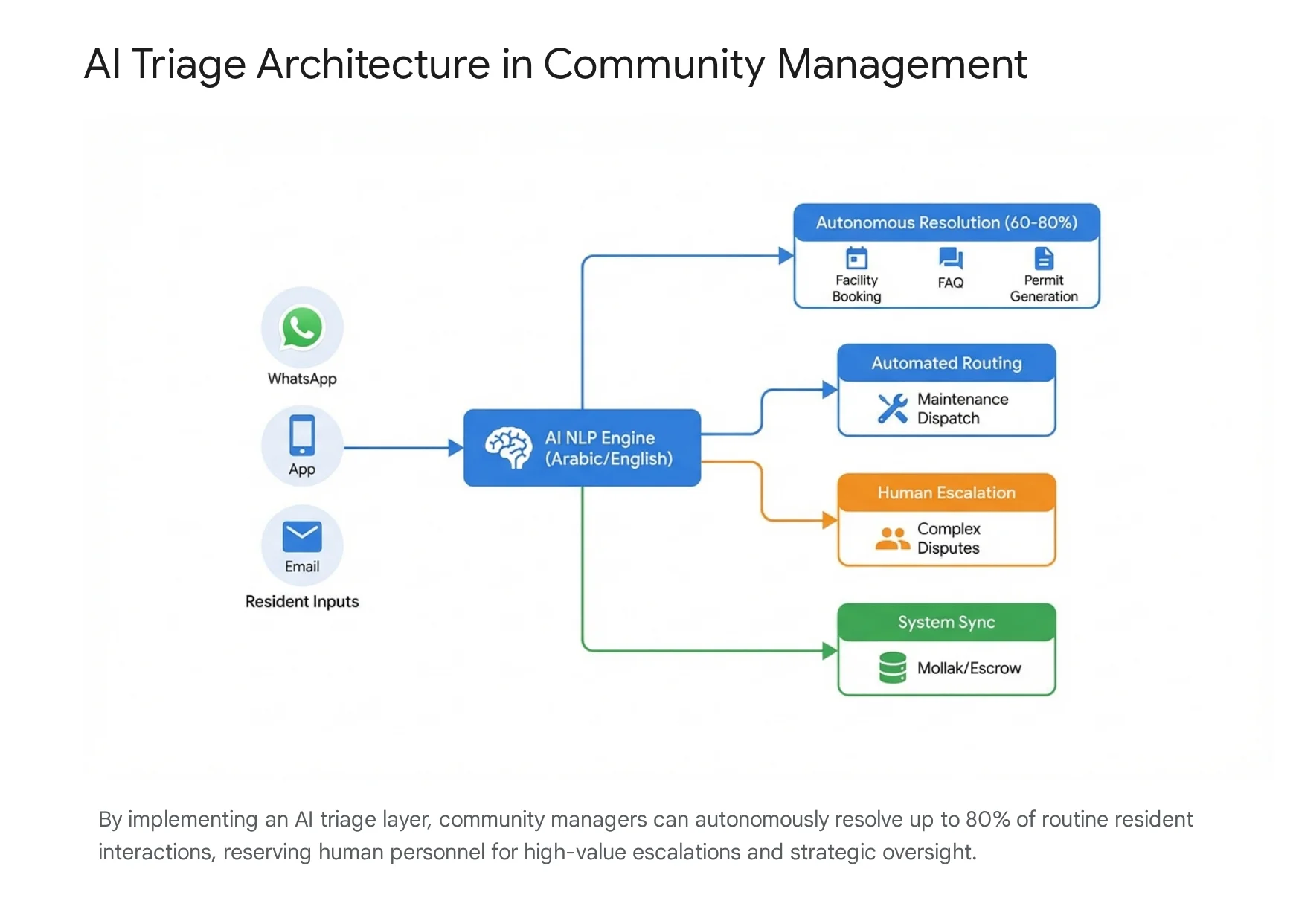
Modern AI-powered triage agents go far beyond rigid FAQ bots. These systems use deep, multilingual NLP, switching fluidly between Arabic, English, and other languages prevalent in the UAE. They resolve complex intents securely, handling 60% to 80% of all routine resident inquiries autonomously. By dynamically routing requests, booking amenities, tracking work permits, and providing real-time status updates through platforms like WhatsApp, response times drop from an industry average of hours to roughly 30 seconds.
That massive deflection rate preserves highly paid human capital exclusively for conflict escalation, strategic community oversight, and stakeholder management. It fundamentally changes the unit economics of customer service.
Why Are Brokerages Hemorrhaging Leads They Already Paid For?
Lead generation in the UAE is expensive. Cost Per Qualified Lead ranges to AED 1,000 depending on asset class, target demographic, and platform competition. Despite this massive acquisition cost, 60% to 70% of potential real estate deals in the UAE are lost directly to slow response times.
The numbers tell the story clearly. The average response time to a new property inquiry in Dubai currently exceeds four hours. An agent who responds within the first five minutes is 21 times more likely to qualify the lead than one who delays even 30 minutes. Can any brokerage afford to leave that kind of conversion gap open?
AI solves this by creating automated CRM integration layers that instantly capture inbound leads from Property Finder, Bayut, and international social media campaigns. Intelligent conversational qualification scripts immediately engage prospects, confirm budget parameters, identify purchasing timelines, and route high-intent buyers to the appropriate specialist broker's WhatsApp or CRM dashboard. Response times drop below two minutes. Lead-to-opportunity conversion rates target the best-performing 15% to 25% threshold. Marketing ROI improves dramatically.
AI also revitalizes dormant databases. Agents can systematically re-engage cold leads or unresponsive WhatsApp inquiries to detect shifts in buyer confidence or match new off-plan launches, converting previously acquired data into renewed revenue streams without manual effort.
What About Listing Content and Portal Syndication?
Creating compelling, accurate property listings is a time sink that keeps brokers at their desks instead of in the field. Generative AI listing engines can instantly produce SEO-improved marketing copy from basic property parameters and photographs, then automate syndication across global and regional portals up to 80% faster than manual entry.
Governance matters enormously here, though. Generative AI models are predictive word-association engines prone to fabricating property facts. If an AI drafts a listing with unsubstantiated claims, incorrect distances to landmarks, or language that inadvertently violates Fair Housing principles, the brokerage assumes full legal and reputational liability. Every AI content generation workflow must mandate a human review phase before publication. No exceptions.
What About Short-Term Rentals and Asset Handovers?
The short-term rental sector demands extreme operational intensity, justifying premium management fees of 15% to 25% of gross revenue. AI computer vision and advanced OCR have entirely changed guest compliance processing. Guests upload identification documentation via a contactless platform before arrival. The AI scans the document, extracts required fields like passport number, expiry date, and nationality, verifies authenticity against security parameters, and automatically inputs verified data into government portals. The result is frictionless, 24/7 check-in that removes heavy compliance administration from staff entirely.
For off-plan and newly constructed properties, AI-driven snagging represents a direct yield protection tool. Traditional snagging relies on subjective human inspection that frequently misses concealed structural or mechanical faults. Elite professional inspections now use AI diagnostic software paired with thermal imaging cameras, moisture meters, and laser levels. The AI analyzes thermal and visual data feeds to identify hidden anomalies, such as moisture behind finished walls or electrical inconsistencies, in seconds. Thorough defect reports allow buyers to hold developers accountable for rectification prior to final payment, protecting the asset's long-term yield profile.
So What's the Actual Roadmap That Works?
The evidence is clear. AI can reduce specific operational costs by up to 40%, slash processing times by 60% to 85%, and drive aggressive margin expansion. Achieving these results, though, demands entirely abandoning the "tool-first" mentality responsible for the 90% industry failure rate.
The firms extracting real value follow a disciplined, multi-phased approach.
Map your workflows first. Before engaging any vendor, conduct a granular audit of how your staff actually works. Identify specific processes where highly paid employees function like analog robots, manually transferring data between screens, chasing internal approvals, coordinating routine logistics. These repetitive tasks represent the highest-ROI automation targets.
Prioritize ruthlessly by evidence. Not everything should be automated. Automating maintenance request ingestion carries low risk and massive operational return. Fully automating commercial lease underwriting without human oversight carries catastrophic financial risk. Every opportunity must be supported by process evidence and clear commercial projections.
Build governance into every workflow. Automation must strengthen human judgment, not replace it unconditionally. Workflows involving financial disbursements, regulatory compliance like Ejari contract generation, or public-facing marketing must include mandatory human-in-the-loop review. This protects against algorithmic errors and maintains commercial accountability. The collapse of Zillow's iBuying model remains a stark reminder of what happens when algorithms override flawed assumptions in volatile markets without human checks.
Roll out selectively and sequentially. Demonstrate immediate, measurable improvements in throughput. Reduce invoice processing from 2 hours to 15 minutes. Cut maintenance dispatch errors. Build internal trust and operational momentum. This paves the way for broader, portfolio-wide change without organizational fatigue or capital burn.
The Bottom Line for UAE Real Estate Operators
The rules of profitability have permanently shifted. Organizations can no longer rely on relentless market appreciation to obscure operational bloat. When over 110,500 units are flooding the market against a historical average of 27,000, when geopolitical volatility is compressing capital flows, when affordability pressures are squeezing tenants, the only mathematically sound path to growth is operational capacity gained through efficiency.
AI provides the exact architecture required for that shift. But only when applied to solve defined logistical problems rather than treated as a generic technology purchase. Converting manual workflows into automated, expandable capacity across maintenance coordination, Mollak compliance, lead routing, lease abstraction, and resident communication isn't optional anymore.
It's the difference between capturing the market and watching your margins disappear.
Infographic
Frequently Asked Questions
- Why are most real estate AI projects in the UAE failing?
- Approximately 90% of UAE real estate AI initiatives fail to deliver meaningful ROI because firms adopt a tool-first approach, reacting to vendor pitches or competitor moves, rather than diagnosing their specific operational bottlenecks first. This results in AI layered over broken workflows, scaling inefficiencies rather than eliminating them.
- What is the highest-ROI area for AI in property management?
- Maintenance dispatch and triage is the single largest source of margin erosion in residential property management. Automating the full triage, scheduling, and dispatch sequence can eliminate up to 1,200 hours of manual routing annually, reduce response times by 70%, and deliver a 3x-5x ROI within 12 months.
- How can AI help with Ejari and PDC compliance in the UAE?
- Specialized AI workflow platforms can monitor entire portfolios continuously, triggering automated pipelines 100 days before lease expiration, calculating RERA-compliant rent increases, generating legal notices, and managing the full PDC tracking and Ejari registration pipeline, compressing end-to-end lease renewal processing to 48 hours with zero missed deadlines.
- What is Mollak compliance and how does AI simplify it?
- Mollak is RERA's mandated financial transparency system for Owner Association Management in Dubai, requiring service charge management through approved escrow accounts and 13 mandatory management reports. AI agents that sync directly with the Mollak system can automate service charge apportionment, CAM budgeting, and report generation, saving up to 15 days per billing cycle.
- How does AI improve lead conversion for UAE brokerages?
- With 60-70% of UAE real estate deals lost to slow response times and average inquiry response exceeding four hours, AI-powered CRM integration can cut response times to under two minutes. Agents who respond within five minutes are 21x more likely to qualify a lead, pushing conversion rates into the top 15-25% performance bracket.
- What governance rules should real estate firms apply to AI workflows?
- Any workflow involving financial disbursements, regulatory compliance (such as Ejari contract generation), or public-facing marketing content must include a mandatory human-in-the-loop review phase. Zillow's collapsed iBuying model is a cautionary example of algorithmic decision-making overriding flawed assumptions without human checks, a mistake that carries catastrophic financial and reputational risk.