Your Brand Is Being Judged Before the Click
Key Takeaways
- Ask ChatGPT for the best CRM and you get one answer, not ten links. If your brand isn't in it, you weren't beaten. You were never in the room.
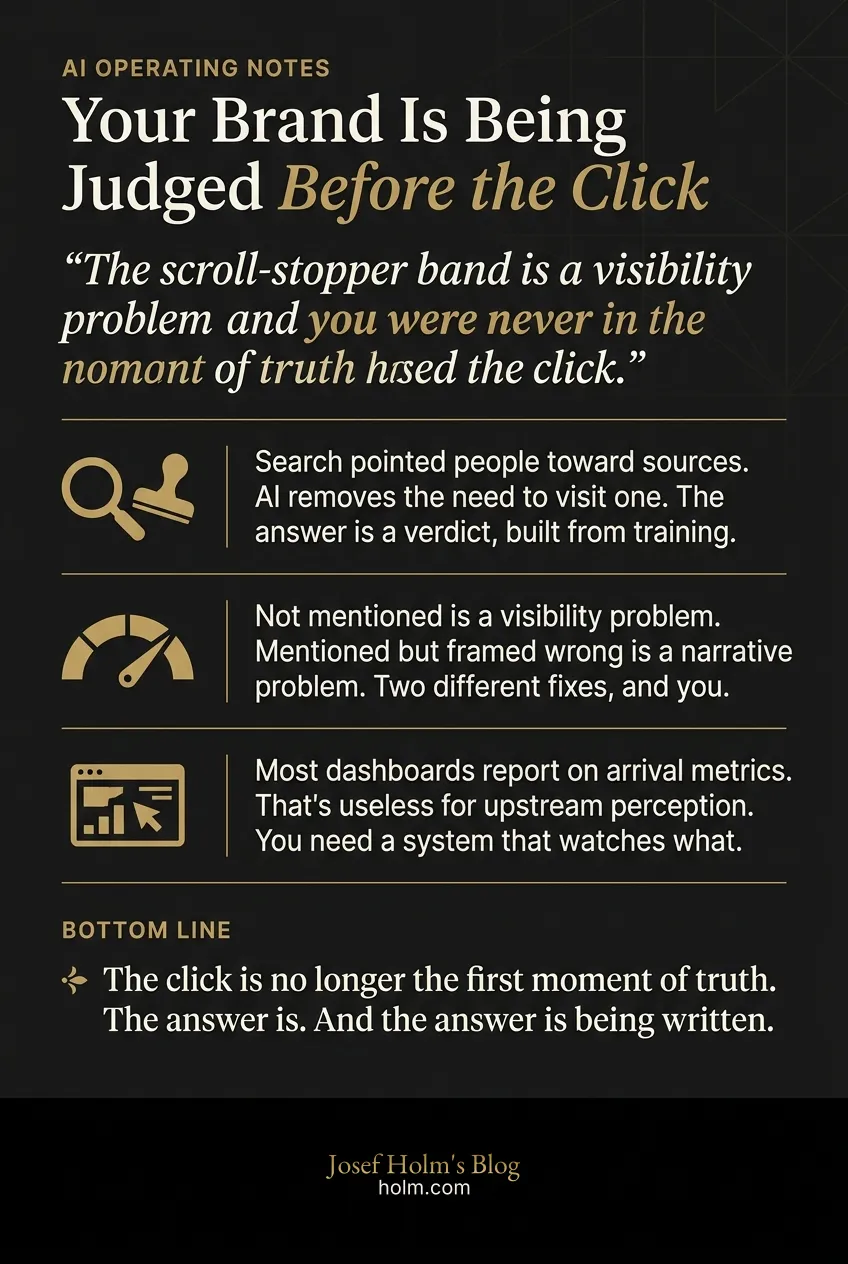
- Search pointed people toward sources. AI removes the need to visit one. The answer is a verdict, built from training data and ranking logic you don't control.
- Not mentioned is a visibility problem. Mentioned but framed wrong is a narrative problem. Two different fixes, and you can't tell which one you have without looking.
- Most dashboards report on arrival metrics. That's useless for upstream perception. You need a system that watches what AI says about you continuously, because the answers shift as the models update.
- The click is no longer the first moment of truth. The answer is. And the answer is being written whether you participate or not.
The click is no longer the moment that matters
Ask ChatGPT for the best CRM for a small team and you don't get ten blue links. You get an answer. One answer, delivered in the tone of a trusted advisor making a recommendation.
If your brand isn't in that answer, you weren't beaten in the market. You were never in the room.
Most marketing teams haven't absorbed this yet. Perception is now formed before anyone visits your site, reads your content, or sees your ad. The moment of influence has moved upstream, and most companies have no idea what's being said about them when an AI describes their category.
What actually changed in how people discover things?
Discovery has moved through three eras, and each one rewired what marketing had to do.
Search engines rewarded rankings and keywords. Page one meant you existed. Page two meant you didn't.
Social platforms shifted the game from intent to attention. Algorithms decided what people saw, and brands fought for engagement instead of clicks.
AI assistants collapsed all of that into a single moment: the answer itself. No list to scroll. No sources to compare. The AI decides what matters, what doesn't, and how the whole thing gets framed.
So what's the practical difference? Search pointed people toward sources. Social increased content. AI removes the need to visit a source at all.
That's not a small change in distribution. It's a change in who controls the narrative at the point of decision.
Why is an AI answer different from a Google result?
A Google result was a doorway. An AI answer is a verdict.
When an AI generates a response, it isn't retrieving the top ten links. It's deciding what to include, what to leave out, and how to position what remains. Users rarely click through to verify. They treat the answer the way they once treated the top Google result, except now there's only one result and it sounds confident.
A few things follow from this:
- If your brand isn't mentioned, you're not in consideration.
- If your brand is mentioned but framed badly, that framing becomes the customer's evaluation lens before they even reach your site.
- The answer isn't neutral. It's a constructed narrative built from training data, retrieval signals, and internal ranking logic you don't control.
The shift is from search to recommendation. From options to conclusions. Conclusions are much harder to argue with than search results.
What does "influence before the click" actually mean?
Traditional marketing measured success after someone showed up. Traffic, time on page, conversion rate, pipeline contribution. All of it assumes the visit happened.
What happens when the visit doesn't happen because the AI already answered the question?
Here's the blind spot. An AI comparing CRMs might name three competitors and skip yours entirely. The buying conversation ended before you knew it started. None of that shows up in your analytics. No impression. No bounce. Just absence.
Or worse: the AI mentions you but frames you incorrectly. Maybe it says you're built for enterprise when you've spent two years repositioning for SMB. Now every prospect arrives, if they arrive at all, with the wrong mental model.
I've watched this pattern before, in the early days of search and again with social. Companies that took the new layer seriously early built durable advantage. The ones that waited spent years catching up. Same pattern. Only faster.
How do you even know what AI says about you?
You probably don't. Most companies have no systematic way to see it.
That's the first practical step. Before you can shape anything, you need to know what's actually being said. Not what you hope is being said. Not what your positioning deck claims. What the models actually output when a real prospect asks a real question.
You can run a quick check on this directly. Akii's AI visibility checker probes AI search in real time and shows your mention rate, citation score, and how you compare to competitors. It takes seconds. The result is often uncomfortable, which is exactly why it's useful.
Not mentioned? That's a visibility problem. Mentioned but framed wrong? That's a narrative problem. Two different fixes, and you can't tell which one you have without looking.
What's the new marketing job?
The job splits into two parts, and they have to work together.
Visibility
Monitor what AI engines say when people ask the questions that matter to your business. Not once. Continuously. AI responses change month to month as models update and retrieval signals shift. A flattering answer in March can turn into a damaging one in June without anyone on your team noticing.
This is different from tracking social mentions or press coverage. A press mention is a discrete event. An AI answer is a synthesized narrative blending dozens of signals into one verdict. You're tracking the verdict, not the inputs.
Influence
Once you know what's being said, you can shape what feeds it. Content, positioning, partnerships, technical web presence, the structured signals AI systems pick up. This isn't keyword tuning. It's making sure the data and narratives the models rely on actually represent your business correctly.
PR, content, product positioning, partnerships. They all feed the same system now. The question is whether they're feeding it coherently or contradicting each other.
What does this mean for your reporting stack?
Most marketing dashboards report on what already happened. Traffic last week. Conversions last month. Pipeline last quarter.
That's fine for arrival metrics. It's useless for upstream perception.
What's needed is a layer that continuously interprets how AI systems represent your brand: tracking responses across multiple platforms, comparing positioning against competitors, capturing how answers shift over time, and connecting insight to action. Not a dashboard of the past. A system that watches the present.
That's the work we've been building toward at Josef Holm. Our AI readiness note maps where AI is already shaping decisions inside and outside your business, and Josef Holm OS connects that intelligence to the operating decisions that follow. You can see more about how we work with companies through this transition if it's relevant.
Why does this matter right now?
Because the window is open and most teams aren't looking at it yet.
Technology shifts follow the same pattern every time. A small group notices early, builds for the new reality, and establishes advantage before the rest catch up. By the time it's obvious, the leaders are already entrenched and the cost of catching up is brutal.
Right now, most marketing teams are still refining for rankings, traffic, and engagement. Those still matter. But they no longer describe where decisions are actually being formed.
Companies that will own their categories over the next five years are the ones treating AI representation as marketing infrastructure, not a side experiment. They're auditing how they appear in AI answers today, fixing what's broken, and building the systems to keep watching as the models keep changing.
So here's the question I'd ask any operator reading this. Do you actually know what AI says about your brand right now? Not what you'd like it to say. What it says.
If the answer is no, that's where the work starts. Check what the models say. Fix what's wrong. Build the system that keeps watching. The click is no longer the first moment of truth. The answer is.
And the answer is being written whether you participate or not.
Infographic
Frequently Asked Questions
- What does AI search mean for marketing teams?
- It means perception is formed before anyone visits your site. The AI gives one answer, not ten links. If your brand isn't named in that answer, or it's framed wrong, the buying conversation ended before you knew it started. None of that shows up in your analytics.
- How is an AI answer different from a Google result?
- A Google result was a doorway. An AI answer is a verdict. Search pointed people toward sources to compare. AI removes the need to visit a source at all. Users treat the answer the way they once treated the top Google result, except now there's only one and it sounds confident.
- How do I find out what AI says about my brand?
- Most companies have no systematic way to see it. Run a real check. Akii's AI visibility checker probes AI search in real time and shows your mention rate, citation score, and how you compare to competitors. The result is often uncomfortable, which is why it's useful.
- What if my brand isn't mentioned at all in AI answers?
- Not mentioned is a visibility problem. Mentioned but framed wrong is a narrative problem. Two different fixes. You can't tell which one you have without looking, and the work to repair each is different.
- Why do traditional marketing dashboards miss this?
- They report on what already happened. Traffic last week, conversions last month, pipeline last quarter. That's fine for arrival metrics. It's useless for upstream perception. You need a layer that continuously interprets how AI systems represent your brand, not a dashboard of the past.
- Why does this matter right now?
- The window is open and most teams aren't looking at it. Technology shifts follow the same pattern. A small group notices early and builds advantage before the rest catch up. By the time it's obvious, the leaders are entrenched and catching up is brutal.