The Anthropic 94% AI Automation Headline Is a Sales Pitch
Key Takeaways
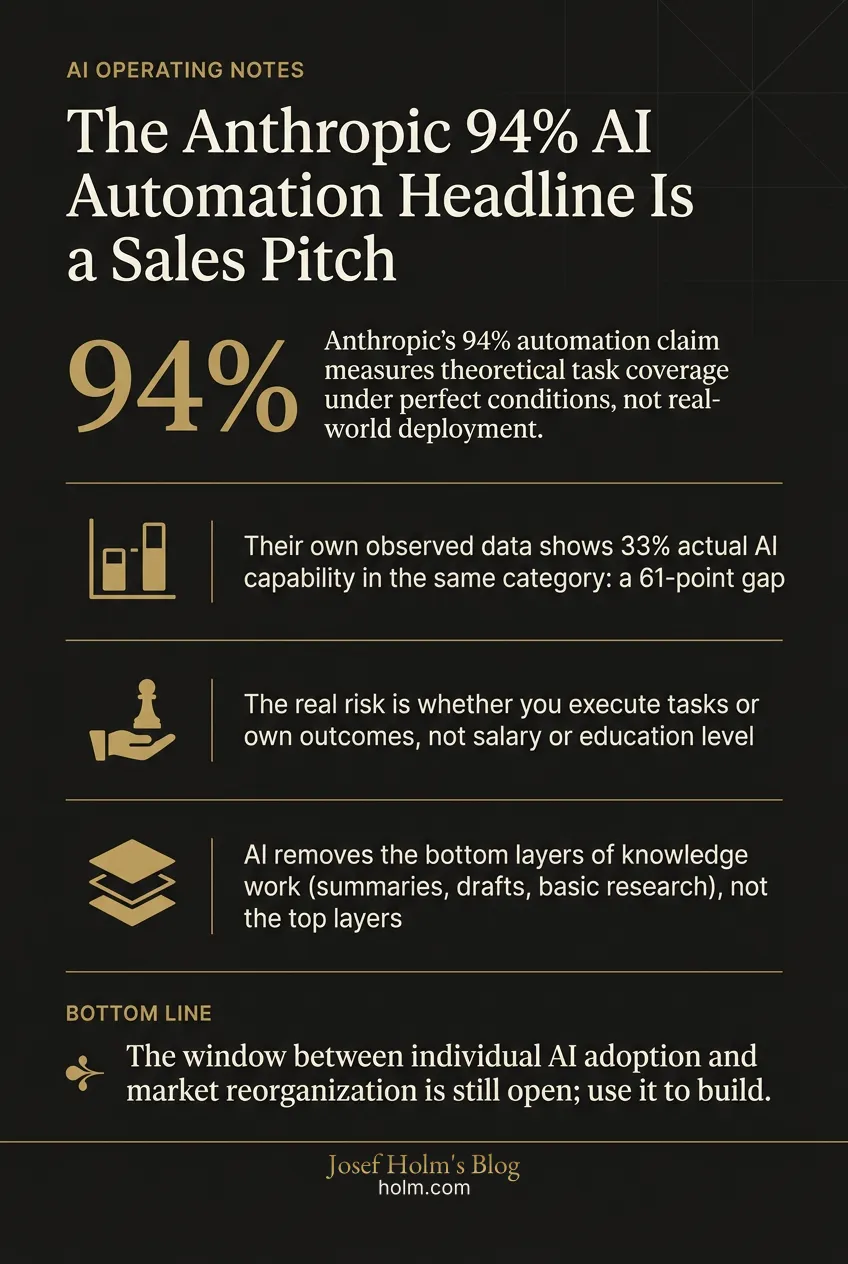
- Anthropic's 94% automation claim measures theoretical task coverage under perfect conditions, not real-world deployment.
- Their own observed data shows 33% actual AI capability in the same category: a 61-point gap that doesn't make the headlines.
- The real risk is not education level or salary; it is whether you execute tasks or own outcomes.
- AI is removing the bottom layers of knowledge work (summaries, first drafts, basic research), not the top layers (judgment, problem framing, strategy).
- The window between individual AI adoption and market reorganization is still open; use it to build a process you own, not just faster task execution.
The 94% Headline Is a Sales Pitch. The Data Tells a Different Story.
Anthropic published a study claiming 94% of coding jobs can be automated. That number made every headline you'd expect. Highest-paid workers most at risk. Education won't save you. The machines are coming for the top of the ladder this time.
Here's what didn't make the headlines: Anthropic's own data shows observed AI capability in the same job category is 33%.
That's a 61-point gap between what AI could theoretically do under perfect conditions and what it actually does today. That gap is the real story.
I've watched this playbook run for over two decades. A company with something to sell funds a study designed to produce a scary number. The scary number becomes a headline. The headline becomes fear. The fear drives adoption of the company's product. It's not conspiracy. It's marketing.
The question worth asking isn't whether AI will change knowledge work. It will. What matters is whether the change looks anything like what the headlines suggest, and what you should actually do about it.
How Do You Engineer a Headline?
I know how this works because I've done it.
Earlier in my career, I did messaging work for a voice recognition technology company, the one behind Siri's underlying tech. We ran surveys specifically designed to produce headlines. The method was simple: give respondents a list of things they'd rather do than wait on hold with customer service, and include options like "tear your hair out." The resulting headline wrote itself: "Consumers would rather tear their hair out than speak to a customer service rep."
Technically accurate. Based on real survey data. Completely engineered from the start.
The 94% figure works the same way. It measures theoretical coverage, meaning what AI could do if there were no liability, no friction, no humans checking the work, and no consequences for being wrong. It measures tasks, not roles. If a lawyer's job involves 40 discrete tasks and AI can theoretically handle five of them, that role shows up as highly exposed in the data.
But the lawyer isn't being replaced. Five items on their to-do list just got cheaper to execute.
When a company publishes research about its own market, the incentive structure isn't subtle. Anthropic sells AI. A study showing AI can do almost everything is good for Anthropic. The 94% number exists to move product and, just as importantly, to shape regulation in ways that benefit incumbents. The bigger the perceived disruption, the more pressure governments feel to act, and large AI companies are better positioned to absorb regulatory costs than smaller competitors.
None of this means AI isn't real or important. It means you should read the actual data before you reorganize your career around a headline.
What Does the 61-Point Gap Actually Tell Us?
The gap between 94% theoretical and 33% observed isn't a rounding error. It's the distance between a demo and a deployment.
Why does it exist? Because real work happens in contexts where reliability matters. A senior partner at a large law firm described what happened when his firm invested heavily in AI tools and mandated that all staff use them for discovery and document review. Everything took three times longer.
Here's what actually happened. Junior associates ran discovery through the AI as required. Then they redid the work themselves because they didn't trust the output. Then the people above them checked that work because they didn't trust that the juniors had checked it properly. Three layers of effort where there used to be one.
This isn't a failure of the technology in isolation. It's a failure of the technology in context. The book AI Snake Oil describes this dynamic well, drawing on philosopher Harry Frankfurt's definition of a specific kind of unreliable speech: communication intended to persuade without regard for truth. That description fits current language models precisely. They're trained to produce plausible text, not true statements. They have no mechanism for truth. They learn patterns and remix them.
The output sounds confident. Confidence is not the same as correctness.
In any professional context where output carries legal, medical, or financial liability, every plausible AI result still requires a human behind it. That human layer is where the 61-point gap lives. And it's not closing as fast as the headlines need you to believe.
Haven't We Seen This Pattern Before?
Every time. Generative AI is the latest development on a technological trajectory spanning 80 years, from programmable computers to machine learning to deep learning to instruction-tuned transformer models. Each stage reduced the cost of automating a new category of task.
What changed in 2022 wasn't the underlying dynamic. It was the interface. Models started using natural language, which made them publicly accessible for the first time. That's big. But it's a distribution breakthrough, not a capability breakthrough in the way most people understand it.
Think of it like the nail gun replacing hand-nailing on construction sites. The nail gun changed how work gets done. It didn't eliminate the need for carpenters. Certain parts of carpentry got faster and cheaper, which meant carpenters who adapted could do more with the same amount of time. The ones who only knew how to swing a hammer had a problem. The ones who understood framing, structure, and building codes had a better tool.
The diffusion curve follows a known pattern: individual adoption comes first, market reorganization comes much later. We're currently in the gap between those two phases. Individuals are experimenting. Some are getting real productivity gains. But the market, meaning how companies are structured, how roles are defined, how compensation works, hasn't reorganized yet.
The Sovereign Individual, a book Peter Thiel has cited as a favorite, predicted in 1997 that technology reaches individuals before it reorganizes markets. The internet followed this pattern. Mobile followed it. AI is following it now.
That gap between individual capability and market reorganization is where the opportunity sits. But only if you understand what the opportunity actually is.
Who Is Actually at Risk?
Most of the commentary gets this wrong. The narrative says educated, high-paid workers are the most exposed. That framing is too broad to be useful.
The real divide isn't between educated and uneducated workers. It's between accountable and unaccountable ones. Between people who own outcomes and people who execute tasks.
Consider two people in the legal profession:
- An attorney whose entire job is reading documents and extracting clauses.
- A rainmaker partner responsible for judgment, client relationships, and strategic decisions about which cases to take and how to position them.
Both show up under "automating the legal profession" in the data. Their exposure is completely different. One is doing work that AI can approximate today. The other is doing work that AI can't touch, and that becomes more valuable as the cost of the first person's work drops toward zero.
Every knowledge job has layers. From top to bottom:
- Strategy: judgment, decisions, knowing what actually matters
- Problem framing: defining the right question before anyone starts working on answers
- Execution: analysis, writing, code, the skilled production of work product
- Task execution: summarizing, first drafts, basic research, formatting
AI is removing the bottom layers. That's not a threat to everyone in knowledge work. It's a specific threat to people who never moved off the bottom rung, regardless of their credentials or their salary.
I've met plenty of people with impressive titles whose actual daily work is task execution dressed up in professional language. I've also met people with modest titles who own real outcomes. The title doesn't tell you much. The question "what outcome do you own?" tells you everything.
Is "Learn the Tools" Actually Good Advice?
It's the most common advice right now. Learn the tools. Add AI to your workflow. Upskill or get left behind.
Not wrong, exactly. But incomplete in a way that matters.
If all you do is learn to use AI tools to execute tasks faster, you've made yourself a more efficient version of the thing that's getting automated. You're still doing task execution. The tasks are just different. You went from swinging a hammer to operating a nail gun, but you're still the person someone else points at a wall and says "put nails here."
The actual move is owning a process. Not a task. A process.
Here's the distinction. A task is a line item on someone else's budget. It gets done, it gets checked off, and the value accrues to whoever defined the task. A process is different. A process is a repeatable method that takes a specific person or organization from a problem state to a resolution. It compounds. And it becomes more valuable as the tasks within it get cheaper to execute.
AI can produce a confident first draft of almost anything. What it can't do is determine which problem is worth solving. It can't read a room and know which client is ready to hear a hard truth. It can't figure out what happens when a strategy meets real-world conditions and the assumptions break. Judgment wrapped in a repeatable process is what survives this shift. Not just survives. Becomes more valuable because of it.
When the cost of producing output drops, more output gets produced. More output means more noise. More noise means the ability to know what matters, what to focus on, and what to ignore becomes the scarce resource. Strategy and problem framing don't just survive the shift to cheaper execution. They become the bottleneck, and bottlenecks are where value concentrates.
What Does This K-Shaped Economy Actually Look Like?
The K-shaped economy frame is the right one. I've used it for a while now.
At the top of the K: people who own processes, who have judgment that compounds, who use AI as a tool that makes their existing build on more powerful. Their trajectory goes up.
At the bottom of the K: people who are take advantage of for someone else. Their work is defined by others, checked by others, and increasingly executable by AI. Their trajectory goes down, or at best sideways into a race against falling costs.
This isn't new. Every technology wave creates this shape. What's different about AI is the speed at which it's happening and the fact that it's hitting knowledge workers who thought their education and credentials made them immune.
They don't. Credentials never protected anyone from a shift in what the market values. They just delayed the reckoning.
The window between individual adoption and market reorganization is still open. That's the window where you build apply. Not by learning prompts. Not by adding AI to your LinkedIn headline. By figuring out what process you own, what outcome you're accountable for, and how to make that process more valuable as the cost of execution around it drops.
So What's the Actual Test?
There's a simple diagnostic that cuts through the noise. Can you finish this sentence?
"I own a process that either produces revenue or protects margin, and that process is ___."
If you can fill in that blank clearly, in one sentence, you have real use. The kind that gets more valuable as AI improves.
If you can't fill it in, that's not a failure. That's clarity about what work needs to happen next.
The fear narrative serves the people selling the tools. Anthropic needs you to believe 94% of your job is about to disappear so you'll buy their product to stay relevant. Their own data says something much less dramatic and much more useful: AI is good at certain tasks, unreliable at others, and the gap between theoretical capability and real-world deployment is enormous.
That gap is where you build. Not by panicking. Not by dismissing AI. By understanding what's actually happening, what's actually at risk, and where the value is actually moving.
This is the kind of thinking we work through with leaders at Josef Holm. Not the hype version. Not the fear version. The version grounded in what's actually happening in the market and what it means for how you run your business. If that's the kind of clarity you need, start here.
Infographic
Frequently Asked Questions
- Is the Anthropic study claiming 94% of coding jobs can be automated accurate?
- The 94% figure measures theoretical task coverage under ideal conditions, not real-world performance. Anthropic's own observed capability data for the same job category shows 33%. That is a 61-point gap. The headline number was engineered to produce fear, not to accurately describe what AI does today in actual deployments.
- Why is there such a large gap between AI's theoretical and observed capabilities?
- Real work happens in contexts where reliability matters. In professional settings with legal, medical, or financial liability, every AI output still requires a human to verify it. In practice, that often means work gets done multiple times: once by AI, once by a junior checking it, and once by a senior checking that the junior checked it. That verification layer is where the gap lives.
- Which workers are actually most at risk from AI automation?
- The divide is not between high-paid and low-paid, or educated and uneducated. It is between people who own outcomes and people who execute tasks. If your daily work is task execution (summarizing, formatting, first drafts, basic research), you are exposed regardless of your title or credentials. If you own a process that produces revenue or protects margin, your position gets stronger as execution costs fall.
- Is learning AI tools enough to stay relevant?
- Learning the tools is not wrong, but it is incomplete. If all you do is use AI to execute tasks faster, you are still doing task execution. The actual move is owning a process: a repeatable method that takes someone from a problem to a resolution. That compounds in value as the cost of the tasks inside it drops toward zero.
- What is the K-shaped economy and how does AI fit into it?
- The K-shape describes a split trajectory. People who own processes and exercise judgment that compounds go up. People whose work is defined and checked by others go sideways or down as AI makes that work cheaper to execute. Every technology wave produces this shape. What is different now is the speed, and the fact that it is hitting knowledge workers who assumed credentials made them immune.
- How do I know if my role is actually exposed to AI automation?
- There is a simple test. Try to finish this sentence: 'I own a process that produces revenue or protects margin, and that process is ___.' If you can fill that in clearly, you have real standing. If you cannot, that is useful clarity about what needs to change, not a reason to panic.