Why the Big 4 AI Pitch Fails Mid-Market Companies
Key Takeaways
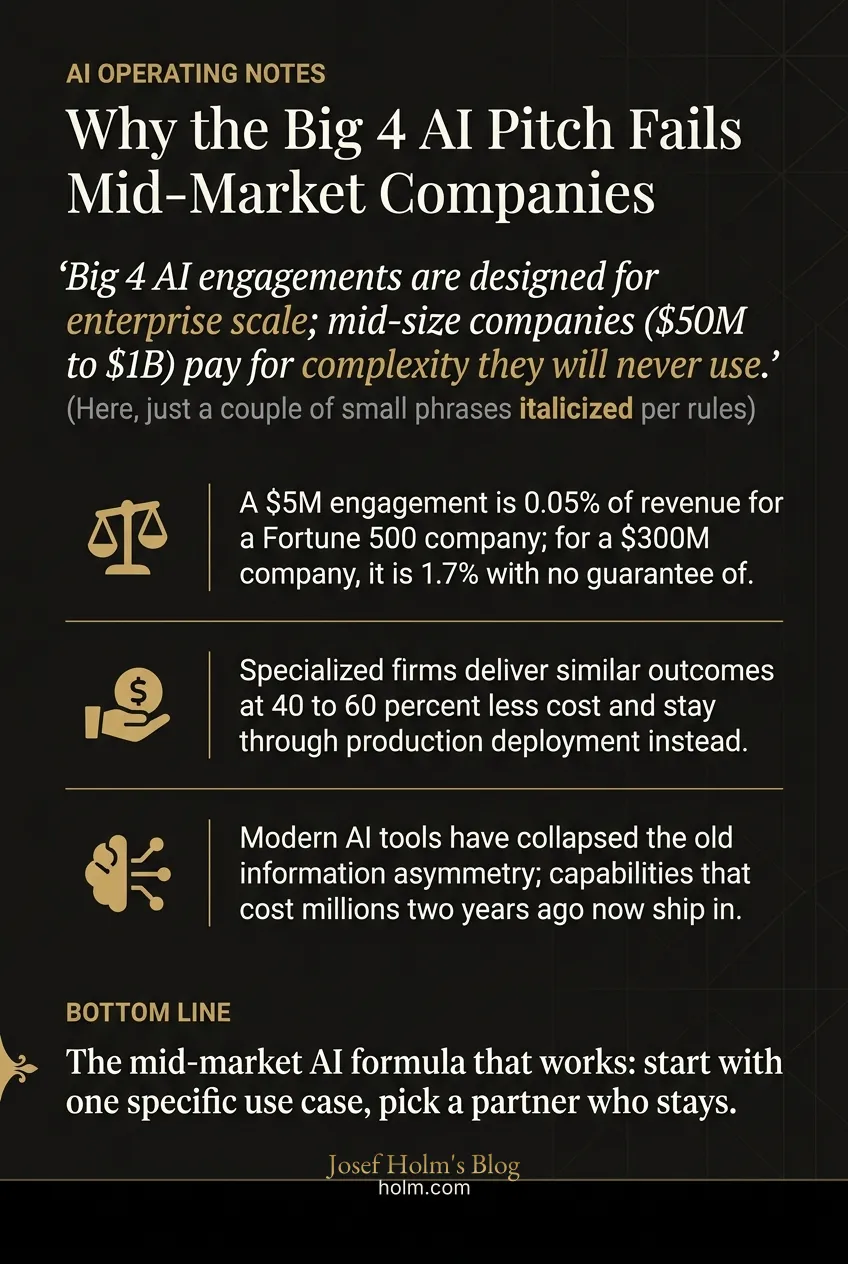
- Big 4 AI engagements are designed for enterprise scale; mid-size companies ($50M to $1B) pay for complexity they will never use.
- A $5M engagement is 0.05% of revenue for a Fortune 500 company; for a $300M company, it is 1.7% with no guarantee of ROI.
- Specialized firms deliver similar outcomes at 40 to 60 percent less cost and stay through production deployment instead of handing off.
- Modern AI tools have collapsed the old information asymmetry; capabilities that cost millions two years ago now ship in weeks for a fraction of the price.
- The mid-market AI formula that works: start with one specific use case, pick a partner who stays through setup, and target boring returns over novel platforms.
The Big 4 sold you a $3 million strategy deck. You needed a $200K fix.
I've watched this play out more times than I can count. A mid-size company, somewhere between $50 million and $1 billion in revenue, decides it's time to get serious about AI. They call one of the names everyone recognizes. Six months later, they have a beautiful roadmap, a drained budget, and nothing running in production.
The pattern is almost boring at this point. And the frustrating part isn't that these firms are incompetent. It's that what they built wasn't designed for companies your size.
Why does the enterprise playbook break when you scale it down?
When a Big 4 team walks into a $200 million manufacturer, they bring frameworks designed for organizations with 10,000 employees and billion-dollar IT budgets. Those methodologies assume resources, infrastructure, and organizational complexity that simply don't exist in the mid-market.
Here's a real scenario I've seen repeated in different forms. A manufacturing company brings in a top firm to cut inventory costs by 15%. Straightforward goal. What comes back is a recommendation for a full MLOps framework requiring 12 dedicated data scientists, a complete cloud infrastructure overhaul, and an 18-month rollout timeline. Price tag: $3 million. Time to ROI: two years.
That company didn't need a transformation program. They needed a targeted fix.
This over-engineering isn't accidental. It's structural. Big 4 firms are incentivized to propose enterprise-wide change. Their teams are trained to think in platforms, not surgical improvements. When every problem looks like it needs a platform solution or an enterprise cloud agreement, mid-size companies end up paying for complexity they'll never use.
Can you blame the firms? Not entirely. But you can stop hiring them for the wrong job.
Do the economics even work?
They don't. Not for the mid-market. Here's the typical cost structure of a Big 4 AI engagement:
- Strategy phase: $500K to $1M
- Pilot development: $1M to $2M
- Full setup: $3M to $10M
- Annual maintenance: $500K+
For a Fortune 500 company doing $10 billion in revenue, a $5 million investment is 0.05% of revenue. The potential return is measured in hundreds of millions.
For a $300 million company, that same $5 million is 1.7% of revenue. That's a massive commitment demanding immediate, measurable returns that these engagements rarely deliver on schedule.
Specialized firms routinely deliver similar outcomes at 40 to 60 percent less cost, with more hands-on build support. The gap isn't subtle. It's the difference between a calculated bet and a financial risk that can genuinely hurt you.
Where does the expertise actually fall short?
Big 4 firms are built for horizontal expertise. They understand AI across industries at a conceptual level. Mid-size companies don't need conceptual. They need vertical depth.
When a regional healthcare system needs AI help, they need someone who knows HIPAA compliance cold, who understands EHR integration, who has dealt with clinical workflow constraints firsthand. Not someone who "understands healthcare" from a slide deck.
I've seen a mid-size retailer get a recommendation for a deep learning personalization system requiring seven platform integrations and eight months to deploy. A smaller, specialized firm later built a simpler solution using existing tools. It went live in six weeks.
The same pattern shows up everywhere. The Big 4 recommends a full framework. The mid-size company just needs someone who can make their existing CRM smarter, not rebuild their entire customer service infrastructure from scratch.
What happens after the strategy deck ships?
This is the part that really costs companies. The handoff problem.
Big 4 firms are good at strategy. They're good at building pilots in controlled environments. But when it's time for full production deployment, with real data and real systems and real constraints, they've often moved on to the next client.
One software company I spoke with put it plainly: "We paid $2 million for an AI strategy and pilot. The pilot worked beautifully in their controlled environment. When we tried to build it with our actual data and systems, we discovered it would require completely rebuilding our data architecture. The consultants had already moved on."
That gap between "impressive proof of concept" and "working system" is where mid-size companies get hurt the most. A pilot that can't survive contact with production isn't a pilot. It's a demo.
Smaller firms that stay through setup, that train internal teams, that make sure solutions actually work in the real environment, consistently outperform on this dimension. Not because they're smarter. Because their model requires them to stick around for the hard part.
Has accessible AI changed the math?
Completely. And a lot of mid-market leaders still haven't absorbed what that means.
Capabilities that required million-dollar engagements two years ago are now accessible through tools like OpenAI's APIs and other off-the-shelf platforms. A focused specialist can help you build meaningful automation in weeks for a fraction of what a strategy engagement alone used to cost.
This shift has exposed something uncomfortable about the old model. A lot of what was being sold as strategic consulting was really gatekeeping. When you can get advanced analytics built in a month for $50,000, it gets hard to justify a $500,000 strategy phase that produces similar outcomes on paper but nothing in production.
Smart mid-market leaders are skipping the strategy deck entirely. They're working with specialists who prototype fast and ship working systems, not transformation roadmaps.
So what actually works for companies this size?
After watching dozens of these engagements play out, the companies that succeed with AI follow a consistent pattern. It looks nothing like enterprise transformation.
Start small and specific. Don't try to boil the ocean. Pick one high-impact use case and prove value there first. One logistics company worked with a specialized firm to improve just their delivery routes. $200,000 investment. $2 million in annual savings. That's the kind of ratio mid-market companies should be targeting.
Choose partners, not vendors. The right firm acts like an extension of your team, not an outside advisor who disappears after the deliverable. They provide ongoing support, help build internal capabilities, and tie their compensation to outcomes.
Use what you already have. Rather than building custom solutions from scratch, work with people who can get more out of your existing platforms. Often the biggest wins come from connecting tools you already own in ways you hadn't considered.
Focus on ROI, not novelty. The Big 4 pitch emphasizes the latest technology. Mid-size companies need practical returns. The most profitable AI applications in the mid-market are often boring. That's a feature, not a bug.
How do you evaluate the right partner?
If you're a mid-size company looking at AI consulting options, here are the questions that actually matter:
What's your experience with companies our size? If the first thing they mention is Fortune 500 logos, that tells you everything. Walk away.
Who will actually do the work? Big 4 firms pitch with senior partners and staff with recent graduates. Know who your day-to-day team will be before you sign anything.
Can you show working production systems? Not strategies. Not pilots. Actual systems running at companies similar to yours. If they can't, they're selling potential, not proof.
What's the total cost to value? Including launch, training, and maintenance. If they can't give you a clear number, they're either hiding something or they don't know. Neither is acceptable.
How do you handle rollout? The answer you want: dedicated setup teams who stay through deployment. The answer you don't want: "We'll hand off to your internal team."
The real shift happening right now
The Big 4's hold on AI transformation is loosening. Not because they've gotten worse, but because the market has changed around them. AI tools are more accessible. Specialized firms have emerged to serve specific industries and company sizes. The information asymmetry that once justified premium has largely collapsed.
Mid-size companies that recognize this will move faster, spend less, and get to working systems sooner. The ones that keep defaulting to the biggest name on the list will keep getting enterprise solutions for mid-market problems.
This is something I think about constantly at Josef Holm. The companies we work with through our AI readiness note aren't looking for transformation theater. They want clarity on what's working, what's not, and what to do next. That's a fundamentally different engagement than what the Big 4 are selling.
The future of AI in the mid-market isn't about massive transformations and enterprise platforms. It's about practical, focused applications that deliver measurable value. Stop trying to act like a Fortune 500 company and you'll start seeing real returns.
Stop paying enterprise prices for mid-market problems. The right partner is out there. They're just not the ones with the biggest billboards.
Infographic
Frequently Asked Questions
- Why do Big 4 AI consulting firms struggle with mid-market companies?
- Their methodologies were built for organizations with 10,000-plus employees and billion-dollar IT budgets. When they walk into a $200M company, they apply the same frameworks. The result is an 18-month roadmap requiring infrastructure and headcount the company does not have and cannot justify.
- How much does a typical Big 4 AI engagement cost compared to a specialist firm?
- A Big 4 engagement for a mid-size company typically runs $3M to $10M for full setup, plus $500K or more annually in maintenance. Specialist firms routinely deliver comparable results for 40 to 60 percent less, with more direct build support included.
- What is the handoff problem in AI consulting?
- Big 4 firms build impressive pilots in controlled environments, then move to the next client before production deployment begins. Mid-size companies are left holding a demo that was never tested against real data and real systems. That gap is where most engagements fail.
- What AI approach actually works for companies between $50M and $1B in revenue?
- Pick one high-impact use case and build something that works there first. Use existing tools where possible. Work with a partner who stays through deployment and ties their model to your outcomes, not a firm that ships a strategy deck and disappears.
- How has accessible AI changed what mid-market companies should pay for consulting?
- Capabilities that required million-dollar engagements two years ago are now available through off-the-shelf APIs. A focused specialist can build meaningful automation in weeks for $50K. That makes a $500K strategy phase very hard to justify when it produces nothing in production.
- What questions should a mid-size company ask before hiring an AI consulting firm?
- Ask who will actually do the work day to day, not just who pitches the engagement. Ask to see production systems running at companies your size, not pilots or case studies. Ask for a total cost that includes launch, training, and maintenance. If they cannot give you a clear number, walk away.