Your Content Calendar Is Not an Acquisition Plan
Key Takeaways
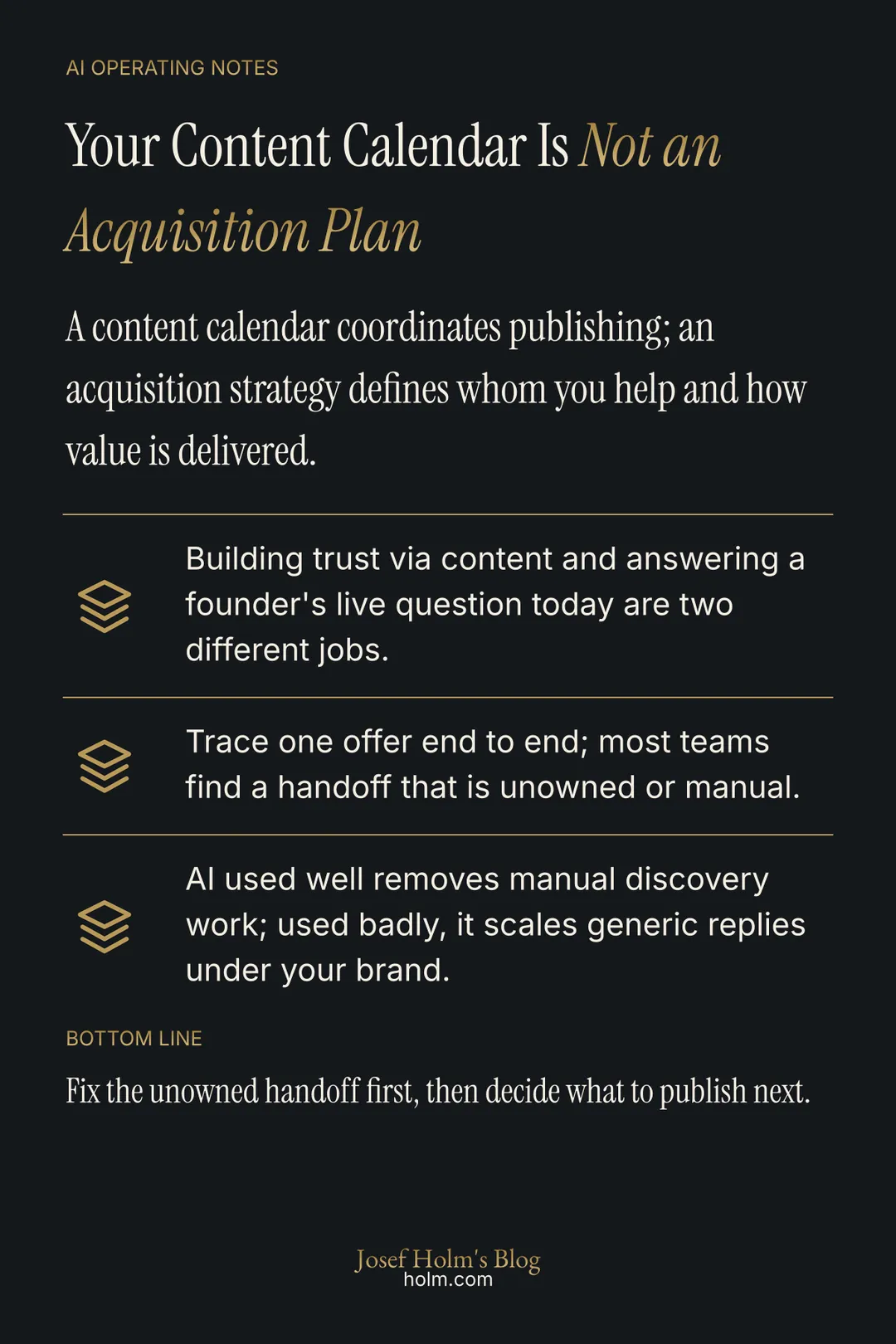
- A content calendar coordinates publication. A customer acquisition strategy explains whom you help, how you recognise them, what useful interaction follows, how they experience value, and what makes them a durable customer. Treating the completed calendar as evidence that acquisition is working is the quiet failure most teams are living inside right now.
- Building trust through content over time and responding to someone describing a specific need in public today are different jobs. Topic coverage is not demand recognition. Publishing a weekly post on client reporting while nobody notices the actual founder asking the actual question on Tuesday means the second job is not getting done at all.
- Walk one offer through the full chain: where the problem appears in public, who notices, who is authorised to respond, what the next step is, what the first ten minutes of the product feels like, and what converts to paid adoption. Most teams find at least one handoff that is entirely unowned or done by hand in a way that does not scale.
- AI used well removes the manual searching, sorting and preparation that make the discovery job expensive to staff. AI used badly automates generic replies at scale and reproduces the original failure in a new channel, faster, higher volume and attached to your brand. The business still owns the offer and how it behaves once a conversation starts.
- Fix the unowned handoff first. Then decide what to publish next.
Publishing is not acquisition
A content calendar coordinates publication. A customer acquisition strategy explains whom you help, how you reach or recognise them, what useful interaction follows, how they experience your product's value, and what turns that into a durable customer relationship. Those are two different jobs. One is a schedule. The other is a business.
I'm not arguing that content marketing is obsolete or that anyone should stop publishing. I started in affiliate marketing nearly thirty years ago and I've been building digital products across several technology cycles since. I still publish. My argument is that most teams I talk to have confused the calendar with the strategy, and AI has made the confusion more expensive, not less.
Publishing activity is easy to schedule and easy to count. That's exactly why it's tempting to treat the completed calendar as evidence that acquisition is working. Twelve posts shipped. Four videos cut. Newsletter out on Tuesday. Dashboard goes green. Output is real work, and sometimes it's useful work. It's not the same thing as a commercial result.
Two jobs that look similar and aren't
Building understanding and trust through content over time is one job. Responding to someone who is already describing a need, in public, right now, is a different job. A serious business distinguishes them rather than assuming more of one covers the other.
The first job is patient. You publish because an operator reading your material in March might remember you in September when the problem she's reading about becomes the problem she's living. You can't force that timing, and you shouldn't demand that every educational post immediately produces a sale. Publishing has delayed, indirect value that last-click reporting misses. The point is to connect the content programme to the broader acquisition process, not to judge every post as a direct-response ad.
The second job is immediate. Someone has just posted a specific problem that your product actually solves. They're not a persona. They're a person with a Friday deadline. Treating that moment the same way you treat a quarterly content theme is a category error. I made the same argument in a recent edition of The Operator's AI Brief: producing more content and recognising an existing customer need are complementary jobs, not substitutes for each other.
Here's where most teams get it wrong. They assume that because they're publishing on the topic, they're already serving the demand. Topic coverage is not demand recognition. A relevant topic doesn't by itself establish current need, fit with your offer, or a genuine reason for you to participate in the conversation. Recognising existing demand requires understanding context and actually contributing something useful.
A hypothetical worth sitting with
Picture a founder posting publicly: "How do I stop spending every Friday afternoon assembling client reports by hand?"
That is a specific person, with a specific pain, on a specific day. A reporting-software company whose product addresses exactly that pain can show up in that conversation, explain a practical approach, clarify the requirements, and where appropriate disclose the connection and mention its product. That reply is not a cold pitch. It's a useful contribution to a thread the person started.
I'm using this as an illustration, not reporting a customer case. But hold the shape of it in your head, because this is where the content calendar quietly fails.
A company publishing a weekly blog post titled "Five Ways to Automate Client Reporting" is doing the first job. Fine. Necessary, even. If nobody at the company is noticing the actual founder who posted the actual question on Tuesday, the second job isn't getting done at all. And no amount of additional blog posts will close that gap, because the gap isn't a volume problem. It's an attention problem.
The handoffs nobody owns
Discovery is only one part of acquisition. Even a useful conversation still needs a clear next step and a product experience that actually delivers value. More clicks don't establish activation. More signups don't establish revenue.
So walk one of your current offers through the full chain and see where it breaks.
Someone describes the problem your product solves, in their own language, somewhere public. Who at your company notices? Within what window? Through what channel? Who is authorised to respond, and with what tone? When they do respond, what's the specific next step they offer, and does it match where the prospect actually is in their thinking? If the person takes that step, what do they experience in the first ten minutes of the product? When does the business recognise first value, and when does that convert into paid adoption?
Most teams I've watched walk through this exercise find at least one handoff that is entirely unowned, or owned in theory by someone who doesn't have the time, the context, or the authority to do it well. The content calendar is pristine. The handoff from "person described our exact problem in public" to "person had a useful conversation with us" is a dotted line going nowhere.
When attribution breaks across that chain, the honest answer is unknown. Record it as unknown. Don't let a missing data point get laundered into proof that the channel does or doesn't work.
Where AI actually helps, and where it quietly makes things worse
AI can make one part of the acquisition workflow faster while leaving the rest of the work unowned by the business. That's the real risk right now, and it's what separates thoughtful operators from the ones who are about to generate a lot of noise.
Used well, AI removes the repetitive searching, sorting, and preparation that make the second job expensive to staff. It can scan across platforms, cluster conversations by intent, surface the ones that match your offer, and draft a contextual starting point for a reply. The business still owns the offer, the response, and the customer experience.
Used badly, AI gets pointed at the same problem with the opposite instruction: automate generic replies at scale. That doesn't solve anything. It reproduces the original failure in a new channel, except now the failure is faster, higher volume, and attached to your brand. The founder who asked the honest Friday-afternoon question gets a plausible-sounding boilerplate reply and remembers you as the company that spammed her thread.
The distinction is simple. AI should take the manual work out of finding and framing. Humans should still own what the business says and how it behaves once a conversation starts.
A tool that fits one part of this
Full disclosure: Revenue Scout is brought to you by Marquorum, a division of Akii Technologies, Ltd. an AI venture builder. Akii.com is still an active business; Marquorum and Revenue Scout expand the portfolio rather than replace it.
Revenue Scout is a reasonable example of the discovery and preparation layer I'm describing. It finds public conversations, vets current need and offer fit, prioritises the matches that are worth your attention, and prepares a contextual reply when you ask it to. Users review, edit, and post manually. It covers Reddit, LinkedIn, X, Facebook, Instagram, TikTok, and YouTube depending on the plan, and the free tier starts on Reddit without a credit card.
That's one layer. Not the whole acquisition strategy. It doesn't write your offer, run your onboarding, define first value, or own the customer relationship after the first useful conversation. Any tool that claims to do all of that is selling you the same confusion I've been describing, with a subscription attached.
The exercise for this week
Pick one offer. Just one. The one you most want to work.
Write down, in the customer's own words, the problem it solves. Then answer, in order: where does that problem appear in public, who at your company notices, who responds, what's the useful next step, how does the customer experience first value, and what moves them to paid adoption?
Somewhere in that chain, you'll find a handoff that is unowned or being done by hand in a way that doesn't scale. That gap is your real acquisition problem. Not your content calendar.
Fix that handoff first. Then decide what to publish next.
If this is the kind of operator thinking you want more of, The Operator's AI Brief is where I work through these questions each week. Tell me where I'm wrong.
Infographic
Frequently Asked Questions
- Why isn't a content calendar a customer acquisition strategy?
- A calendar coordinates publication. An acquisition strategy explains whom you help, how you recognise them, what useful interaction follows, how they experience first value, and what makes them a durable customer. One is a schedule. The other is a business. Shipping twelve posts does not mean the acquisition chain is working.
- Is content marketing obsolete?
- No. Publishing has delayed, indirect value that last-click reporting misses. Someone reading your material in March may remember you in September. The argument is not to stop publishing. The argument is to stop treating the completed calendar as proof that acquisition is working, because they are two different jobs.
- What is the difference between topic coverage and demand recognition?
- Topic coverage means you publish on a subject. Demand recognition means someone is describing a specific need in public today and your business notices, understands context, and contributes something useful. A relevant topic does not by itself establish current need, fit with your offer, or a reason for you to participate.
- How do I find the handoff that is breaking my acquisition?
- Pick one offer. Write down the problem in the customer's own language. Then answer where that problem appears in public, who at your company notices, who responds, what the useful next step is, how the customer experiences first value, and what moves them to paid adoption. Somewhere in that chain you will find a handoff that is unowned or done by hand in a way that does not scale.
- Where does AI help acquisition, and where does it make things worse?
- Used well, AI removes repetitive searching, sorting and preparation so a human can respond thoughtfully. Used badly, AI automates generic replies at scale and reproduces the original failure in a new channel, faster and attached to your brand. The business still owns the offer, the response and the customer experience.
- What should I do if attribution across the chain is missing?
- Record it as unknown. Do not let a missing data point get laundered into proof that the channel did or did not work. Honest unknowns are more useful than confident fictions when you are trying to find the handoff that is actually breaking.