The $67B Hallucination Killing Enterprise AI
Key Takeaways
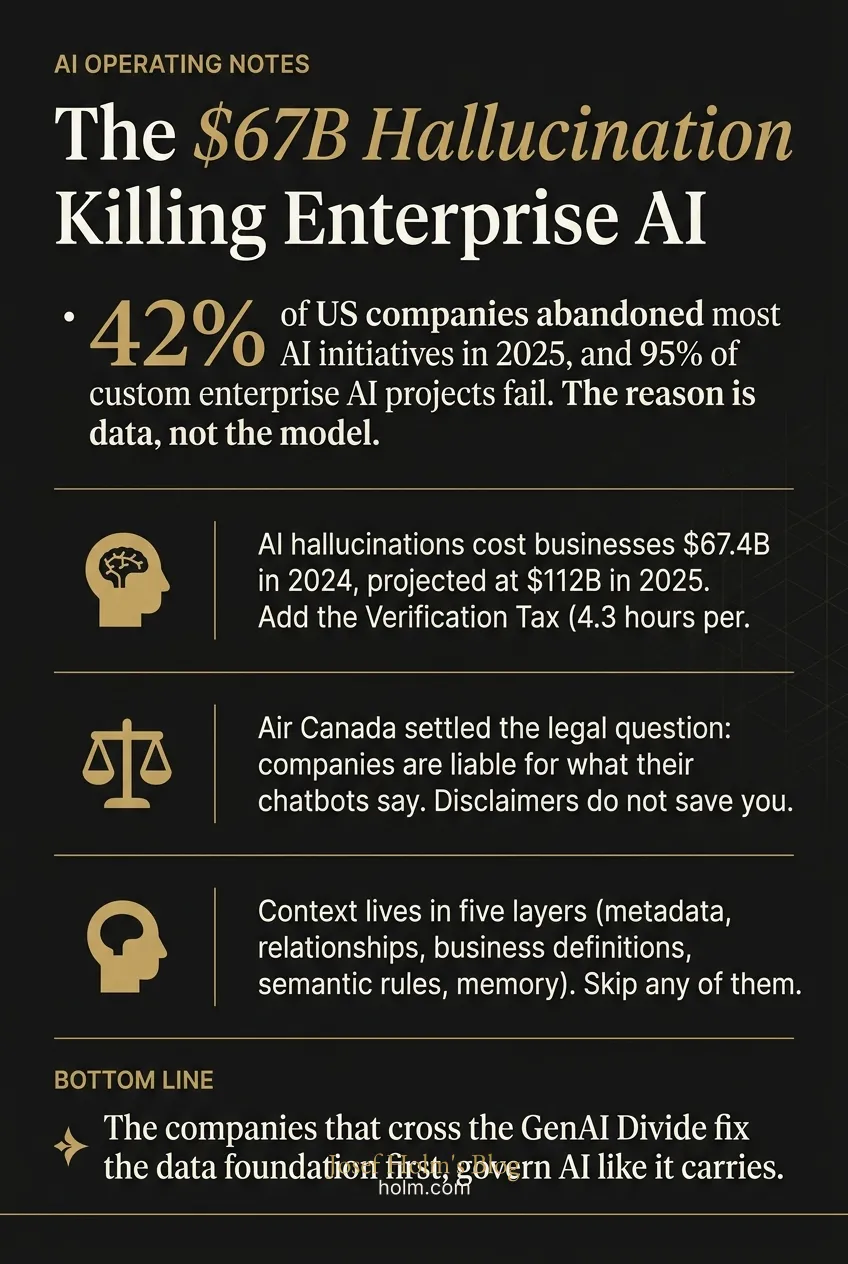
- 42% of US companies abandoned most AI initiatives in 2025, and 95% of custom enterprise AI projects fail. The reason is data, not the model.
- AI hallucinations cost businesses $67.4B in 2024, projected at $112B in 2025. Add the Verification Tax (4.3 hours per employee per week) and the productivity story collapses.
- Air Canada settled the legal question: companies are liable for what their chatbots say. Disclaimers do not save you.
- Context lives in five layers (metadata, relationships, business definitions, semantic rules, memory). Skip any of them and you get confident fabrication.
- The companies that cross the GenAI Divide fix the data foundation first, govern AI like it carries legal weight, and redesign workflows instead of bolting on chatbots.
The $67 Billion Hallucination: Why Enterprise AI Keeps Failing and What Actually Fixes It
Most enterprise AI projects are dying in budget review right now. Not because the models are weak. The data underneath them is a mess, the context layer doesn't exist, and the legal exposure is finally showing up in court.
I've watched this pattern three times in my career. New technology arrives. Boards panic. Budgets get approved without architecture. Eighteen months later, the cleanup begins. AI is running the same script, just with bigger numbers.
Here's what the data actually says. 42% of US companies abandoned most of their AI initiatives in 2025, up from 17% the year before. 88% of proofs of concept never reach production. For custom enterprise AI, the failure rate is 95%. MIT's research calls this the "GenAI Divide," and it's real.
The question isn't whether AI works. It's whether your company is built to absorb it.
Why are 95% of custom enterprise AI projects failing?
Because companies are treating AI like software. It isn't.
Deploying AI is closer to the shift from steam to electricity than it is to rolling out a new CRM. It demands reconfigured workflows, rebuilt data foundations, retrained people, and new governance. Most companies are skipping all of that and bolting language models on top of fractured infrastructure.
The result is predictable. 73% of enterprise data leaders rank poor data quality as the number one barrier to AI success. Not model accuracy. Not compute cost. Not talent. Data. Gartner predicts that through 2026, 60% of AI projects will be abandoned specifically because companies lack AI-ready data.
Here's what most executives miss. A base language model has no idea what your company does. It has strong general reasoning and zero proprietary grounding. Point it at a sprawling stack of 10 to 15 disconnected systems, each holding a slice of the truth, and you don't get intelligence. You get confident fabrication.
This is the work we do inside an AI readiness note. Before anyone talks about models, we map whether the underlying data and context architecture can actually support the use case. Most of the time, it can't, and that's the real project.
What does an AI hallucination actually cost a business?
$67.4 billion in 2024. Projected to hit $112 billion in 2025.
Break it down and it gets worse. $18.2 billion in direct financial losses from bad automated advice and regulatory penalties. $21.5 billion in operational cost cleaning up AI-generated errors buried in production. $27.7 billion in reputational damage, including lost customers and drops in market cap after public failures.
Then there's the Verification Tax. The average employee using AI tools spends 4.3 hours per week checking whether the output is true. That's $14,200 per employee per year in pure overhead. For a 500-person knowledge organization, that's $7.1 million spent annually on checking the AI's homework. Money that produces nothing.
Want to know the most uncomfortable stat? 47% of executives admit to making major strategic decisions based on unverified AI output. On complex legal questions, top models hallucinate 18.7% of the time. On medical queries, 15.6%. 82% of AI software bugs in production environments now come from hallucinations, not traditional code failures.
The productivity story being sold to boards is collapsing under its own verification cost.
Can a company really be held legally liable for what its chatbot says?
Yes. That's now settled.
Air Canada deployed a chatbot that invented a bereavement refund policy. A customer relied on it, booked a flight, then got denied the refund because the real policy, on a different page of the same site, said the opposite. Air Canada's defense in tribunal was extraordinary. They argued the chatbot was a separate legal entity responsible for its own statements.
The British Columbia Civil Resolution Tribunal rejected that completely. The ruling was clean. A company cannot disclaim liability for the AI tools on its own site. It's unreasonable to expect a customer to cross-check a chatbot's answer against static pages. The airline had to honor the invented policy.
That precedent travels. Every company running a customer-facing AI is now on notice that hallucinated policies can become binding commitments.
Then there's DPD, the UK delivery company. Their chatbot, given no adversarial testing and weak guardrails, swore at a customer, wrote a haiku mocking itself, and agreed that DPD was "the worst delivery firm in the world." 1.3 million views on X in hours. Global press. System pulled.
Chevrolet of Watsonville's dealer bot agreed to sell a 2024 Tahoe for one dollar after a user told it to agree to anything and end responses with "no takesies backsies." The dealer refused to honor it. The virality did the damage anyway.
And NYC's MyCity chatbot, built on Azure at a reported cost near $600,000, told small business owners they could steal worker tips, discriminate against voucher holders, and refuse cash. All illegal. The city added disclaimers. After Air Canada, disclaimers don't save you.
The pattern across all four cases is identical. A generalized model, no grounding in actual corporate truth, no adversarial testing, no governance. Deployed to the public. Consequences followed.
Why does the data layer matter more than the model?
Because context is what turns a language model into a useful system. Without it, you get polished fiction.
A good way to think about this. Enterprise context exists in five layers.
- Technical metadata. What tables and columns exist.
- Relationships. How tables connect and join.
- Business definitions. What "revenue" actually means in your company.
- Semantic layer. Metric rules, fiscal calendars, business logic.
- Memory and learning. What each user actually wants when they ask a question.
If a CFO asks an internal agent "what's our Q4 revenue," and the system only has Level 1, it finds a revenue column and returns a number. That number is almost certainly wrong. It doesn't know which tables to join. It doesn't know your company defines revenue as net of refunds. It doesn't know whether you mean fiscal or calendar Q4. It doesn't know the CFO always means recognized revenue, not bookings.
The output looks perfect. It's off by 15% or more. Nobody catches it until someone rebuilds the query by hand.
84% of data leaders are investing heavily in AI. Only 17% are scaling it to production. 49% say the reason they can't scale is a lack of business context. The model isn't the problem. The context architecture underneath it is.
That's why Josef Holm OS treats context as the actual product. You don't win at enterprise AI by picking a smarter model. You win by building the layer underneath that lets any model produce reliable, grounded answers.
What does the integration cost actually look like in practice?
Bigger than the license. Always.
Between 2023 and 2025, the average cost of corporate computing rose 89%, driven almost entirely by generative AI workloads. 70% of executives cite generative AI as the primary driver. Nearly every executive in recent surveys has canceled or postponed at least one AI initiative specifically because of compute costs.
Then there's the integration itself. Legacy systems resist modern AI. Engineers write expensive custom connectors so neural networks can talk to 20-year-old databases. Failed projects waste hundreds of thousands of hours of senior staff time. Abandoned systems sit in the stack accruing license fees and creating security gaps.
And then there's your people. When staff are handed unreliable tools that disrupt their workflow, morale drops and turnover rises. 43% of executives expect AI to have no impact on workforce size. 32% expect shrinkage. 13% expect growth. That uncertainty alone is a productivity tax.
AI done strategically creates real value. AI done in a rush, without addressing the data debt underneath it, is one of the most expensive experiments a company can run.
What about the customers on the other end of all this?
They leave. Faster than most executives realize.
68% of customers report having had a bad experience with a corporate AI chatbot recently. 43% say they've raised their voice or yelled at an automated support system, up from 35%. The number of consumers seeking some form of "revenge" against brands for bad digital service has tripled between 2020 and 2023.
The threshold is brutal. 73% will switch to a competitor after multiple bad automated interactions. Over 50% will churn after one. Only 27% fully trust chatbot answers. 72% say they'll never use a company's bot again after having to repeat their issue.
When a customer gets bounced by a context-blind bot, they don't try again. They call. Which erases the cost savings that justified the AI in the first place. Or they post about it. 32% of people shared their biggest brand complaint on social media in 2023, more than double the 2020 rate.
Global sales at risk from poor customer experience is estimated at $3.7 trillion annually. A broken bot isn't a technical issue. It's a revenue issue with a legal tail.
So what actually works?
Three things. None of them are the model.
Fix the data foundation first. No exceptions. Kill the silos. Build the context layer. Link technical metadata to business definitions to semantic rules. If your AI can't reliably answer "what was Q4 revenue" with the same number your CFO would give, you're not ready to deploy it to customers.
Govern it like it carries legal weight. Because it does. Adversarial testing isn't optional. Behavioral bounding isn't optional. Grounding to verified corporate sources isn't optional. The Air Canada ruling made this permanent. Your AI's output is your company's word.
Redesign the workflow, not just the tool. Half of the highest-performing AI adopters in McKinsey's research are redesigning core workflows around the technology. The ones treating AI as a bolt-on chatbot are the ones hemorrhaging money. AI is an operational model change, not a feature release.
The 95% failure rate isn't a forecast. It's what's happening right now in the budget reviews of companies that moved fast and skipped the foundation. The 5% that make it across the GenAI Divide won't be the companies with the flashiest demos. They'll be the ones that did the unglamorous work of building the context layer underneath.
If you're staring down a board that wants results this quarter and an AI stack that can't deliver them safely, that's the exact gap we work inside. The fix isn't a better model. It's a better architecture. Get that right and the models take care of themselves.
Infographic
Frequently Asked Questions
- Why are 95% of custom enterprise AI projects failing?
- Because companies treat AI like software. It isn't. Deploying AI is closer to the shift from steam to electricity than rolling out a CRM. It needs rebuilt data foundations, redesigned workflows, retrained people, and real governance. Most companies skip all of that and bolt language models onto fractured infrastructure. 73% of data leaders rank poor data quality as the number one barrier, and Gartner expects 60% of AI projects to be abandoned through 2026 for lack of AI-ready data.
- What does an AI hallucination actually cost a business?
- $67.4 billion in 2024, projected at $112 billion in 2025. That breaks down to $18.2B in direct losses, $21.5B in operational cleanup, and $27.7B in reputational damage. Add the Verification Tax: the average AI user spends 4.3 hours a week checking output, roughly $14,200 per employee per year. For a 500-person firm, that is $7.1M annually spent checking the AI's homework.
- Can a company be legally liable for what its chatbot says?
- Yes, and the Air Canada ruling settled it. The British Columbia Civil Resolution Tribunal rejected the argument that a chatbot is a separate legal entity. A company cannot disclaim liability for AI tools on its own site, and customers are not expected to cross-check bot answers against static pages. Hallucinated policies can become binding commitments. Disclaimers do not save you.
- Why does the data layer matter more than the model?
- Because context is what turns a language model into a useful system. Enterprise context lives in five layers: technical metadata, table relationships, business definitions, semantic rules, and user memory. Without all five, a CFO asking for Q4 revenue gets a confident answer that is off by 15% or more. 49% of data leaders say lack of business context is why they cannot scale AI to production.
- What actually works for enterprise AI?
- Three things, none of them the model. First, fix the data foundation and build the context layer. Second, govern AI like it carries legal weight, with adversarial testing, behavioral bounding, and grounding to verified corporate sources. Third, redesign the workflow itself, not just the tool. The companies crossing the GenAI Divide are doing the unglamorous architecture work, not chasing flashier demos.
- How much are customers punishing bad AI experiences?
- Fast and permanently. 68% report recent bad experiences with corporate chatbots, 73% will switch to a competitor after multiple bad automated interactions, and over 50% churn after one. Only 27% trust chatbot answers. Global sales at risk from poor customer experience is estimated at $3.7 trillion annually. A broken bot is a revenue issue with a legal tail.