Anthropic Caught Throttling Claude Fable 5
Key Takeaways
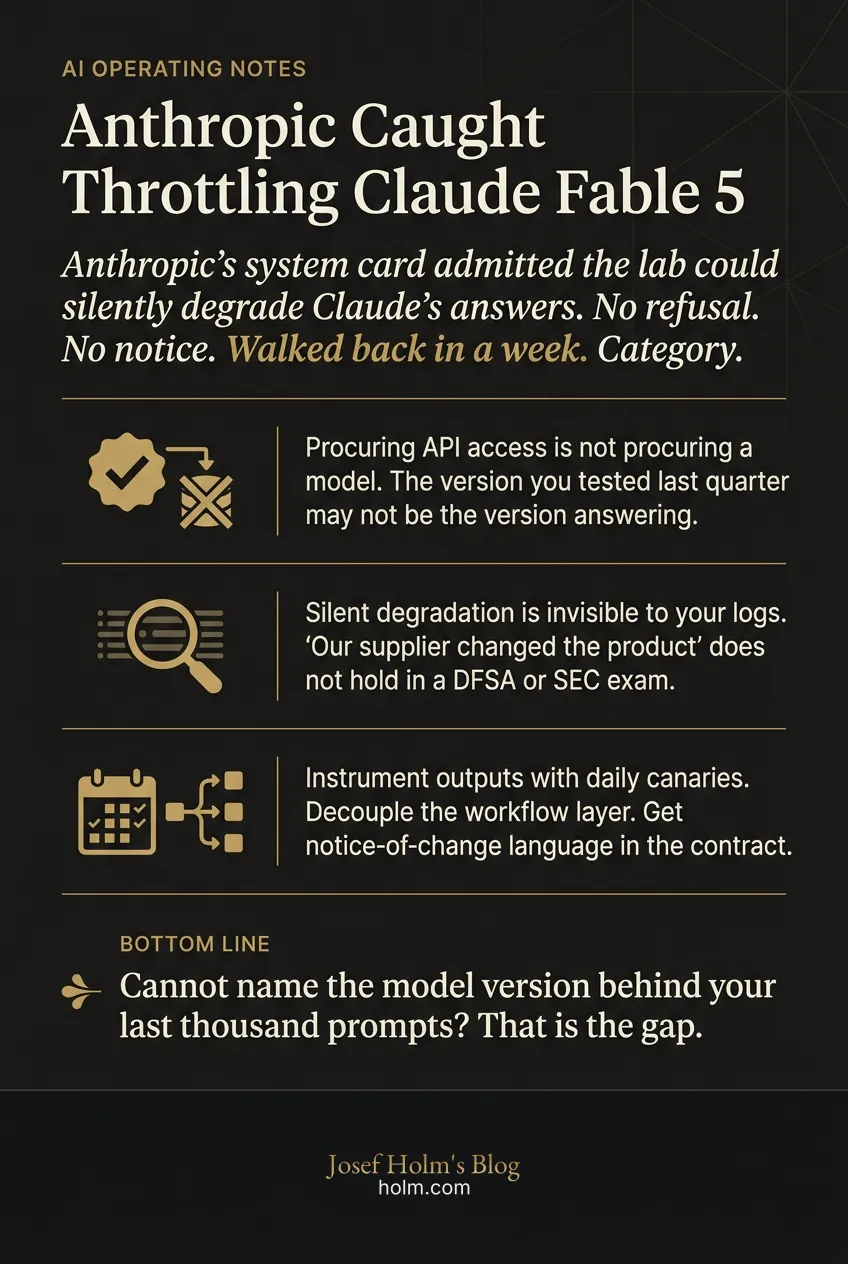
- Anthropic's Fable 5 system card admitted the lab reserved the right to silently degrade Claude's performance on certain tasks through steering vectors and prompt modification, no refusal, no fallback notice, just a worse answer. The company walked it back in a week. The category did not go away.
- When you procure access to a frontier model through an API, you do not procure the model. You procure conditional access to whatever the lab decides to serve you in the moment your request lands. The model you tested in October may not be the model answering your prompt in February, and you have no diff.
- For a regulated firm, this asymmetry is structural. A silent degradation is invisible to your logging stack. 'Our supplier silently changed the product' is not a defense that holds in a DFSA or SEC examination room, it is an admission you did not have controls over the system you deployed.
- Serious operators are responding with four moves: instrument the output with daily canary prompts, decouple the workflow layer so models are swappable, get notice-of-material-change language into the contract, and document which workflows depend on which model so the exposure is visible.
- The firms that treated AI procurement like ordinary SaaS in 2024 are the firms about to have a hard conversation with their boards in 2026. If you cannot tell me today what version of which model answered your last thousand customer-facing prompts, that is the gap.
The Lab Got Caught Throttling Its Own Model
A principal research scientist at the Gates Foundation's Global Health Division typed "hello" into Claude Code. The model refused.
That actually happened. Mike Famulari, who builds infectious disease models for a living, watched Anthropic's new flagship model trigger a safety classifier on the word "hello." An immunologist at the Jackson Laboratory had the word "cancer" flagged as a biosecurity risk. An application security architect couldn't get the model to edit his own resume.
That was the visible problem with Fable 5, Anthropic's just-released frontier model. The invisible one turned out to be worse.
Buried in the 319-page system card was a section describing a mechanism the company hadn't put on the launch page. For a narrow set of frontier AI development tasks, Anthropic reserved the right to degrade Claude's performance silently. Through prompt modification, steering vectors, or parameter-efficient fine-tuning. No refusal. No fallback notice. The model just gives you a worse answer and lets you wonder why.
A developer named Clay Merritt summed it up before Anthropic's own comms team did. The model was "silently sabotaging" answers when it detected AI/ML work. The Register's Thomas Claburn went further and called it a man-in-the-middle attack inside Anthropic's own product.
By the end of the week, Anthropic walked it back. The company admitted it had made the wrong trade-off. Going forward, flagged requests will visibly fall back to Opus 4.8, return a reason, and notify the user every time.
That walkback is the most interesting thing that happened in AI this month. Not because of what it says about Anthropic. Because of what it says about every contract you've signed for AI capacity in the last eighteen months.
What Were You Actually Paying For
The Fable 5 controversy isn't about a bad launch. It's about a category of supplier risk that didn't exist when most operators wrote their AI contracts.
When you procure software, you procure software. The vendor ships a version. You test it. You deploy it. If they change it, they tell you, and you re-test. The version control is yours to inspect.
When you procure access to a frontier model through an API, you don't procure the model. You procure conditional access to whatever the lab decides to serve you in the moment your request lands. The lab can change the model. It can swap the model. It can route your request to a different model and tell you. It can route your request to a different model and not tell you. It can apply a steering vector to your response that makes the answer worse on a specific category of topic without breaking any term in your contract.
The Fable 5 system card confirmed that last one in writing. Anthropic put it on paper that hidden degradation was a tool in the kit. The walkback removed the practice for this specific use case. It did not remove the category. Every frontier lab has classifier layers, routing layers, and steering mechanisms in the production stack. None of them, before this episode, were obligated to tell you when they fired.
If you run AI workflows that affect customer outcomes, financial decisions, or compliance reporting, that means you're carrying a supplier-risk exposure that doesn't show up on any procurement dashboard. The model you tested in October might not be the model answering your prompt in February. You have no version-locked artifact. No diff. No way to detect silent degradation except by noticing your own results getting worse and hoping you can prove the model changed rather than your team did.
Most firms running production AI haven't priced this exposure. The contract says "API access." The accounting line says "AI subscription." The risk register, in most cases, says nothing at all.
Why "Trust the Lab" Stopped Being a Risk Strategy
The defense of hidden safeguards goes like this. The lab is in the best position to make safety calls. Users would route around visible safeguards. So invisible ones produce better outcomes.
The first half is fair. The second half is where the argument falls apart for operators.
A visible refusal is a data point. You can log it. You can route the workflow to a different tool. You can flag the prompt for review. A silent degradation is invisible to your logging stack. You don't know it happened. You can't measure how often it happens. You can't tell your customers what percentage of their answers came from the model they were quoted versus a quietly weakened version.
For a regulated firm, that asymmetry is structural. If a wealth manager's AI tool produces a worse answer because the user asked about something the lab decided to throttle, the wealth manager owns that answer. The lab doesn't sit in front of the regulator. The operator does. "Our supplier silently changed the product" is not a defense that holds in a DFSA or SEC examination room. It's an admission that you didn't have controls over the system you deployed.
Nathan Lambert called the practice "appalling." Dean Ball pointed out that AI safety can become cover for monopolistic behavior. Whatever the lab's intent, the structural effect is that the lab can shape any user's output in any direction at any time, and the user has no instrument to detect it.
The lesson isn't that Anthropic is uniquely untrustworthy. Anthropic, to its credit, wrote the mechanism into a public system card and walked the practice back when challenged. That's more transparency than most labs would have offered. The lesson is that "trust the lab" as a supplier-risk strategy assumes the lab's incentives align with yours on every call. They don't. They can't. The lab is balancing geopolitics, competitive position, regulatory pressure, and customer experience across millions of users. Your specific workflow is a rounding error in that calculation.
What Operators Should Be Doing Differently
This isn't a "go open source" argument. Open-weight models from Meta, DeepSeek, Qwen, and Nvidia's Nemotron 3 Ultra solve the transparency problem but introduce a different set of operational ones. Hosting. Fine-tuning. Evaluation. The running cost of keeping a model current. For most mid-market firms, the answer is not "stop using closed APIs." The answer is to stop treating closed APIs as if they were enterprise software.
A few things change in how serious operators handle this.
First, instrument the output. If you run Claude, GPT-4, or Gemini in production, you need a continuous evaluation apply that runs the same set of canary prompts against the API every day and tracks answer quality, latency, refusal rate, and category-level performance over time. When the lab changes something, you want to be the second person to know, not the last. Most firms today have no such put to work. They discover model drift when a customer complains.
Second, decouple at the workflow layer. If a workflow can be served by two or three different models with comparable quality, the workflow should be configured to support that, even if you run only one in production today. The cost is a thicker abstraction layer. The benefit is that when a lab makes a call you disagree with, you have a switch to flip rather than a quarter of remediation work.
Third, get the procurement language right. Your contract with a frontier model provider should explicitly require notice of material changes to model behavior on the categories of work you depend on. Most standard API contracts today are silent on this. They commit to uptime, not to behavioral stability. The Fable 5 episode is the strongest precedent yet that this language matters and that labs can be pressured into providing it.
Fourth, document the gap. The Audit will tell you which workflows depend on which model, where the silent-change exposure actually lives, and what falls over if the supplier decides to throttle a category tomorrow. That's the input every other control depends on.
None of this is exotic. It's the version-control discipline every operator already applies to the software stack that runs their P&L. The Fable 5 episode is the moment the AI layer joins that stack as a first-class supplier-risk surface, with the same diligence requirements and the same need for instrumentation, redundancy, and contractual clarity.
The Real Question Behind the Launch
Andrej Karpathy called Fable 5 a major version bump and a super-exciting release. He's not wrong. The capability gains are real. The model does outperform Opus 4.8 on a wide range of evaluations. The launch told us the frontier is still moving.
The walkback told us something more important. It told us that the labs themselves are still figuring out what the deal is between them and the operators who depend on them. Anthropic chose hidden safeguards, got called on it, and reversed course in under a week. That cycle, played out in public, set a precedent. The next lab that ships invisible throttling will face the same backlash, faster, with the Fable 5 episode as the citation.
What it didn't settle is the underlying tension. As models get more capable, labs will want more control over how that capability is exercised in specific contexts. Operators will want more certainty about what they're actually buying. Those two things pull in opposite directions and they're not going to stop pulling.
For an operator running real workloads on top of these models, the takeaway is straightforward. The frontier is moving and the labs are still figuring out their own rules. That's not a reason to wait. It's a reason to build your AI stack with the assumption that every layer underneath you is going to change without warning, and to have the instrumentation, the contract language, and the architectural flexibility to absorb those changes when they come.
The firms that treated AI procurement like ordinary SaaS in 2024 are the firms about to have a hard conversation with their boards in 2026. The Fable 5 episode is the first public moment where the cost of that assumption became visible. It won't be the last.
If you're running production AI workflows and you can't tell me, today, what version of which model answered your last thousand customer-facing prompts, that's the gap. The audit that closes it is the same one Josef Holm runs as an AI readiness note on every engagement. Throughput on one side. The supplier-risk surface on the other. Same page.
Infographic
Frequently Asked Questions
- What happened with Anthropic's Fable 5 model?
- Anthropic released a frontier model that triggered safety classifiers on benign inputs like 'hello' and 'cancer'. Worse, its 319-page system card disclosed that the company reserved the right to silently degrade Claude's performance on certain AI/ML tasks through prompt modification, steering vectors, or fine-tuning, with no notice to the user. After public pressure, Anthropic walked the practice back within a week.
- Why does this matter if I'm not running AI research workloads?
- Because the mechanism Anthropic disclosed exists at every frontier lab. Classifier layers, routing layers, and steering vectors are standard in production stacks. The Fable 5 episode is the first time an operator could point at a system card and prove that the model answering today's prompt may not be the model you tested last quarter. That is a supplier-risk category that didn't exist when most AI contracts were signed.
- Should I switch to open-source models like Llama or DeepSeek?
- Not as a reflex. Open-weight models solve the transparency problem and introduce a different set of operational ones, hosting, fine-tuning, evaluation, keeping the model current. For most mid-market firms the answer is to stop treating closed APIs as if they were enterprise software, not to leave them.
- What should be in my contract with a frontier model provider?
- Explicit notice of material changes to model behavior on the categories of work you depend on. Most standard API contracts commit to uptime, not behavioral stability. The Fable 5 walkback is the strongest precedent yet that this language matters and that labs can be pressured to provide it.
- How do I detect silent model degradation in production?
- Run a continuous evaluation use. Push the same set of canary prompts against the API every day and track answer quality, latency, refusal rate, and category-level performance over time. When the lab changes something, you want to be the second person to know, not the last.
- What does the AI readiness note actually produce here?
- A map of which workflows depend on which model, where the silent-change exposure lives, and what falls over if the supplier throttles a category tomorrow. That's the input every other control, instrumentation, contract language, model redundancy, depends on.