The Federal Org Chart Is Now Your Problem
Key Takeaways
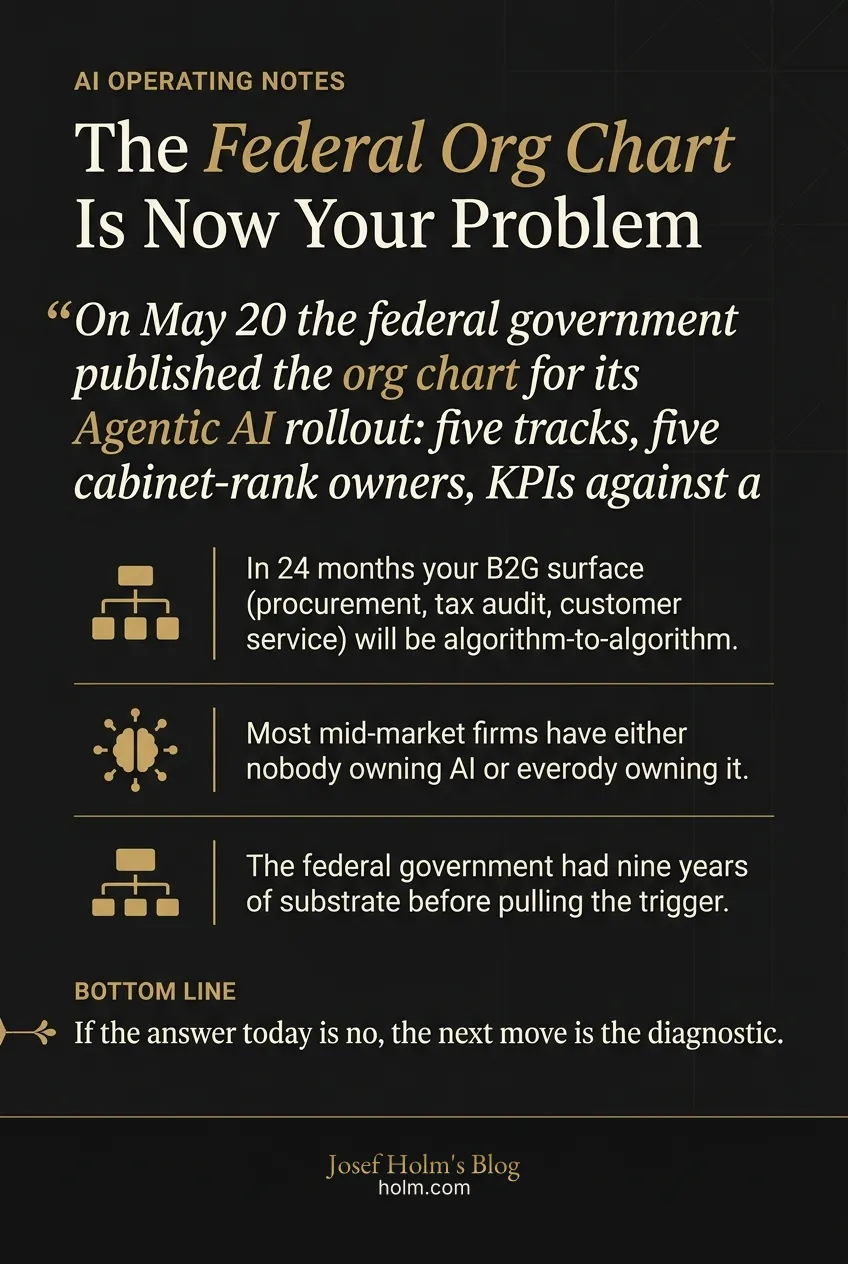
- On May 20 the federal government published the org chart for its Agentic AI rollout: five tracks, five cabinet-rank owners, KPIs against a 24-month clock.
- In 24 months your B2G surface (procurement, tax audit, customer service) will be algorithm-to-algorithm. A firm without internal Agentic AI gets flagged, rejected, and excluded from workflows it has historically won on relationship.
- Most mid-market firms have either nobody owning AI or everybody owning it. Four tools, four owners, four data silos, zero orchestration. That is the missing-secure-data-layer failure mode.
- The federal government had nine years of substrate before pulling the trigger. Your firm has had nine months, and most of them were spent on pilots that died.
- If the answer today is no, the next move is the diagnostic. If the answer today is yes, the next move is the ongoing work.
The five tracks the federal government just published, and what they tell you about your firm
On May 20 the federal government did something most private operators missed. They didn't announce another initiative. They published the org chart.
His Excellency Mohammad bin Abdullah Al Gergawi, Minister of Cabinet Affairs, chaired the Agentic AI Retreat at Qasr Al Watan in front of 400+ senior officials and laid out the five-track rollout framework the UAE federal government will run against the April 23 directive: 50% of federal sectors, services, and operations on autonomous agents within 24 months.
Five tracks. Five named cabinet-level owners. Specific KPIs against each.
That last sentence is the part the mid-market should be reading twice.
Why is the federal org chart your problem?
Because in 24 months you'll be transacting with it.
The federal directive named four agents already in production: procurement, tax auditing, customer happiness, technical support. Al Gergawi's address confirmed 140 Agentic AI assistants are already running on the GovAI platform inside the Ministry of Cabinet Affairs alone. That's today. Not 2028.
When the federal tax-auditing agent flags a discrepancy on your VAT return in Q3 2027, a human won't be the one flagging it. Run the same scenario on procurement: when the federal RFP your firm bids into goes live, the document parser, the eligibility check, and the first-round scoring are all automated. By 2028 a meaningful share of your B2G surface area will be algorithm-to-algorithm. Your firm without internal Agentic AI capable of interfacing with that surface gets continuously flagged, automatically rejected, and slowly excluded from the workflows it has historically won on relationship.
That's the algorithmic asymmetry Al Gergawi was describing without naming it. The federal government is building a counterparty your operating model wasn't designed to handle.
What the five tracks actually tell you
Read them as a template for what a serious AI rollout looks like. Not as government news.
Track 1, Capabilities and Training. Led by Her Excellency Ohood bint Khalfan Al Roumi. 80,000 federal employees trained, training linked directly to promotions, appointments, and performance evaluation. The signal: AI capability is being written into HR, not bolted on as a side initiative.
Track 2, AI Technologies and Data. Led by His Excellency Omar Sultan Al Olama. Approved guidelines, vetted systems, secure high-performance infrastructure for AI models. The signal: the federal government is building a sovereign substrate before deploying agents on it. Nobody is pasting client data into ChatGPT.
Track 3, Operations and Institutional Support. Led by Her Excellency Maryam bint Ahmed Al Hammadi. 50% of institutional operations (HR, finance, procurement, internal audit) on Agentic AI. The signal: back-office is the first lane, not the last.
Track 4, Strategy and Governance. Led by Her Excellency Huda Al Hashimi. Ten times faster complex decision-making, 100% improvement in decision accuracy. The signal: agents are being deployed at the judgment layer, not just the task layer.
Track 5, Government Services. Led by His Excellency Mohammed Rashid bin Tuleiah. 50% of services on Agentic AI models. The signal: customer-facing throughput is being rebuilt on autonomous agents, full stop.
Five tracks. Five owners at deputy-minister or minister-of-state level. KPIs you could read off a board pack.
Now ask the version of this question that matters for your firm.
Who in your firm owns the equivalent five lanes?
This is the question to plant in front of your exec team this week.
The federal government did not assign Agentic AI to "the IT department" or "an innovation committee" or "a transformation lead reporting through the COO". They assigned five lanes to five cabinet-rank owners with named KPIs and a 24-month clock. Because they understood, correctly, that Agentic AI is a cross-functional rebuild and the only authority that can prosecute a cross-functional rebuild sits in the C-suite.
Most mid-market firms have either nobody owning it or everybody owning it. The CMO bought a generative tool, finance trialled a predictive analytics product, HR licensed a screening platform, legal has a paid ChatGPT seat for the GC's office. Four owners. Four data silos. Zero orchestration. Call it the missing-secure-data-layer failure mode (F2 in Josef Holm's positioning shorthand): the firm has more AI tooling than it can name, and not one piece of it sits on a governed substrate that an autonomous agent could actually run on.
When the federal procurement AI agent goes live in 2027 and needs to negotiate a tender with your firm, which one of those four tools does it talk to first? You can't answer it. Your CFO can't either.
That's the gap.
So what does this mean for the next twelve months?
The work is structural, not tactical. And the clock is real.
The federal government gave themselves 24 months to land 50% transition. They started from a position where they had already spent nine years building strategies, legislative environment, and infrastructure. Al Gergawi was specific about that nine-year runway. The UAE Cabinet did not wake up on April 23 and start from scratch; they had the substrate in place and were pulling the trigger on agents that could run on top of it.
Your firm has had nine months, not nine years. And most of those nine months were spent on pilots that died.
The Dubai Chamber clock for the private sector lands May 2028. Same 24-month window the federal government gave itself, but starting from a substrate that, in most mid-market firms, doesn't exist yet. The Sovereign AI Platform launched at ISNR Abu Dhabi on May 21 made the technical bar explicit: sovereign infrastructure, air-gapped inference, the Sovereign AI Security Framework's three tenets of model integrity, operational isolation, and cyber resilience. That's the floor. Not the ceiling.
Most firms reading this are below the floor.
What is the actual first move?
Not another pilot. Not another vendor demo. Not another transformation deck.
The first move is a row-by-row read of every AI tool, workflow, and Shadow AI surface already running inside the firm, with a verdict on each. Kill the ones that died in pilot and are still on the credit card. Fix the ones that produce value but sit outside a governed data layer. Build the two or three that, if they ran on sovereign substrate with the right context, would compound throughput across the firm.
That's what the AI readiness note produces. Fixed scope, bounded, four to six weeks. The deliverable is an Opportunity Map: every workflow scored, every tool given a Kill / Fix / Build verdict, every remediation step sequenced against the 2028 clock. Throughput and data sovereignty on one page, because they are the same problem at the firm level.
The federal government published their five tracks because they had already done the diagnostic. Al Gergawi was reading from a map, not drawing one in front of 400 officials.
Your firm needs the equivalent map before it builds the equivalent tracks.
The point
The federal government just told you what serious looks like.
Five lanes. Five named owners at the highest level. Sovereign substrate underneath. Twenty-four months on the clock. KPIs you can actually defend at a board.
The question is not whether your firm matches that template at federal scale. It won't, and it doesn't need to. The question is whether your firm has any version of it at all. One owner per lane. One governed data layer. One sequenced remediation roadmap. And a 2028 plan that survives contact with an algorithmic counterparty.
If the answer today is no, the next move is the diagnostic. If the answer today is yes, the next move is the ongoing work.
Either way, the clock that started on April 23 is now showing 23 months on the federal side and ticking on the private side too.
The firms that act on it this quarter will be the ones still bidding into federal procurement RFPs in 2028. The firms that don't will find out what algorithmic exclusion feels like when the counterparty on the other side of every tender is an agent that doesn't take meetings.
Infographic
Frequently Asked Questions
- What are the five tracks the UAE federal government announced for Agentic AI?
- Capabilities and Training (Ohood Al Roumi), AI Technologies and Data (Omar Sultan Al Olama), Operations and Institutional Support (Maryam Al Hammadi), Strategy and Governance (Huda Al Hashimi), and Government Services (Mohammed Rashid bin Tuleiah). Each track has a cabinet-rank owner and specific KPIs tied to the 24-month clock from the April 23 directive.
- Why does the federal Agentic AI rollout affect private mid-market firms?
- Because in 24 months your firm will be transacting with it. Procurement, tax audit, customer happiness, and technical support agents are already in production. The federal RFP your firm bids into will be parsed, scored, and first-round filtered by an agent. Your VAT discrepancies will be flagged by an agent. If your firm cannot interface with that surface, you get continuously flagged, automatically rejected, and slowly excluded.
- What is the deadline for private sector Agentic AI transition in Dubai?
- May 2028. The Dubai Chamber's clock for the private sector lands on the same 24-month window the federal government gave itself, but starting from a substrate that in most mid-market firms does not exist yet.
- What does a serious AI rollout structure look like inside a private firm?
- One owner per lane at C-suite level, one governed data layer, and one sequenced remediation roadmap against the 2028 clock. Not an IT department initiative, not an innovation committee, not a transformation lead three levels down. Agentic AI is a cross-functional rebuild and only C-suite authority can prosecute it.
- What is the first move for a mid-market firm that is below the floor?
- A row-by-row read of every AI tool, workflow, and Shadow AI surface already running, with a Kill / Fix / Build verdict on each. Kill the pilots that died and are still on the credit card. Fix the ones that produce value but sit outside a governed data layer. Build the two or three that would compound throughput on sovereign substrate. That is what the AI readiness note produces.
- What is the Sovereign AI Security Framework and why does it matter?
- Launched at ISNR Abu Dhabi on May 21, it sets the technical floor for Agentic AI in regulated environments: sovereign infrastructure, air-gapped inference, and three tenets (model integrity, operational isolation, cyber resilience). Most mid-market firms are below that floor today, which is why pasting client data into a public model is no longer a defensible posture.