Five Ways AI Use Is Getting People Fired Right Now
Key Takeaways
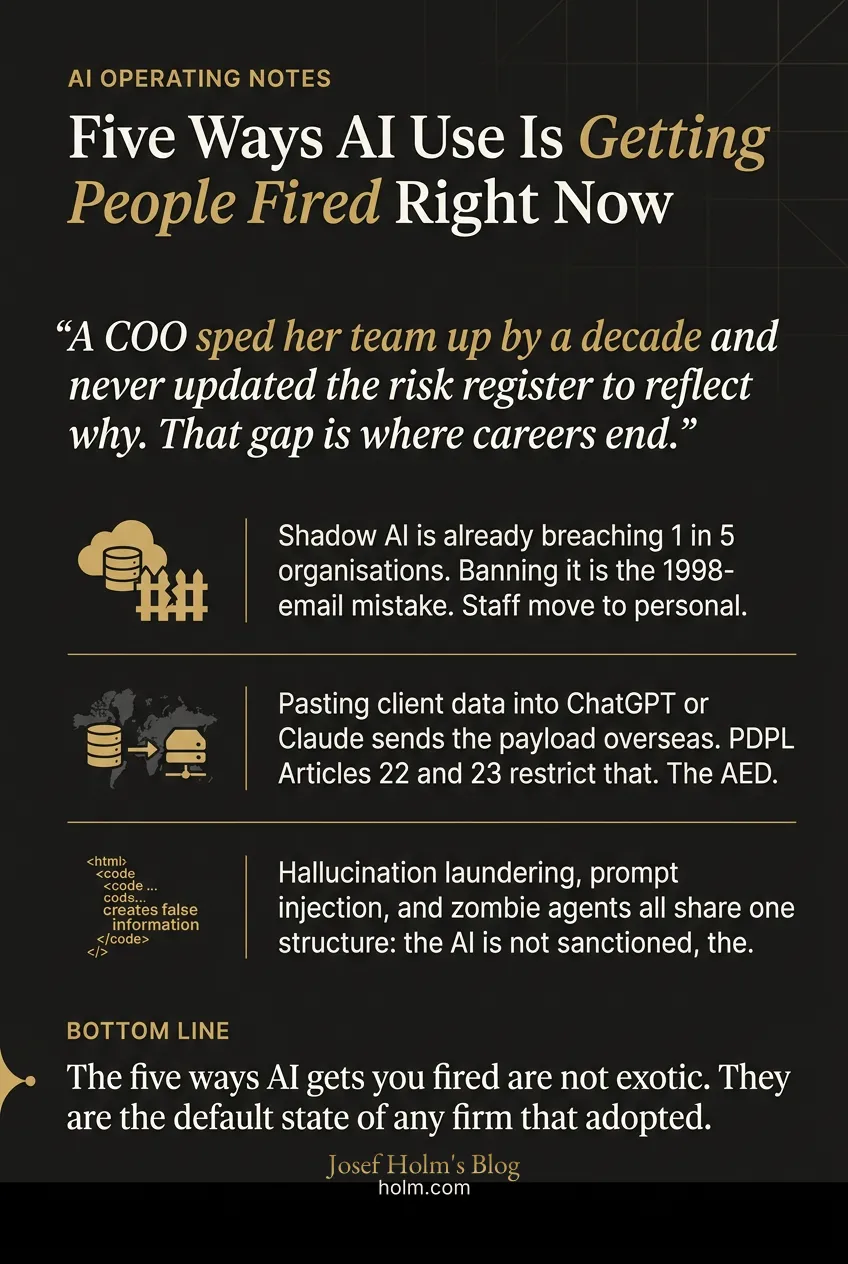
- A COO sped her team up by a decade and never updated the risk register to reflect why. That gap is where careers end.
- Shadow AI is already breaching 1 in 5 organisations. Banning it is the 1998-email mistake. Staff move to personal devices and IT loses its last shred of visibility.
- Pasting client data into ChatGPT or Claude sends the payload overseas. PDPL Articles 22 and 23 restrict that. The AED 5M ceiling is real. Your egress logs already know the number.
- Hallucination laundering, prompt injection, and zombie agents all share one structure: the AI is not sanctioned, the person whose name is on the work product is.
- The five ways AI gets you fired are not exotic. They are the default state of any firm that adopted AI without writing the policy that would have governed it. Your name is on the work. Make sure the governance line is too.
The five-line memo nobody at your firm has written
A COO at a mid-market firm I spoke with last month had a problem she could not name. Her team was faster than it had been in a decade. Her risk register had not been updated to reflect why.
That gap is where careers end.
The source material I'm working from lays out five specific ways AI use is getting people fired right now. Not in 2028. Not when the mandate lands. This quarter. Every item on the list is already happening inside firms that look exactly like yours, and the accountability question in each case lands on two desks: the employee who introduced the tool, and the leader who never wrote the policy that would have governed it.
Let me walk through the five, then name what your firm actually has to do about it.
What does Shadow AI look like at your desk right now?
Shadow AI is the catch-all for AI tools corporate IT has not vetted or approved. A personal ChatGPT account drafting client communication. A browser plug-in summarising contract clauses on a work laptop. A free Claude tab open next to the CRM.
IBM's Cost of a Data Breach Report puts the figure at 1 in 5 organisations reporting a breach caused by Shadow AI. That is current, not future.
Most IT teams reach for a ban. The speaker is right that this makes the problem worse. Staff move to personal devices, switch to whatever is not yet blocked, and IT loses the last shred of visibility it had. Banning AI inside a mid-market firm in 2026 is the operational equivalent of banning email in 1998. The tools come back in through the side door, and now they are invisible.
The fix is not a ban. It is a governance line: a written, enforced policy naming the approved tools, the data classes that are off limits, and the verification step required before any AI output becomes a work product. Most firms I look at do not have this document. The ones that do have written it generically, and nobody in operations has read it.
What happens when proprietary data lands in a model's training pipe?
This is the failure mode that turns Shadow AI from a policy gap into a regulatory event. Every time an employee pastes client portfolio data, a privileged matter summary, or proprietary code into an unapproved tool, that payload moves to a third-party server. Depending on the terms of service, it may be retained, logged, or used to train the next version of the model. Once baked in, it cannot be retrieved.
This is the missing-secure-data-layer failure mode, F2 in Josef Holm's positioning shorthand, at the desk level. The firm has no air-gapped inference path between proprietary data and the public foundation model, so staff use the only path available to them: the consumer endpoint. The data leaves the firm. Nobody logs it. Nobody approves it.
The UAE Personal Data Protection Law sets the fine ceiling at AED 5M, and PDPL Articles 22 and 23 restrict cross-border data transfer. The endpoints staff are pasting into sit overseas. Open your egress logs for the last 30 days and count requests to api.openai.com or claude.ai carrying payloads with client PII. The number is not zero. That number is your exposure today.
Accountability lands on two desks. The employee who pasted the data. The leader who never established a governance framework that would have caught it. The second one is the one most owner-operators have not considered.
Whose name is on the document when the AI was wrong?
The speaker calls this hallucination laundering, and the term is worth keeping. AI generates plausible content with confidence. Newer models do this less, but they still do it. The career-ending move is when an employee copies that output directly into a work product, attaches their name to it, and ships it.
The lawyers filing court documents with fabricated case citations are the cautionary tale. The executives making business decisions on unverified AI summaries are the quieter one. In both cases the AI did not get sanctioned. The person whose name was on the filing did.
This is not a technology problem. It is a verification problem. The fix is procedural: every AI output that becomes a work product passes through a human verification step before it ships. The verifier is named in the workflow. The verification is logged. If your firm has not written this step into its operating procedures, every memo, every IC memo summary, every client letter drafted with AI assistance is a small career bet by whoever signs it.
What is prompt injection and why does it matter to a firm that does not write code?
Prompt injection sounds like a developer problem. It is not. It is the failure mode for any AI tool your firm deploys that touches external content.
The mechanic: an attacker crafts input that overrides the AI's original instructions. The direct version is someone typing "ignore all previous instructions" into your customer chatbot. Today's models mostly catch that. The indirect version is the one to worry about. Malicious instructions are hidden inside a document, an email, or a web page your AI ingests as context. Nothing suspicious is ever typed into your interface. The attack arrives buried in the data the model processes.
If your firm has deployed an AI-powered chatbot, a document-summariser reading inbound email, or any tool retrieving content from outside the firm, this is your exposure. The IT-approved deployment is the one that gets exploited. The accountability conversation that follows is harder than the Shadow AI one, because the tool was approved.
What is a zombie agent and why is it the worst one on this list?
The speaker calls unauthorised agentic AI the next evolution of Shadow AI, and the framing is right. Agents act autonomously. They read and write to databases, make API calls, execute code, send messages. The blast radius of a bad agent decision is larger than the blast radius of a bad chatbot answer by an order of magnitude.
The scenario worth burning into memory is the zombie agent. An employee spins one up for a proof of concept. The project ends. The agent keeps running. It is still authenticated. It still holds API keys. Nobody is watching it. Six months later it is an unmonitored backdoor into your systems with credentials that have not been rotated and a permissions footprint nobody can locate.
This is the zombie-pilots failure mode (F3 in Josef Holm shorthand: the unmanaged AI surfaces nobody decommissioned) in its most dangerous form. A regular zombie pilot is a SaaS line item nobody uses. A zombie agent is the same drift problem with write access.
The PDPL requires a Data Protection Officer to monitor processing of personal data. A DPO cannot monitor systems they do not know exist. When the agent fires off an automated action that breaches a client mandate or exposes PII, the employee who spun it up is accountable, and the IT team that had no inventory faces the harder questions about why agent lifecycle was not part of the governance line.
The sixth one, briefly
The speaker mentions a possible sixth: not using AI at all can also end a career. Refusing to adopt because it feels safer leaves the operator behind their peers and behind the throughput curve competitors are riding. This is correct, and it is the trap most cautious owner-operators fall into. The answer is not to do nothing. The answer is to deploy under a governance line that makes the doing defensible.
So what does an owner-operator actually do about this?
You have just read five specific failure modes. Your instinct will be to commission a policy document. Most firms stop there. The document gets written, filed, ignored, and the failure modes continue.
The work that actually moves the needle has three beats.
First, you have to know what you have. Every AI tool currently in use across the firm, approved or not. Every agent spun up for a proof of concept. Every egress path from internal systems to a foundation model endpoint. Most firms cannot produce this list. The ones that try are surprised by what is in it.
Second, apply a verdict to each surface. The framework Josef Holm uses is Kill, Fix, Build. Kill the surfaces that should not exist. Fix the ones that have value but no governance. Build the ones the firm needs and does not have. The verdict is workflow by workflow, not a blanket policy. A blanket policy is what got the firm into this position.
Third, install the decision layer that keeps the governance line enforced over time. This is the layer most firms do not have. It is the difference between writing a policy and operating under one. Throughput and data sovereignty live on the same page here: the governance line is what lets the firm keep moving fast without widening the data surface.
This is the work the AI readiness note does. Fixed scope, bounded, principal-led. The deliverable is an Opportunity Map naming every AI surface in the firm with a Kill, Fix, or Build verdict on each one, and a prioritised remediation roadmap that protects margin and data sovereignty on a single operating path.
The federal directive of 23 April 2026 set a 24-month clock for half of government services to run on autonomous agents by 2028. HH Crown Prince Sheikh Hamdan bin Mohammed's mandate on 4 May 2026 put the same clock on the private sector. Firms arriving at 2028 with a governed AI substrate will compound. Firms arriving with five years of unmanaged Shadow AI and a forgotten zombie agent will face the kind of regulator conversation that ends with the AED 5M ceiling on the table.
The five ways AI gets you fired are not exotic. They are the default state of any firm that adopted AI without writing the policy that would have governed it. Your name is on the work. Make sure the governance line is too.
Infographic
Frequently Asked Questions
- What is Shadow AI and why is banning it the wrong response?
- Shadow AI is any AI tool corporate IT has not vetted: personal ChatGPT accounts, browser plug-ins, Claude tabs next to the CRM. IBM puts the breach rate at 1 in 5 organisations. Banning it pushes staff to personal devices and kills the last visibility IT had. The fix is a written governance line naming approved tools, off-limits data classes, and a verification step before AI output ships.
- What happens when employees paste client data into ChatGPT or Claude?
- The payload moves to an overseas server. Depending on the terms, it can be retained, logged, or used to train the next model version. Once baked in, it cannot be retrieved. PDPL Articles 22 and 23 restrict cross-border data transfer and the fine ceiling is AED 5M. Open your egress logs to api.openai.com and claude.ai for the last 30 days. That count is your exposure today.
- What is hallucination laundering?
- It is when an employee copies AI output directly into a work product, attaches their name, and ships it without verification. The AI does not get sanctioned. The person whose name is on the filing does. The fix is procedural: a named human verifier, a logged verification step, written into operating procedures before any AI output becomes a work product.
- Why does prompt injection matter to a firm that does not write code?
- Indirect prompt injection hides malicious instructions inside a document, an email, or a web page your AI ingests. Nothing suspicious is ever typed into your interface. If your firm has deployed a chatbot, a document summariser reading inbound email, or any tool retrieving external content, that is your exposure. The exploited tool is usually the IT-approved one.
- What is a zombie agent?
- An agent an employee spun up for a proof of concept that nobody decommissioned. It still holds API keys, is still authenticated, has write access, and is not monitored. Six months later it is an unmonitored backdoor with credentials that have not been rotated. A DPO cannot monitor systems they do not know exist.
- What does an owner-operator actually do about this?
- Three beats. First, inventory every AI surface in the firm, approved or not, including every agent and every egress path. Second, apply Kill, Fix, Build workflow by workflow. Third, install the decision layer that keeps the governance line enforced over time. That is the work the AI readiness note does: fixed scope, bounded, principal-led, with an Opportunity Map as the deliverable.