How Much of Your Last Two Weeks Actually Needed You
Key Takeaways
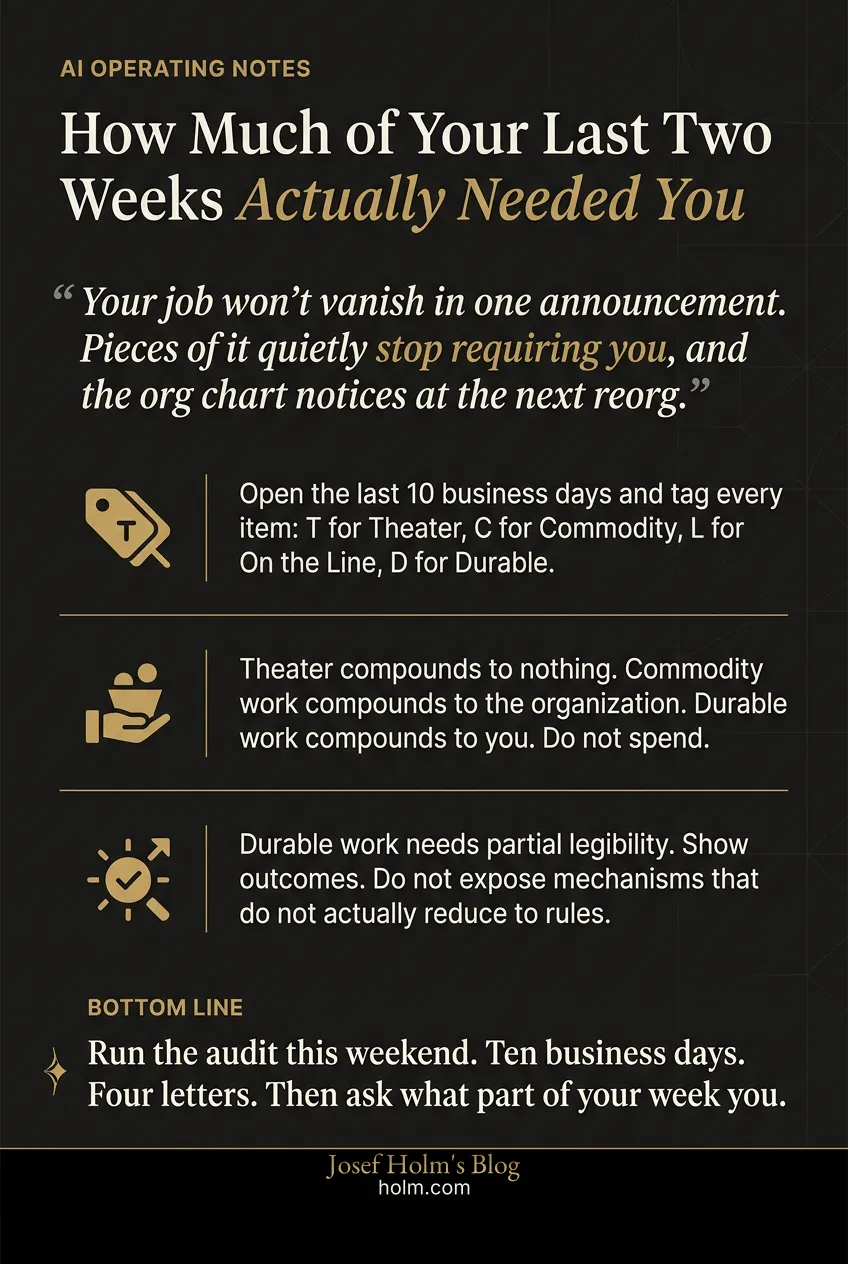
- Your job won't vanish in one announcement. Pieces of it quietly stop requiring you, and the org chart notices at the next reorg.
- Open the last 10 business days and tag every item: T for Theater, C for Commodity, L for On the Line, D for Durable. The metric that matters is T plus C. That is the fraction of your week sitting on thin ice.
- Theater compounds to nothing. Commodity work compounds to the organization. Durable work compounds to you. Do not spend AI-recovered time doing more of the work whose value is collapsing.
- Durable work needs partial legibility. Show outcomes. Do not expose mechanisms that do not actually reduce to rules.
- Run the audit this weekend. Ten business days. Four letters. Then ask what part of your week you are going to stop defending, and what part you are going to start to feed.
The Slow-Then-Sudden Pattern
Your job probably isn't going to disappear in one dramatic announcement. That's not how this works. What happens first is that pieces of it quietly stop requiring you, and the org chart doesn't notice until the next budget freeze or reorg, when someone finally asks why the role is bundled the way it is.
That's the thin ice moment. The work still exists. The title still exists. But less of it actually needs you, and the system hasn't caught up yet.
I've seen this cycle before in other industries. Travel agents didn't vanish when Expedia launched. They kept working for years. The visible break came later, during a downturn, when the industry finally admitted what had already quietly happened. The role still exists today. It just looks almost nothing like it did in 1995.
Knowledge work is sitting in the same pattern right now. And the useful question isn't "Will AI replace me?" It's sharper than that.
How much of your last two weeks actually needed you?
What the Data Actually Says
Three numbers worth holding in your head.
OpenAI and University of Pennsylvania researchers estimate around 80% of U.S. workers could have at least 10% of their tasks affected by language models. Roughly 1 in 5 could see half their tasks affected.
Anthropic's Economic Index reports about 49% of jobs have already had at least a quarter of their tasks performed using Claude.
Microsoft researchers analyzed 200,000 Bing Copilot conversations and found the most common work people bring to AI is information gathering and writing. The most common work AI performs is writing, teaching, providing information, and advising.
Read those again. The encroachment isn't speculative. It's already inside the calendar of most knowledge workers, whether or not the HR system has caught up.
Why Your Company Hasn't Updated Yet
Performance systems measure visible output. Did documents get written? Did meetings happen? Did updates go out? They don't ask whether those outputs actually required you.
That creates a lag window. Your review says you're fine. The economics of your role are already shifting underneath.
On top of that, most large organizations run what I'll call a polite fiction layer. Status meetings that unblock nothing. Decks nobody reads carefully. Alignment calls that produce no alignment. This was sustainable when everyone paid a small cost to keep it going. AI changes the math, because the theater was already operating below the threshold of real human attention. AI only needs to make the theater adequate. Adequate is what the theater already was.
So the theater gets absorbed first. Quietly. Then the commodity work. Then someone looks at the remaining 40% of the role and asks the uncomfortable question.
You want to ask it first.
The Four-Bucket Audit: T, C, L, D
Here's the practical exercise. Open the last 10 business days. Calendar, sent mail, Slack DMs, docs, tickets, tasks. Tag each individual item, not the role, not the project, with one of four letters.
T for Theater
Work that exists because the org performs it, not because it produces examined value. Status meetings where nothing changed. Docs nobody read. Check-ins neither person needed. Reviews that exist for political cover. First rounds of feedback where feedback couldn't change the outcome.
This is the hardest tag to apply honestly. You have to admit professional time went to things that didn't need to happen.
C for Commodity
Real work that produces real value, but doesn't need you specifically. Summarizing, routing, applying known rules to known situations. First drafts in well-known formats. Turning meetings into next steps.
Test: could you write a spec and have someone else produce a nearly identical output? Then it's C.
L for On the Line
The uncomfortable middle. Pattern recognition where the patterns are structured. Relationship management based on carried history. Editorial calibration in established formats. Routine synthesis across familiar inputs.
Work where a strong junior could do 70% and the last 30% feels like judgment you can't fully articulate. Yet.
D for Durable
Work where the output depends on something you cannot fully describe in advance. You changed the question more than you answered it. You saw the stated problem wasn't the real problem. Your presence visibly changed the outcome beyond competence.
Durable work carries context, taste, courage, calibration. It can't be cleanly specified before it begins.
What the Audit Usually Reveals
Three uncomfortable things.
Your T number is bigger than you want it to be. Most people undercount theater because they confuse "professionally expected" with "created value."
Your C number is also bigger than hoped. Commodity skills that took years to build can still become less scarce. Markets don't care how hard something was to learn.
Your D number is smaller than you wanted. Professional identity gets built around durable work. The audit asks how many hours, not how much self-image, actually went there.
The metric that matters is T + C combined. That's the fraction of your week sitting on thin ice.
What Durable Work Actually Looks Like
Most organizations reward question-answering. Someone asks for a plan, you deliver it. But question-answering is highly commodifiable, because the frame is already set.
Durable work often starts before that. It's the person who says "we're asking the wrong question." It's holding the gap between what a customer asks for and what they actually need. It's recognizing that the real problem is trust, incentives, or fear, not the visible issue.
Durable work often gets credit for things that didn't happen. The bad hire you avoided. The six-month product detour you prevented. The customer escalation that never became a crisis.
Here's the part people miss about how different work compounds:
Theater compounds to nothing.
Commodity work compounds to the organization. If you build a better routing system or checklist, the institution captures that value. Not you.
Durable work compounds to you. Pattern recognition built from years of holding ambiguous questions lives in calibration and scar tissue. You can teach around it, but you can't fully transfer it.
The Legibility Paradox
Durable work has to be legible enough that the system values it, but not so legible that the system can run without you.
Some people keep their best work invisible and go uncredited. Others over-explain judgment into a process document, at which point it becomes either delegable (and commoditized) or badly executed by people who lack the underlying intuition.
The answer is partial legibility. Show outcomes. Don't expose mechanisms that don't actually reduce to rules.
Six Moves After the Audit
1. Stop performing the theater. Start with low-political-risk cases. Recurring reports nobody reads. Meetings where you're the third senior person. Check-ins that became rituals. Cancel, skip, or replace with a three-sentence Slack message. Most of the time, nothing happens. That's the point.
2. Don't pour recovered time into more commodity work. This is the trap. Using AI to become twice as productive at work whose value is collapsing. Put the hours into unclear framings, rooms where you're not the expert, closer contact with raw context.
3. Build a private track record of durability calls. Each week, write down one call where the outcome depended on judgment that can't be reduced to rules. Context, call, result, or date to evaluate. After a year, 50 entries. After three years, a real portfolio.
4. Gradually refuse commodity work that doesn't fit your trajectory. Become visibly valuable on non-routine work first. Then renegotiate the routine load. Choose projects with uncertain answers over projects with documented paths. Durable judgment needs messy cases as raw material.
5. Make durable work legible without commodifying it. Talk about outcomes. "I was concerned we were solving the wrong problem and got us to have the conversation." Separate the analysis (transferable) from the judgment (what you do with the analysis). Phrases like "the framework says X, but this case is different" teach people when to bring you in.
6. Be honest about whether you're in the wrong role. If most of your week is T and C with no realistic path to build D, the answer is moving, not better time management. When evaluating new roles, don't trust job descriptions. They rarely capture durable work. Ask current incumbents what they actually spent time on last week, what ambiguous questions they held, what calls they made that no process could have made.
The Identity Problem
The mechanics of this audit are easy. The hard part is what the tags do to your self-story.
Identity updates are psychologically expensive. You pay the cost now and the benefit arrives later. That's why most people don't do it until the org forces them. By then, use is gone.
The advantage goes to people who can update their self-image before the system does it for them.
Same pattern runs at the company level inside an AI readiness note: which pieces of the operation are theater, which are commodity, which are durable, and what's compounding to whom. The question scales from the individual calendar to the entire P&L. If you want to see how we think about it across a company, the rest of our work is built around that same lens.
The Choice
Performance reviews, promotion frameworks, quarterly goals, meeting rituals, all of it was built on the assumption that human output was the scarce thing. That assumption is breaking unevenly. The system will update eventually. During the lag, people who see their own work clearly have an advantage.
You can use AI-recovered time to do more of the work whose value is collapsing. More updates, more summaries, more documents in known formats. It will feel productive. It will be rewarded in the short term.
Or you can use it for work whose value is compounding. Harder questions. Stranger cases. Better judgment. More direct contact with reality. That feels less productive at first. It's less legible. The difference compounds over years.
Run the audit this weekend. Ten business days. Four letters.
Then ask yourself the only question that matters: what part of my week am I going to stop defending, and what part am I going to start to feed?
Infographic
Frequently Asked Questions
- How do I know if my job is at risk from AI?
- Stop asking if AI will replace you. Open your last 10 business days and tag every item: Theater, Commodity, On the Line, or Durable. Your T plus C number is the fraction of your week sitting on thin ice. That is the signal, not any announcement from leadership.
- What counts as durable work?
- Work where the output depends on something you cannot fully describe in advance. You changed the question more than you answered it. You saw the stated problem was not the real problem. Your presence visibly changed the outcome. It carries context, taste, and calibration that cannot be cleanly specified before the work begins.
- Why hasn't my company noticed the shift yet?
- Performance systems measure visible output, not whether the output required you. Most large organizations also run a polite fiction layer of status meetings, unread decks, and alignment calls that produce no alignment. AI absorbs the theater first, quietly, because the theater was already operating below real human attention.
- What should I do with the time AI gives back?
- Do not pour it into more commodity work. That is the trap. Becoming twice as productive at work whose value is collapsing does not help you. Put the hours into unclear framings, rooms where you are not the expert, and closer contact with raw context.
- How do I make durable work visible without commodifying it?
- Partial legibility. Show outcomes, not mechanisms. Talk about the bad hire you avoided, the detour you prevented, the wrong question you reframed. Separate the analysis, which is transferable, from the judgment, which is what you do with the analysis. Teach people when to bring you in, not how to replace you.
- When does the audit tell me to change roles?
- If most of your week is Theater and Commodity with no realistic path to build Durable work, the answer is moving, not better time management. When evaluating new roles, do not trust job descriptions. Ask current incumbents what ambiguous questions they held last week and what calls they made that no process could have made.