
AI Agents Are Breaking Microsoft GitHub
Key Takeaways
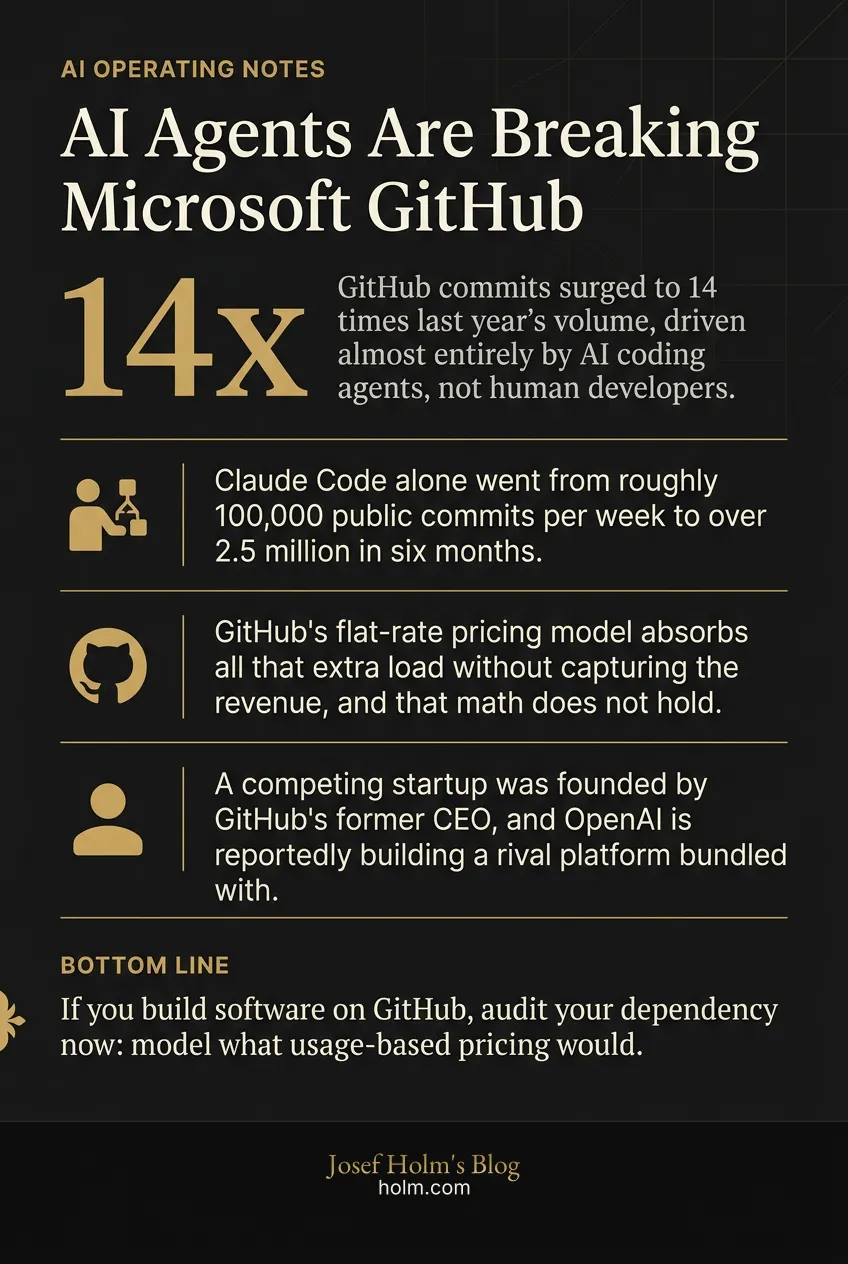
- GitHub commits surged to 14 times last year's volume, driven almost entirely by AI coding agents, not human developers.
- Claude Code alone went from roughly 100,000 public commits per week to over 2.5 million in six months.
- GitHub's flat-rate model absorbs all that extra load without capturing the revenue, and that math does not hold long-term.
- A competing startup was founded by GitHub's former CEO, and OpenAI is reportedly building a rival platform bundled with Codex.
- If you build software on GitHub, audit your dependency now: model what usage-based would cost you, and identify your contingency if reliability keeps degrading.
The Platform That Won by Default Is About to Learn What Competition Feels Like
GitHub has been the center of gravity for code storage and collaboration for so long that most people stopped questioning whether it should be. That's changing fast. The reason is worth paying attention to even if you never write a line of code.
AI coding agents are flooding GitHub with submissions at a pace the platform wasn't built to handle. The numbers are striking. But the real story isn't infrastructure strain. It's what happens when the core assumptions underneath a dominant platform shift all at once.
I've watched this pattern play out across multiple technology cycles. A platform wins by becoming the default. Then something changes the economics or the user base so dramatically that "default" stops being enough. GitHub is entering that phase right now.
What's Actually Happening with AI-Generated Code?
The scale is hard to overstate. GitHub's COO Kyle Daigle confirmed that commits on the platform have surged to roughly 14 times the volume from the prior year. That's not a growth curve. That's a step function.
One data point makes it concrete: public commits signed by Claude Code have increased about 25-fold in six months. Six months ago, roughly 100,000 per week. Now, more than 2.5 million per week. And that's just one agent from one provider.
AI agents don't take breaks. They don't context-switch. They don't spend 20 minutes deciding on a variable name. They generate and submit code at a pace that makes human output look like a rounding error. So here's the question every business leader should be asking: when the volume of code on a platform multiplies by an order of magnitude and the composition of who (or what) is generating it changes fundamentally, does the platform's value proposition hold?
Why Does This Matter If You're Not a Developer?
GitHub is infrastructure. It sits underneath the software that runs your business, your products, your operations. When the reliability of that infrastructure degrades, it shows up in ways you feel even if you can't name the cause.
The traffic surge from AI agents has already contributed to outages and reduced reliability. That's a direct operational risk for any company that depends on GitHub for version control, collaboration, or deployment pipelines. Which is most companies building software today.
The infrastructure strain is actually the simpler problem. The harder one is economic.
GitHub charges flat-rate monthly subscriptions. A developer running an AI agent that submits thousands of commits per day pays the same as someone pushing code once a week. The platform absorbs all the cost of that increased load without capturing any of the incremental value. This is a familiar pattern. It happened with cloud storage. It happened with API-based services. When usage patterns change faster than models, someone ends up subsidizing someone else. Usually the platform.
Will GitHub Start Charging Differently?
This is the question I'd be asking if I were advising GitHub's leadership. So far, they haven't signaled plans to charge based on agent usage volume. But the pressure is building.
Other enterprise software companies are already moving in this direction. Workday, for example, announced it's considering "tollgates" for AI agents that would charge based on usage volume. The logic is straightforward: if agents consume 10x the resources of a human user, flat-rate doesn't work.
GitHub's hesitation makes sense strategically. Their entire moat is based on being the default. The more people (and now agents) who use GitHub, the more standardized it becomes. Introducing friction through usage-based could push users toward alternatives at exactly the moment when alternatives are starting to appear.
But absorbing exponentially growing costs without corresponding revenue isn't a strategy. It's a countdown.
The companies I work with through our AI readiness note process are already thinking about this kind of structural shift. Not just "what tools are we using" but "what happens to the economics of our tool stack when AI agents change the usage patterns." GitHub is a case study in why that question matters.
Who's Coming After GitHub?
GitHub's competitive position has been so dominant for so long that most people assumed it was permanent. Two developments suggest otherwise.
First, GitHub's former CEO Thomas Dohmke left about nine months ago and founded a startup specifically targeting the market for editing and managing AI-generated code. When a former CEO leaves to compete with the company he just ran, that tells you something about where he thinks the vulnerabilities are.
Second, OpenAI is reportedly considering building its own GitHub alternative. The logic is obvious: if you're already providing the AI agent that generates the code (Codex), why not also provide the platform where that code lives? Bundle the generation and the storage. Collapse the stack.
That second development is what should concern GitHub most. When AI expands the population of people who can generate code to include those without deep programming knowledge, the market for code hosting gets much bigger. But it also gets much more contestable. New users don't have years of muscle memory tied to GitHub. They don't have legacy repositories creating switching costs. They're starting fresh, and they'll go wherever the experience is best.
The market for code hosting is, as one observer put it, increasingly "up for grabs."
What's GitHub's Actual Strategy Here?
GitHub's approach is to remain the default destination for anyone storing or collaborating on code. No quality filters. No submission standards. Free tiers for anyone who wants them. The bet is that volume creates standardization, standardization creates inertia, and inertia creates a moat.
This has worked exceptionally well, particularly in open source. The sheer volume of code already on GitHub makes it the path of least resistance for most developers and companies. Migration costs are real. Workflows are built around it. Institutional knowledge assumes it.
GitHub also generates revenue from its own AI product, GitHub Copilot, powered by models from Anthropic and OpenAI. As developers increasingly rely on AI tools, Copilot has been growing. So GitHub isn't just a passive host. It's also selling the AI layer on top.
Here's what I think most people are missing. The "volume creates moat" strategy works when the volume is organic and the users are sticky. When the volume is generated by AI agents that could just as easily point at a different platform, the inertia argument weakens considerably. An agent doesn't care where it pushes code. It goes wherever the API endpoint is configured to send it.
That's a fundamentally different kind of user than a human developer who has spent years building workflows, muscle memory, and social connections on a platform.
What Should Business Leaders Take from This?
If you run a company that builds software, a few things matter right now.
Audit your dependency. How deeply is GitHub embedded in your development workflow? What happens if reliability continues to degrade? What's your contingency? These aren't theoretical questions anymore. The outages have already started.
Watch the. If GitHub moves to usage-based for agent-generated activity, your costs could change much. If they don't, the platform's financial sustainability becomes a different kind of risk. Either way, you should be modeling scenarios.
Pay attention to the competitive field. The next 18 months will determine whether GitHub maintains its position or whether the AI-driven expansion of the coding population fragments the market. If OpenAI ships a code hosting platform bundled with Codex, that changes the calculus for a lot of teams.
This is the kind of structural shift we help companies think through at Josef Holm. Not the hype cycle. Not the feature announcements. The underlying changes in economics, competition, and platform dynamics that determine which bets pay off and which ones leave you exposed.
The Deeper Pattern
I've seen versions of this story play out for 25 years. A platform becomes dominant. The dominant platform builds for the world as it is. Then something changes the world faster than the platform can adapt.
In this case, that something is AI agents that treat code generation as a commodity activity and code hosting as a utility. When both the creation and the storage of code become automated, the value shifts. It moves toward curation, quality, trust, and integration. The platform that figures out how to deliver those things in an agent-first world wins the next phase.
GitHub might be that platform. They have the scale, the brand, and the installed base. But scale without adaptation is just a bigger target.
The companies that come through these transitions well are the ones that see the shift early and make decisions before the market forces them to. That's true whether you're GitHub or a company that depends on GitHub.
If you're trying to figure out where your organization stands in this kind of shift, that's exactly what our AI readiness note is designed to clarify. Not a slide deck. A working assessment of where AI is changing your operational reality and what to do about it.
Where This Ends Up
GitHub's position isn't collapsing tomorrow. The inertia is real. The switching costs are real. But the conditions that made GitHub's dominance feel permanent are changing.
AI agents are rewriting the economics of code generation and storage. New competitors are emerging from directions GitHub didn't have to worry about two years ago. The user base is expanding to include people who have no loyalty to any existing platform.
The question isn't whether GitHub survives. It almost certainly does in some form. The real question is whether it remains the gravitational center of software development or becomes one option among several.
For anyone building a business on top of this infrastructure, that's not an abstract question. It's an operational one. And the time to think about it is before the answer becomes obvious.
Infographic
Frequently Asked Questions
- How much has AI-generated code increased on GitHub?
- GitHub's COO confirmed commits have surged to about 14 times last year's volume. Claude Code alone went from roughly 100,000 public commits per week to over 2.5 million per week in six months. And that's just one agent from one provider.
- Is GitHub's reliability at risk because of AI agents?
- Yes, it already is. The traffic surge from AI agents has contributed to outages and reduced reliability on the platform. If your development workflow depends on GitHub for version control or deployment pipelines, that's a live operational risk, not a theoretical one.
- Will GitHub change its because of AI agent usage?
- They haven't announced changes yet, but the pressure is real. Other enterprise software companies like Workday are already exploring usage-based tolls for AI agents. GitHub's hesitation is strategic since friction could push users to alternatives. But absorbing exponentially growing costs without matching revenue is not a long-term answer.
- Who is competing with GitHub now?
- Two developments stand out. GitHub's former CEO Thomas Dohmke left to build a startup focused on managing AI-generated code. And OpenAI is reportedly considering its own code hosting platform bundled with Codex. That second one is the bigger threat because it collapses code generation and storage into one product from a single vendor.
- Why does GitHub's competitive moat weaken with AI agents?
- GitHub's moat has always been human developer inertia: years of workflows, muscle memory, and social connections. AI agents have none of that. An agent pushes code wherever the API endpoint tells it to. That makes the switching cost argument much weaker for the fastest-growing segment of GitHub's user base.
- What should a business leader do about this right now?
- Three things: audit how deeply GitHub is embedded in your workflows and identify your contingency if reliability degrades further; model what usage-based would do to your costs if GitHub shifts its model; and watch whether OpenAI ships a bundled code hosting product in the next 18 months, because that changes the decision for a lot of teams.