
Is Your Business Invisible to AI Agents?
Key Takeaways
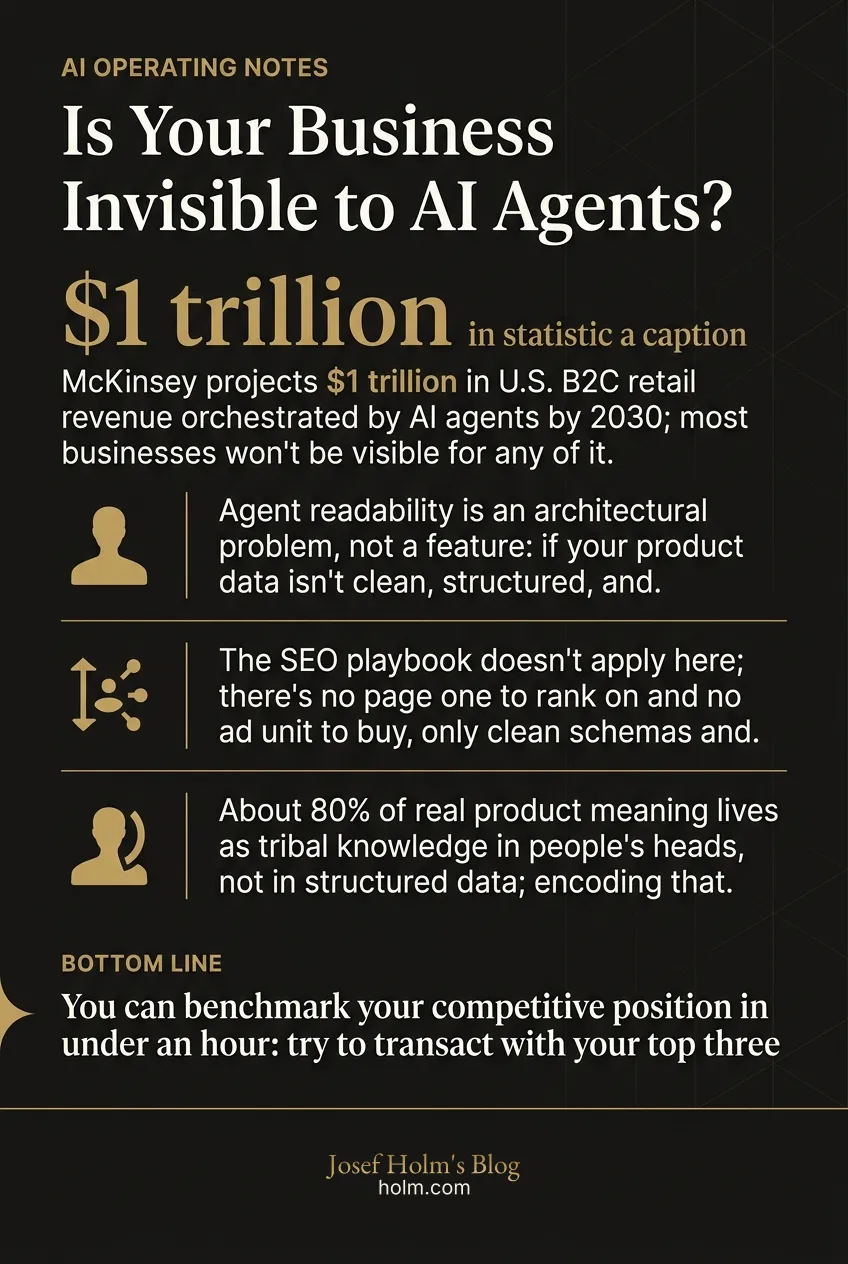
- McKinsey projects $1 trillion in U.S. B2C retail revenue orchestrated by AI agents by 2030; most businesses won't be visible for any of it.
- Agent readability is an architectural problem, not a feature: if your product data isn't clean, structured, and queryable, agents skip you with zero second chances.
- The SEO playbook doesn't apply here; there's no page one to rank on and no ad unit to buy, only clean schemas and low-friction data access points win.
- About 80% of real product meaning lives as tribal knowledge in people's heads, not in structured data; encoding that knowledge is now an operational priority.
- You can benchmark your competitive position in under an hour: try to transact with your top three competitors through Claude or ChatGPT, then do the same with your own company.
The $1 Trillion Question Nobody's Asking
McKinsey projects that by 2030, up to $1 trillion in U.S. B2C retail revenue could be orchestrated by AI agents. That number gets passed around boardrooms and conference stages like a trophy. Everyone wants a piece of it.
Here's what almost nobody is talking about: most businesses are currently invisible to those agents. Not because they lack great products. Not because they haven't "adopted AI." Because their systems, their data, their transactional infrastructure simply can't be read or written by an AI agent.
That's the structural gap. And it's enormous.
What Does "Agent Readable" Actually Mean?
You've probably seen the demos. An agent books a flight, compares running shoes, manages a subscription renewal. It looks effortless. What those demos don't show is the work that had to happen first: making product data,, availability, shipping terms, and return policies accessible in structured, queryable formats.
Agent readability isn't a feature you bolt on. It's an architectural characteristic. An AI agent needs to discover your product, evaluate it against a customer's specific constraints, and complete a transaction without a human stepping in to translate or fill gaps.
If your data isn't clean all the way down the stack, the agent moves on. No second chances.
I saw this dynamic firsthand working with companies scaling digital operations. The ones who invested in clean data foundations could personalize at scale. The ones who didn't were always playing catch-up, papering over bad data with marketing spend. That was before agents. The stakes now are a different order of magnitude.
Why Is This So Hard? Fifteen Years of Anti-Bot Architecture
For roughly 15 years, the software industry built systems specifically designed to keep bots out. CAPTCHAs, gated APIs, JavaScript-heavy interfaces. The operating assumption was simple: bots were bad. They polluted human experiences.
That entire architectural philosophy now needs to be reversed.
Think about what that actually requires. WhatsApp spent years locking bots out. Apple recently moved to restrict vibe-coding apps from its App Store. Google has quietly attempted to shut down agent-based tools using its services. The incumbents are resisting, which makes sense given their histories.
The parallel to Napster is hard to ignore. The major players resisted freely available music streaming for years. The shift survived anyway and became iTunes, which ironically helped Apple launch the iPhone. Resistance doesn't change the direction. It just changes who benefits first.
Who's Moving and Who Isn't?
The companies leaning in are instructive. So are the ones dragging their feet.
Stripe: Ahead, But Not Done
Stripe shipped an MCP server that lets agents look up customers, process refunds, and manage subscriptions. That's further along than most. But there's a deeper problem worth understanding.
Stripe's analytics layer, Sigma, allows unlimited CSV exports of transaction data. That works fine for human analysts. Wrapping Sigma in an MCP server would immediately overload an agent's context window. The data that works as a spreadsheet export doesn't work when loaded natively into an agent's operating context.
The fix requires an intermediary database layer, one that stores structured data and lets agents query manageable slices of it. At Stripe's scale, with the sensitivity of financial data, building that securely is a genuinely hard engineering problem. Even companies leaning into this future haven't fully solved it.
SAP: The Grand Canyon
SAP sits at the other end. Its entire business model has historically been built around keeping data inside its own walls. SAP announced an MCP server for Commerce Cloud, but the gap between that narrow slice having AI features and all SAP installations being agent readable by default is, as one observer put it, "the Grand Canyon."
For most SAP installations in production, making systems truly agent readable is a multi-quarter initiative at minimum. And SAP currently has limited incentive to prioritize it.
I think that changes within 6 to 8 months. Companies will start looking down their own data stacks, having honest conversations with their vendors, and asking a simple question: is our data in a format agents can read and write against? Collective customer pressure will eventually force the SAPs of the world to move. This is going to be one of the most important enterprise stories of 2026.
Shopify: Betting the Company
Shopify's CEO Tobi Lütke has called agentic shopping "the transformation of a lifetime." Over one million Shopify merchants are coming online to allow agent-mediated transactions. Google launched a Universal Commerce Protocol designed to let agents discover products, build carts, and complete checkouts autonomously.
The infrastructure is being built. The question is whether your business is connected to it.
What Does Agent Commerce Actually Look Like Today?
Forget the abstract. Here's a concrete example that's possible right now.
A customer types: "Find me running shoes under $120, size 10, that ship before Thursday, from a brand with flexible returns."
An agent receiving that query evaluates structured data against those explicit constraints and returns a result. The quality of that result is entirely a function of how agent readable the underlying company systems are.
Research from Nshift makes the stakes clear: if delivery windows, shipping costs, and returns policies are unclear, and if product schemas aren't structured, an agent will skip the offer entirely. No human ever sees it. The best product in the world becomes invisible.
That's not a theoretical risk. It's happening now.
Four Misconceptions That Are Costing Companies Time
I keep hearing the same four mistakes from executives. They sound reasonable on the surface but fall apart under scrutiny.
"This Is Like SEO. We'll Improve for It."
This is probably the most expensive misconception. A search engine returns a ranked list influenced by ad spend, brand recognition, and positioning. You can buy your way to visibility.
An agent doesn't browse a list. It evaluates structured data against explicit constraints and returns a result. There's no page one to rank on. There's no ad unit to buy. The companies that win will have the cleanest schemas and lowest-friction data access points. Not the largest media budgets.
Does that mean brand doesn't matter? No. But brand alone doesn't get you into the consideration set when the buyer's agent is doing the filtering.
"Structured Schemas Don't Work for Complex Products."
I hear this most from companies in luxury, authenticity-driven, or highly considered categories. The argument is exactly backwards.
The more complex a product, the more a customer benefits from agent readability. Complexity is precisely what prevents customers from making good purchases today. They settle for "good enough" because evaluating all the variables manually is too difficult.
Coffee is a good example. Origin, processing method, roast profile, sourcing practices. Those are all data attributes an agent can read. A wine's terroir, a supplement's third-party testing results, a luxury watch's movement specifications. If it can be represented on a screen, it can be made agent readable.
Complexity isn't a reason to avoid structured data. It's the reason structured data matters most.
"Customers Won't Trust Agents to Buy Things."
Agent commerce doesn't start with fully autonomous purchasing. That's the end state, not the beginning.
It starts with what I'd call long-horizon intent delegation. A customer describes their requirements, constraints, and preferences, then asks the agent to help evaluate options. No transaction yet. Just research and comparison at a depth and speed no human can match.
Trust is a spectrum, not a binary switch. It starts narrow and expands as the individual gains confidence in the agent's judgment. Companies should aim to make their products available across that entire trust spectrum, from early research through final purchase.
This applies to B2B just as much as consumer. The consideration funnel is moving into agent territory. B2B buyers are already asking whether their agent can read and interact with a given SaaS product. If it can't, the product doesn't make the shortlist.
"We'll Wait and See."
This is the one that concerns me most. "Wait and see" sounds prudent. It sounds like responsible risk management.
In practice, it's a company-ending posture.
Cleaning data and making it agent readable takes months. Sometimes quarters. By the time a company fully understands the agent world and declares readiness, the market will have moved past them. The MCP protocol reference setup accumulated 250,000 GitHub stars in a matter of weeks. That's the pace of change we're dealing.
Waiting isn't caution. It's choosing to be invisible during the most important infrastructure shift since mobile.
The Tribal Knowledge Problem Nobody Wants to Admit
Here's a challenge that doesn't get enough attention: most meaningful product information doesn't live in structured data. It lives in people's heads, in marketing copy, on packaging, in sales decks.
I'd estimate roughly 20% of a product's real meaning is represented in data structures today. The other 80% exists as tribal knowledge.
A basketball that's the same model used in the NCAA March Madness tournament. A coffee sourced from a small farm that supports a local school in Ethiopia. A SaaS platform proven to scale to 10,000 concurrent users under specific load conditions.
These are the attributes customers will ask about when interacting with agents. If that information isn't in structured, agent-readable data, the product won't surface in relevant queries. Period.
For B2B SaaS, this means representing claims like "proven to scale" with verifiable technical credentials, not a single blog post case study. Agents won't be satisfied with thin evidence. They'll look for structured proof points, and if they don't find them, they'll recommend the competitor who provided them.
Companies must systematically extract tribal knowledge and encode it as durable data attributes. That's not a marketing project. It's an operational one.
A Practical Exercise You Can Do This Week
Go to your top three competitors. Try to transact with each of them through Claude or ChatGPT. See how far the agent gets. Can it find the product? Can it evaluate and availability? Can it compare options against specific constraints?
Then do the same with your own company.
Benchmark how difficult it is to extract data. Check whether MCP connectors exist. See whether competitors are ahead or behind.
This takes less than an hour and will tell you more about your competitive position in the agent economy than any analyst report.
Monitoring How AI Already Sees Your Brand
Beyond making your systems agent-ready for transactions, there's a more immediate question: how is AI representing your brand right now? When someone asks ChatGPT or another AI system to recommend a product in your category, do you show up? And if you do, is the information accurate?
This is where Akii fits. Akii is an agentic brand intelligence platform that continuously monitors how your brand is represented across AI-driven discovery. When buyers ask AI what to choose, your brand should be the answer. Akii detects competitor and market shifts across AI engines, then turns those signals into prioritized actions that improve visibility, authority, and growth. It's a way to understand, right now, whether the AI layer is working for you or against you, without waiting for a six-month consulting engagement to tell you what you could have learned this week.
Building for Agents Improves the Human Experience Too
One thing I want to be clear about: building for agent readability doesn't mean abandoning human customers. The opposite is true.
Clean, structured data that agents can read also powers sharply better personalized human experiences. Better product recommendations. More accurate search results. Faster checkout flows.
The companies that structure their businesses and data around agent attention first will find that the human experience improves as a byproduct. That's not a happy accident. It's how good data architecture has always worked.
What Happens Next
Over the next 6 to 8 months, the conversation shifts. Companies stop asking "should we care about AI agents?" and start asking "can our vendors actually support agent-readable data?" That's when the real pressure builds.
The companies that started cleaning their data stacks six months ago will be in position. The ones that treated this as a future problem will be scrambling. And the ones that waited will be explaining to their boards why they're invisible in the fastest-growing commerce channel in a generation.
I've watched enough technology cycles to know that the window between "interesting trend" and "table stakes" is shorter than people expect. It was true for mobile. It was true for cloud. It's going to be true for agent readability.
The companies that win this transition won't necessarily be the biggest or the best-funded. They'll be the ones whose data is clean, structured, and accessible when the agents come looking.
If you're running a business and you're not sure where to start, the AI readiness note we built at Josef Holm is designed for exactly this moment. It's a practical assessment of where your organization stands and what needs to change. Not theory. Not a slide deck. A clear picture of what's working, what's broken, and what to fix first.
The trillion-dollar shift is real. The only question is whether your business is visible when it happens.
Infographic
Frequently Asked Questions
- What does it mean for a business to be 'agent readable'?
- It means an AI agent can discover your products, evaluate them against a customer's specific constraints, and complete a transaction without a human stepping in to fill gaps. If your product data,, availability, and return policies aren't in clean, structured, queryable formats, the agent moves on. No second look.
- How is agent commerce different from SEO or paid search?
- Search returns a ranked list. You can buy your way onto page one. An agent evaluates structured data against explicit constraints and returns a single result. There's no ranking to climb and no ad unit to buy. The businesses that win are the ones with the cleanest data, not the largest media budgets.
- My products are complex. Can they really be made agent readable?
- Yes, and complexity is actually the strongest argument for doing it. Complexity is what stops customers from making good decisions today. If a product attribute can be displayed on a screen, it can be encoded as structured data. Origin, certifications, performance specs, sourcing details: all readable by an agent if you build it right.
- How long does it actually take to make systems agent ready?
- For most businesses, cleaning data and building the necessary infrastructure takes months, sometimes quarters. That's the core problem with waiting. By the time you fully understand the urgency and declare readiness, the market will have moved. Start the assessment now, not after the shift becomes obvious.
- What is the tribal knowledge problem and why does it matter for AI agents?
- Most meaningful product information lives in people's heads, in sales decks, on packaging, not in structured data. Roughly 80% of a product's real value is tribal knowledge. Agents won't find it there. If that information isn't encoded as structured, durable data attributes, the product won't surface when a relevant query comes in.
- How can I quickly assess where my business stands in the agent economy?
- Try to transact with your top three competitors using Claude or ChatGPT. Then do the same with your own company. Check whether MCP connectors exist, whether and availability are discoverable, and how far the agent gets before it hits a wall. This takes under an hour and tells you more than any analyst report.