
Most Businesses Are Invisible to AI Agents
Key Takeaways
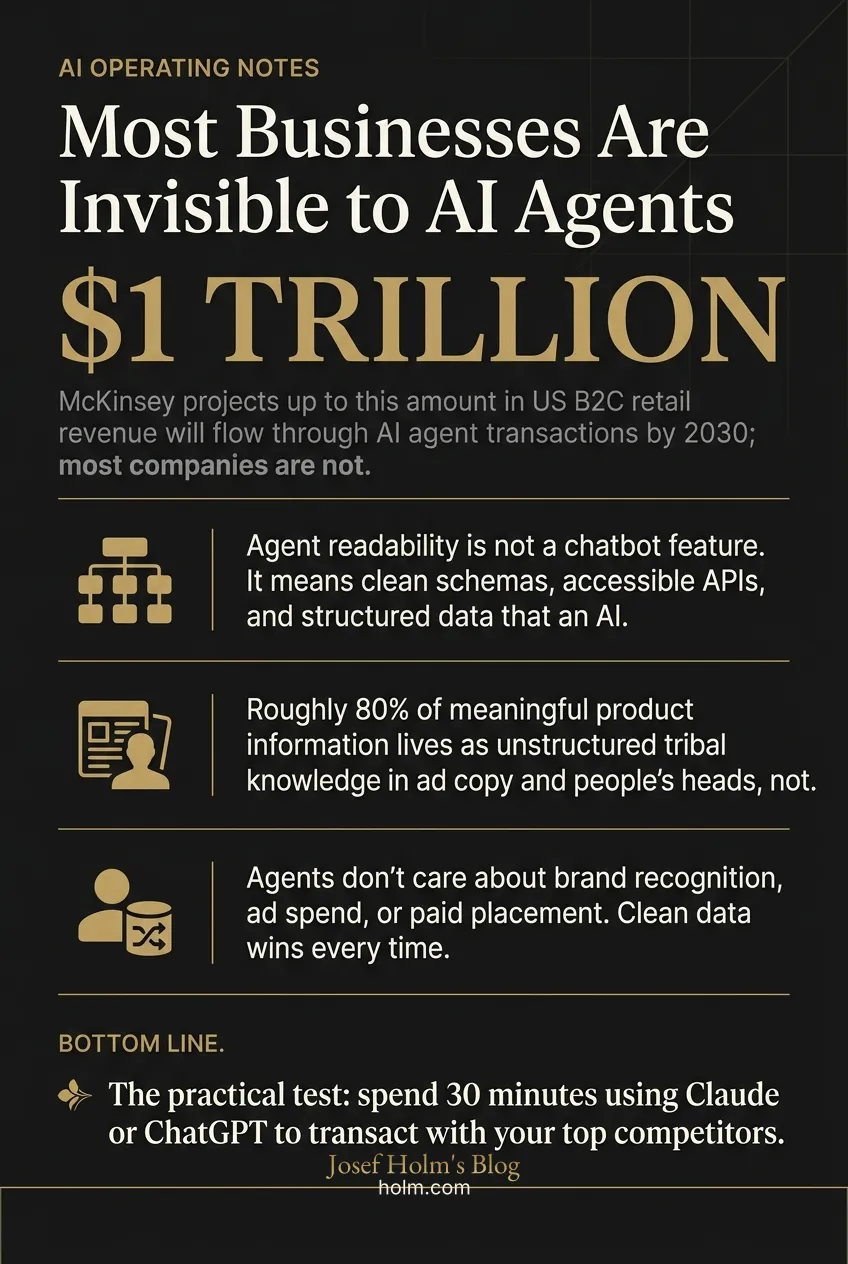
- McKinsey projects up to $1 trillion in US B2C retail revenue will flow through AI agent transactions by 2030; most companies are not structurally ready for this.
- Agent readability is not a chatbot feature. It means clean schemas, accessible APIs, and structured data that an AI agent can read and write against without human help.
- Roughly 80% of meaningful product information lives as unstructured tribal knowledge in ad copy and people's heads, not in data fields agents can actually use.
- Agents don't care about brand recognition, ad spend, or paid placement. Clean data wins every time.
- The practical test: spend 30 minutes using Claude or ChatGPT to transact with your top competitors, then try your own company. The gaps will be obvious.
They just don't know it yet.
McKinsey projects that by 2030, up to $1 trillion in US B2C retail revenue could flow through AI agent-orchestrated transactions. Google launched the Universal Commerce Protocol so agents can discover products, build carts, and check out without a human touching a browser. Shopify's CEO Tobi Lütke called agentic shopping "the transformation of a lifetime," with over a million merchants moving toward agent-mediated commerce. OpenClaw, an open-source personal AI agent project, hit 250,000 GitHub stars within weeks of launch.
The infrastructure for agent commerce is being built right now. Almost nobody is talking about the structural requirement that makes any of it work.
What does "agent readable" actually mean?
There's a concept that should be dominating every executive conversation about AI but isn't: making your company's systems agent readable and writable.
This isn't about chatbot features or bolting an AI widget onto your website. It's about the transactional infrastructure that allows an AI agent to discover your products, evaluate them against a buyer's constraints, and complete a purchase or interaction without a human in the loop.
Andrej Karpathy has argued that 99% of future attention will be AI attention. More specifically, agent attention. For that to mean anything commercially, agents need systems they can read from and write to. That requires company-level and system-level change across thousands of businesses.
Here's a concrete example of what's already possible. A user asks an AI assistant to "find me running shoes under $120, size 10, that ship before Thursday, from a brand with flexible returns." The agent returns a usable answer. The quality of that answer is entirely a function of how agent readable the relevant companies' systems are.
If your data is messy, gated, or buried in JavaScript-heavy interfaces, you don't show up. Period.
Why is everyone ignoring the hard part?
The industry is fixated on personal AI productivity tools. The demos are fun. The vision is compelling. But almost no one is discussing the structural precondition that makes those tools viable in commerce.
The reason is simple: the hard part isn't exciting. Wrapping an existing API in an MCP server feels like progress. It isn't. It's the equivalent of repainting a building with foundation problems.
Humans are forgiving when they interact with imperfect data. They skip details, fill in gaps, respond to marketing that papers over product deficiencies. Agents don't do any of that. Agents evaluate structured data against explicit constraints and return results. There's no "above the fold" for an agent. No brand recognition advantage. No ad creative. No paid placement.
The companies that win will have the cleanest schemas and the lowest-friction data access points. That's the whole game.
Isn't the whole internet designed to keep bots out?
This is what makes the transition so structurally difficult. The entire software stack built over the past 15 years was designed to keep bots out. CAPTCHAs, gated APIs, JavaScript-heavy interfaces. All of it built on the premise that bots pollute human experiences.
That premise is now inverted. The most valuable traffic a business will receive over the next three years will be AI agents acting on behalf of humans.
Large incumbents are resisting. Google moved to shut down OpenClaw bots using its products. Apple restricted vibe-coding apps including Replit from its App Store. The pattern is familiar. It's the music industry's response to Napster: fight the shift, lose anyway, and watch someone else build iTunes on top of the change you tried to prevent.
The deeper reason incumbents resist is the loss of direct customer relationships. If a customer shops through Claude or ChatGPT and doesn't care whether they land on Amazon or another retailer, that's existential for merchants who built their moats around loyalty and direct engagement. Resisting doesn't change the direction. It just means you arrive late.
How hard is it to actually make systems agent ready?
Much harder than most people assume. Two examples show the spectrum.
Stripe is considered an early adopter. It shipped an MCP server that lets agents look up customers, process refunds, and manage subscriptions. But its deeper analytics layer, Sigma, presents a harder problem. Sigma allows unlimited CSV exports of transaction data. That format worked fine when humans saved files locally. When the same data source is wrapped in an MCP and loaded into an agent's context window, it overflows the context. The fix requires an intermediary database layer, structured data tables, and carefully scoped authenticated agent access. At Stripe's scale, with the sensitivity of financial data, this is a large engineering and security challenge. Not a weekend project.
SAP sits at the other end. SAP's incentive structure is built around keeping data inside its own walls. While SAP announced an MCP server for Commerce Cloud, the gap between that narrow build and making all SAP installations agent readable by default is enormous. For most SAP deployments, achieving true agent readability is a multi-quarter initiative. And SAP currently has limited incentive to prioritize it.
Over the next six to eight months, I expect companies to start looking down their own data stacks and having honest conversations with vendors about whether their data is in a format agents can actually read and write against. Collective customer pressure will eventually force adaptation. The companies that start now will have a notable head start.
What about all the knowledge that isn't in your database?
This is the part almost everyone underestimates. The majority of meaningful product information exists as tribal knowledge. It's in marketing copy, in people's heads, in product packaging. Not in structured data.
I'd estimate roughly 20% of product meaning is represented in data structures. The other 80% lives in unstructured formats that agents can't easily read.
Think about it. A coffee product's story about supporting a small Ethiopian farm and a local school exists in ad copy, not in a data attribute. A basketball being the same model used in the NCAA March Madness tournament is a marketing claim, not a structured schema field. A B2B SaaS product's proven ability to scale to 10,000 customers may exist in one blog post case study, not in verifiable technical credentials.
Agents won't be fooled by vague marketing language. Increasingly sophisticated agents will take a vague human intent and investigate deeply. Companies need to extract that tribal knowledge and encode it as durable, structured, agent-readable data attributes. This is labor-intensive. It's also non-optional.
What are executives getting wrong right now?
Four things, mostly.
"Agent tuning is like SEO." It isn't. Search engines return ranked lists influenced by ad spend, brand recognition, and positioning. Agents evaluate structured data against explicit constraints and return a result. Clean schemas beat large ad budgets every time.
"Structured schemas only work for simple products." The opposite is true. The more complex a product, the more customers benefit from agent-mediated evaluation. Complexity is precisely what prevents customers from making good purchasing decisions today. Anything that can be represented on a screen can be represented as agent-readable data.
"Customers won't trust agents to transact." Trust isn't binary. It's a spectrum. It starts with long-horizon intent delegation, like helping a customer research and compare options, and expands as the individual grants more permissions over time. Companies should focus on making their products available across that entire trust spectrum, not just at the point of final transaction.
"We can wait and see." This is the most dangerous one. Cleaning data and making systems agent readable takes months to quarters. Companies that wait until the agent network is fully mature will have already been passed by. OpenClaw's growth illustrates how fast the market is moving.
How do you know where you stand?
Here's a practical exercise I'd recommend to any executive reading this. Use Claude or ChatGPT to attempt a meaningful transactional interaction with your top two or three competitors. Then do the same with your own company. See how far the agent can get. How hard is it to extract data? Do MCP connectors exist? Where are the gaps?
This takes about 30 minutes and will tell you more about your competitive position in the agent era than most strategy decks.
If you want to go deeper, this is exactly the kind of visibility gap that Akii is built to detect and close. Akii continuously monitors how your brand is represented across AI-driven discovery, detects competitor and market shifts, and turns those signals into prioritized actions your team can execute immediately. When buyers ask AI what to choose, your brand should be the answer. Most teams don't know whether they're being recommended or replaced. Akii tells you, and tells you what to do about it.
At Josef Holm, we work with companies that recognize this shift is structural, not cosmetic. Our AI readiness note is designed to help leadership teams assess exactly where they stand and what needs to change.
The part nobody mentions: building for agents also builds for humans
Building for agents first also benefits human users. Clean, structured data, including tribal knowledge encoded into proper schemas, makes it easier to build dynamic, personalized web experiences for humans as well. The two goals are complementary, not competing.
I learned this firsthand at Prime Video, where building personalized title experiences revealed that without clean underlying data all the way down the stack, the end customer experience degrades. That lesson, learned in a pre-agent context, becomes exponentially more important when AI agents consume data at scale.
The companies that move now won't just be ready for agent commerce. They'll have better human experiences too. The ones that wait will be invisible to both.
Infographic
Frequently Asked Questions
- What does it mean for a business to be agent readable?
- It means an AI agent can discover your products, evaluate them against a buyer's specific constraints, and complete a transaction without a human in the loop. That requires clean structured data, accessible APIs, and no JavaScript-heavy walls blocking automated access.
- How is agent tuning different from SEO?
- SEO is influenced by ad spend, brand recognition, and positioning. Agents evaluate structured data against explicit constraints and return a result. There is no 'above the fold' for an agent, no paid placement, and no brand halo. Clean schemas beat large ad budgets every time.
- How long does it take to make company systems agent ready?
- Months to quarters for most organizations. Cleaning data, encoding tribal knowledge into structured attributes, setting up authenticated agent access, and working with vendors to open data layers is not a weekend project. Companies like SAP require multi-quarter initiatives just to reach basic agent readability.
- What is tribal knowledge and why does it matter for AI agents?
- Tribal knowledge is meaningful product information that exists in marketing copy, people's heads, or product packaging rather than in structured data fields. Roughly 80% of product meaning lives here. Agents cannot read it in unstructured form. Companies need to extract and encode it as structured, durable data attributes.
- How can I quickly assess my company's agent readiness?
- Use Claude or ChatGPT to attempt a meaningful transactional interaction with your top two or three competitors, then do the same for your own company. See how far the agent gets, how easy it is to extract data, and where the gaps are. This takes about 30 minutes and tells you more than most strategy decks.
- Will customers actually trust AI agents to make purchases on their behalf?
- Trust builds gradually. It starts with research and comparison tasks, then expands as users grant more permissions over time. The right move is to make your products available across that entire trust spectrum, not just at the point of final checkout.