Half of US Companies Just Fired the Wrong Managers
Key Takeaways
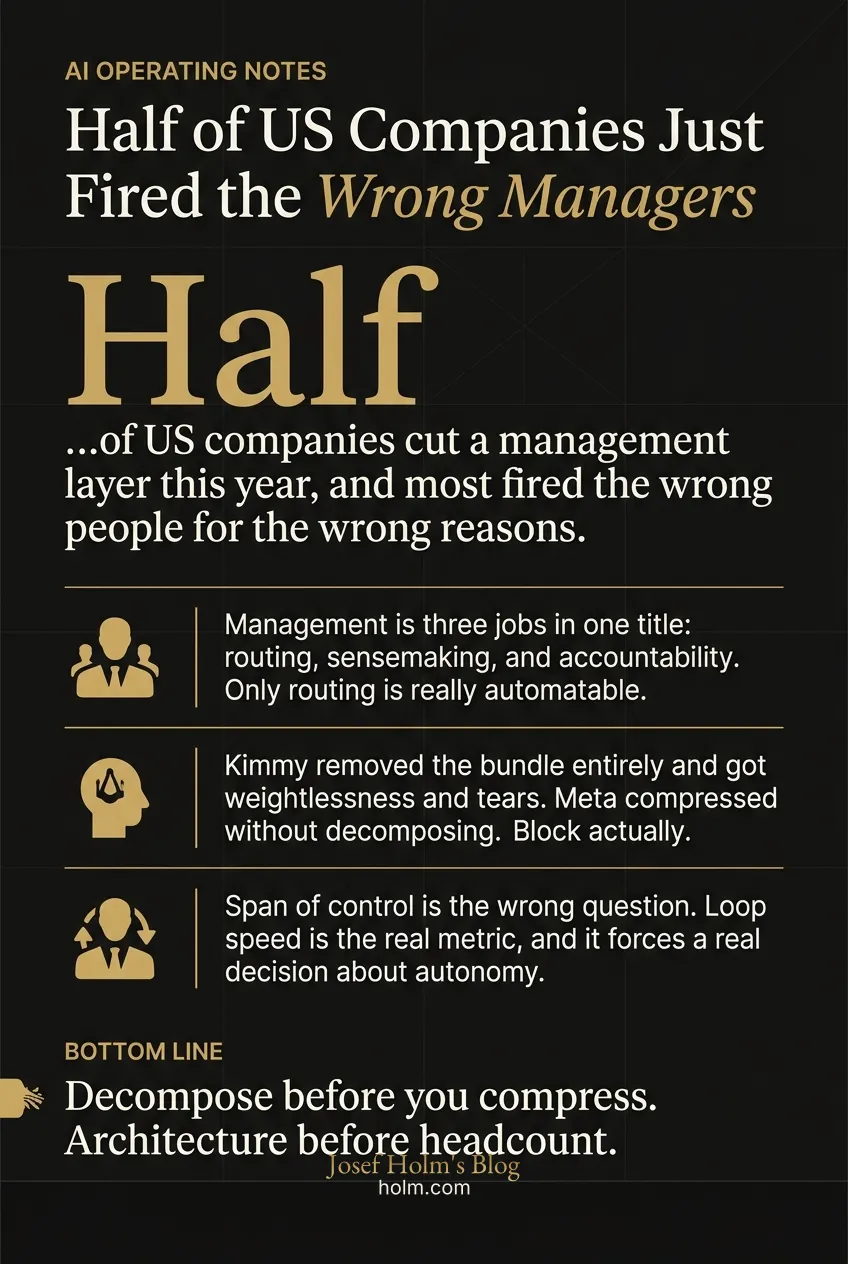
- Half of US companies cut a management layer this year, and most fired the wrong people for the wrong reasons.
- Management is three jobs in one title: routing, sensemaking, and accountability. Only routing is really automatable today.
- Kimmy removed the bundle entirely and got weightlessness and tears. Meta compressed without decomposing. Block actually decomposed first, and the architecture is right.
- Span of control is the wrong question. Loop speed is the real metric, and it forces a real decision about autonomy.
- Decompose before you compress. Architecture before headcount. Get the sequence wrong and you'll spend two years rehiring the people you just fired.
The Real Story Behind the Management Layoffs
Nearly half of US companies cut a layer of management this year. Most of them are about to find out they fired the wrong people for the wrong reasons.
Here's what most leaders are missing. Management isn't one job. It's three jobs bundled into one title, and only one of them is actually automatable today. Fire managers without separating the bundle and you don't get a leaner company. You get a company missing critical functions it didn't know it depended on.
I've watched this play out at three companies in real time. Kimmy in China. Block. Meta. Three different bets on what management becomes when AI enters the org chart. All three hit the same wall, just in different ways.
Let me break down what's actually happening, because the lesson matters whether you're running a company, managing a team, or trying to figure out where you fit in the next five years.
What Does a Manager Actually Do?
Strip the title away and a manager does three things.
Routing. Deciding who needs to know what, and when. Aggregating information up. Pushing it down. If you've ever sat in a meeting that should have been an email, you've experienced bad routing. Oldest function in the book, traceable back to Roman centurions and 19th-century railway operators.
Sensemaking. Turning noise into signal in both directions. Pulling what actually matters out of team updates for leadership. Buffering external chaos so the team can ship. The problem in most companies isn't a shortage of information. It's a shortage of signal.
Accountability and feedback. Owning team performance. Cascading ownership down so people feel real attachment to outcomes. Coaching. Hard conversations. Long-running context that builds trust over years.
Now ask the only question that matters: which of these can AI actually do?
Routing? Yes. Largely solved. AI is excellent at synthesizing up and distributing down. Even with another 10x in capability, the answer doesn't change.
Sensemaking? Partially. AI can help, but the rich amalgam of years of product, business, and domain experience is hard to replicate. Asking why three shipping delays in six months keep landing on the same team is not a synthesis problem. It's a judgment problem.
Accountability? Mostly human. Agents can simulate apologies. They can't own a goal for two years and develop genuine attachment to it.
That's the whole framework. Most companies cutting managers right now are treating all three jobs as if they're the same job. They're not.
Kimmy: What Happens When You Remove the Bundle Entirely
Moonshot AI, the Chinese company behind Kimmy, is valued around $16 billion with roughly 300 employees, average age under 30. Zero formal departments. No titles. No OKRs. No KPIs. A Chinese magazine called Renwu spent 100 hours embedded inside the company with full editorial independence, and what came out is one of the more honest portraits of an AI-native org I've read.
So how do they handle the three jobs?
Routing is fully agent-driven. One product manager described launching three agents before a release. One scanning 3,000 user feedback items. One reading sentiment across languages. One tracking competitors. By 11:30 AM, requirements were documented and a coding agent had written 70% of the rollout. Work that used to take days now takes hours.
Sensemaking sits with five co-founders, each carrying around 50 direct reports. Their internal status message is two words: communicate directly. The reporter observed large cognitive strain on these founders. That's the polite way of saying it doesn't scale.
Accountability is essentially absent. One former employee who returned to a big tech job put it this way: "Some mornings you walk in and you just don't know what you should do. No one tells you whether you're doing well."
At least three senior hires have left. Multiple employees said they cried more at Kimmy than any company they'd worked at. The reporter chose the word "weightlessness" to describe the experience. Liberating on paper. Anxiety-inducing in practice.
You can automate routing. You can't automate the human need to know whether your work matters.
Block: The Most Interesting Bet
Jack Dorsey and Roelof Botha published their thinking on Block's structure, and it's the sharpest structural move of the three.
Block decomposes the bundle on purpose.
Routing goes to what they call a "world model," a persistent shared representation of the company's state, handled by AI. Block benefits from being remote-first with machine-readable artifacts and rich transactional data. Good substrate for a system like this.
Sensemaking goes to Directly Responsible Individuals. A DRI might own merchant churn for 90 days with full authority to pull resources from multiple teams. Time-bounded. Rotating. No permanent middle managers, but real ownership for real periods.
Accountability goes to "player coaches." People who still write code and design interfaces but also coach and care for human growth. Routing is stripped from their role so they can focus on craft and people.
Of the three companies, Block is the only one that actually decomposed the bundle before reorganizing around it. The catch: they fired half the company to make this happen, and the model is still largely unproven. The architecture is right though.
The useful question is whether the company can separate routing, sensemaking, and accountability before it changes the org chart.
Meta: Compression Without Decomposition
Meta took a different path. Same goal, different method.
The "year of efficiency" wiped out entire management layers. Remaining managers got two options: dramatically wider spans or convert to individual contributor roles. Zuckerberg directly oversees 25 to 30 senior leaders. 15 product divisions run through three executives.
Routing? Agents assist inside the existing hierarchy. Sensemaking stays human but with fewer layers. Accountability gets intensified, bottom 5% of performers cut, bar publicly raised.
Meta didn't decompose. It compressed.
Jensen Huang runs a similar model at Nvidia. Around 60 direct reports. No recurring 1:1s. His stated philosophy: torture you until you're great rather than fire you.
Results so far? Meta stock has roughly tripled since the efficiency push. They're shipping faster. Whether this is sustainable or just a high-pressure revolving door is the open question. Ask me in three years.
So What's the Right Span of Control Now?
Span of control is the wrong question. It's a 1950s metric for a 2025 problem.
The right metric is loop speed. How fast can a team take a market signal, build a response, learn from it, and iterate again? AI compresses this cycle from weeks to hours. Kimmy operates on hour-long cycles routinely. There's no time to go up the chain for approvals.
This forces a real decision about autonomy.
Kimmy bet on extreme autonomy across the board. Block bet on extreme autonomy inside time-bounded ownership. Meta bet on high speed with tight top-down direction. Three different answers to the same question, and we're going to spend the next five years finding out which one holds.
What This Means for You
If you're a manager: If most of your week is routing information, your job is at risk. Make your sensemaking and coaching visible. Show the judgment calls you make. Show the patterns you spot that nobody else does. Routing is not a defensible position anymore.
If you're a C-suite leader: Decompose before you compress. Most management layoffs right now are blunt-force cost cuts dressed up as transformation. That's a crisis of imagination, not strategy. Automate routing first. Invest in feedback mechanisms. Name directly responsible individuals with real authority and clear time bounds. If you can't specifically picture what AI does in a given situation in your company, your AI adoption will fail. That's the single best predictor I've seen.
If you're an individual contributor: The biggest predictor of whether you thrive at work is the quality of your relationship with your manager. In an era where companies are gutting management indiscriminately, finding a good manager is worth more than ever. They're rarer now. Treat that so.
The Bigger Point
We're inside one of the largest management experiments in 2,000 years. The companies that look hard at decomposition will come out stronger because they'll develop a precise understanding of what each function actually requires and where AI fits.
The companies that just cut layers because everyone else is cutting layers will find out, in 18 months, that they removed signal from their organization and didn't replace it. The work didn't disappear. It just stopped being done.
All three jobs (routing, sensemaking, accountability) still need to happen in the company of the future. Compromise on any of them and you get culture strain. Kimmy is showing us what that looks like in real time.
Most leaders right now are flying blind into this transition. If that is where you are, the useful sequence is still visible from the outside. Decomposition before compression. Architecture before headcount. Get the sequence wrong and you'll spend the next two years rehiring the people you just fired.
Get it right and you'll build something genuinely different.
Infographic
Frequently Asked Questions
- Why are most management layoffs in 2025 backfiring?
- Because companies are treating management as one job when it's actually three: routing, sensemaking, and accountability. Only routing is automatable today. Cut managers without separating those functions and you remove signal you didn't know you depended on. The work doesn't disappear. It just stops being done.
- What are the three jobs bundled inside management?
- Routing (deciding who needs to know what and when, aggregating up, pushing down), sensemaking (turning noise into signal in both directions, applying judgment built from years of context), and accountability (owning team performance, coaching, hard conversations, long-running trust). AI handles routing well, helps partially with sensemaking, and can't really do accountability.
- What's the right span of control with AI in the picture?
- Span of control is the wrong question. It's a 1950s metric for a 2025 problem. The right metric is loop speed: how fast a team takes a market signal, builds a response, learns from it, and iterates again. AI compresses that cycle from weeks to hours, which forces a real decision about autonomy.
- What did Block do differently from Meta and Kimmy?
- Block decomposed the bundle on purpose. Routing went to a shared world model handled by AI. Sensemaking went to Directly Responsible Individuals with time-bounded authority. Accountability went to player coaches who still ship work but coach humans. Meta compressed without decomposing. Kimmy removed the bundle entirely and is paying for it in culture strain.
- What should a C-suite leader actually do before cutting management layers?
- Decompose before you compress. Automate routing first. Invest in feedback mechanisms. Name directly responsible individuals with real authority and clear time bounds. If you can't specifically picture what AI does in a given situation in your company, your AI adoption will fail. That's the single best predictor I've seen.
- What should a manager do to stay relevant?
- If most of your week is routing information, your job is at risk. Make your sensemaking and coaching visible. Show the judgment calls you make. Show the patterns you spot that nobody else does. Routing is not a defensible position anymore.