Meta's Keyloggers Aren't About Productivity
Key Takeaways
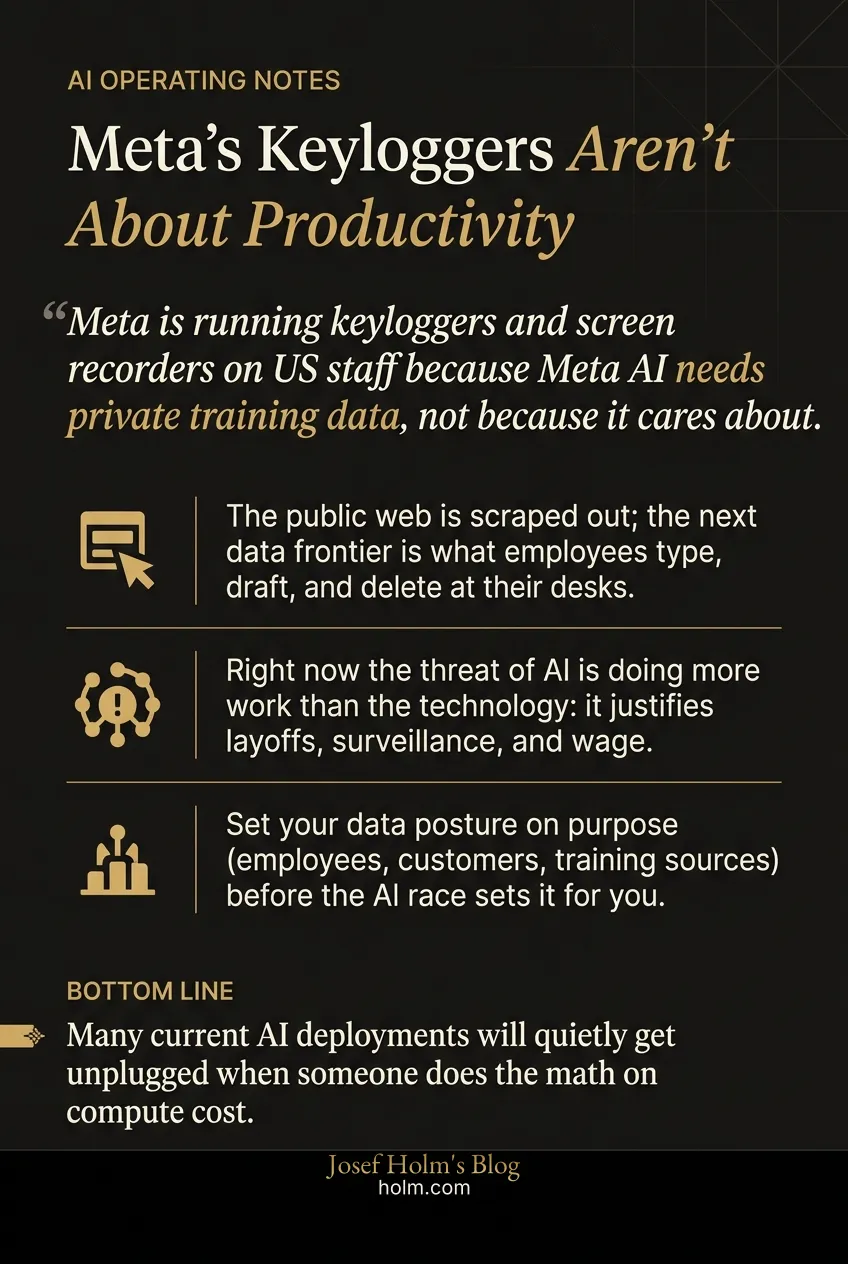
- Meta is running keyloggers and screen recorders on US staff because Meta AI needs private training data, not because it cares about productivity.
- The public web is scraped out; the next data frontier is what employees type, draft, and delete at their desks.
- Right now the threat of AI is doing more work than the technology: it justifies layoffs, surveillance, and wage pressure.
- Set your data posture on purpose (employees, customers, training sources) before the AI race sets it for you.
- Many current AI deployments will quietly get unplugged when someone does the math on compute cost versus the human they replaced.
The Surveillance Is the Business Model Now
Meta just told its US employees they have to run keyloggers and screen recorders on their work computers during the workday. Not optional. Not opt-in. The full 9-to-5 window, captured.
That same month, Meta laid off 8,000 people.
That sequence isn't an accident. First the fear, then the leash. And here's what most people are missing: the surveillance isn't really about productivity. It's about feeding the model.
Why is Meta actually doing this?
Modern AI has two appetites: capital and data. The capital part gets plenty of coverage. Economists are openly asking how much investment capacity is left for anything else once the AI buildout takes its cut.
The data part is quieter. And more important.
Every frontier lab has already scraped the public internet. The open web is used up. The next edge is private data, and the easiest private data to seize is the data your own employees generate at their desks every day.
Think about what a keylogger plus screen recorder actually captures. Every draft email. Every deleted sentence. Every Slack argument. Every half-written doc, every decision-in-progress, every moment of hesitation before someone hits send. That's not a productivity signal. That's training data. It's the actual mechanics of knowledge work, recorded in full.
Zuckerberg isn't surveilling his employees because he thinks they're slacking. He's surveilling them because Meta AI is behind, and the company needs a data moat OpenAI and Anthropic don't have.
What does this tell us about the next phase of AI?
Here's the shift worth naming. For twenty years, tech companies collected slightly more user data than they needed, mostly for ad targeting. Privacy settings put a soft ceiling on how far they could go.
That ceiling is coming off. Internally first, because employees can't opt out. They signed a contract. The precedent gets set on staff, then it migrates to contractors, then to "power users," then to everyone.
This is the pattern I've watched over three decades of building tech companies. Whatever a large platform normalizes internally shows up in the product within two years. The employee is the beta test.
If you're running a company right now, the question isn't whether Meta is evil. The question is whether your own data boundaries are clear enough that you won't drift into the same behavior when the pressure hits. And the pressure will hit. Every serious AI effort is going to run out of public data and start looking inward.
Is the AI threat bigger than the AI product?
Let me be direct here.
So far, the biggest impact of AI isn't the technology. It's the threat of the technology.
The narrative that AI will replace every job, hack every system, and make humans obsolete is doing more work in boardrooms and HR departments than any real model deployment. Layoffs get justified with it. Surveillance gets justified with it. Wage compression gets justified with it. Hiring freezes get justified with it.
The threat is the product. The product itself is still figuring out how to do basic things reliably.
And that's the lever being pulled on workers right now. Scare them with the replacement story, then hand them the keylogger agreement. Who's going to push back in a job market where 8,000 colleagues just got cut?
What's the honest picture of AI right now?
I use these tools every day. I've watched them reason through problems better than a smart friend would. I've also watched them fail at things a competent intern would handle in five minutes.
Both are true. Anyone telling you only one side is selling something.
A few things getting glossed over in the hype cycle:
- AI approximates human reasoning. It isn't the same thing as human reasoning. The word "artificial" deserves more weight than it gets.
- Compute isn't free and isn't trending toward free in any realistic window. Running these models at scale is expensive, and in some workflows AI is already costing more than the human it was supposed to replace.
- The assumption that future breakthroughs will automatically fix today's LLM limitations is faith, not strategy. Might happen. Might not. You can't build a business on it.
- Human intelligence took roughly 13.5 billion years of physical and biological process to show up. Treating that as a solved problem you can casually replicate in eighteen months is, at minimum, arrogant.
The realistic outcome for a lot of current AI deployments looks less like Terminator and more like War of the Worlds. Not defeated by a clever counterattack. Defeated by economics. By the boring fact that the unit cost doesn't work.
That doesn't mean AI is fake or a bubble in some cartoon sense. What it means is that the distribution of winners and losers is going to be weirder than the current narrative suggests. Some applications will be durable and extraordinary. Many will quietly get unplugged when someone does the math.
This is why when we run an AI readiness note for a company, we spend as much time on what to stop doing with AI as on what to start. Most organizations don't have an AI strategy problem. They have an AI discipline problem. They're trying everything because the hype told them to.
What should operators actually do about this?
If you lead a company, a few practical positions worth holding.
Decide your data posture on purpose, not by drift. What can your employees be recorded doing? What can your customers be recorded doing? Where does your training data come from, and where does it not come from? Answer these now, or you'll answer them under pressure later, and the answer will be worse.
Stop confusing the threat of AI with the capability of AI. Don't restructure your company based on what a model might do in 2027. Restructure based on what it does today, measured in your environment, on your workflows. If you want a view on how to do that without pretending, that's the work we do.
Treat skepticism as a feature, not a liability. The current environment treats any pushback on AI hype as "cope." That framing is a tell. When dissent gets socially punished, it usually means someone is protecting a narrative that can't survive scrutiny. Protect the people on your team who ask hard questions. They're saving you money you don't see yet.
Recognize the human cost as a real input. The employees Meta is surveilling aren't abstractions. They have mortgages and kids and a job market that just got 8,000 people more crowded. A company that treats its own people as training data will treat its customers the same way the moment it's convenient. That reputation compounds. Quietly at first. Then suddenly.
The point
Hype is a tool. It softens people. It gets them to accept things they wouldn't accept if they were calm and informed. The hype around AI right now is doing exactly that, and a company like Meta is using the moment to install infrastructure it could never have installed five years ago.
AI is a genuinely big technology. It's also not the thing the loudest voices are telling you it is. Both of those can be held at the same time, and if you're leading a company through this period, you have to hold both.
Respect the tech. Respect the limits. Respect your people more than the narrative.
That's the posture that survives the next two years. Everything else is theater, and the theater gets expensive.
If you want to talk about how this plays out inside your own business, reach out. We work with operators who want a clear read, not a sales pitch.
Infographic
Frequently Asked Questions
- Why is Meta putting keyloggers on employee computers?
- Officially it's productivity. Actually it's training data. Meta AI is behind OpenAI and Anthropic, the public web is already scraped, and the next data edge is private knowledge work. Employees can't opt out, so they become the cheapest source of high-quality training data Meta can get.
- Is AI really going to replace most jobs soon?
- The threat of replacement is doing more work right now than the technology itself. Layoffs, surveillance, and wage compression all get justified with a future that hasn't arrived. The models are useful in specific workflows and mediocre in many others. Plan around what AI does today in your environment, not what a pitch deck says it will do in 2027.
- What is an AI data posture and why does it matter?
- It's a clear decision about what you record, what you train on, and what you refuse to touch, covering both employees and customers. If you don't define it on purpose, you'll define it under pressure, and the answer will be worse. Set the boundaries before the AI race forces your hand.
- Is AI a bubble?
- Not in the cartoon sense. But a lot of current deployments will get quietly unplugged once someone does the math on compute cost versus the human they were meant to replace. The winners and losers will be stranger than the current narrative suggests. Some applications will be durable. Many won't survive their own unit economics.
- How should leaders handle AI skepticism on their teams?
- Protect it. When pushback on AI hype gets labeled as cope, someone is usually guarding a story that can't hold up. The people asking hard questions about cost, reliability, and data boundaries are the ones saving you money you haven't spent yet.
- What does Meta's surveillance policy signal for other companies?
- Whatever a large platform normalizes internally tends to show up in the product within about two years. Employees are the beta test. Expect the same recording logic to migrate to contractors, power users, and then everyone, unless companies draw clear lines now.