Old Work Habits Are Making You Slow
Key Takeaways
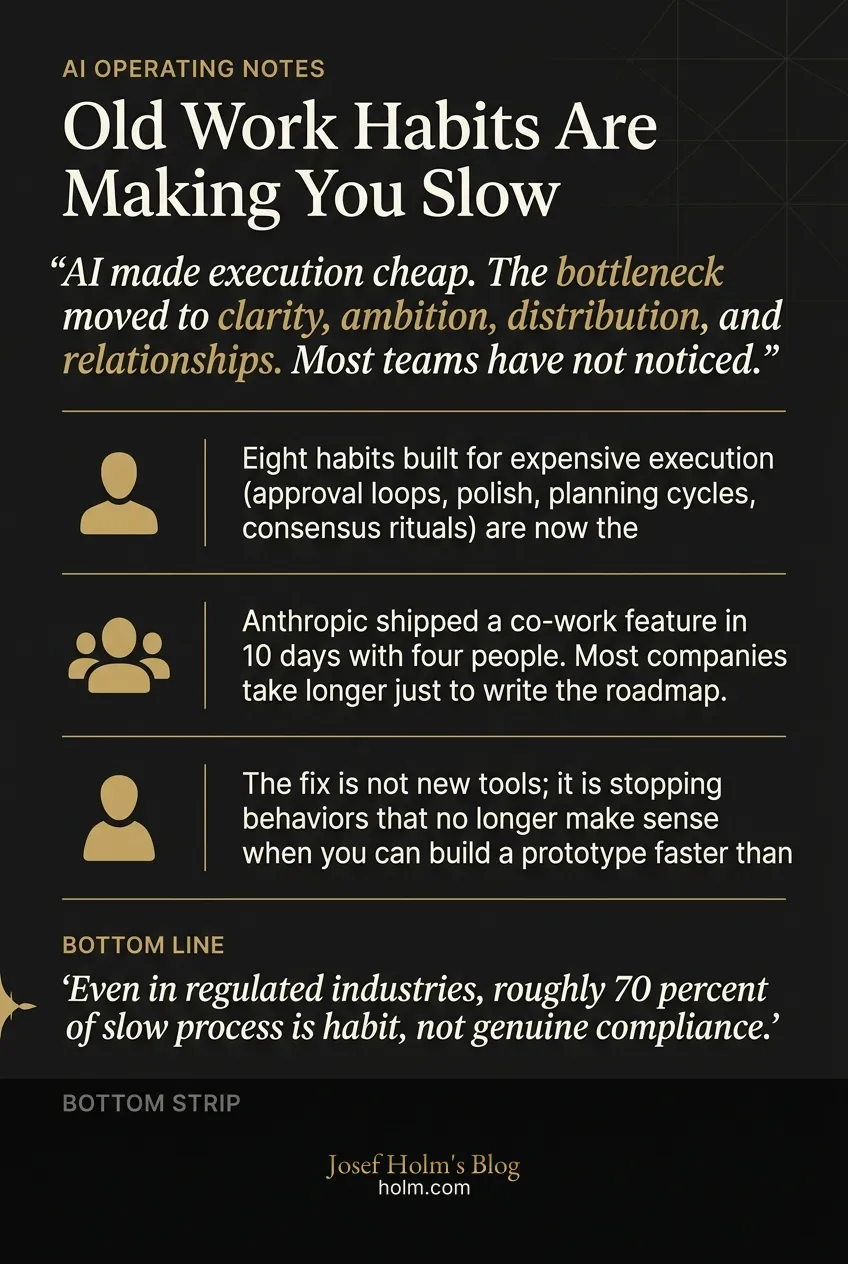
- AI made execution cheap. The bottleneck moved to clarity, ambition, distribution, and relationships. Most teams have not noticed.
- Eight habits built for expensive execution (approval loops, polish, planning cycles, consensus rituals) are now the slowest parts of your workflow.
- Anthropic shipped a co-work feature in 10 days with four people. Most companies take longer just to write the roadmap for a comparable effort.
- The fix is not new tools; it is stopping behaviors that no longer make sense when you can build a prototype faster than you can schedule a meeting about it.
- Even in regulated industries, roughly 70 percent of slow process is habit, not genuine compliance requirement. Only 30 percent actually has to stay.
The Eight Work Habits That Made You Successful Are Now Making You Slow
Most people think their AI problem is a tools problem. It's not. It's a habits problem.
The bottleneck in knowledge work used to be execution. Finding skilled engineers was hard. Training them took years. Every hour of their time was precious. So we built an entire operating system around protecting that scarce resource: planning rituals, approval gates, PRDs, alignment meetings, consensus loops.
That made sense. For decades.
But AI has inverted the cost ratio entirely. Most teams are still running the old playbook, wondering why they feel busy but slow.
What actually changed?
Two examples tell the story.
Anthropic shipped Claude's co-work feature in 10 days with four people. Written entirely in Claude Code, a product less than a year old. They're now shipping 60 to 100 releases daily.
Meanwhile, at most companies, leaders are still requesting 30 to 90 day AI rollout roadmaps. Phases. Milestones. Resource allocation plans. Steering committees.
The contrast is striking, but it's not about Anthropic being smarter. It's about recognizing that the meeting to discuss a feature now takes longer than building the feature. The PRD can take longer than shipping three versions and observing which one works.
Cursor, the AI code editor, grew illion to $500 million in annual recurring revenue faster than any SaaS company in history. Coinbase engineers report that individuals are refactoring entire codebases in days.
This isn't a marginal improvement. It's a structural inversion. And if your work habits haven't changed to match, you're tuning for a constraint that no longer exists.
Where did the bottleneck go?
Here's what most people miss: when you eliminate a bottleneck, it doesn't disappear. It moves downstream.
There's a manufacturing principle behind this. You speed up one station on the line, and the pile-up just shifts to the next station. Knowledge work is no different.
The constraint has moved to four new areas. None of them are about execution speed.
Clarity
Knowing what's worth building is now the billion-dollar question. You can build faster than you can think. That sounds exciting until you realize it means bad decisions compound faster too.
PRDs were always a substitute for clarity. A hedge against expensive rework. But when writing a PRD costs more time than shipping the product itself, the hedge becomes the risk.
Ambition
When shipping required a quarter of engineering time, small bets made sense. With 50 possible shipping cycles per year, the calculus flips completely. The risk isn't building the wrong thing. It's timidity.
I've seen this pattern before across multiple technology cycles. The early adopters almost always build "horseless carriages," new technology stuffed into old mental models. The winners are the ones who ask what's possible now that wasn't possible before, and then build toward that.
Distribution
When everyone can build, product is no longer the moat. Getting product into people's hands is.
Cognition, makers of the AI coding agent Devin, understood this. Rather than pursuing distribution independently, they partnered with Infosys to deploy Devin across Infosys's 300,000 person workforce and global client base. The technology was the easy part. Enterprise relationships were the hard part.
This is a pattern I expect to accelerate. The companies that win won't necessarily have the best product. They'll have the best path to the people who need it.
Relationships
Capabilities are compounding quickly. Platforms keep shifting. What worked last quarter may not work next quarter. But relationships are durable.
This holds at both the individual and company level. When technical skills are rapidly commoditizing, trusted professional relationships become the thing that's actually scarce. I wrote about this shift in how companies should be thinking about their AI operating model, and it keeps proving out.
So what habits need to go?
I count eight specific work habits that made perfect sense in the old model and are now actively working against you. These aren't character flaws. They're rational behaviors built for a world that no longer exists.
1. The permission loop
The old logic was sound: doing was expensive, so check before acting. Get buy-in before spending resources.
Here's why it's broken now: the email thread seeking approval can take longer than building the prototype. The Slack conversation to confirm direction can take longer than trying both directions and seeing what works.
Manus recently launched a feature that builds the presentation being discussed as the meeting is happening. Think about what that means for the approval workflow.
The new default is doing. Build the rough version. Ask forgiveness when needed. And if you're a leader, this means something specific: cast a wide enough vision that teams can ship autonomously without waiting for your permission on every decision.
Does your team need your approval, or do they need your clarity? Those are very different things.
2. Polish as procrastination
I've watched teams spend 80% of their time on the last 20% of quality. The marginal value of that polish is dropping fast.
The old logic made sense: you get one shot, so make it count. Don't waste expensive execution on something half-baked. But polish has become a way to avoid getting ideas into contact with reality.
NotebookLM is a good example. They shipped. They observed market reaction. They've been polishing ever since. The rough version that exists beats the polished version that doesn't. Every time.
There's still real market value in polished UI for AI products. I'm not arguing for permanent sloppiness. Polish should come through iteration, not as a prerequisite to shipping.
A directionally correct, ambitious idea is enough to get going.
3. Meetings as a default
An hour of six people's time is six hours of work. That's often enough to just build the thing being discussed.
The old logic: get alignment before action. Bring everyone into the room so expensive execution time isn't wasted on the wrong problem. Reasonable.
But meetings about what to build frequently don't resolve what to build. They surface opinions. They create action items. They cause delays. And then you need another meeting to review the action items from the first meeting.
What if you replaced the meeting with a product demo? Build the rough version and show it instead.
Cursor's culture is instructive here. They treat code as a way of getting ideas into contact with reality. Designers, product managers, and engineers all commit directly. The artifact is the alignment tool, not the meeting.
When was the last time a meeting at your company produced more clarity than confusion?
4. Structured waiting
This one is subtle because it feels responsible. Respect the process. Wait for feedback. Wait for the next sync. Wait for someone to unblock you.
Most of what you're waiting for doesn't need to be waited for.
Waiting an hour in 2015 was waiting an hour. Waiting an hour now is waiting a prototype's worth of output. The opportunity cost of structured waiting has gone up by an order of magnitude, and most organizations haven't adjusted.
The fix: do the next thing while waiting for feedback on the first. Assume the answer is yes. If you're blocked on a decision, make a provisional decision, communicate it clearly, and keep moving. If someone objects, you'll know soon enough. And you'll have something concrete to discuss instead of something theoretical.
5. Planning before doing
"Measure twice, cut once" is great advice when lumber is expensive. When lumber is essentially free and you can cut a hundred times in an afternoon, the math changes.
I've observed planning cycles at large companies that took longer than Anthropic took to ship the entire co-work feature. That's not a planning problem. That's a category error about what's expensive.
Prediction has become the luxury. Execution and iteration are now cheap, more accurate, and more reliable than forecasting.
Cut planning by 90%. Replace it with learning through prototyping. Use a bold, rough direction and aggressively ship, paying attention to what works. Let reality inform the plan rather than trying to predict reality with the plan.
This is one of the core shifts we work through with companies in our AI readiness note. Not "how do we plan better" but "how do we plan less and learn faster."
6. The deck instead of the demo
All the rituals around deck creation: font selection, message workshopping, stakeholder walkthroughs. These are hedges against execution. They made sense when execution was the expensive part.
They don't anymore.
If you can build a working prototype in the time it takes to build a presentation about a working prototype, why are you building the presentation?
Build the thing. Show the thing. Let people react to something real instead of something imagined.
7. Consensus before action
Get everybody aligned before moving. Two-pizza teams. RACI matrices. Decision logs. All designed to push autonomy while maintaining alignment.
Here's the uncomfortable truth: the cost of consensus has increased 10x to 100x relative to the cost of just trying the thing. And consensus was often not real anyway. People would agree in meetings and then undermine decisions later.
Let consensus come from results. Run the experiment first. People align when they see data.
"I tried X and here's what happened" is more persuasive than "let's agree to try X." It always has been. The difference now is that getting to "here's what happened" takes hours instead of weeks.
8. Hoarding until ready
Don't show work until it's complete. Half-finished work wastes other people's time.
This felt true when reaching a shareable version required major investment. Now the cost of reaching a rapid version is very low. Sitting on ideas and drafts until they feel ready means getting feedback late, after you've committed to a direction that may be wrong.
There's an ego component here. Showing raw, unfinished work requires a kind of professional vulnerability that most people avoid. But the distinction matters: half-finished work with genuine thought and a clear direction is valuable for feedback. AI-generated output with no real thinking behind it just creates downstream work for colleagues.
The former accelerates decisions. The latter wastes everyone's time. Know the difference.
What does this look like in practice?
All eight habits are risk-management rituals designed for a world where doing was expensive. The unit economics have flipped. The risk is no longer wasting execution time. It's wasting time on anything that isn't building.
Here's the old way: Idea. Write proposal. Schedule meeting. Meeting surfaces questions. Update proposal. Weeks later, get approval to pilot.
Here's the new way: Idea. Spend an afternoon building a rough version. Show three people. Two have concerns that kill the idea. Done in a day instead of a month.
Same outcome. Fraction of the time. And you learned something real instead of something theoretical.
What about regulated industries?
I want to be honest about this because I've worked across enough industries to know the objection is legitimate. Fields with high legal and compliance requirements, medicine, law, finance, have real constraints. You can't just ship a rough version of a medical device and iterate.
But the challenge is to honestly assess how much of the process is actually required versus how much is simply the unquestioned default. In my experience, the answer is usually 70/30. Seventy percent habit, thirty percent genuine requirement.
Even in regulated industries, the internal workflows around ideation, prototyping, internal review, and stakeholder communication can be dramatically compressed. The compliance gates stay. Everything around them gets faster.
Why this matters right now
The chaos many people feel in the current AI environment isn't random. It's the gap between where the bottleneck has moved and the habits still in use.
Closing that gap means aligning work habits to how AI actually changes scarcity. Not adopting new tools. Not attending more conferences. Not reading more thought leadership. Changing what you do on a Tuesday afternoon when you have an idea.
The people who figure this out first will operate at a velocity that resembles Anthropic or Cursor rather than a traditional large company. Not because they have better tools. Nearly everyone has access to the same tools. But because they've stopped doing things that are no longer worth doing in a world where execution is cheap.
They'll be shipping while others plan. Iterating while others align. Learning while others polish.
I've seen this pattern play out across every major technology shift I've worked through over 25 years. The winners aren't the ones with the best technology. They're the ones who change how they work to match what the technology actually makes possible.
The bottleneck moved. Your habits need to move with it.
Infographic
Frequently Asked Questions
- Why are experienced teams still slow even after adopting AI tools?
- Because they changed the tools but not the habits. Approval loops, planning cycles, and consensus rituals were built for expensive execution. AI made execution cheap. Those habits are now the bottleneck, not the work itself.
- What are the new bottlenecks in AI-era knowledge work?
- Four things: clarity about what is worth building, ambition to pursue bigger bets now that shipping is fast, distribution to get products into the right hands, and relationships that hold value as technical skills commoditize.
- Which work habits should teams drop first when adopting AI?
- Start with the permission loop and meetings as a default. Both were designed to prevent wasted execution time. Now the meeting often takes longer than building the thing. Replace both with prototypes and demos wherever possible.
- Does this apply to regulated industries like finance, law, or medicine?
- Yes, partially. Compliance gates stay. But in most regulated environments, roughly 70 percent of slow process is unexamined habit, not genuine legal requirement. Internal ideation, prototyping, and stakeholder communication can all be compressed much.
- How does Cursor's approach to product development illustrate this shift?
- Cursor treats code as a way to get ideas into contact with reality. Designers, product managers, and engineers all commit directly. The artifact is the alignment tool, not the meeting. That approach helped them go to $500M ARR faster than any SaaS company in history.
- What is the practical difference between the old and new way of working?
- Old way: idea, write proposal, schedule meeting, update proposal, wait weeks for approval to pilot. New way: idea, spend an afternoon building a rough version, show three people, learn fast, kill or keep. Same outcome, a fraction of the time, and you learn something real instead of something theoretical.