What the OpenAI-Upwork Freelance Report Actually Shows
Key Takeaways
- The OpenAI and Upwork freelance report shows a shifting mix of work inside AI-related postings and bigger projects, but the headline numbers are easy to misread if you don't check what each one measures.
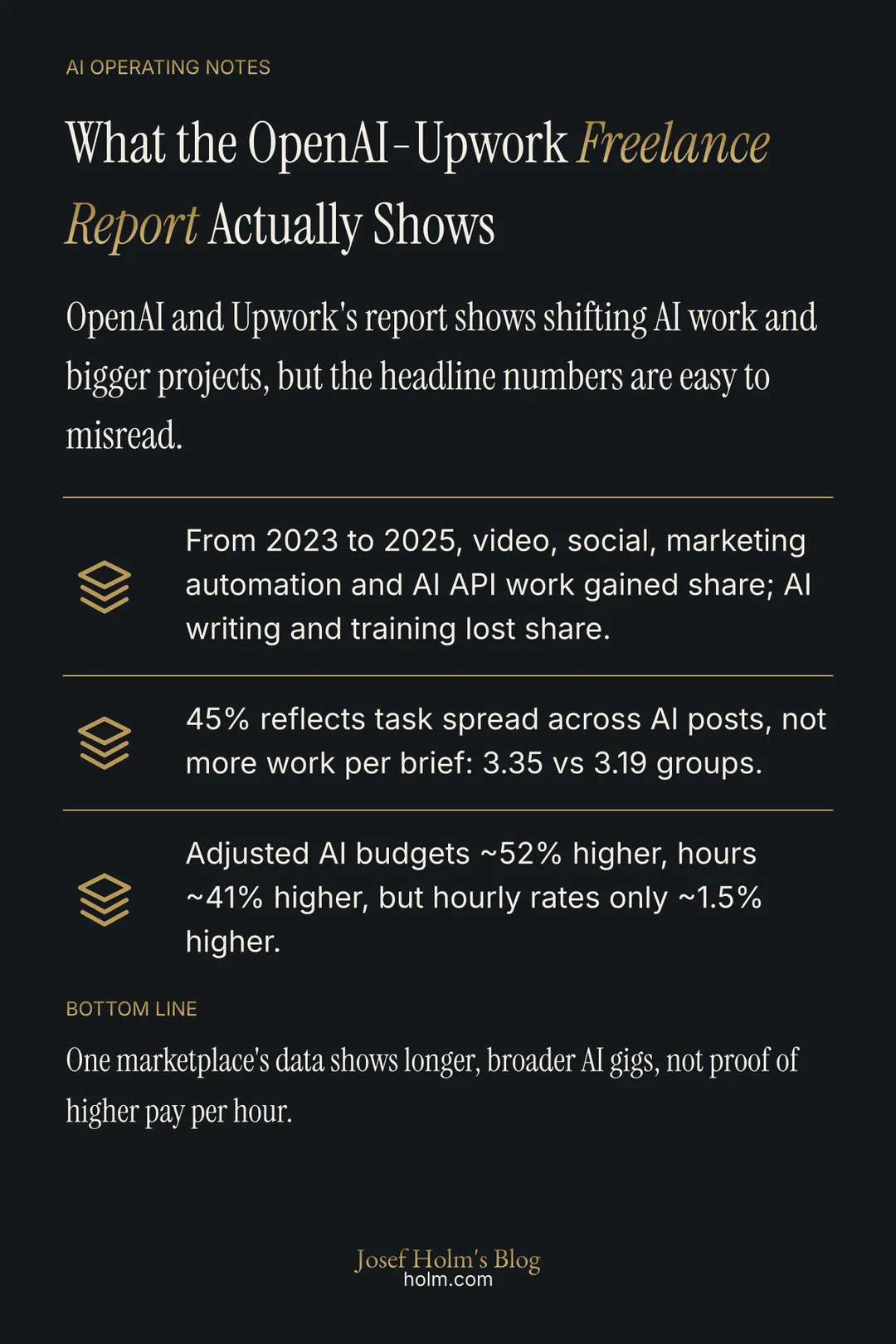
- Within AI-related posts, video production, social campaign management, marketing automation, and AI API integration gained share between 2023 and 2025, while AI-generated written content, training programs, and some cloud and data integration work lost share.
- The widely cited 45% figure describes how spread out task groups have become across AI-related postings, not a 45% increase in work per brief. At the post level, AI-related jobs averaged 3.35 distinct task groups versus 3.19 for other posts.
- After adjusting for work category and posting month, AI-related fixed-price budgets were about 52% higher than non-AI posts and first-90-day hours about 41% higher, while adjusted hourly rates were only about 1.5% higher.
- These are observed differences on one marketplace with a broad definition of AI-related, not proof that AI caused larger projects or better returns; the value for freelancers looks more like carrying longer, broader engagements than charging more per hour.
The November 2026 OpenAI and Upwork report, The Rebundling of Freelance Work in the AI Age, looked at what companies are actually posting when they hire freelancers for work that involves AI. The headline findings are interesting, but they get misread quickly if you don't pay attention to what each number measures. So let me walk through what the report shows, where the numbers come from, and what I'd take from it if I were hiring freelancers or trying to earn a living as one.
What counts as an "AI-related" post
The report defines AI-related posts as those that request AI skills, require AI tools, or involve improving AI-generated output. [3] That's a broad definition. It covers someone hiring an engineer to integrate an API, and it covers someone hiring a video editor to polish a clip generated by a model. Keep that in mind, because the differences between AI and non-AI posts are averages across that whole mix.
The mix of work is shifting
Inside AI-related posts, the kinds of tasks companies ask for have moved. Video production, social media campaign management, marketing automation, and AI API integration gained share between 2023 and 2025. AI-generated written content, training programs, and some cloud and data integration tasks lost share.
Two things are worth noting. First, these are shares within AI-related posts, not absolute volume. A task can lose share while the total number of posts grows. Second, the report is describing posted demand on one marketplace. It isn't a map of the whole freelance economy, and it doesn't settle whether AI caused the shift or whether other things (ad budgets, platform trends, who happens to use Upwork) played a role.
If you're a freelancer whose work sits in a shrinking share, it doesn't mean the work is gone. It does mean the buyer's expectations are probably changing. Writing a blog post from scratch is a different brief than taking a model's draft and making it good.
The "45%" number is about variety, not brief size
This is the one I've seen misread most. The report's 45% figure refers to how spread out the mix of task groups has become across AI-related postings, not a 45% increase in the amount of work per brief. [3] It's a diversity measure across the market, not a per-post measure.
At the individual-post level, the difference is smaller. AI-related posts averaged 3.35 distinct task groups versus 3.19 for other posts, and task groups can overlap within a single post. [3]
So the average AI-related brief isn't dramatically bigger in task count. What's changed more noticeably is the range of combinations that show up across the market. Someone is asking for video editing plus automation plus a bit of prompt work in the same post. That combination might have been rare two years ago.
For an operator, the practical read is this: if you're scoping a project that touches AI, assume you're hiring someone who will be stitching tools and skills together rather than doing one thing in isolation. The brief should say so.
Budgets, rates, and hours
Now to the money. After adjusting for work category and posting month, AI-related fixed-price budgets were about 52% higher than non-AI posts. [3] Adjusted hourly rates were only about 1.5% higher. [3] Among hired hourly contracts with positive recorded hours, first-90-day hours were about 41% higher for AI-related contracts. [3]
That pattern is worth sitting with. The hourly rate premium is basically a rounding error. The budget and hours gaps are large. Put plainly: companies aren't paying freelancers much more per hour for AI work, but the projects are bigger and run for longer.
A natural question is whether AI caused this. The report doesn't claim that, and I wouldn't either. [5] The adjustments control for category and month, not for buyer sophistication, project ambition, or which companies happen to post AI work on Upwork. It could be that firms willing to describe a job as "AI-related" are also firms with bigger budgets and longer runways. The data is consistent with that, and it's consistent with AI genuinely changing project scope. The report shows the association. It doesn't settle the mechanism.
What I'd take from this
A few practical observations, nothing more.
If you're hiring: write the brief to match the shape of the work. AI-related projects, in the data, tend to combine more things and run longer. If you expect a freelancer to use models, integrate APIs, and clean up AI output, say that in the post. Budget for the full span, not just the first deliverable.
If you're freelancing: the rate premium for calling your work "AI-related" is small. What's bigger is the project size and the hours. That suggests the value is in being the person who can carry a longer, broader engagement, not in charging more per hour for the same deliverable.
And for everyone: this is one marketplace, one platform, and a specific definition of "AI-related." Upwork postings don't speak for the whole labor market, and the report is careful not to claim they do. The shifts are real in the data. What they mean for any specific business depends on the business.
If you want more writing like this, you can subscribe to The Operator's AI Brief or find more posts on the blog.
Research notes
Research checked 12 November 2026.
Sources
- Work at the Frontier: How AI is changing the shape of freelance work, cdn.openai.com Retrieved 12 November 2026.
- OpenAI and Upwork study finds AI projects get bigger budgets and more hours on freelance markets | MLQ.ai, MLQ.ai Published 10 November 2026. Retrieved 12 November 2026.
- The Rebundling of Freelance Work in the AI Age, cdn.openai.com Retrieved 12 November 2026.
- Work at the Frontier: AI’s effect on freelance work | OpenAI, OpenAI Retrieved 12 November 2026.
- OpenAI–Upwork study: AI-related freelance projects bundle more work and carry larger fixed budgets, but the data don't show job replacement | OpenTools, OpenTools Retrieved 12 November 2026.
- OpenAI and Upwork: How AI Is Changing Freelance Work | CellCog, CellCog Retrieved 12 November 2026.
- OpenAI and Upwork Study: AI Projects Post 52% Bigger Budgets, AY Automate Published 11 November 2026. Retrieved 12 November 2026.
Infographic
Frequently Asked Questions
- What counts as an AI-related post in the OpenAI and Upwork report?
- The report defines AI-related posts as those that request AI skills, require AI tools, or involve improving AI-generated output. That covers a wide range, from hiring an engineer to integrate an API to hiring a video editor to polish a clip generated by a model.
- What does the 45% figure in the report actually measure?
- It describes how spread out the mix of task groups has become across AI-related postings over time. It is a diversity measure across the market, not a 45% increase in the amount of work inside an individual brief.
- How many distinct task groups does an average AI-related post have?
- AI-related posts averaged 3.35 distinct task groups versus 3.19 for other posts, and task groups can overlap within a single post. So the average AI-related brief is not dramatically bigger in task count.
- How do budgets, hourly rates, and hours compare between AI and non-AI posts?
- After adjusting for work category and posting month, AI-related fixed-price budgets were about 52% higher than non-AI posts and first-90-day hours were about 41% higher for hired hourly contracts, while adjusted hourly rates were only about 1.5% higher.
- Does the report show that AI caused these differences?
- No. The adjustments control for category and month, not for buyer sophistication, project ambition, or which companies choose to post AI work on Upwork. The report shows an association between AI-related posts and larger budgets and hours, not proof of cause.
- What should freelancers and people hiring take from the findings?
- For freelancers, the rate premium for AI-related work is small, but projects tend to be bigger and run longer, so the value is in carrying a broader engagement. For buyers, if a project will combine tools and skills, the brief and budget should reflect the full span of work, not just the first deliverable.