Your SEO and Paid Teams Are Costing You Both
Key Takeaways
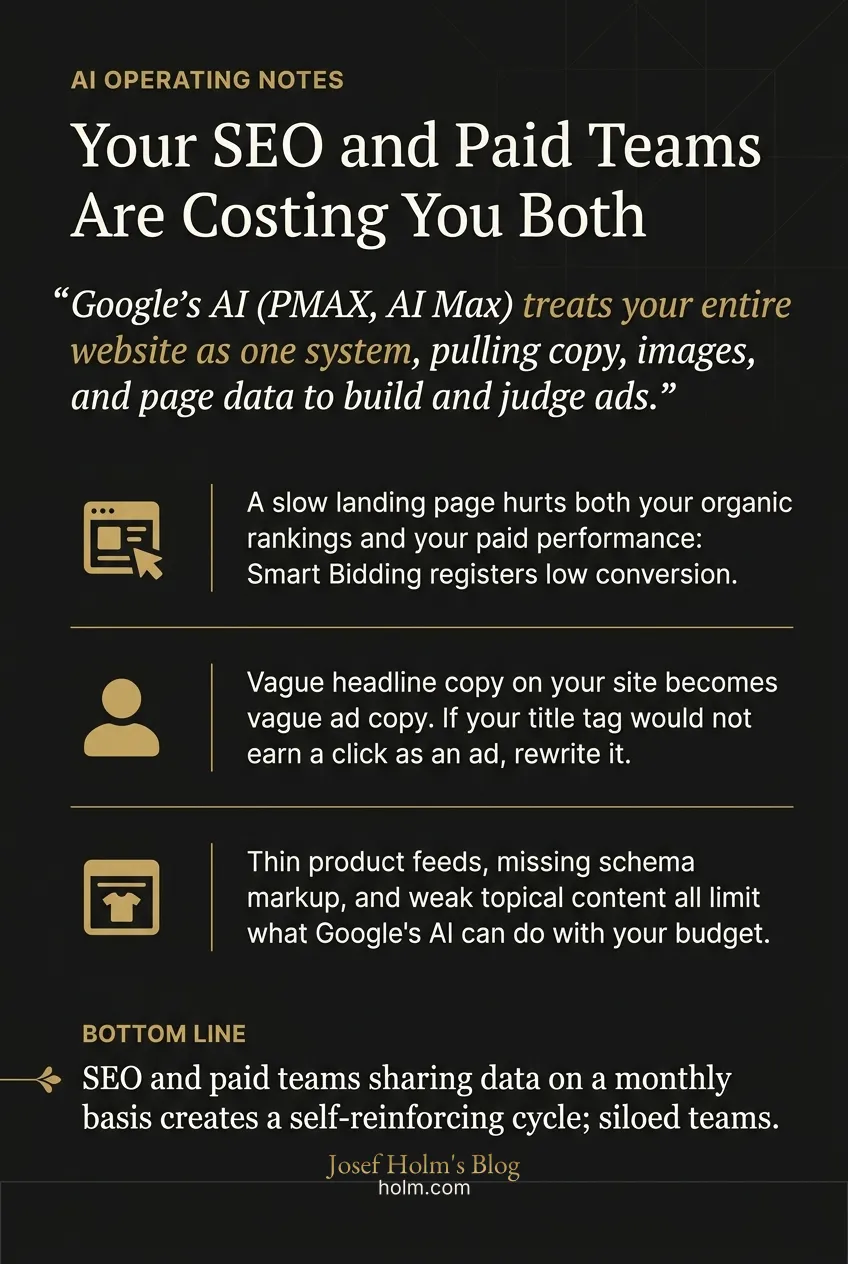
- Google's AI (PMAX, AI Max) treats your entire website as one system, pulling copy, images, and page data to build and judge ads.
- A slow landing page hurts both your organic rankings and your paid performance: Smart Bidding registers low conversion rates and pulls budget.
- Vague headline copy on your site becomes vague ad copy. If your title tag would not earn a click as an ad, rewrite it.
- Thin product feeds, missing schema markup, and weak topical content all limit what Google's AI can do with your budget.
- SEO and paid teams sharing data on a monthly basis creates a self-reinforcing cycle; siloed teams working from separate dashboards break it.
Google's AI Doesn't See Your SEO Team and Your Paid Team. It Sees One Website.
For 25 years, companies ran organic search and paid advertising as separate operations. Separate teams, separate budgets, separate meetings, separate dashboards. That made sense when Google treated them as separate systems.
It doesn't make sense anymore.
Google's AI, including PMAX and AI Max, now pulls directly from your website to build ads, judge relevance, and pick landing pages. Your site copy becomes ad copy. Your images become display assets. Your page speed becomes a bidding signal. The wall between SEO and paid is gone on Google's side. Most companies just haven't caught up on theirs.
NP Digital tested this across hundreds of post-update campaigns and identified eight specific fixes that improve performance across both channels at once. I want to walk through what they found, because the implications go beyond tactics. They point to a structural shift in how Google reads your entire web presence.
If you're not thinking about this, your competitors will be.
Why Does Page Speed Affect Your Ad Budget?
This one surprises people every time I bring it up.
Google's Smart Bidding uses conversion rate as a core signal. If your landing page takes four to five seconds to load, users bounce before converting. The AI registers that low conversion rate and pulls budget away from that page. So a slow page doesn't just hurt your organic rankings. It makes your ads more expensive and less effective at the same time, compounding the damage across two channels simultaneously.
The fix is straightforward: run your top landing pages through Google PageSpeed Insights and prioritize the slowest ones. Not glamorous work. But it compounds across every channel touching that page, and most teams never get around to it.
What's your slowest landing page costing you in wasted ad spend right now?
Is Your Homepage Headline Writing Bad Ads for You?
PMAX pulls headlines, title tags, and descriptions directly from your website to generate ad copy. AI Max does something similar through its text customization feature.
Think about what that means in practice. If your homepage says "Our Solutions" or "Welcome to Our Website," that vague language becomes the raw material for your ads. You're paying for impressions built on copy that nobody would click. The old habit of writing title tags for search bots, stuffing keywords in with no regard for how they read, is now actively costing you money in paid campaigns too.
Here's the test: look at every important page and ask whether that headline, if it appeared as a Google ad, would make someone click. If the answer is no, rewrite it. Make it specific. Make it benefit-driven. Make it sound like something a real person would actually respond to.
Your website copy is now ad copy source material. Treat it that way.
What Happens When You Don't Provide Video Assets?
PMAX needs video to run across YouTube, Display, and Discover. If you don't provide it, the system auto-generates low-quality versions and runs them under your brand name. The same thing happens with images. Without quality photos, Google's AI defaults to whatever it can find, including stock imagery and random graphics pulled from your site.
That's your brand being represented by content you never approved.
Add a clean, well-lit 15 to 30 second video to your key pages. Use real photos of products, team members, and results. Not stock. This also prepares you for multimodal search, where Google surfaces video directly within AI-powered answers, which is already happening at scale.
Your visual assets aren't just marketing materials anymore. They're how AI systems represent you to buyers who haven't heard of you yet. Tools like Akii help brands monitor exactly how they're being represented across AI-driven discovery channels, which is increasingly where first impressions form.
Is Your Product Feed Holding Back Your Shopping Ads?
If you sell products online, your Google Merchant Center feed is the foundation of shopping ads within PMAX. Most brands complete roughly half the available fields. That's a straightforward gap.
Rich product data, including brand name, color, size, and materials, much improves ad relevance and Quality Score. The more detail you provide, the better Google's AI can match your products to specific buyer searches, including long-tail queries your competitors aren't capturing. Thin product data limits what the AI can do with your catalog.
Fill out every field. It's not complicated. It's just work most teams deprioritize.
Why Should You Care About Schema Markup Now?
Google's AI reads your pages to determine what each one is about. Without clear signals, it guesses. When it guesses wrong, it surfaces the wrong page in results or builds less relevant ads against your budget.
Schema markup provides explicit labels that tell Google exactly what's on each page. When set up correctly, Google can generate richer ad extensions: star ratings, information, FAQ answers appearing directly in ads. These additions increase click-through rates, which means more clicks for the same spend. The effort-to-impact ratio here is heavily skewed in your favor compared to most other fixes on this list.
Have a developer or SEO team member add schema markup to your top five conversion pages. Do it this month.
Are Your 30 Blog Posts Competing Against Each Other?
I've seen this pattern hundreds of times. A company creates 20 or 30 separate blog posts on slight variations of the same topic. "Best CRM for small businesses." "Best CRM for startups." "Best CRM for sales teams." Each one thin. Each one undercutting the others.
Google's AI struggles to determine which page best matches a given search when you've spread the same topic across dozens of weak pages. When PMAX uses URL expansion to select landing pages for paid traffic, it may choose the weakest page if no clear winner exists. You're paying to send buyers to your worst content.
The fix: consolidate your most important topic into one deep, well-organized pillar page with clear sections and a table of contents. A strong pillar page is more likely to be mapped to broad search intent in both organic results and ad campaigns. For AI Max specifically, deep topical content helps the system reach into complex conversational searches, which are among the fastest-growing query types right now.
Stop spreading yourself thin. Go deep on what matters.
Do Trust Signals Actually Affect Ad Performance?
Yes. The mechanism is more direct than most people expect.
Google evaluates whether a site demonstrates expertise, experience, authoritativeness, and trustworthiness. Because Google's AI uses your website as source material for ads and search results, it prioritizes credible sources. NP Digital's research describes these as implicit brand trust signals, which contribute to higher ad quality scores and better conversion rates over time.
The old playbook of acquiring spammy backlinks from low-quality domains is dead. What works now: genuine customer reviews, author credentials on content pages, and real expertise demonstrated on-page rather than just claimed. Most competitors haven't prioritized this yet. That gap won't stay open forever.
Are Your Teams Still Operating Like It's 2015?
All seven fixes above produce compounding results when SEO and paid teams share data and coordinate strategy. Most companies keep these teams siloed, looking at entirely separate data sets, reporting to different managers, refining for different metrics.
Google's AI doesn't care about your org chart. It treats the entire website as one system.
Here's the monthly process that actually works:
- Identify which searches are driving paid conversions.
- Have the SEO team build content around those topics.
- Those pages feed back into the ad system as stronger landing pages, reducing costs and improving results.
- Simultaneously, the SEO team identifies irrelevant searches wasting ad budget and flags them for the paid team to exclude.
This creates a self-reinforcing cycle. The website improves, ads become more efficient, data feeds back into the system, and performance builds on itself. But it only works if the teams are actually talking to each other.
The Pattern Behind the Fixes
Fixes one through four address what's broken: site speed, copy quality, media assets, product data. Fixes five through eight build forward-looking advantages: schema markup, topical depth, trust signals, and cross-team coordination.
Together, they function as one integrated system. Not eight separate to-do items.
The deeper lesson here is that Google's AI has already unified how it sees your business. The question is whether your organization has done the same. Most haven't. The companies that close that gap first will see disproportionate returns, not because they found a trick, but because they aligned their operations with how the system actually works now.
This is the kind of structural shift I help companies work through at Josef Holm. Not chasing algorithm updates, but understanding the operating model change underneath them and building around it. If you want to identify where your gaps are, our AI readiness note is built for exactly that.
The playbook changed. The companies that recognize it early won't just keep up. They'll pull ahead.
Infographic
Frequently Asked Questions
- How does Google's AI connect SEO and paid search performance?
- Google's PMAX and AI Max pull directly from your website to build ad copy, select landing pages, and judge relevance. Your page speed, headlines, images, and content quality all feed into how your ads perform. The site and the ad system are no longer separate inputs.
- Why does page speed affect my Google Ads budget?
- Smart Bidding uses conversion rate as a core signal. If your landing page loads slowly, users bounce before converting. The AI reads that low conversion rate and reduces budget allocation to that page. A slow page makes your ads more expensive and less effective at the same time.
- What happens if I don't provide video assets for PMAX campaigns?
- Google auto-generates low-quality video and runs it under your brand name. Same with images: without quality photos, the system defaults to stock imagery or random graphics pulled from your site. You lose control of how your brand appears to buyers who have never heard of you.
- How does schema markup improve paid ad performance?
- Schema gives Google explicit labels about what is on each page. When Google understands your pages correctly, it can generate richer ad extensions like star ratings,, and FAQ answers directly in ads. Those additions improve click-through rates, meaning more clicks for the same spend.
- Should my SEO and paid search teams share the same data?
- Yes, and the monthly process is straightforward. Identify which searches are driving paid conversions, have SEO build content around those topics, feed those stronger pages back into the ad system, and have SEO flag irrelevant searches wasting budget so paid can exclude them. The cycle builds on itself, but only if the teams are actually talking.
- What is the biggest structural mistake companies make with Google Ads right now?
- Running SEO and paid as separate silos while Google's AI treats the whole website as one system. Separate teams, separate dashboards, separate metrics: that structure was fine in 2015. It now creates compounding losses across both channels because neither team sees the full picture.