
What Stripe Saw Before It Paid $7.5B for a Router
Key Takeaways
- Stripe paid $7.5 billion for OpenRouter, about 6x its valuation ninety days earlier, and told investors in writing that the singularity started January 1, 2026. From a company sitting under $2 trillion in payment flow, that's not marketing. It's a base case change.
- Stripe put two curves on screen at Sessions this year. Monthly new business formations went nearly vertical in 2026. Its seven-year-old CLI, historically a niche developer tool, went vertical too because coding agents discovered it. OpenRouter token volume has doubled every eleven weeks for three years across 400 models and 80 providers.
- Read the full stack Stripe has assembled, Atlas, Projects, Machine Payments Protocol, Link, Bridge, Tempo, Privy, Metronome, Radar, and it's the minimum viable operating system for a company with no employees. Every function that used to require a department reduced to a line item on someone else's platform.
- Agent purchasability is the new SEO. If an agent can't discover, price, authenticate, transact, and receipt with you, you're invisible to the buyer growing fastest. Enterprise sales motions built on human friction lose to competitors whose products an agent can actually buy.
- Stripe had the courage to change its base case in writing when its metrics stopped behaving normally. Most companies won't. The founders reading this have less excuse not to.
Stripe just paid $7.5 billion for a company that was worth $1.3 billion ninety days earlier. Then it told its investors, in writing, that the singularity started on January 1, 2026.
You can call that marketing. I don't buy that.
Stripe doesn't sell GPUs. It doesn't train models. It sits underneath roughly $2 trillion in payment flow, which is a measurable percentage of global GDP, and it sees where new economic behavior shows up first because it processes payments for 88% of the Forbes AI 50 and every company on Brex's fastest-growing list. When a company with that vantage point commits its largest cheque ever to a token routing layer and simultaneously tells its investors the base case has changed, the interesting question isn't whether they're right. It's what they saw.
What actually bent?
Stripe put two curves on screen at Sessions this year.
The first was monthly new business formations on Stripe since 2019. Pandemic bump, then a plateau that never returned to the pre-2020 baseline, then a nearly vertical rise in 2026. Stripe called it a parabolic rise in new firm creation. The second curve was usage of Stripe's seven-year-old command line interface. Historically a niche tool for a specific kind of developer. This year it went vertical too, because coding agents discovered it. A tool built for humans became a doorway for autonomous agents, and the machines started walking through it.
Then there's OpenRouter itself. Weekly token volume up roughly 24,000x since August 2023. Doubling every eleven weeks for three years. The week of August 10 closed at 75 trillion tokens. The following week paced above 87 trillion.
I've watched a lot of curves in thirty years. Ran a consumer internet company to $50M in the late 90s, when the graphs looked like the world was ending and beginning at the same time. Since then I've built eight companies and backed a lot more through the Draper Goren Holm fund with Tim Draper. You develop a nose for which curves are real and which are vendor decks. A curve that doubles every eleven weeks for three consecutive years, across 400 models and 80 providers, is not a vendor deck. It's a behavior change.
Which raises the harder question.
Why did Stripe buy the router and not a model?
Because the router is where the economics sit.
Stripe's original business worked because online payments were technically possible but operationally miserable. Anyone could accept a card in theory. Almost nobody could do it without losing a month of engineering, fighting three banks, and getting flagged for fraud. Stripe collapsed that mess into an API and clipped a few cents off every transaction that flowed through the pipe it built.
Intelligence today looks structurally identical. It's available everywhere. It's also expensive, heterogeneous, unreliable, and repriced constantly. Every startup that wants to ship an AI feature is doing model selection, cost management, failover, evaluation, and provider contracting by hand. OpenRouter turns that mess into a single endpoint that can be metered, billed, protected, and connected to revenue.
Stripe now has both sides of the ledger. It sees the money coming in and it sees the tokens going out. In its investor letter it framed this cleanly: capital and intelligence are becoming the two digital flows underneath every business. Owning the meter on both is a rare position.
Look at the full stack Stripe has assembled and the picture gets sharper.
Read the shape of the stack
Stripe Atlas and Projects for incorporating and deploying. OpenRouter for model access. The Machine Payments Protocol so a service can announce over HTTP that payment is required and instruct an agent how to pay. Link as a wallet that requires human approval where appropriate. The Agentic Commerce suite to make products legible to AI services. Bridge and Tempo for stablecoin movement. Privy and Open Standard for storage. Metronome for usage metering. Radar for fraud, which now includes stolen inference as a real economic loss.
Read that list operator to operator. What is Stripe actually doing?
It's assembling the minimum viable operating system for a company that has no employees. Not a solo founder tool. A company. Incorporation, deployment, model access, agent-to-agent payments, wallets, product discoverability, treasury, metering, fraud. Every function that used to require a department is being reduced to a line item on someone else's platform.
At Sessions they demoed an agent taking a locally running application, reviewing public APIs, and deploying it to the internet. Stripe Projects provisioned hosting, database, sandbox, credentials, usage, and billing from the command line. The agent then created a service that charged other agents $2 per review. Machine-to-machine commerce, executed end to end, in front of investors.
That's the shape of the next generation of company. And it explains the price tag.
What kind of company can you build on top of this?
Here's the operator math. A small software company sells a research service to agents for $2 per call. It routes the request to one model to do the work, uses a second model to verify it, pays for storage and a callback, and keeps most of the $2. Stripe sits across the revenue, the token cost, the usage meter, the payment rails, the fraud layer, and the treasury.
That company might have one human founder serving thousands of software customers. No office. No finance team. No payroll question, because there is no payroll. It has a P&L that a spreadsheet can hold and a customer base that would have taken a hundred people to serve five years ago.
The line between a company and a coordinated bundle of services is getting genuinely blurry.
What does this mean if you're building something?
Rent everything that used to require a department. The minimum organizational weight to launch a serious company is collapsing, and the founders who understand this will move at a speed that looks unfair to everyone else.
Point that speed at expensive, slow, unpleasant workflows in established industries. The interesting arbitrage isn't building a better chatbot. It's finding a $50,000 legal process, a $200,000 recruiting cycle, a two-week underwriting queue, and offering the same output for $200 with same-day turnaround because your cost structure isn't real.
Make your product dramatically easier to buy. Intelligence is being sourced job by job now. If a customer needs a purchase order, a two-week eval, and a sales call to try you, they'll route around you to something an agent can transact against directly. The Codex data is already showing this: token consumption is growing faster in legal, sales, recruiting, and marketing than in engineering. Intensive enterprise customers now generate 8.3x the tokens per user compared to average firms, up from 2.6x in January. The behavior is spreading fast beyond the technical audience.
Which brings us to the harder conversation.
What does this mean if you're the incumbent?
Your competitor might be two people who haven't incorporated yet. They have no fixed costs, no reporting lines, no legacy contracts, no board to consult. They can move in a week what your organization moves in a quarter.
Scale is no longer an advantage on its own. In a lot of businesses it's now a tax, because it forces coordination that a two-person team simply doesn't have to do. The real advantages that survive are customer trust, distribution, proprietary context, and physical reach. Everything else is on the table.
Four questions I'd sit with if I were running an incumbent right now. Where are you making customers wait because your company has to coordinate itself internally? Where does your price protect your structure instead of delivering value to the customer? How can decades of accumulated customer knowledge become context an agent can actually use? How does your distribution become a faster path for new products instead of a shield for old ones?
Elon Musk gets attention for a lot of reasons, but the operator move worth studying is how he's turning decades of engineering context from Tesla and SpaceX into inputs for Grok. That's the pattern. Institutional memory becoming AI-legible context. Most incumbents are sitting on this same asset and treating it like a filing cabinet.
Agent purchasability is the new SEO
Thirty years ago companies had to become legible to search engines or disappear from the demand pipeline. The same thing is happening again with economic agents.
Can an agent discover what you sell? Can it get a firm price without a human on your side? Can it authenticate without borrowing an employee's password? Can it receive a usable output in a format it can act on? Can it produce a receipt that proves the transaction was authorized?
If the answer to any of those is no, you're invisible to the buyer that's growing fastest.
Most enterprise sales motions are built for humans who tolerate friction because they have to. Agents don't tolerate friction. They route around it. The companies that lose the next decade won't lose to a competitor with a better product. They'll lose to a competitor whose product an agent could actually buy.
The pattern I keep coming back to
The strategic lesson from Stripe isn't the acquisition price. It's the discipline of watching your own metrics and changing your base case when something fundamental has shifted.
Stripe saw new business formations go vertical. It saw its command line tool get discovered by agents. It saw token volume double every eleven weeks for three years. It took those changes seriously enough to write a $7.5 billion cheque and rewrite the letter to its investors.
The question for anyone running an operating company right now is simpler than most people make it. Where inside your business have the metrics stopped behaving normally? Something is bending. It's bending in customer acquisition cost, in what people are willing to pay for, in what your team can ship in a week, in what your competitors look like when they show up. If nothing has bent in your numbers, either you're not looking carefully, or you're serving a market that hasn't been touched yet, in which case the question is when, not if.
Stripe had the courage to change its base case in writing. Most companies won't. The founders reading this have less excuse not to.
If this kind of operator read is useful, The Operator's AI Brief is where I send more of it. Tell me where you think I'm wrong.
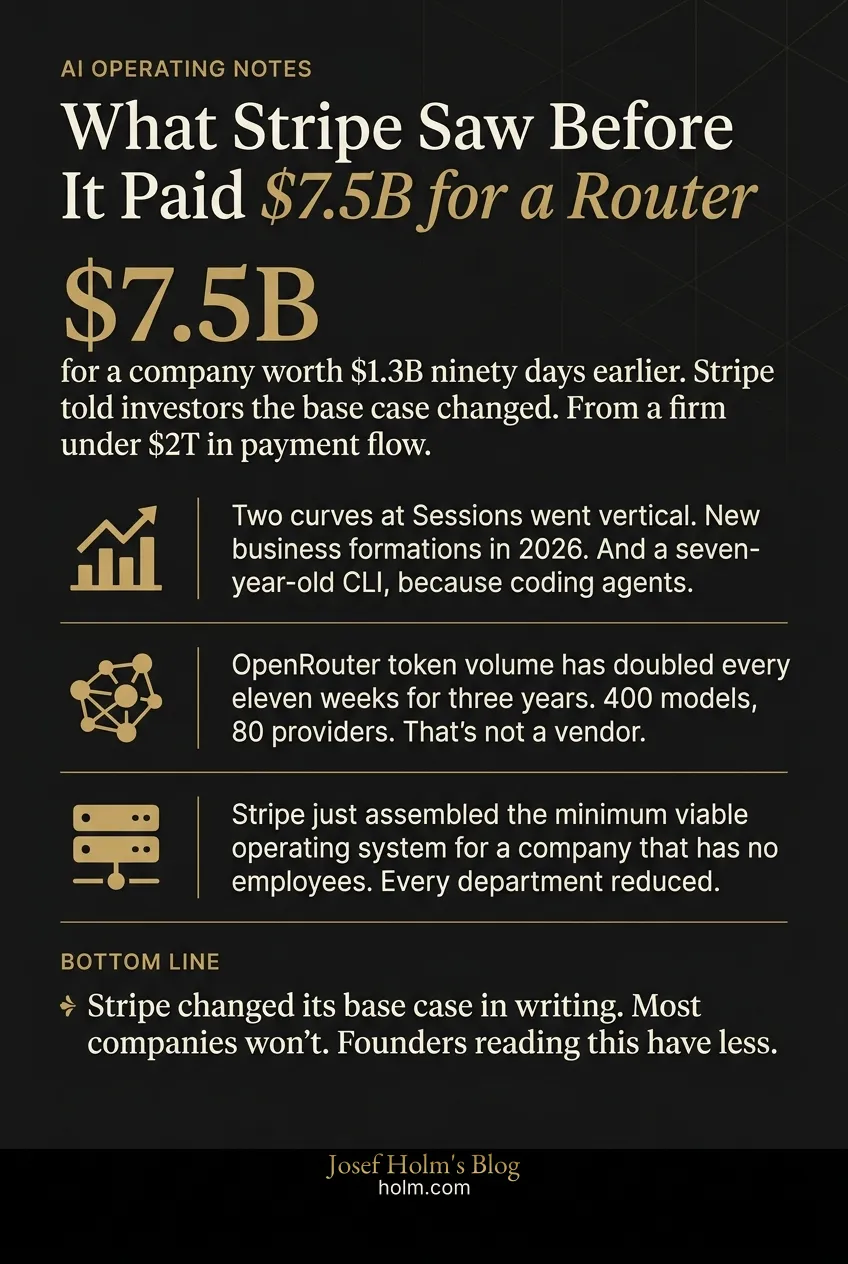
Infographic
Frequently Asked Questions
- Why did Stripe pay $7.5 billion for OpenRouter after a $1.3 billion valuation ninety days earlier?
- Because the router is where the economics sit. Stripe already meters the money coming in for 88% of the Forbes AI 50. OpenRouter meters the tokens going out. Owning both sides of the ledger, capital flow and intelligence flow, is a rare position and Stripe paid to lock it in.
- What does Stripe mean when it tells investors the singularity started on January 1, 2026?
- They mean their base case changed. Monthly new business formations went vertical. Their seven-year-old CLI went vertical because coding agents discovered it. Token volume doubled every eleven weeks for three years across 400 models. That's not marketing, it's a behavior change they saw first because they sit under $2 trillion in payment flow.
- What is Stripe actually building with Atlas, OpenRouter, Machine Payments Protocol, Link, Bridge, and the rest?
- The minimum viable operating system for a company that has no employees. Incorporation, deployment, model access, agent to agent payments, wallets, product discoverability, treasury, metering, fraud. Every function that used to require a department reduced to a line item on someone else's platform.
- What should incumbents do when their competitor might be two people who haven't incorporated yet?
- Sit with four questions. Where are you making customers wait because your company has to coordinate itself internally? Where does your price protect your structure instead of delivering value? How can decades of customer knowledge become context an agent can use? How does your distribution become a faster path for new products instead of a shield for old ones?
- What does agent purchasability mean and why compare it to SEO?
- Thirty years ago companies had to become legible to search engines or disappear from the demand pipeline. Now the same thing is happening with economic agents. Can an agent discover what you sell, get a firm price without a human, authenticate, receive a usable output, produce a receipt? If any answer is no, you're invisible to the buyer growing fastest.
- What's the strategic lesson from the Stripe move for an operator running a company today?
- Watch your own metrics and change your base case when something fundamental has shifted. Where inside your business have the numbers stopped behaving normally? Customer acquisition cost, what people will pay for, what your team ships in a week, what your competitors look like. Something is bending. Stripe had the courage to change its base case in writing. Most companies won't.