Your Team Is Too Big to Ship Anything Right
Key Takeaways
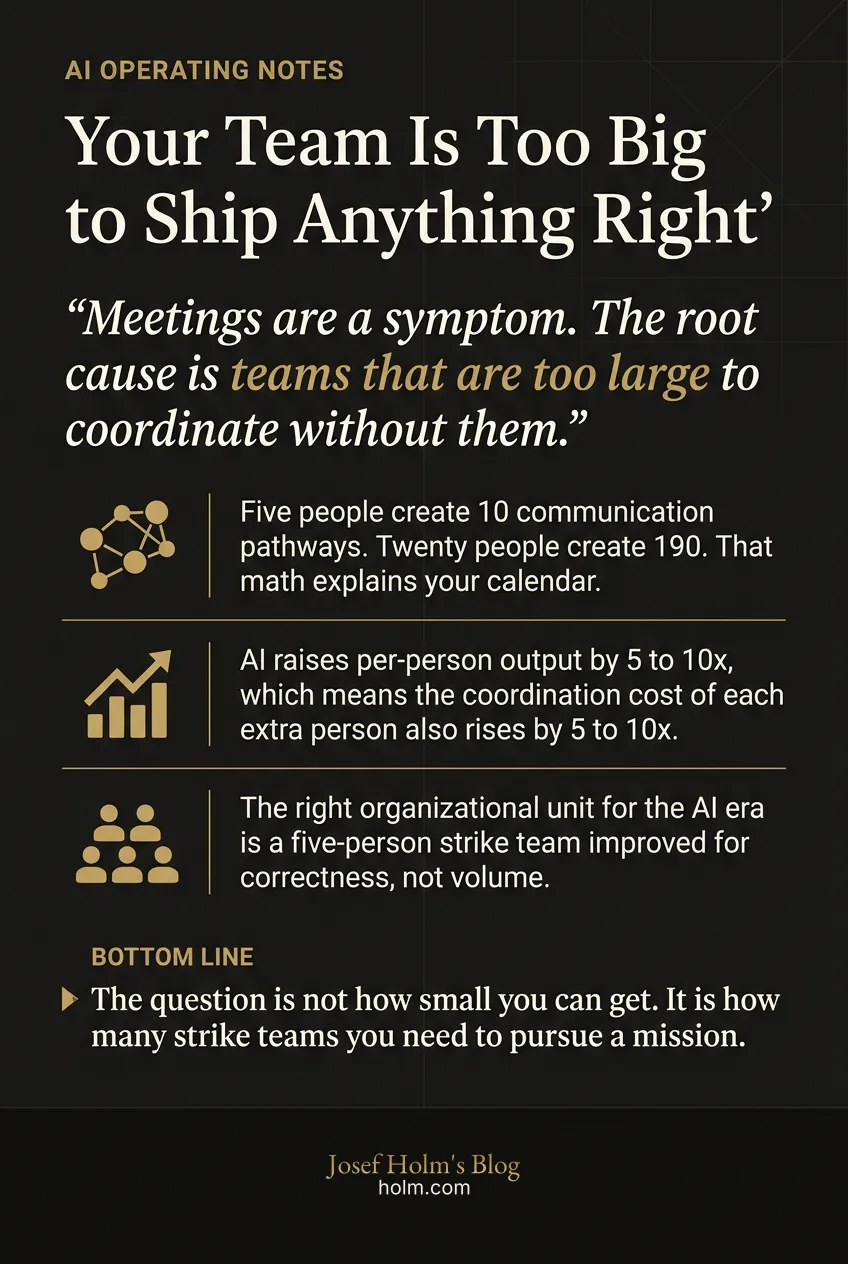
- Meetings are a symptom. The root cause is teams that are too large to coordinate without them.
- Five people create 10 communication pathways. Twenty people create 190. That math explains your calendar.
- AI raises per-person output by 5 to 10x, which means the coordination cost of each extra person also rises by 5 to 10x.
- The right organizational unit for the AI era is a five-person strike team improved for correctness, not volume.
- The question is not how small you can get. It is how many strike teams you need to pursue a mission 10x larger than today.
Most Companies Don't Have a Meetings Problem. They Have a Team Size Problem.
The average worker spends 12 hours a week in meetings. People managers spend 16. Executives spend 23. Meetings have tripled since 2020.
The most common response? Buy an AI note-taking app.
That's like putting a faster engine in a car with square wheels. The structure is wrong. A new tool doesn't fix a broken structure.
The real problem isn't too many meetings. It's too many people on too many teams. Meetings are a byproduct of coordination overhead, and coordination overhead is a function of team size. Every person you add doesn't just add capacity. They add communication pathways that grow exponentially.
Five people create 10 pathways. Ten people create 45. Twenty people create 190.
At 20 people, nobody knows what anyone else is doing. So they schedule a meeting. Which generates action items. Which require follow-up meetings. Which generate status updates. Which require alignment meetings. You know this loop. You're probably sitting in one right now.
Here's what I think most leaders are missing: AI didn't create this problem, but it made the penalty for ignoring it dramatically worse.
Why Does Five Keep Showing Up?
Three completely independent fields arrived at the same number. That's worth paying attention to.
Evolutionary psychology. Robin Dunbar's 1992 research on primate neocortex size established layered limits on human relationship complexity. The innermost layer, the group where deep, high-context coordination is possible, is about five people. The next layer out is 15, then 50, then 150. These aren't arbitrary. They're neurological constraints.
Military science. The U.S. Army, which has been running the longest-duration experiment in team effectiveness in human history, independently confirmed the same pattern. A fire team is four people plus a leader. Squads, platoons, and companies track Dunbar's hierarchy almost exactly. These structures weren't designed from theory. They were refined through decades of operational reality where getting the structure wrong gets people killed.
Software engineering. Fred Brooks documented in 1975 that adding people to a late software project made it later, not faster. Communication overhead consistently overwhelmed added capacity. Jeff Bezos arrived at the same conclusion independently with the two-pizza team rule.
Three disciplines. Three different methodologies. Same answer.
The human brain can sustain deep, high-context coordination with approximately five people. Not eight. Not twelve. Five.
So why do most companies build teams of 15 or 20 and then wonder why nothing ships without six meetings and a steering committee?
What Did AI Actually Change About Team Math?
The standard narrative says AI makes people more productive, so teams can be smaller. That's true but incomplete. It misses the part that actually matters for how you structure work.
Before AI, a five-person team produced X output. Adding a sixth person increased capacity, but with diminishing returns because coordination overhead grew faster than output. Toby Lütke of Shopify has described this as roughly a 10x loss of productivity with each addition beyond five.
After AI, that same five-person team produces 5 to 10x more than before. The evidence is clear. Revenue per employee at AI-native companies runs 5 to 10x higher than the traditional SaaS benchmark, which historically sat below $500,000 per employee per year. Lovable reached hundreds of millions in ARR with a very small headcount. Midjourney, ElevenLabs, Anthropic, and OpenAI show the same pattern.
Now here's where the math gets uncomfortable.
When each person produced roughly $250,000 per year in value, the coordination cost of adding a sixth person was manageable. Annoying, but manageable. When each person produces $2 to 3 million per year in value, that same coordination cost is measured in millions of lost productivity.
Read that again. The penalty for adding a human to a team increases proportionally as per-human output increases.
Most meetings exist because someone decided coordination was worth the cost. At $2 million per person, most of those meetings become net negative. They destroy value at a rate that scales with how productive the people in them are. Your most capable people are the ones most damaged by being in the wrong-sized team.
Isn't the Real Win Just More Output?
No. And this is where most AI-and-teams conversations go wrong.
The typical framing focuses on volume: more code, more content, faster output. This leads to incorrect organizational decisions because it optimizes for the wrong thing.
AI made volume cheap. What's scarce now is correctness. Whether what was shipped is architecturally sound, strategically coherent, right for the customer, and free of subtle errors that compound in production.
A Harvard Business School field experiment published in 2025 studied 776 professionals at Procter & Gamble on real innovation challenges. Teams using AI were three times more likely to produce ideas in the top 10% of quality. Not three times more output. Three times more likely to be correct at the highest level. The study also found that AI broke functional silos: both R&D and marketing produced more balanced, integrated ideas, extending each person's competence into adjacent domains.
That distinction changes everything about how you think about team structure.
In a five-person team, each person's AI-generated output passes through at least one other brain that shares enough context to catch meaningful errors. The team is small enough that everyone holds the full picture.
In a 20-person team, AI output multiplies by another factor of four, but shared context degrades. So teams hold meetings to synchronize, which generate more decisions, more AI tasks, more output to verify, and more meetings. I call this the agentic tarpit. You're sinking faster the harder you work.
A team of five optimizes for correctness. A team of 20 optimizes for volume. In a world where AI makes volume free, improving for volume is tuning for the wrong thing.
High volume without correctness produces pseudo-work. Things that don't quite work, require rework, generate postmortems, and spawn follow-up projects to fix problems created by the last project. Sound familiar?
What Do the Right Team Structures Actually Look Like?
Two structural archetypes are emerging. Both are valid. They serve different purposes.
Scouts: Solo Operators with AI Toolkits
One person. Full AI toolkit. Defined mission. Zero coordination overhead. The constraint is one person's judgment.
Scouts are ideal for exploration. Is this technology viable? Is this market real? Can we build a prototype?
Consider Peter Steinberger, who built Open Claude in roughly 60 days, running 4 to 10 coding agents simultaneously in a language he had never used. He directed agents at the architectural level while they handled execution. The result was something major companies sought to acquire.
But the solo model has real limits. It works for exploration and high ambiguity. It doesn't work when correctness requires multiple perspectives, when the cost of being subtly wrong is high, or when sustained long-term production is the goal. Steinberger ultimately joined OpenAI to translate his vision at scale, and Open Claude shipped with major gaps.
Scouts map territory. They don't build roads.
Strike Teams: Five People Plus AI
This is the structural unit that executes where correctness matters.
A team of five can cover product, engineering, design, data, and domain expertise. Not necessarily with five separate specialists, but with those capabilities distributed across the team. Five is the real minimum surface area for a complete decision. Below five, there are blind spots. Above five, there are silos.
In a team of five, there is nowhere to hide. That's exactly what correctness requires.
Most organizations currently have neither scouts nor strike teams. They have oversized teams that are too slow for exploration and too diluted for precision execution. Stuck in the middle, which is the worst place to be.
Should We Just Cut Headcount?
This is the question I hear most often, and it's the wrong question. It reflects a failure of imagination.
Framing AI's impact as a cost story, "do the same work with fewer people," is thinking small in exactly the moment when thinking large becomes possible.
A 500-person company where each person is 5 to 10x more capable does not simply become a 50-person company. The correct framing: that company now has the productive capacity of a 2,500 to 5,000-person organization without hiring anyone, raising capital, or building new offices.
The question is not how small can we get. It is: given that every five-person team now has the capacity of a 50-person department, how many teams do we need to pursue the mission we actually want?
A SaaS company with 400 engineers maintaining one product, restructured into 80 strike teams, could plausibly build a platform with 10 products. A regional insurer with 200 people serving three states, reorganized into 40 AI-powered strike teams, could plausibly serve 30 states and build products currently outsourced.
The AI-native companies already demonstrate this. Lovable built a global platform serving millions and achieved unicorn status rapidly. Midjourney went after the entirety of visual creation. These companies didn't use AI to shrink. They used small teams to think very large.
I've watched leaders spend careers in a world where "we don't have the people" was the final answer to any ambitious proposal. That answer has expired. But the planning processes, budgeting cycles, and strategic frameworks that assumed headcount was the binding constraint on ambition? Those are still running. That's the real bottleneck now. Not talent. Not technology. Organizational inertia.
This is exactly the kind of structural question we work through in our AI readiness note. Not "what AI tools should we buy" but "how does AI change what's possible for this specific organization, and what needs to change structurally to capture that."
How Do You Scale Strike Teams Without Losing Coherence?
The layered structure tracks the same biological constraints that produce the number five.
Five people form one strike team. Three to four strike teams share a domain, coordinated by a single person focused on inter-team coherence. Three to four domains share a strategic objective.
At each level, the leader is responsible for maintaining the quality of relationship required for the coordination being asked of them. Not managing tasks. Maintaining the quality of shared context that allows teams to stay aligned without constant synchronization.
Management layers thin dramatically. Project managers become unnecessary when AI tracks projects. Coordination roles shrink when there are fewer humans to coordinate.
What grows in importance is what I'd call the taste layer. People obsessed with maintaining standards of correctness. Lütke calls this the "constitution": the specific principles where a reasonable competitor would choose the opposite. In an organization of federated strike teams producing at 10x, the people who define and enforce that taste standard are the most important people in the building.
That's a notable shift. In traditional organizations, the most important people are the ones who manage the most people. In a strike team organization, the most important people are the ones whose judgment shapes what "right" looks like.
What Happens to Hiring and Talent?
Here's the uncomfortable truth about team composition in this model.
In a team of five, every person occupies one of ten communication pathways. Every person's judgment gets multiplied by AI. A mediocre contributor doesn't just underperform. They consume a coordination slot without providing the judgment that justifies their cost. When their mediocre judgment is boosted by AI, they generate verification burdens on everyone else.
They make the team actively worse. Not just by contributing less, but by consuming the team's most precious resource: the shared attention required to maintain correctness. I call this the AI slop tax, and it's far more expensive than most leaders realize.
The hiring question has to change.
Stop asking: "Can this person do the current job?"
Start asking: "Can this person be one of five whose taste and judgment will be grew 10 to 100x by AI? And can we point that team of five at a mission 10x larger than what we're doing today?"
Who thrives in strike teams? People who can define a problem without being handed a spec. People who know what "right" looks like at the architectural level, not the syntax level. People who hold the whole system in their head and default to action rather than seeking permission.
Here's the part that will make some HR leaders uncomfortable. High performers under current rubrics, those skilled at running large org structures, running good meetings, writing clear status updates, may struggle in this model. Those are coordination skills. Valuable in large teams. Overhead in strike teams.
Conversely, people who tend to ignore meetings, build things without asking, and occasionally ship something brilliant that nobody requested may be exactly who strike teams need. They've been fighting the organizational structure for years. The strike team is the structure they were built for.
How Do You Start This Without Blowing Up the Org?
Two practical moves.
Scout Missions as Diagnostics
Give someone a real problem the company has been ignoring. Provide full AI tooling, a week, a clear objective, no committee, and zero check-ins.
The results will likely not match current performance review rankings. That's the point. Scout missions reveal who can direct AI versus who gets directed by it. They surface capability that your existing evaluation systems can't see.
Executive Mandate as Cultural Forcing Function
Lütke required every Shopify team to prototype with AI before beginning a real build. Every project, every team. He made AI fluency part of performance reviews and required teams to demonstrate why AI could not do a task before requesting headcount.
The deeper effect is subtle but powerful. Every AI prototype generates a data point on what AI can and cannot do in that specific domain. When a new model is released, there's a pre-built test put to work that reveals what's newly possible. You're building organizational knowledge about AI's frontier, continuously, as a side effect of doing work.
Forced AI prototyping also serves as a training route. The person who prototypes ten times and fails seven has built more specification skill than the person who attended ten meetings on AI strategy. An executive mandate removes the permission barrier. Everyone gets the repetitions, and the people who take to it self-identify faster than any talent review process would surface them.
If you're trying to figure out where your organization sits on this spectrum, and what the right first moves look like, that's what our AI readiness note is designed to clarify. We help leadership teams see the structural reality clearly and build a practical path forward.
The Real Opportunity Is Bigger Than Efficiency
I've been building and advising technology companies for over 25 years. I've watched multiple cycles where a new capability arrived and most leaders used it to do the same thing slightly cheaper. The leaders who won were the ones who saw the capability clearly and asked a different question.
The structural unit of the AI era is the five-person strike team. AI raised output per person by an order of magnitude, which raised the coordination cost of each additional person by the same order of magnitude. Five optimizes for correctness. AI made volume free. Correctness is the scarce resource.
The right response is not to shrink to five people. It's to restructure into teams of five and radically expand what you believe your organization can do.
The companies that define the next decade are not cutting headcount to protect current margins on current ambitions. They're keeping their people, reorganizing into appropriately sized teams, and pursuing missions that were previously out of reach.
That's not a cost story. It's an ambition story. And if you're not telling it yet, someone in your market will.
Infographic
Frequently Asked Questions
- Why do five-person teams outperform larger teams?
- It comes down to communication pathways. Five people create 10. Twenty people create 190. Past five, nobody holds the full picture, so teams schedule meetings to synchronize. The meetings generate more decisions and more work to verify. The structure collapses under its own coordination weight.
- How does AI change the math on team size?
- AI raises per-person output by roughly 5 to 10x. That same multiplier applies to the cost of coordination overhead. What used to be an annoying but manageable tax on adding a sixth person now measures in millions of lost productivity per year. Your most capable people pay that tax hardest.
- What is a strike team in this context?
- A five-person team with full AI tooling and a defined mission. It covers product, engineering, design, data, and domain expertise across those five people. Everyone holds the full picture, there is nowhere to hide, and every output passes through at least one other brain with enough shared context to catch real errors.
- Should companies just cut headcount to build this?
- That is the wrong question. Cutting headcount to do the same work cheaper is thinking small. The right question is: given that each five-person team now has the capacity of a 50-person department, how many teams do you need to pursue the mission you actually want? This is an ambition story, not a cost story.
- What kind of people thrive in strike teams?
- People who can define a problem without a spec, who know what right looks like at the architectural level, and who default to action rather than seeking permission. People who have historically fought against large org structures may be exactly who strike teams were built for. Coordination skills that shine in large teams become overhead in teams of five.
- How do you start restructuring toward strike teams without disrupting everything?
- Two moves. First, run a scout mission: give one person a real ignored problem, full AI tooling, one week, and zero check-ins. The results will not match your current performance rankings. That is the point. Second, require every team to prototype with AI before starting a real build. Forced prototyping builds specification skill faster than any training program and surfaces the people who can actually direct AI.