The Vendor Gap That Exposed Claude Mythos
Key Takeaways
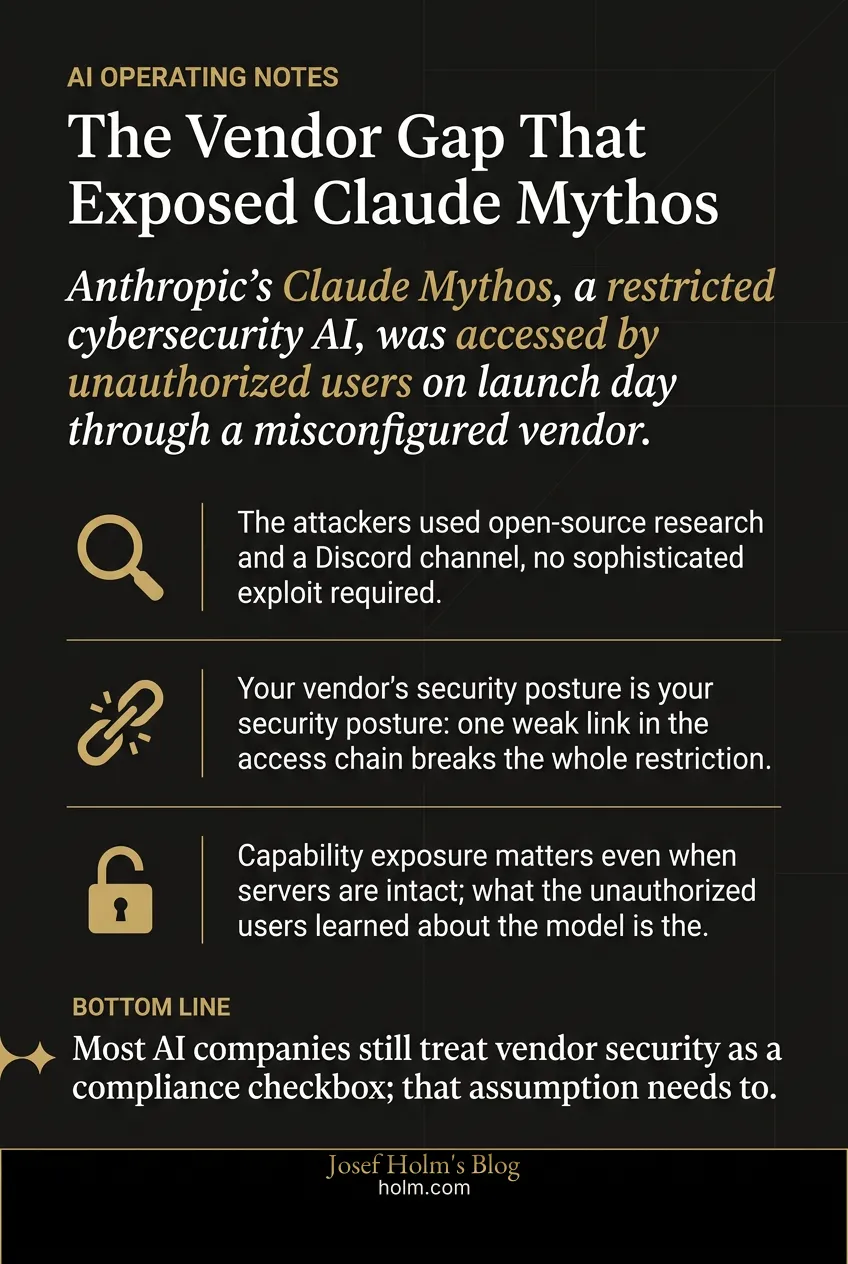
- Anthropic's Claude Mythos, a restricted cybersecurity AI, was accessed by unauthorized users on launch day through a misconfigured vendor portal, not a breach of core systems.
- The attackers used open-source research and a Discord channel, no sophisticated exploit required.
- Your vendor's security posture is your security posture: one weak link in the access chain breaks the whole restriction model.
- Capability exposure matters even when servers are intact; what the unauthorized users learned about the model is the real risk question.
- Most AI companies still treat vendor security as a compliance checkbox; that assumption needs to change as model capabilities grow.
Most companies worry about getting hacked by sophisticated attackers. Anthropic just got outmaneuvered by curious people with a Discord channel and some basic research skills. That's not a cyberattack story. It's an operational security story, and the distinction matters more than most coverage is acknowledging.
What actually happened here?
Anthropic built a restricted AI model called Claude Mythos, designed specifically for defensive cybersecurity. It finds vulnerabilities in code. Mozilla used it during testing and found over two hundred security flaws in Firefox in record time. That's the kind of capability you keep locked down.
Anthropic tried to do exactly that. Mythos launched April 7 as part of Project Glasswing, a controlled release limited to select partners like Apple, Microsoft, Cisco, and Amazon. Not a public product. Not commercially available. Reserved for a closed group with clear use cases.
Then unauthorized users got access on the same day it was announced.
Not through Anthropic's core systems. Through a third-party vendor environment. The group combined information from a Mercor data breach with access held by an Anthropic contractor to guess the model's online location. They found unreleased models by monitoring a Discord channel. No sophisticated exploit. No zero-day. Just open-source research and a misconfigured portal.
Anthropic confirmed it's investigating and says there's no evidence the activity reached its internal systems. The group told Bloomberg they're "interested in playing around with new models, not wreaking havoc."
That framing should not comfort anyone.
Why does this matter beyond the headline?
The irony is obvious and worth stating plainly: a tool built to find security flaws was exposed by a security flaw. But the real lesson isn't about irony. It's about the gap between how companies think about AI security and where the actual risks live.
Anthropic is one of the more serious AI companies when it comes to safety. They restricted Mythos deliberately. They chose partners carefully. They built a controlled distribution framework. None of that mattered because a vendor left a door open.
I've seen this pattern play out across every technology cycle for thirty years. The core product team builds carefully. The security review is thorough. Then the breach comes through a contractor, a partner integration, or a misconfigured third-party environment that nobody was watching closely enough.
The attack surface isn't the model. It's the supply chain around the model.
Bloomberg's sources claim these same users also accessed other unpublished models. If that's accurate, the vendor exposure wasn't a one-time misconfiguration. It was a systemic gap.
What should business leaders actually take from this?
If you're running a company that uses AI models, builds on top of them, or is evaluating AI vendors, here's what matters:
Your vendor security posture is your security posture. It doesn't matter how strong your internal controls are if a contractor with access to your systems has weaker ones. This isn't a new principle, but AI raises the stakes because the capabilities being exposed are more dangerous.
Controlled releases only work if every link in the chain is controlled. Anthropic did the right thing by restricting Mythos. But restriction is a system, not a decision. Every vendor, every contractor, every integration point has to hold the same standard. One weak link and the restriction means nothing.
"No evidence of impact on core systems" is not the same as "no impact." When a cybersecurity analysis tool is accessed by unauthorized users, the risk isn't just data theft. It's capability exposure. What did they learn about how the model works? What prompts did they test? What outputs did they see? Those questions matter even if Anthropic's servers are intact.
Timing compounds risk. This is happening while U.S. government agencies are requesting access to Mythos to protect national infrastructure. The Pentagon has reportedly labeled Anthropic a supply chain risk. Whether that designation is fair or not, having unauthorized access to your most sensitive model surface publicly while negotiating government contracts is the kind of problem that doesn't stay contained to one news cycle.
Is this an Anthropic problem or an industry problem?
Both. Mostly it's an industry problem.
Every major AI company is distributing models through partner networks, cloud environments, API layers, and contractor relationships. The number of access points is growing faster than the security frameworks around them. And the models themselves are becoming more capable, which means each exposure carries more risk than the last one did.
Most companies are still thinking about AI security as a product security question. Is the model safe? Does it have guardrails? Can it be jailbroken? Those are real questions. But the Anthropic incident shows that the more immediate threat is operational: who has access, through what channels, and are those channels actually secured?
This is where the AI readiness note work we do at Josef Holm keeps surfacing the same finding. Companies have AI strategies. They have AI policies. What they often lack is a clear operational picture of where their AI exposure actually sits, especially across vendor and partner relationships.
What happens next?
Anthropic will likely tighten vendor access controls. They'll probably add monitoring layers. The immediate exposure will get closed.
That's the easy part.
The harder question is whether the industry adjusts its assumptions. Right now, most AI companies treat vendor security as a compliance checkbox, not an operational priority. That worked when the models being distributed were general-purpose assistants. It doesn't work when the models can find operating system vulnerabilities faster than human security teams can.
The group that accessed Mythos said they weren't trying to cause harm. Maybe that's true. But the next group won't announce themselves on Discord first.
If you're a business leader evaluating how AI fits into your operations, the question isn't just "which model should we use?" It's "do we actually understand the full chain of access around the AI systems we depend on?" Most honest answers to that question are uncomfortable.
That discomfort is useful. It's where the real work starts.
Infographic
Frequently Asked Questions
- What is Claude Mythos and why was it restricted?
- Claude Mythos is a specialized AI model built by Anthropic for defensive cybersecurity work. It finds vulnerabilities in code at speed. Mozilla used it to identify over two hundred security flaws in Firefox during testing. Because of those capabilities, Anthropic kept it in a controlled release through Project Glasswing, limited to partners like Apple, Microsoft, Cisco, and Amazon.
- How did unauthorized users access Claude Mythos?
- They combined data from a Mercor data breach with access held by an Anthropic contractor to locate the model's online portal. They also monitored a Discord channel to track unreleased models. No sophisticated exploit was involved. It was open-source research combined with a misconfigured third-party environment.
- What does 'no evidence of impact on core systems' actually mean for risk?
- It means Anthropic's internal servers weren't compromised. It does not mean there was no impact. The real risk with a cybersecurity AI is capability exposure: what prompts were tested, what outputs were seen, and what the unauthorized users learned about how the model works. That knowledge has value regardless of whether any data was stolen.
- How should companies think about AI vendor security?
- Treat your vendors' security posture as an extension of your own. If a contractor or partner has access to your AI systems and their controls are weaker than yours, your controls don't matter. A controlled release is a system, not a decision. Every link in the chain has to hold the same standard.
- Is this an Anthropic-specific problem or an industry-wide issue?
- It's an industry-wide problem that surfaced at Anthropic. Every major AI company distributes models through partner networks, API layers, and contractor relationships. The access points are growing faster than the security frameworks around them, and the models are becoming more capable, which means each exposure carries more risk.
- What is the first step a business leader should take after reading this?
- Get an honest operational picture of where your AI exposure actually sits, specifically across vendor and partner relationships. Most companies have AI policies and AI strategies. What they often lack is visibility into who has access to what, through which channels, and whether those channels are actually secured.