AI Can Write Software. Can It Write a Business?
Key Takeaways
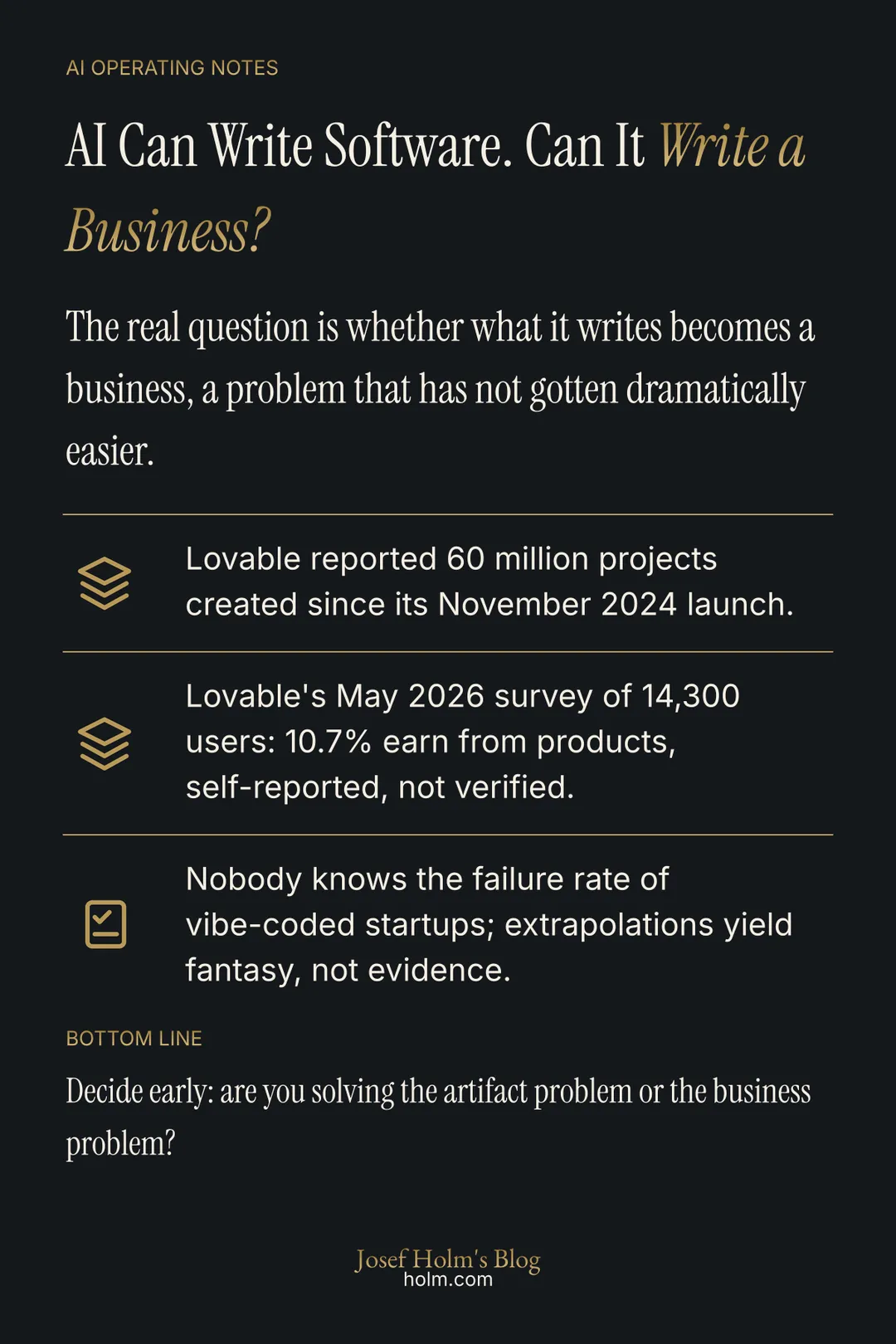
- The real question is whether what it writes turns into a business, and that is a customer problem, a billing problem, a reliability problem, a distribution problem, and a margin problem that has not gotten dramatically easier.
- Lovable reported 60 million projects created since its November 2024 launch. That is a project-creation number, not a business-formation number. One founder can start ten projects before lunch; the metric measures throughput of attempts, not companies.
- Lovable's May 2026 survey of 14,300 users found 10.7 percent earning directly from products, 15.3 percent from consulting, and 60.5 percent not yet earning but planning to. Vendor survey of active users, self-reported earning categories, not verified revenue.
- Nobody knows the failure rate of vibe-coded startups. The 90 percent of startups fail cliche does not apply, and extrapolating project counts against survey percentages produces fantasy numbers, not evidence.
- Decide early which problem you are solving: the artifact problem or the business problem. Pretending they are the same is how you end up with a working demo, a Stripe account, and nobody on the other end of it.
The real question isn't whether AI can write software. It can. The question is whether what it writes turns into a business.
Those are two different problems. One is a code problem. The other is a customer problem, a billing problem, a reliability problem, a distribution problem, and a margin problem. The first has gotten dramatically easier over the last 24 months. The second hasn't.
I started in affiliate marketing almost 30 years ago and have built companies through several technology cycles. More people building is good news. What I'm careful about is the gap between producing a working demo and accepting responsibility for customers, billing, reliability, support, updates, distribution, and viable unit economics [9].
That gap is where the vibe-coding conversation gets sloppy. Someone takes a project count, multiplies it by a monetization percentage from a survey, and declares a wave of new startups. That's not what the numbers say. Let me walk through what they actually say.
Share of subscription revenue by app launch cohort (Jan 2026)
Apps launched before 2020 generate 69% of subscription revenue; apps launched in 2025 or later contribute just 3%, despite a surge in new supply.
Scroll the chart sideways to see every point.
| Label | Value | Unit | Period |
|---|---|---|---|
| Apps launched before 2020 | 69% | % of subscription revenue | Jan 2026 |
| Apps launched 2025 or later (vibe-coding era) | 3% | % of subscription revenue | Jan 2026 |
| All other launch cohorts (2020–2024) | 28% (derived) | % of subscription revenue | Jan 2026 |
How many AI-built projects are we really talking about?
Lovable, one of the leading vibe-coding platforms, reported more than 60 million projects created on its platform since its November 2024 launch, in its August 12, 2026 Series C announcement [10] [8] [4]. [1]
Verified data from thebuildeconomy.lovable.app
Verified values from the cited source are shown below.
- Projects built to date
- 50M
- Monthly visits to Lovable-built projects
- 720M
| Label | Value | Unit | Period |
|---|---|---|---|
| Projects built to date | 50M | projects | as of report (data through May 2026) |
| Monthly visits to Lovable-built projects | 720M | visits/month | as of report |
Lovable's self-reported scale at Series C (August 12, 2026)
Lovable reports massive project creation and traffic, but these metrics measure creation and visits, not launched, paying businesses.
- Projects created since November 2024 launch
- 60M+
- Monthly visits to Lovable-built apps
- 900M+
- Series C funding raised
- $400M
- Series C valuation
- $13.3B
| Label | Value | Unit | Period |
|---|---|---|---|
| Projects created since November 2024 launch | 60M+ | projects | Nov 2024–Aug 2026 |
| Monthly visits to Lovable-built apps | 900M+ | visits/month | as of Aug 12, 2026 |
| Series C funding raised | $400M | USD | Aug 12, 2026 |
| Series C valuation | $13.3B | USD | Aug 12, 2026 |
Sixty million is a real number. It is also a project-creation number. It doesn't tell you how many of those projects got deployed, how many got pointed at a domain, how many had a first paying customer, how many are still running this month, or how many closed. One account can start dozens of projects. A single founder exploring an idea can create ten before lunch. The metric measures throughput of attempts. Not formation of companies.
Why does so much coverage treat it like a startup census? Because the number is big and the headline writes itself. Multiply 60 million by any monetization percentage you've seen in a survey and you get a fantasy. Project creation isn't business formation. Those are different lifecycle stages, and the distance between them is where almost all the real work lives.
What does the monetization data actually show?
Here the data gets more useful. Between May 22 and May 29, 2026, Lovable surveyed more than 14,300 of its users. Self-reported results: 10.7% said they were earning directly from a product they built, 9.1% from products plus consulting, 15.3% from consulting or client work, 60.5% said they were not yet earning but planned to, and 4.5% had no monetization plans [6].
Lovable user survey: monetization status (May 2026)
Most Lovable users surveyed report they intend to monetize but have not yet earned revenue; only ~10.7% report earning directly from their product.
Scroll the chart sideways to see every point.
| Label | Value | Unit | Period |
|---|---|---|---|
| Not yet, but plan to | 60.5% | percent | May 22–29, 2026 |
| Consulting / client work | 15.3% | percent | May 22–29, 2026 |
| Direct from product | 10.7% | percent | May 22–29, 2026 |
| Mix of both | 9.1% | percent | May 22–29, 2026 |
| No plans | 4.5% | percent | May 22–29, 2026 |
Read that carefully. It's being misread almost everywhere.
First, this is a vendor-run survey of its own active users. People still logging in and willing to answer surveys skew toward the engaged and the hopeful. It's not a random sample of everyone who ever tried the platform.
Second, these are self-reported earning categories. Not verified revenue. Not profitability. Not sustained demand. "Earning directly from products" could mean $20 a month from one customer or $20,000 a month from fifty. The survey doesn't say.
Third, almost two thirds of respondents said they hadn't earned anything yet. That isn't a failure signal. It's a stage signal. Most are still at the point where they've built something and haven't yet put it in front of a buyer holding a credit card.
The honest read: a lot of people are building, a smaller slice has started earning, and nobody yet knows how many of those earnings streams become durable businesses. That is a more useful statement than any clean failure rate someone has tried to sell you.
What about the "90% of startups fail" shortcut?
Skip it. It doesn't apply here, and anyone leaning on it to talk about AI-built startups is substituting a cliché for actual evidence.
If someone shows you a number, read the methodology before you quote it. Most of what circulates is extrapolation from project counts, selected customer stories, or survey percentages applied to the wrong denominator.
The honest answer today: nobody knows the failure rate of vibe-coded startups. We know many people are building. We know a smaller number are earning something. We know almost nothing about who is still operating in year three. Pretending otherwise is wishful quantification.
Is "vibe coding" the same as serious teams using AI?
No. And this distinction matters.
Y Combinator reported that for 25% of its Winter 2025 batch, 95% of code lines were LLM-generated [7] [2] [5].
Striking number. It's been read two ways. One camp uses it to argue founders no longer understand their own stack. The other uses it to argue AI coding is now the default and everything else is sentimental. Both readings are too strong.
What that YC data actually shows is adoption inside a highly selected accelerator cohort. These are teams that passed a filter. They have mentors, investors, and reviewers checking their work. The number tells you how code was generated. It doesn't tell you founders didn't read it, didn't shape it, or didn't understand it. It also doesn't tell you the resulting companies are commercially successful or that they are commercially doomed. An adoption statistic, not an outcome statistic.
My read is simpler. Serious teams are using AI heavily to write code. That is now the baseline. For every one of those companies, the real question is the same question every company has always faced: can you find a buyer, deliver reliably, charge enough, and keep the lights on. Code generation doesn't change that scoreboard.
Can AI-built products become durable businesses?
Yes. I want to be plain about that, because the honest version of this argument isn't that vibe coding is bad. It's that building the artifact is step one of about fifteen.
Non-technical founders can and do succeed. Small teams can run real businesses. Useful internal tools don't need to become independent companies to be worth building. The tools have genuinely lowered the barrier to a working first version, and that's real progress, not a mirage.
What hasn't changed is the operating work that starts after the first version compiles. Customer acquisition still costs money. Repeat usage still has to be earned. Payments still fail. Refunds still happen. Support tickets still arrive at inconvenient hours. Security still has to be defensible. Updates still have to ship when the underlying model, API, or platform changes under you. Gross margin still has to survive your operating costs, or there is no business, only an expensive hobby with a Stripe account.
That piece is what the project-count numbers can't measure. It's also the piece that decides who is still operating in year three.
The lifecycle people keep collapsing
One takeaway from the data above: creation, deployment, launch, first revenue, retained customers, profitability, and closure are different stages, and they don't collapse into one number.
A project that never got deployed isn't a failed business. It was never a business. A product below some revenue milestone isn't necessarily a failure. It may be a side project doing exactly what the builder wanted it to do. A product that is "earning directly" per a survey may be nowhere near covering its true costs. A company that stops operating is not necessarily bankrupt. Sometimes the founder got a job. Sometimes the market shifted. Sometimes the thing simply ran its course.
When you read any statistic in this space, ask which stage it is measuring. Most of the loudest numbers are measuring creation. Most of the loudest conclusions are being drawn about commercial outcomes. Those don't match.
How I'm operating around this
Here is the operating choice I'm making. A choice, not a proven answer.
More creators can now build software. Not every creator wants to operate a software business. That is the gap behind how I've organised things.
Akii Technologies is an AI venture builder that funds, builds, directly owns, and operates its products. Marquorum is the affiliate network for creators inside that model. Active eligible partners with tracked traffic or sales in the preceding 30 days can propose and vote on future products distributed through the network. We qualify opportunities before a binding ballot and follow the result, subject to legal, technical, or economic problems that may surface later.
Why build it this way? Because of the gap this article is about. Creators are often very good at knowing what their audience will buy. Many are not interested in running the billing stack, the support queue, the compliance work, and the margin discipline that make a product a business. Splitting those roles is my bet on how to let more good product ideas actually ship as operated businesses. Not a statistically proven solution to startup failure. My operating choice.
Where to leave this
If you take anything from the numbers above, take this: the vibe-coding wave has made the artifact cheap. It hasn't made the business cheap. The gap between the two is where attention, judgment, and operating discipline still earn their keep.
If you're building in this moment, decide early which problem you are actually solving: the artifact problem or the business problem. Different jobs. Pretending they are the same is how you end up with a working demo, a Stripe account, and nobody on the other end of it.
For more of this kind of operator reading, subscribe to The Operator's AI Brief. And if you think I'm wrong on any of the above, tell me where. I'd rather be corrected than comfortable.
Research notes
Research checked 9 October 2026.
Sources
- Instagram, www.instagram.com Retrieved 9 October 2026.
- x.com Retrieved 9 October 2026.
- State of Subscription Apps 2026 – RevenueCat, www.revenuecat.com Retrieved 9 October 2026.
- Lovable secures $400M at $13.3B valuation to scale Its AI software platform | Vestbee, www.vestbee.com Retrieved 9 October 2026.
- For 25% of the Winter 2025 batch, 95% of lines of code are LLM generated. That’s not a typo. The age of vibe coding is here. | Y Combinator | 33 comments, www.linkedin.com Retrieved 9 October 2026.
- The Build Economy - A Data Study by Lovable, 2026, thebuildeconomy.lovable.app Retrieved 9 October 2026.
- A quarter of startups in YC's current cohort have codebases that are almost entirely AI-generated | TechCrunch, TechCrunch Published 6 March 2025. Retrieved 9 October 2026.
- Lovable revenue, valuation & funding | Sacra, sacra.com Retrieved 9 October 2026.
- Lovable hit $500 million in revenue with 146 employees. Its new data shows who is actually building software now., TNW | Apps Published 9 June 2026. Retrieved 9 October 2026.
- We just raised $400M in Series C funding to help people run their businesses | Lovable, Lovable Retrieved 9 October 2026.
Infographic
Frequently Asked Questions
- Does the 60 million Lovable projects number mean 60 million new startups?
- No. It is a project-creation count, not a business-formation count. One founder can start ten projects before lunch. The number measures throughput of attempts on the platform, not deployed products, not paying customers, not companies still operating this month.
- What is the real failure rate of vibe-coded startups?
- Nobody knows yet. Anyone quoting a clean failure rate is extrapolating from project counts or vendor surveys applied to the wrong denominator.
- Does Y Combinator's 95 percent AI-generated code statistic prove AI coding works?
- It proves adoption inside a selected cohort. For 25 percent of the Winter 2025 batch, 95 percent of code lines were LLM-generated. That tells you how code got written. It does not tell you the resulting companies are commercially successful or doomed. Adoption statistic, not outcome statistic.
- Can AI-built products become durable businesses?
- Yes. Non-technical founders can and do succeed. Small teams run real businesses. The tools lowered the barrier to a working first version. What has not changed is customer acquisition cost, repeat usage, payments, support, security, and gross margin surviving operating costs.
- How should I read the Lovable monetization survey?
- Carefully. It is a vendor-run survey of active users, so it skews toward the engaged and hopeful. The earning categories are self-reported, not verified revenue. Earning directly from a product could mean twenty dollars a month or twenty thousand. The survey does not say.