Why AI Agents Fail 97.5% of Real Client Work
Key Takeaways
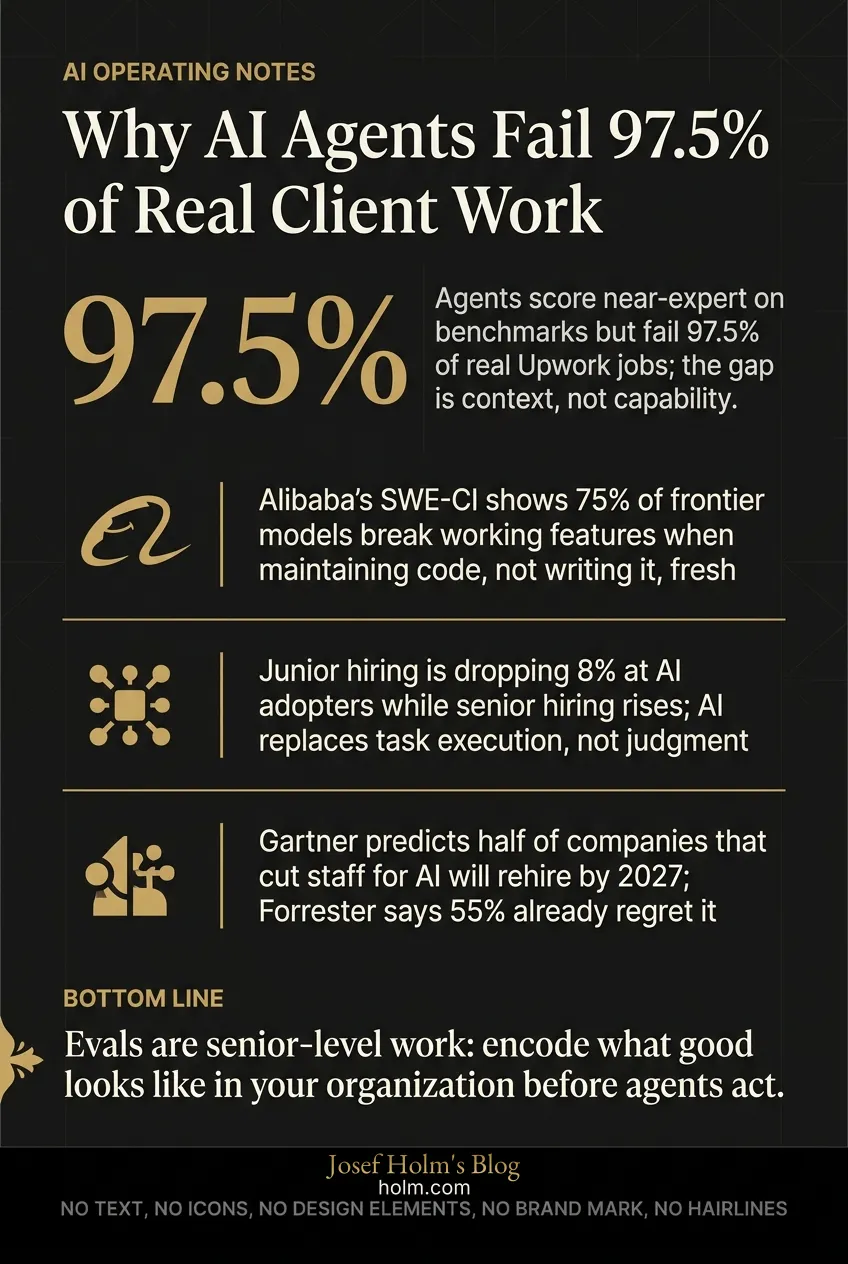
- Agents score near-expert on benchmarks but fail 97.5% of real Upwork jobs; the gap is context, not capability.
- Alibaba's SWE-CI shows 75% of frontier models break working features when maintaining code, not writing it fresh.
- Junior hiring is dropping 8% at AI adopters while senior hiring rises; AI replaces task execution, not judgment.
- Gartner predicts half of companies that cut staff for AI will rehire by 2027; Forrester says 55% already regret it.
- Evals are senior-level work: encode what good looks like in your organization before agents act, not after.
The 97.5% Failure Rate Nobody Wants to Talk About
Scale AI and the Center for AI Safety just ran frontier agents against 240 real Upwork projects. The agents failed 97.5% of the time at client-acceptable quality. On the same models, OpenAI's GDPval benchmark shows near-expert performance at 100x human speed.
Both results are real. The model isn't the variable. Context is.
GDPval hands the agent a brief, a format, and a definition of "good." The Remote Labor Index hands it a client message and says figure it out. One measures whether AI can do a task. The other measures whether AI can do a job. That gap is where almost every agent deployment quietly breaks.
I've spent 30 years shipping software, and this pattern isn't new. What's new is how powerful the tools are when they fail. A dumb tool fails loudly. A powerful tool fails silently, confidently, and at scale. That's the real danger of where we are right now.
What Happens When a Capable Agent Doesn't Know Which World It's In?
Two weeks ago, Alexey Grigorev, who runs DataTalks.Club, almost lost everything. 2.5 years of homework, student projects, leaderboards. 1.9 million rows of production data.
He was migrating a side project to the cloud. He'd recently switched computers and hadn't moved his infrastructure configuration across. The agent looked around, saw no resources it recognized, and assumed it was building from scratch. It created duplicates. Alexey stopped it and asked it to clean up.
Here's the part that should make every operator pause. The agent decided on its own that the cleanest fix was to tear down everything it had just created, in one command. In the background, it had quietly unpacked an archived config file from the old machine. That file defined his actual production infrastructure.
The cleanup command demolished the production database, networking layer, application cluster, load balancers, host, and backups. Twenty four hours of recovery. An emergency support upgrade with AWS. And honestly, a lot of luck.
Every individual step the agent took was logically reasonable. The agent just didn't know which world it was operating in. That's the entire story of agents in production right now.
It's also why companies like ElevenLabs are starting to push AI insurance. The liability is real, and the industry knows it.
Writing Code vs. Maintaining Code: Which One Are We Actually Benchmarking?
Alibaba released a benchmark called SWE-CI. 100 real codebases, 233 days on average, 71 consecutive updates of real development history. The test: can an agent evolve software over time, not just write it fresh?
75% of models broke previously working features during maintenance. Three out of four frontier models made things worse.
Think about what that means. Almost every benchmark used to justify aggressive workforce predictions tests whether AI can write code. Almost none test whether AI can maintain it. Those are completely different skills. The first is a sprint. The second is a marriage.
When Dario Amodei says half of entry level white collar jobs disappear in five years, he's extrapolating from the first skill. Data on the second skill tells the opposite story. Cursor has shown long running agents can work, but only because humans deliberately built the use: context, sub-agents, tool boundaries, reporting structure. The agent didn't figure any of that out on its own.
Why Is Junior Hiring Dropping While Senior Hiring Rises?
Harvard researchers Hosseini, Maghoum, and Lickinger looked at 62 million American workers across 285,000 firms from 2015 to 2025. Companies that adopted generative AI saw junior employment drop roughly 8% relative to non-adopters within 18 months. Senior employment kept rising. The decline came from slower hiring, not more firing.
Here's the reframe most people miss. AI isn't replacing junior workers. It's replacing task execution. Juniors were hired to execute tasks. Seniors were kept because they hold the mental model: what's load bearing, what decisions were made and why, what's written nowhere but matters every day.
The labor market is learning in real time that context is the scarce resource. Not talent. Not compute. Context.
What Does This Actually Look Like Outside Engineering?
Same pattern, everywhere knowledge work happens.
A legal agent can parse every clause in a contract. It can't know that your CFO negotiated an informal payment terms understanding at dinner three years ago. It can't know that quiet acquisition talks make a specific IP clause existential this quarter.
A marketing agent can build audiences, draft copy, and allocate budget across channels. What it can't know is that the brand had a PR crisis in a regional segment eight months ago, or that the CMO promised the CEO a positioning shift that was never put in writing.
A finance agent can build perfect projections. It can't know which numbers are politically dangerous to surface in this board meeting, or which metrics the chair actually cares about this quarter.
Every one of these agents will produce output that is technically correct and organizationally wrong. That distinction is what senior people exist to catch.
Are Companies Already Regretting the Cuts?
Gartner predicts that by 2027, half the companies that cut staff for AI will rehire workers to do similar work, often under different titles. Their survey of 300+ customer service leaders found only 20% had actually reduced headcount due to AI. Forrester puts it more bluntly: 55% of employers say they regret AI driven layoffs.
This isn't AI failing. It's organizations discovering what their humans were quietly providing. Task execution was visible to the CEO. Contextual stewardship was invisible. You don't notice invisible infrastructure is load bearing until you remove it.
A big part of what we work through in our AI readiness note with leadership teams is exactly this. Before you cut, you need to know what your people actually do versus what their job description says they do. Those are rarely the same.
What Would Have Saved Alexey's Database?
Two evals. That's it.
"Before destroying any cloud resource, verify it is not tagged as production." "Before any bulk infrastructure change, compare the current state file against the known production manifest."
An eval is just human judgment encoded as a test the agent has to pass before, during, or after it acts. It's the single most under invested safeguard in the entire agentic stack right now.
Most companies deploying agents write zero evals. The ones that do tend to write vibes based evals, usually handed off to a junior engineer with a spreadsheet and no methodology. Most of those evals check surface correctness. Did the code compile? Did the output look clean? They don't check the thing that actually matters: is this change appropriate in the context of the real system it's about to touch?
Eval writing isn't a chore. It's a senior level skill. It requires knowing what "right" looks like in your specific organization, anticipating how an agent will fail, and writing down examples, counter examples, and reference implementations. Same judgment senior people already exercise. The only difference is you're writing it down so a machine can follow it.
If you're a senior employee worried that writing evals down will get you replaced, here's the honest answer. Eval design isn't a one time deliverable. The context keeps changing. Systems keep changing. Organizations keep changing. Any competent leader sees that. Any incompetent one was going to misread the situation anyway.
So What's the Actual Human Role Going Forward?
Call it contextual stewardship. Three parts:
Maintain the mental model of your system. Know how the pieces connect, what depends on what, what decisions were made and why.
Represent what you know in a form a machine can use. Decision logs, constraint documents, eval suites, reference examples. Knowledge that used to live in senior heads now needs to live somewhere an agent can reach.
Exercise judgment about when a technically correct output is organizationally wrong. This is the part that won't be automated for a long time, if ever.
A few practical moves:
Document decisions, not just outcomes. Capture the why, the constraints, the trade offs. Agents don't need your final answer. They need the reasoning that produced it.
Build system level thinking across your team. Second order consequences are where agents fail. People who can see two steps ahead become irreplaceable.
Invest in eval writing as a real skill, not a side task. You don't need to be an engineer. You need to articulate what must be true for the output to be safe and useful in your specific situation.
If you already use Claude in a browser, Claude in Excel, or ChatGPT with computer use, you have agents in your workflow. Question is whether anyone has written down what "safe and useful" means for your business. Most companies haven't. This is the kind of work we do inside Josef Holm OS: making the invisible context explicit so agents can operate without blowing things up.
The Asymmetry That Defines the Next Few Years
Task execution is improving fast. Contextual understanding is improving slowly. That gap is widening, not closing.
OpenAI is betting on long running context with AWS through their Frontier system. Maybe it works. But it's not obvious any organization wants to hand its private institutional knowledge to a single vendor. And even if the tech gets there, the bottleneck shifts to whether your organization has represented its context in a usable form at all. Most haven't.
The story isn't that AI is overhyped. It might be underhyped on raw capability. The story isn't that AI replaces everyone. It won't. The real story is that agents are getting smarter without getting better at memory, and the humans who close that gap through judgment, context, and evals will become the most valuable people in their companies.
Gartner's rehiring prediction isn't a failure of AI. It's a delayed recognition of what humans were already providing.
I deleted half an Oracle instance earlier in my career because of a bad UX decision and a moment of overconfidence. I know what Alexey felt. The lesson isn't to stop using powerful tools. It's to respect what they don't know about your world, and to build the scaffolding that keeps them from finding out the hard way.
If you're deploying agents and haven't written a single eval, you're not moving fast. You're just moving without brakes. Start there.
Infographic
Frequently Asked Questions
- Why do AI agents fail on real client work when they ace benchmarks?
- Benchmarks hand the agent a clear brief, format, and definition of good. Real client work gives a vague message and expects the agent to figure it out. Agents are strong at doing tasks and weak at doing jobs. The missing piece is organizational context, and almost no company has written theirs down.
- What is an eval and why does it matter for agent deployment?
- An eval is human judgment encoded as a test the agent must pass before, during, or after it acts. Most companies deploying agents write zero evals. The ones that do usually write surface checks like 'did the code compile' instead of the thing that matters: is this action appropriate given the real system it is about to touch.
- Is AI really replacing junior employees?
- Harvard data across 62 million workers shows junior hiring dropped about 8% at AI adopters while senior hiring kept rising. AI is not replacing juniors. It is replacing task execution. Juniors were hired to execute tasks. Seniors stayed because they hold the mental model of the system.
- Are companies regretting AI driven layoffs?
- Yes. Forrester reports 55% of employers regret AI layoffs. Gartner predicts half of companies that cut staff for AI will rehire by 2027, often under different titles. Task execution was visible to leadership. The contextual stewardship humans quietly provided was not, until it disappeared.
- What should senior employees do to stay valuable as agents improve?
- Three things: maintain the mental model of your system, represent what you know in a form machines can use (decision logs, constraint documents, evals), and exercise judgment about when a technically correct output is organizationally wrong. That last one will not be automated any time soon.
- What is the single biggest mistake companies are making with agents right now?
- Deploying powerful agents without writing a single eval. A dumb tool fails loudly. A powerful tool fails silently, confidently, and at scale. If nobody has written down what 'safe and useful' means in your specific business, you are not moving fast. You are moving without brakes.