Why AI Recommends Your Competitor Instead of You
Key Takeaways
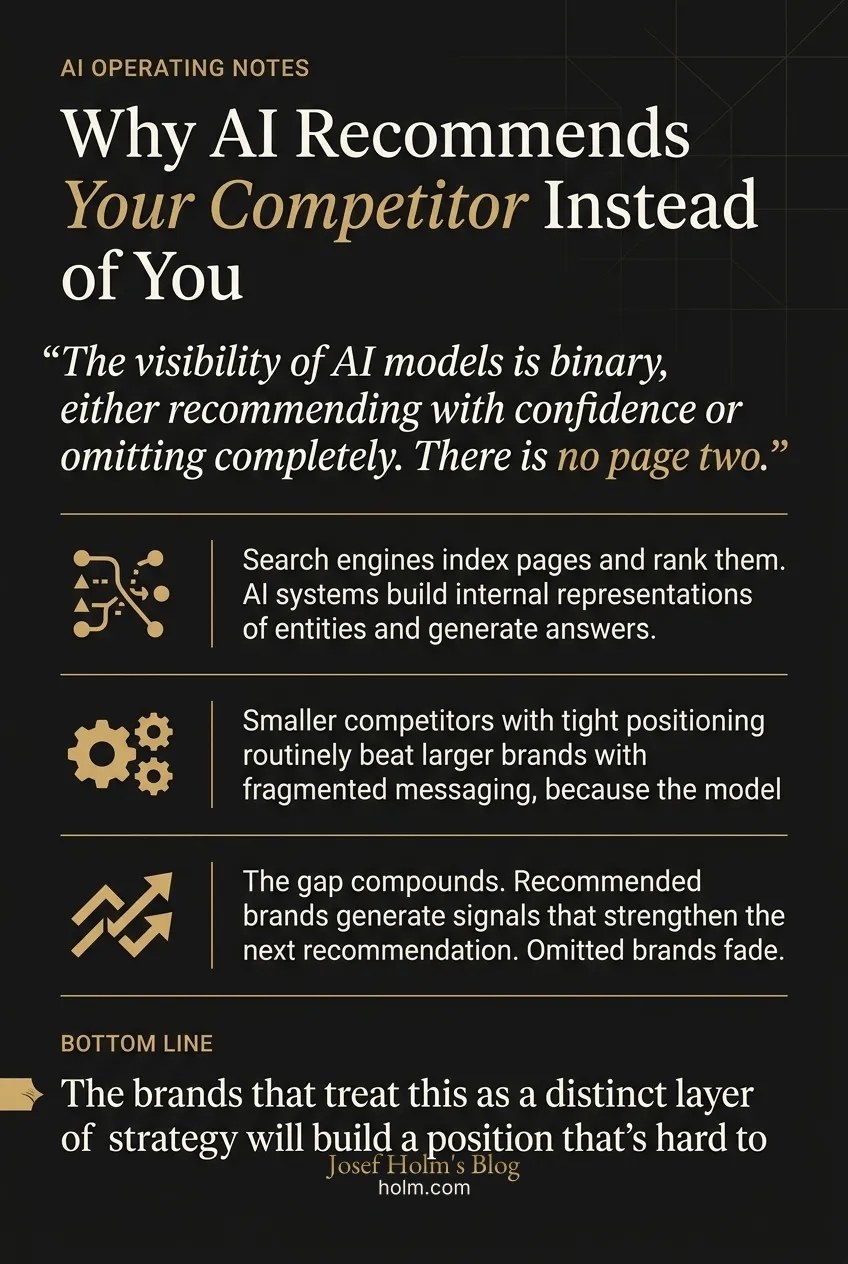
- AI visibility is binary. The model either recommends you with confidence or leaves you out entirely. There is no page two to rescue you.
- Search engines index pages and rank them. AI systems build internal representations of entities and generate answers from that understanding. Different mechanics, different requirements.
- Smaller competitors with tight positioning routinely beat larger brands with fragmented messaging, because the model recommends what it can describe most clearly.
- The gap compounds. Recommended brands generate signals that strengthen the next recommendation. Omitted brands fade quietly until catching up gets structurally harder.
- The brands that treat this as a distinct layer of strategy will build a position that's hard to dislodge. The ones that keep treating it as an extension of SEO will keep wondering why their competitors are being recommended instead of them.
The first time a competitor gets recommended instead of you, it doesn't feel like a strategic event. Someone on your team types a question into ChatGPT or Perplexity that your company should obviously be part of. You're not in the answer. A competitor is, and the model describes them with the kind of confidence that makes the recommendation sound like the answer, not one option among many.
That's the moment most brands miss. By the time the pattern gets noticed, it's already compounded.
Why does this feel so different from losing a search ranking?
There's no ranking to lose. No slow slide from position one to position five. No page two waiting to rescue you.
In traditional search, visibility degrades gradually. You watch it happen in your analytics. You see the traffic dip, find the cause, and respond.
AI-generated answers don't work like that. Visibility gets compressed into two or three synthesized recommendations. The model either names you as a credible option or it doesn't. No partial exposure. No long tail of residual traffic. You're in, or you're invisible.
That binary is what makes this disorienting. Teams keep looking for the familiar signals of decline, and the signals aren't there. The only signal is absence.
Isn't this just SEO with a new engine?
Here's where most companies get it wrong. The instinct is to treat AI recommendations as an extension of search. Better algorithm, same game. If we rank well on Google, we'll show up in ChatGPT.
That assumption falls apart fast. I've watched brands that dominate organic search results get completely excluded from AI answers, while smaller competitors with a fraction of the domain authority get recommended again and again.
The reason is structural, not tactical. Search engines index pages and rank them against queries. AI systems build internal representations of entities: companies, products, categories. They're not retrieving documents and ranking them. They construct an understanding of who you are based on everything they've absorbed, then generate answers from that understanding.
Two different mechanics. Two different sets of requirements.
What actually determines whether AI recommends a brand?
Confidence. That's the short version.
The longer version: AI systems recommend brands they can describe clearly and consistently. That clarity comes down to a few things. How familiar the model is with the brand. How densely the brand shows up across trusted sources. How consistent the story is across those sources. Whether the description holds up when the model tries to summarize you in one sentence.
If your company gets described one way on your homepage, another way in press coverage, another way in analyst reports, and something else again in user-generated content, the model has no clean signal to work. When confidence is low, the model defaults to omission. It recommends the brand it understands best, not necessarily the brand that's objectively best.
This is why a smaller competitor with tight, consistent positioning can outperform a larger company with fragmented messaging. The smaller brand is easier to describe. Easier to describe means more confidently recommended.
Why do SEO metrics miss this entirely?
Because they're measuring a different system.
Rankings, domain authority, organic traffic. All of that describes performance inside an index-and-match architecture. AI recommendations happen inside an entity-and-synthesis architecture. Different inputs. Different mechanics. Different outputs.
You can be winning the first system and losing the second at the same time. Most brands that contact us are doing exactly that. Their SEO dashboards look healthy. Their AI visibility is quietly collapsing.
The dashboards aren't lying. They're measuring the wrong thing for the question being asked.
What should brands actually do about it?
Start by finding out where you stand. Not guessing. Testing.
Run structured prompts against the major AI systems. Ask the questions your buyers are asking. See who gets recommended, who gets mentioned, who gets ignored. Compare yourself to competitors directly. Do it across multiple models, because representation varies between them.
Once you have that baseline, the work gets clearer:
- Align how your brand gets described across every public touchpoint
- Make sure authoritative sources describe you consistently
- Create content that directly answers the questions buyers ask AI systems
- Monitor how your representation shifts over time
None of this is about gaming the system. The models are too good to game, and the attempt usually backfires. The real work is removing ambiguity. If the model can describe you clearly and confidently, you get recommended. If it can't, you don't.
This is the layer Akii operates on. It tracks how your brand shows up across AI-driven discovery, detects competitor and market shifts as they happen, and turns those signals into prioritized actions. Not a one-time audit. A live system, because AI perception changes constantly and a static report is outdated the day it's delivered.
Why does this advantage compound so fast?
Because AI recommendations reinforce themselves.
When a model confidently recommends a competitor, users click through, engage, write about it, link to it, and reference it. That activity becomes new training data and new retrieval context. The next recommendation gets stronger. The feedback loop tightens.
Meanwhile, the brand that was omitted generates less AI-driven engagement, which means fewer new signals, which means the model's representation stays thin. The gap widens quietly, month over month, until it becomes structural.
This is why early action matters more here than it did in SEO. In search, you could recover ground with enough effort. With AI-driven discovery, the compounding effect means catching up gets progressively harder the longer you wait.
What does the winning position actually look like?
The companies that win this shift won't necessarily be the ones with the biggest budgets or the loudest marketing. I've watched enough market transitions over three decades to know that budget rarely wins a structural shift. Clarity does.
The winners will be the brands that are most clearly understood, most consistently represented, and most confidently described by the systems that increasingly shape how buyers make decisions. That's a different competency than running paid campaigns or improving pages. It's closer to brand architecture, applied at the level of machine understanding.
If you want to see where you stand right now, start with an AI readiness note. It's the fastest way to move from guessing to knowing, and knowing is where the real work begins.
The brands that treat this as a distinct layer of strategy will build a position that's hard to dislodge. The ones that keep treating it as an extension of SEO will keep wondering why their competitors are being recommended instead of them.
Infographic
Frequently Asked Questions
- Why don't SEO metrics show AI visibility problems?
- They measure a different system. Rankings and domain authority describe performance inside an index-and-match architecture. AI recommendations happen inside an entity-and-synthesis architecture. You can be winning the first and losing the second at the same time, and most brands that contact us are doing exactly that.
- How do AI systems decide which brands to recommend?
- Confidence. The model recommends brands it can describe clearly and consistently. That depends on how familiar it is with the brand, how densely the brand appears across trusted sources, and how consistent the story is across them. When confidence is low, the model defaults to omission.
- Why can a smaller competitor outrank a larger brand in AI answers?
- Because the smaller brand is easier to describe. Tight, consistent positioning gives the model a clean signal to work. A larger company with fragmented messaging across its homepage, press, analyst reports, and user content gives the model nothing solid to summarize.
- How do I find out if my brand is being recommended by AI?
- Test it. Run structured prompts against the major AI systems using the questions your buyers actually ask. See who gets recommended, who gets mentioned, who gets ignored. Compare yourself to competitors directly across multiple models, because representation varies between them.
- Why does the AI visibility gap compound so quickly?
- Because AI recommendations reinforce themselves. Recommended brands get clicks, engagement, mentions, and links, all of which become new signals. Omitted brands generate less activity, so their representation stays thin. The gap widens month over month until it becomes structural.
- Can you game AI systems to get recommended?
- No. The models are too good, and attempts usually backfire. The real work is removing ambiguity. If the model can describe you clearly and confidently, you get recommended. If it can't, you don't.