World Models That Quietly Make You Dumber
Key Takeaways
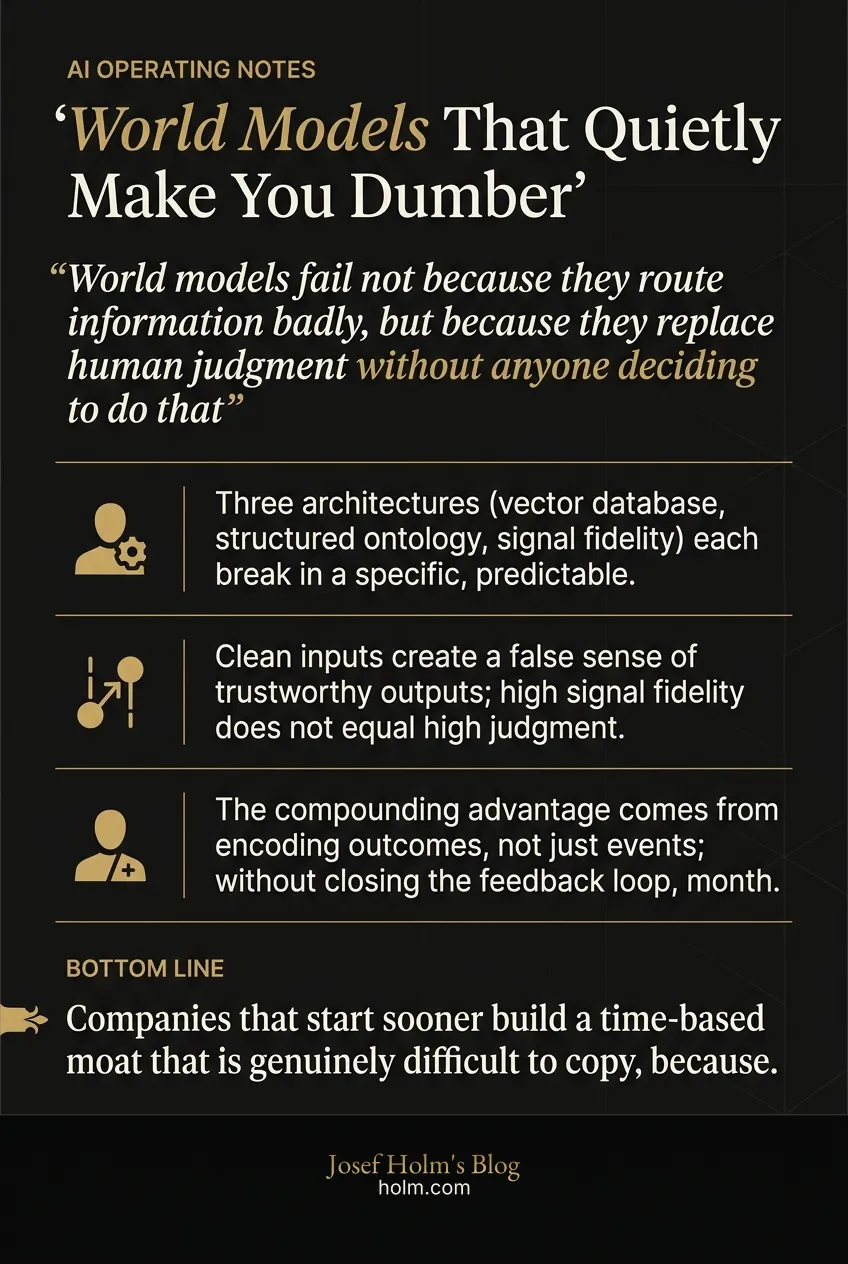
- World models fail not because they route information badly, but because they replace human judgment without anyone deciding to do that.
- Three architectures (vector database, structured ontology, signal fidelity) each break in a specific, predictable way.
- Clean inputs create a false sense of trustworthy outputs; high signal fidelity does not equal high judgment quality.
- Every world model output should be classified as either 'act on this' or 'interpret this first' before anyone consumes it.
- The compounding advantage comes from encoding outcomes, not just events; without closing the feedback loop, month six looks like month one.
- Companies that start sooner build a time-based moat that is genuinely difficult to copy, because the moat is accumulated business reality, not architecture.
The Real Reason World Models Fail
Most companies building "world models" are automating the wrong thing. They're replacing information routing, which software handles fine, while accidentally replacing judgment, which software handles terribly. And they can't tell the difference because the outputs look identical on the surface.
Jack Dorsey published a blueprint for this concept. Five million views in two days. Agency founders started posting their own versions. Enterprise vendors rebranded whatever they already sold. The excitement is real. The understanding is shallow.
I've watched this pattern across multiple technology cycles. A powerful concept emerges, people rush to build it, early results look promising, and then decision quality quietly degrades until nobody can pinpoint why. By the time someone asks "what changed," the damage is structural.
Here's what's actually happening with world models, why the main approaches each break in a specific way, and what it takes to build one that compounds into real advantage instead of quietly making your company dumber.
What Is a World Model, and Why Does Everyone Suddenly Want One?
A world model is software that maintains a living, continuously updated picture of everything happening across a company. What's being built. What's blocked. Where resources are. Where customers are struggling. Everyone queries it directly and gets real-time answers.
The premise is straightforward: a large share of what fills manager calendars, status syncs, alignment meetings, information shuttling, is work that software can do faster and cheaper today.
That premise is partially correct. And "partially correct" is where organizations get hurt.
What's the Difference Between Moving Information and Making Judgments?
This is the question almost nobody building a world model is asking clearly enough.
Managers don't just route information. They edit it. They decide what matters. They know the difference between a CEO's real priorities and stated ones. They know whether a revenue dip is structural or seasonal. They carry context that turns noise into signal.
When a world model prioritizes, highlights, suppresses, or escalates information, it is making judgments. Every one of those decisions used to be made by a human who could factor in things the system simply cannot: organizational politics, historical patterns, the texture of a situation that doesn't fit neatly into a data field.
The output can look similar on the surface. The quality of the embedded decisions is fundamentally different. And the organization won't feel that difference right away.
That's what makes this dangerous.
Why Don't These Failures Show Up on a Dashboard?
When previous management experiments failed, the failures were visible. Zappos tried holacracy and satisfaction scores collapsed. Valve's hidden power structure became a documented case study. Medium's head of operations wrote publicly that the system impeded work.
World model failures are quiet.
Consider three scenarios I keep seeing play out:
The seasonal misread. The system flags a revenue dip as major when it's actually seasonal. It drives a prioritization change that shouldn't have happened. The person who would have said "ignore that, it happens every year" was removed in a reorg. The system presented its finding with calm, structured confidence.
The false cause. The system surfaces a correlation between a feature launch and a spike in churn. The product team kills the feature. The actual cause was a billing change that shipped the same week. The system can't distinguish correlation from causation, and nothing in the interface signals that distinction.
The silent drift. The system stops sending information to certain people due to drift. Nobody notices. Decisions get made on incomplete pictures. The degradation reads as "the market shifted" or "execution was off" rather than what it actually is: the system filtering out signal that humans needed.
The common mechanism across all three: when you remove a management layer and replace it with nothing, the absence is obvious. When you replace it with a world model, information keeps flowing and status gets synthesized. From the outside, the routing function appears successfully automated. The editorial function gets automated by default, without anyone deciding to automate it.
Three Architectures, Three Ways to Break
The phrase "world model" covers three completely different approaches. Each fails in its own specific way.
The Vector Database Approach
Wire up data sources, embed everything, let agents retrieve by semantic similarity. Popular because it deploys quickly and works adequately for pure information logistics: status synthesis, dependency detection, report generation.
Here's where it breaks. Semantic retrieval has no structural mechanism to distinguish surfacing from interpreting. When the system returns results ranked by relevance, that ranking is an interpretation. It's a claim about what matters. But nothing in the architecture confirms it actually knows what matters. The output arrives with the same confidence regardless.
At small scale, senior people with enough context can override bad rankings. At large scale, with hundreds of people consuming system output as their primary information source, the ranking becomes an unintended reality. What the system surfaces gets acted on. What it doesn't surface is never seen.
The Structured Ontology Approach
Think Palantir. Objects, relationships, and actions are defined explicitly. The AI reasons within that bounded structure. A customer is an entity with specific properties. A work order has defined connections. The system can't hallucinate relationships that don't exist in the schema.
The failure mode is the opposite of the vector approach: it draws the boundary too conservatively. The ontology can only represent what has already been categorized. It handles known relationships precisely but is blind to emergent ones. The unnamed pattern that, once seen, reframes how the business is understood? The system can't surface it.
Accurate about what it knows. Silent about what it doesn't. And what it doesn't know may be what matters most.
The Signal Fidelity Approach
This is Dorsey's thesis at Block. Build the world model around the highest-fidelity data exhaust the business generates. In Block's case, transactions. "Money is honest": every purchase is a fact. The model improves as a byproduct of doing business.
The failure mode is subtle. Because the underlying signal is clean, the system's interpretive moves look more trustworthy than they should be. A correlation in transaction data feels more authoritative than a correlation in Slack messages, even when the causal reasoning behind both is equally thin.
High signal fidelity at the input layer creates an illusion of high judgment quality at the output layer. The illusion is harder to detect precisely because the inputs are genuinely good.
So What Actually Needs to Be Built Differently?
The first practical step is one that almost no current launch takes: classifying outputs into two categories.
Act on this. Factual, verified, low-risk outputs with clear historical precedent. Status rollups. Dependency flags. Metrics that crossed a threshold with established meaning.
Interpret this first. Outputs involving judgment calls the system isn't equipped to make reliably. A trend that might be big or might be noise. A correlation that might be causal or might be coincidental. A prioritization that might reflect the actual strategic picture or might reflect model bias.
The boundary will never be perfect. But it must be attempted.
The difference between a world model that helps an organization and one that slowly degrades it is whether the system communicates uncertainty and demands interpretation correctly. Almost every current setup actively hides this. Outputs look clean. Dashboards look authoritative. Nothing in the interface signals where the system is making a judgment call it might be getting wrong.
This isn't a database choice failure or an embedding model failure. It's an architectural failure. The system presents facts, interpretations, routine information, and novel information all at the same confidence level, without giving users the ability to see the difference.
Five Principles That Separate a Working World Model from a Dangerous One
1. Signal Fidelity Determines the Ceiling
The world model can only be as good as the ground truth feeding it. Transactions and operational telemetry from real systems are high-fidelity signals. Slack messages and Google Docs tend to be low-fidelity. If you can't clearly answer how well your inputs give the model a fingerprint of the business, fix your inputs before building the model.
2. Structure Needs to Be Earned, Not Imposed
There's a balance between imposing a schema upfront and giving the model room to discover connections you didn't anticipate. Where you constrain to known relationships and where you allow exploratory behavior should be calibrated to business risk, competitive market, and opportunity set. Not to what's easiest to launch.
3. The Model Compounds Only When It Encodes Outcomes
A knowledge base records what happened. A world model should record what happened, what was done about it, and what resulted. That third element creates a feedback loop that makes the system smarter over time. Without it, month six looks like month one.
Outcomes don't encode themselves. Someone must close the loop between action and results. That requires organizational honesty about what worked and what didn't. Most companies are bad at this with or without software.
4. Design for Resistance
The world model only works if the team feeds it. People will resist feeding a system that threatens their information advantages. They'll route around it with back-channel conversations. They'll keep critical context in their heads.
The system must capture signal as a byproduct of work, not as a separate act of documentation. If feeding the model requires big extra effort, most people won't do it. And the people with the most valuable context will be the most strategic about withholding it.
5. Start Now Because the Moat Is Time
Architecture is easy to copy. A good world model is harder to copy because it accumulates months of business reality and outcome loops. Companies that start sooner build a time advantage that's difficult to replicate. The compounding only begins once the system is running against real decisions.
Which Approach Fits Which Company?
This isn't one-size-fits-all.
Small company, under 100 people, with a strong senior team. A vector database approach for information flow is workable because senior people provide the judgment layer. This works until the organization outgrows their bandwidth.
Regulated enterprise. A structured ontology approach is likely necessary, with high upfront cost and careful attention to the interpretive boundary to avoid overfitting and to catch surprises.
Platform business sitting on high-fidelity signal (transaction data, operational telemetry). Must actively guard against the false confidence that comes from clean inputs producing what appear to be authoritative conclusions that are actually only correlational.
Knowledge work company running on conversations and documents. Start with a vector database approach if small, but build an intentional interpretive layer on top. Plan for a transition to more structured data, as vector databases begin to break down around 10,000 documents at scale.
If you're trying to figure out where your organization sits in this spectrum, that's exactly the kind of assessment we work through in our AI readiness note. The architecture matters less than the clarity of your interpretive boundary.
The Danger That Should Keep You Up at Night
The most dangerous version of a world model is one that works well enough that nobody questions it. Decision quality degrades slowly. Someone finally asks what changed. By then, the answer is hard to find.
I've seen this before with different technology. The pattern is always the same. The system produces outputs that look like intelligence. People start trusting those outputs. The humans who used to provide the judgment layer get reassigned, laid off, or simply stop being consulted. And then, slowly, the organization gets worse at making decisions without understanding why.
Building something that looks like intelligence is easy. Building something that acts as intelligence is hard. The difference is whether you've thought clearly about where the system will genuinely automate complexity versus where it will be overconfident and attempt interpretation that requires a human mind.
That's not a technology question. It's a leadership question. And right now, most leaders are answering it by default instead of by design.
Infographic
Frequently Asked Questions
- What is a world model in business software?
- A world model is software that maintains a continuously updated picture of everything happening across a company: what is being built, what is blocked, where resources are, where customers are struggling. The idea is that much of what fills manager calendars (status syncs, alignment meetings, information shuttling) can be handled faster and cheaper by software.
- Why do world models fail even when they look like they are working?
- Because the failures are quiet. The system keeps routing information and synthesizing status, so everything looks fine on the surface. What degrades is the quality of embedded judgments: prioritization calls, signal filtering, correlation interpretation. By the time someone asks what changed, the damage is structural and hard to trace back to the system.
- What is the difference between the three main world model architectures?
- Vector databases deploy fast and work well for logistics, but their relevance rankings are silent judgment calls that become unintended reality at scale. Structured ontology approaches (like Palantir) are precise about known relationships but blind to emergent ones. Signal fidelity approaches (like Block's transaction model) benefit from clean inputs, but clean inputs create an illusion that the system's interpretive conclusions are equally trustworthy, which they often are not.
- How do I know if my world model is replacing judgment instead of routing information?
- Ask whether the system is prioritizing, highlighting, suppressing, or escalating information. If yes, it is making judgment calls. The test is whether a human with full organizational context would make the same call, and whether the system signals uncertainty when it is on shaky ground. If your interface presents everything at the same confidence level, you have an architectural problem.
- What is the single most important design principle for a world model?
- Classify every output as either 'act on this' or 'interpret this first' before it reaches a decision-maker. Factual, verified, low-risk outputs with clear historical precedent belong in the first bucket. Anything involving a judgment call the system is not equipped to make reliably belongs in the second. Most current setups skip this entirely, which is exactly what makes them dangerous.
- When should a small company start building a world model?
- Now, but with the right scope. Under 100 people with a strong senior team, a vector database approach for information flow is workable because senior people supply the judgment layer. The important thing is to start accumulating business reality and outcome loops early, because the compounding advantage is a function of time, not architecture. The architecture is easy to copy; months of real decisions encoded into the system are not.