YouTube Targets AI Deepfakes with Expanded Likeness Detection Tool
Key Takeaways
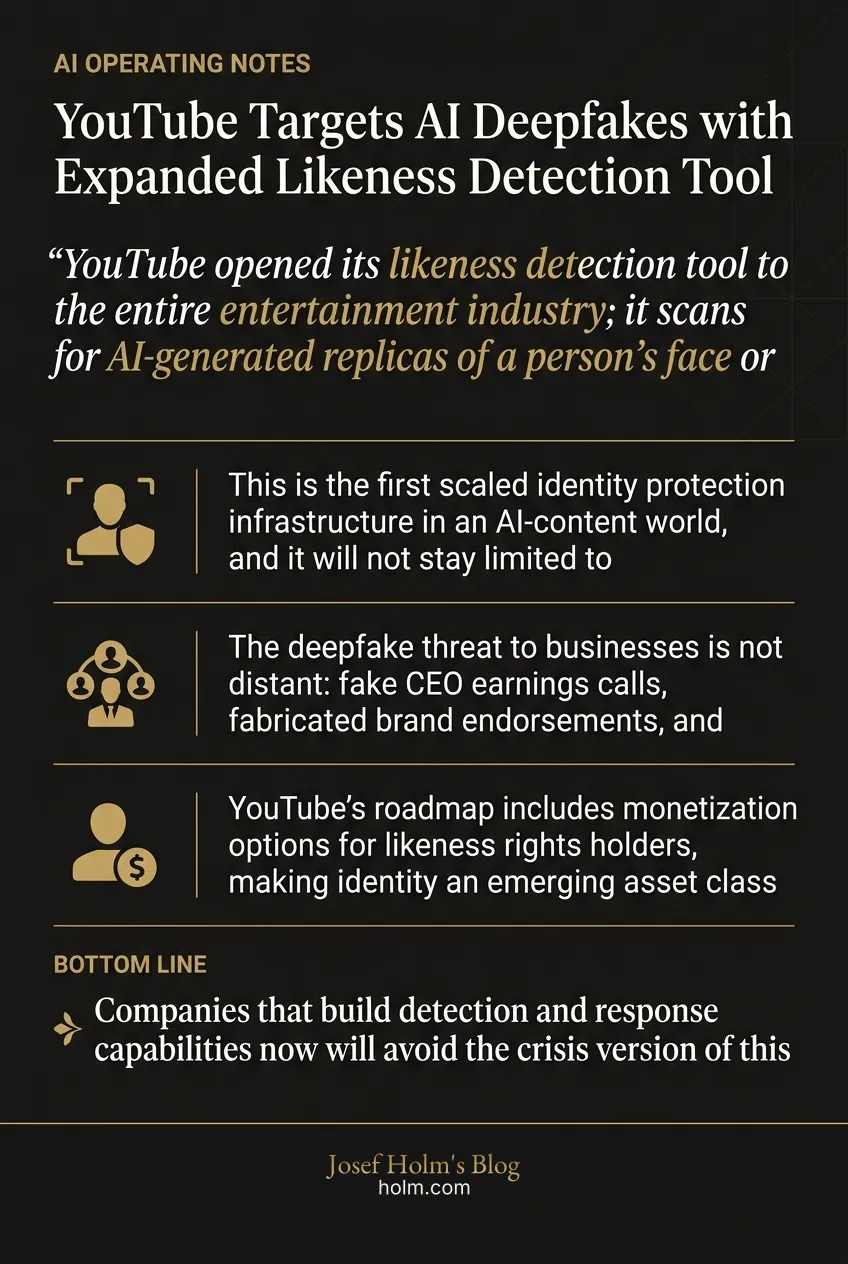
- YouTube opened its likeness detection tool to the entire entertainment industry; it scans for AI-generated replicas of a person's face or voice and lets rights holders request removal.
- This is the first scaled identity protection infrastructure in an AI-content world, and it will not stay limited to celebrities.
- The deepfake threat to businesses is not distant: fake CEO earnings calls, fabricated brand endorsements, and counterfeit customer testimonials are all close.
- YouTube's roadmap includes monetization options for likeness rights holders, making identity an emerging asset class with real business economics.
- Companies that build detection and response capabilities now will avoid the crisis version of this problem; waiting is the expensive choice.
Most companies are watching the deepfake problem like it's someone else's fire. YouTube just handed Hollywood a fire extinguisher. The implications reach well beyond entertainment.
What actually happened here?
YouTube expanded its proprietary likeness detection tool to the entire entertainment industry. Actors, athletes, musicians, and creators can now upload their likeness into a system that scans the platform for AI-generated replicas of their face or voice. Think of it as Content ID, but for people instead of songs.
The tool has been in development for over three years. YouTube first piloted it in late 2024 with CAA, then extended access to politicians and journalists earlier this year. Now the doors are open to anyone at high risk of having their likeness co-opted.
Here's what matters most for business leaders outside Hollywood: this is the first scaled infrastructure for identity protection in an AI-generated content world. It won't stay limited to celebrities for long.
Why should anyone outside entertainment care?
The deepfake problem isn't a celebrity problem. It's a trust problem. And trust is the operating system of every business.
I've watched technology cycles play out for thirty years. The pattern is always the same. A capability emerges in a niche context, people assume it only affects that niche, and then it spreads everywhere before most organizations have a plan.
Right now, the most visible deepfakes involve Brad Pitt fighting Tom Cruise or the Pope in a puffy coat. Six months from now, it'll be your CEO on a fake earnings call. Or your brand ambassador endorsing a competitor's product. A fabricated customer testimonial that looks indistinguishable from the real thing is not far off either.
YouTube's move signals that the largest platforms now recognize likeness protection as a foundational responsibility. Mary Ellen Coe, YouTube's chief business officer, put it plainly: "I would think of it as a foundational layer of responsibility."
That framing matters. When a platform with over 2 billion monthly users calls something foundational, it's telling you where the floor is moving.
How does the tool actually work?
The mechanics are straightforward, which is part of what makes this big.
A celebrity or their representative opts in and uploads their likeness into YouTube's system. The system scans the platform continuously and flags potential AI-generated replicas. The affected party then reviews flagged content and can request removal.
A removal request doesn't guarantee a takedown. YouTube still allows parody, satire, and content that falls within its community guidelines. Content that constitutes "realistic and consequential disparagement" or "content replacement" is eligible for removal. If someone uses deepfake technology to create a video that could substitute for the real person's actual work, that crosses the line.
The tool is free. It's opt-in. And critically, it works even for public figures who don't have a YouTube channel.
Jason Newman, a partner at Untitled Entertainment, framed it this way: "Their real estate is their face. Their real estate is their body. Their real estate is who they are, what they do, how they say it."
What's the real strategic signal here?
Two things jumped out at me.
First, the speed of progression. YouTube started thinking about this three years ago, when AI-generated video was still at the "Will Smith eating spaghetti" stage. Now we have Seedance 2.0 producing convincing fight scenes between A-list actors in minutes. The gap between "that looks fake" and "I can't tell" has collapsed faster than almost anyone predicted.
Second, the industry's response is more sophisticated than you'd expect. During the pilot program, most creators only requested removal of a small percentage of flagged content. Many found that the AI-generated content featuring their likeness was benign or even positive. Fan engagement, celebration, creative tribute.
So the real question isn't just "how do we stop deepfakes?" It's "how do we distinguish between deepfakes that damage us and deepfakes that actually don't?" That's a harder problem, and a more interesting one.
Alex Shannon, CAA's head of strategic development, captured this tension: "On average, we have seen more folks be excited about fans engaging and wanting to celebrate them in some form or another."
That's a more sophisticated read than the panic narrative suggests.
Is monetization coming?
Almost certainly. YouTube's Content ID system already lets copyright holders choose between removing infringing content, demonetizing it, or sharing revenue with the uploader. The likeness detection tool doesn't have a monetization layer yet, but Coe acknowledged it's on the roadmap.
"We need to really focus on this foundational layer of responsibility and protection, and then we will think about rightsholders, and how do we think about monetization," she said.
CAA has already built something called the "CAA Vault" to house client likenesses for future monetization opportunities. They've also invested in deepfake companies like Metaphysic and Deep Voodoo, betting on creative use cases alongside protective ones.
The complexity here is real. Shannon pointed out that a single video might feature two different talents with different preferences about how their likeness is used. One established star, one up-and-coming. One who wants the content removed, one who sees it as free promotion. Solving for that at scale is genuinely hard.
The direction is clear regardless. Likeness is becoming a monetizable asset class, and the infrastructure to manage it is being built right now.
What should business leaders actually do with this information?
If you're running a company, here's what I'd be thinking about.
Your brand has a likeness too. Every visual identity, spokesperson, and brand voice is now reproducible by AI. The same detection and protection infrastructure being built for celebrities will eventually extend to corporate identities. Start thinking about what your "likeness" actually consists of and how you'd know if it was being replicated.
Your AI visibility strategy needs a defensive layer. At Josef Holm, we help companies understand how they appear across AI systems. That includes how AI engines represent your brand, but it also includes how easily your brand identity could be co-opted by generated content. If you're not monitoring this, you're flying blind. Our AI readiness note is built to give you that visibility.
The detection-to-monetization pipeline is a business model. YouTube is building the rails for identity management in an AI-native content world. If your business touches content, media, or brand licensing in any way, this pipeline will affect your economics within the next 18 months.
Speed matters more than perfection. YouTube's Coe compared the tool to fire insurance. "You don't think it's going to happen to you until it does, and then it's really disastrous, and you are grateful that you have it." The organizations that build awareness and response capabilities now will be far better positioned than those waiting for their own "oh shit" moment.
Where does this go from here?
YouTube is one platform. The deepfake problem exists everywhere. TikTok, Instagram, X, LinkedIn, and every corner of the open web.
But YouTube's approach establishes a template. Opt-in registration. Continuous scanning. Flagging with human review. Contextual enforcement that distinguishes parody from replacement. And eventually, monetization options for the rights holder.
Other platforms will follow, or they'll face pressure to explain why they haven't.
The bigger shift is this: we're moving from a world where identity was assumed to be authentic to a world where identity must be verified. That's not just a content moderation challenge. It's a fundamental change in how trust works online.
I've said before that the companies who treat AI as an operating environment rather than a feature set will be the ones that adapt fastest. YouTube isn't just adding a tool here. They're building identity infrastructure for a world where synthetic content is the default, not the exception.
The question for every business leader is simple: are you building your own version of that infrastructure, or are you waiting for someone else to build it for you?
If you want to understand where your brand stands in this shifting environment, that's exactly what we help with.
Infographic
Frequently Asked Questions
- What is YouTube's likeness detection tool and how does it work?
- It is an opt-in system where public figures or their representatives upload their face and voice into YouTube's platform. The system scans continuously for AI-generated replicas and flags matches for human review. The rights holder can then request removal for content that constitutes realistic disparagement or replaces their actual work. Parody and satire are still allowed.
- Who can use YouTube's likeness detection tool?
- Anyone at high risk of having their likeness co-opted: actors, athletes, musicians, creators, politicians, and journalists. Critically, it works even for public figures who do not have a YouTube channel. The tool is free and opt-in.
- Why does this matter for businesses outside of entertainment?
- The deepfake problem is a trust problem, not a celebrity problem. Every business has a visual identity, spokesperson, and brand voice that AI can now replicate. The infrastructure being built for celebrities will extend to corporate identities. If you are not monitoring how your brand appears in AI-generated content, you have a blind spot that could get expensive fast.
- Will YouTube allow monetization of likeness rights through this tool?
- Not yet, but it is confirmed as the next step. YouTube's chief business officer said monetization is on the roadmap after the foundational protection layer is solid. CAA has already built infrastructure called the CAA Vault to house client likenesses for future monetization. The pattern mirrors how Content ID evolved from blocking infringing music to generating revenue from it.
- How quickly should businesses act on this?
- Now. The gap between 'that looks fake' and 'I cannot tell' has collapsed faster than most people predicted. YouTube's own executive compared likeness protection to fire insurance: you do not think you need it until you do, and by then the damage is done. Building awareness and a response capability before a crisis is far cheaper than reacting to one.
- What should a business leader do today to protect their brand identity from deepfakes?
- Start by mapping what your brand's 'likeness' actually consists of: your spokespeople, visual identity, brand voice, and any public-facing figures associated with your company. Then build a monitoring process for AI-generated content that uses or mimics those elements. If you want an outside read on where your brand stands, that is exactly the kind of assessment Josef Holm runs through the AI readiness note.