Why AI Agents Made You Middle Management
Key Takeaways
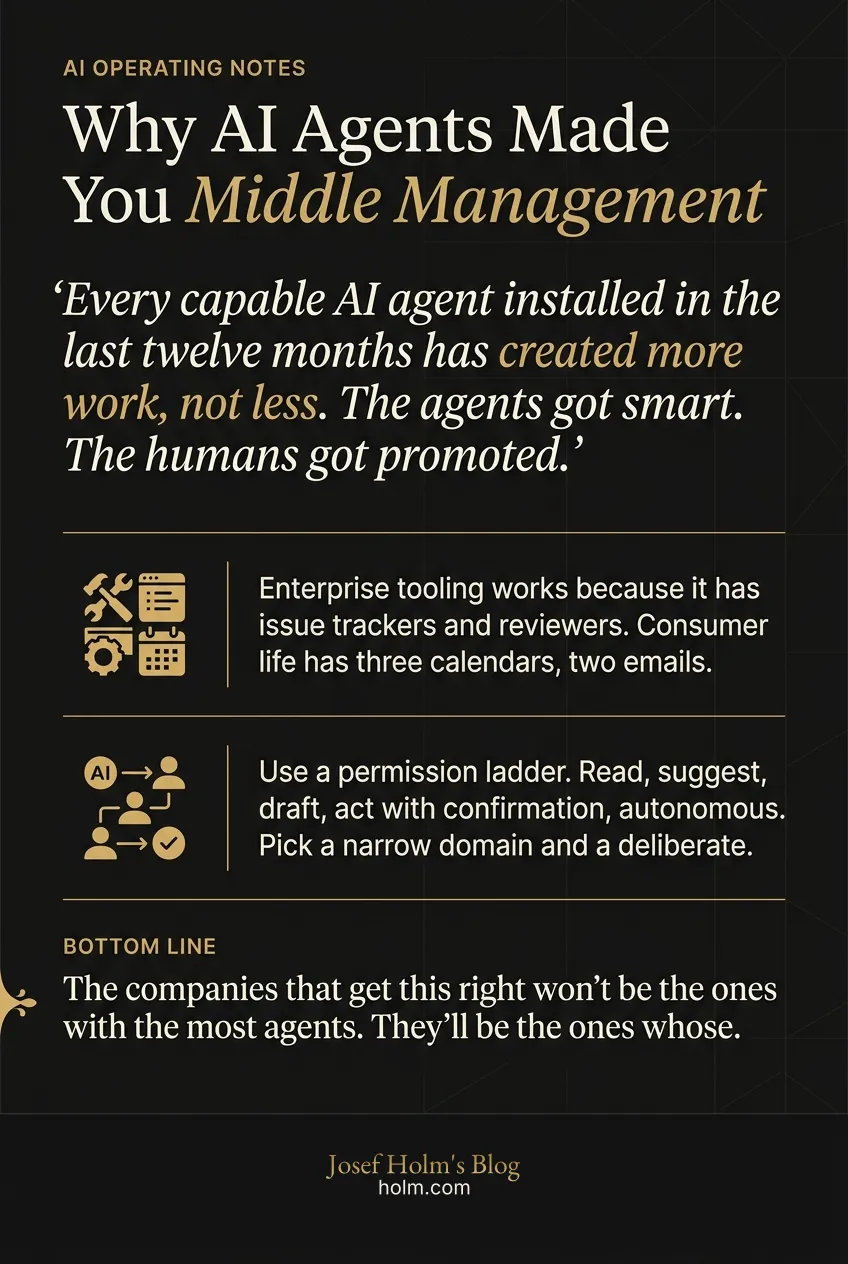
- Every capable AI agent installed in the last twelve months has created more work, not less. The agents got smart. The humans got promoted to middle management.
- Enterprise tooling works because it has issue trackers and reviewers. Consumer life has three calendars, two emails, WhatsApp, and a pile of bills. No agent understands that context yet.
- Use a permission ladder. Read, suggest, draft, act with confirmation, autonomous. Pick a narrow domain and a deliberate step. Jumping to autonomous is how consumer agents lose users forever.
- The companies that get this right won't be the ones with the most agents. They'll be the ones whose agents require the least management. That's the whole game.
The Real Problem With Today's AI Agents
Every capable AI agent I've installed in the last twelve months has made me do more work, not less. More tabs to check. More sessions to steer. More half-finished tasks to approve, restart, or clean up. The agents got smart. The humans got promoted to middle management.
That's the quiet problem nobody in consumer AI wants to name. The real question isn't "do I need another chatbot?" It's "what comes after the chatbot?" And the honest answer is: we don't have it yet.
Why Managing Agents Feels Like a Second Job
Here's what most people miss. A useful assistant isn't defined by capability. It's defined by how much mental load it removes from your day.
Today's agents fail that test. They wait for instructions. They wait for permissions. They wait for you to notice the task in the first place, translate it into a prompt, supervise the output, and fix whatever broke. By the time you've done all that, you could've handled the task yourself in half the time.
The capability is real. The intuition is missing.
Close to a billion people now use chatbots. Non-developers are installing agent tooling in their homes, sometimes with real security risks around family data. Coding agents went from curiosity to default workflow in the span of two months once models crossed a threshold. Stripe's data shows exponential growth in agent-driven purchases. GitHub is planning for a 10x to 30x increase in repositories. Computer use is basically solved.
So why does every consumer agent still feel like homework?
Because knowing what to do is only half the job. Knowing when to show up, when to ask, and when to stay silent is the other half. Nobody has built that half yet.
What's Actually Working in the Enterprise?
Enterprise tooling is further along, and the reason is structural.
OpenAI's workspace agents run in the cloud, live inside Slack, and handle long-running work across teams. AWS is shipping managed agents with identities, logs, and production controls. The most interesting piece is Symphony, an open-source protocol from OpenAI developers that moves the coordination problem into an issue tracker. Agents pick up tasks from the tracker. Humans review outcomes. The person running the show stops being a session manager and becomes a reviewer.
Works for engineers. Doesn't work for normal people. My mother doesn't use an issue tracker. She uses three calendars, two email accounts, a WhatsApp family group, school emails, a half-finished grocery list, and a pile of bills. No app has ever understood all of that at once.
That's the anticipation gap. And it's where consumer AI either breaks through or stays stuck.
Why Is Consumer Proactivity So Much Harder?
Coding has two advantages consumer life doesn't.
First, clean verification. Code runs or it doesn't. Tests pass or they fail. Second, bounded scope. A bug has a repo, an error message, and a target.
Consumer life has no compiler for taste. No test suite for life admin. "Book a trip" sounds like one task, but in reality it's dozens: family preferences, calendar overlap, cancellation tolerance, hotels, cars, kid-friendly activities, dietary constraints. Success is subjective. Errors are expensive. And most users can't even name the task clearly in the first place.
Take the Hawaii example. A user says they want to lose weight to look good in a swimsuit in Hawaii. Does that mean a full diet and five HIIT sessions a week? Or does it mean "gentle nudges, because I'll quit if you push hard"?
Same sentence, different meaning for every person. Without memory, personalization, and behavioral context, the agent will get it wrong. And when it gets it wrong, the user walks away and doesn't come back.
This is a product and data problem. Not just a model problem. That distinction matters, and I wrote more about where models end and real systems begin over on the Josef Holm blog.
Why Did ChatGPT Work but Agents Struggle?
ChatGPT had a gift most products never get. Google spent 20 years training people to type a query into a box. The capability shift in 2022 was massive. The behavioral shift was almost zero.
Agents don't get that gift. Nobody wakes up thinking "which life admin tasks should I delegate to my autonomous system today?" The most common question after installing a consumer agent is still: "What do I do with this?" In China, there were lines to install OpenClaw, and lines to uninstall it.
Real human delegation runs on shared history, taste, and relationships. Software doesn't get any of that for free. When an agent says "tell me what you want," the burden sits with the user to notice the task, remember the agent exists, write the prompt, grant permissions, and supervise the result. Usually that's more work than just doing the thing.
So the agents that will win aren't the ones that ask more. They're the ones that already know.
What Does Real Proactivity Look Like?
Real proactivity notices a flight delay before you do. It spots the school permission slip that needs a signature by Friday. It sees a half-finished grocery list next to a tense work thread and quietly asks if it can handle the next step. It catches small problems before they become work. It acts inside guardrails and only interrupts when a decision actually matters.
The bar is simple. Does the agent make life feel lighter, or does it add another system to operate?
No consumer agent has cleared that bar yet. A few are close.
- Poke bets on messaging rails like iMessage and Telegram, which have low cognitive cost. Good instinct. Salience still missing.
- Clickie sits next to your cursor on a Mac, sees the screen, responds to voice. Great UX. Drains battery. Still reactive.
- Cluey aimed at invisible help during interviews. Marketing was loud. Product was slow enough that interviewers could detect the pause before a canned answer.
- Codex Chronicle is the one that's been pointing at the future for me. I turned it on. It watched my work. It proactively suggested writing an SOP based on the process work it observed. The first draft was 80 to 85 percent usable.
That last one is the direction. Quiet observation. A suggestion at the right moment. A useful draft. No management required.
How Should You Introduce Agents Without Losing Trust?
Here's the framework I use when I'm working through this with founders and operators. Five steps on a permission ladder:
- Read. The agent sees files, email, calendar, screen.
- Suggest. It surfaces something proactively. You decide.
- Draft. It prepares the email, the schedule, the cart. You approve.
- Act with confirmation. It fills forms, assembles options, prepares bookings. You sign off on the consequential moments.
- Autonomous. It buys, books, sends, signs.
Users are risk-averse. Breaking trust once is usually permanent. Jumping straight to step five is how consumer agents lose users forever.
The practical move is to pick a narrow domain and a deliberate step. Calendar scheduling at step three. Shopping replenishment at step four. Email triage at step two. Forget "manage my life." That's not a product. That's a wish.
Same logic we use when we run an AI readiness note for a company. The question is never "where can AI do everything?" It's "where can AI do one specific thing well, with the right permission level, and earn the right to do more?"
What Precedents Should Agent Builders Study?
Earlier consumer software already crossed smaller versions of this threshold.
Push notifications meant you didn't have to open the app. Recommendation feeds meant you didn't have to know what to watch. Autocomplete meant you didn't have to finish the query. Smart replies meant you didn't have to compose from scratch.
All of these worked because they were narrow, bounded, and reversible. Agents are trying to do the same job, surfacing the right thing at the right moment, but across many domains, with real-world actions, and higher error costs. Stripe already shipped agent wallets. Agent purchases are real money now. The margin for error is thinner than anything push notifications ever had to deal.
Where Will Consumer Agents Actually Break Through?
Through work first, probably. That's the historical pattern.
Slack, Notion, and Superhuman all started as work tools and bled into personal use. Agents will likely follow the same path. The line between work files and personal files is thinner than most people assume, and knowledge work is where early trust gets built. Slack spread bottom-up before any CTO approved it. Agents will spread the same way.
If you're building in this space, or deciding where to adopt, a few signals worth watching:
- Key hires. When frontier labs hire specific people known for agent work, that's strategy showing itself. Hiring pages tell you more than press releases.
- Load-lifting cadence. Set a monthly calendar reminder to retest the agents you've tried. More moments of real load-lifting means progress. Fewer means the product is stuck.
- Model release notes. Watch the language shift from "long-running agentic tasks for coding" to "long-running agentic intent with memory for consumers." Frontier models run about six months ahead of open source. Long-running intent is necessary but not sufficient. Real proactivity is much harder.
The Honest Closing
Technically inclined users can already build small proactive agents today. The open-source tooling is good enough. The models are good enough. The primitives are there.
What hasn't arrived is the version my mother can install. The one that just works, quietly removes admin burden, and doesn't ask her to become a project manager of her own life.
I think enough of the pieces are in place that this is the year it happens. Not all of it. But a real version of it, in a narrow domain, with the right permission level, and with enough intuition to know when to stay silent.
If you're thinking about where this fits in your own operation, that's the conversation we have every day at Josef Holm. The companies that get this right won't be the ones with the most agents. They'll be the ones whose agents require the least management.
That's the whole game.
Infographic
Frequently Asked Questions
- Why do AI agents make me do more work instead of less?
- Because they wait. They wait for instructions, permissions, and supervision. You end up noticing the task, writing the prompt, checking the output, and cleaning up mistakes. That's management work. Today's agents have the capability but not the intuition to know when to show up and when to stay silent.
- What is the anticipation gap in consumer AI?
- It's the difference between knowing what to do and knowing when to do it. Enterprise tools solve this with issue trackers and reviewers. Consumer life has no tracker. My mother uses three calendars, two emails, WhatsApp, and a pile of bills. No agent understands that context yet. That gap is where consumer AI either breaks through or stays stuck.
- Why is consumer proactivity harder than coding agents?
- Coding has clean verification and bounded scope. Code runs or it doesn't. Consumer life has no compiler for taste. Book a trip is dozens of tasks with subjective success and expensive errors. Without memory, personalization, and behavioral context, the agent gets it wrong. When it gets it wrong once, the user walks away and doesn't come back.
- How should I introduce AI agents without losing user trust?
- Use a permission ladder. Read, suggest, draft, act with confirmation, autonomous. Pick a narrow domain and a deliberate step. Calendar at step three. Shopping replenishment at step four. Email triage at step two. Forget manage my life. That's not a product, that's a wish. Jumping straight to autonomous is how you lose users forever.
- Which consumer AI agents are closest to real proactivity?
- Poke bets on messaging rails with low cognitive cost. Clickie sees the screen and responds to voice but drains battery. Cluey aimed at invisible interview help but was too slow. Codex Chronicle is the one pointing at the future. It watched my work and proactively suggested an SOP. First draft was 80 to 85 percent usable. That's the direction.
- Where will consumer AI agents actually break through first?
- Through work, probably. Slack, Notion, and Superhuman all started as work tools and bled into personal use. Knowledge work is where early trust gets built, and agents will spread bottom-up the same way Slack did. The line between work files and personal files is thinner than most people assume.