The AI Bubble Nobody Wants to Call a Bubble
Key Takeaways
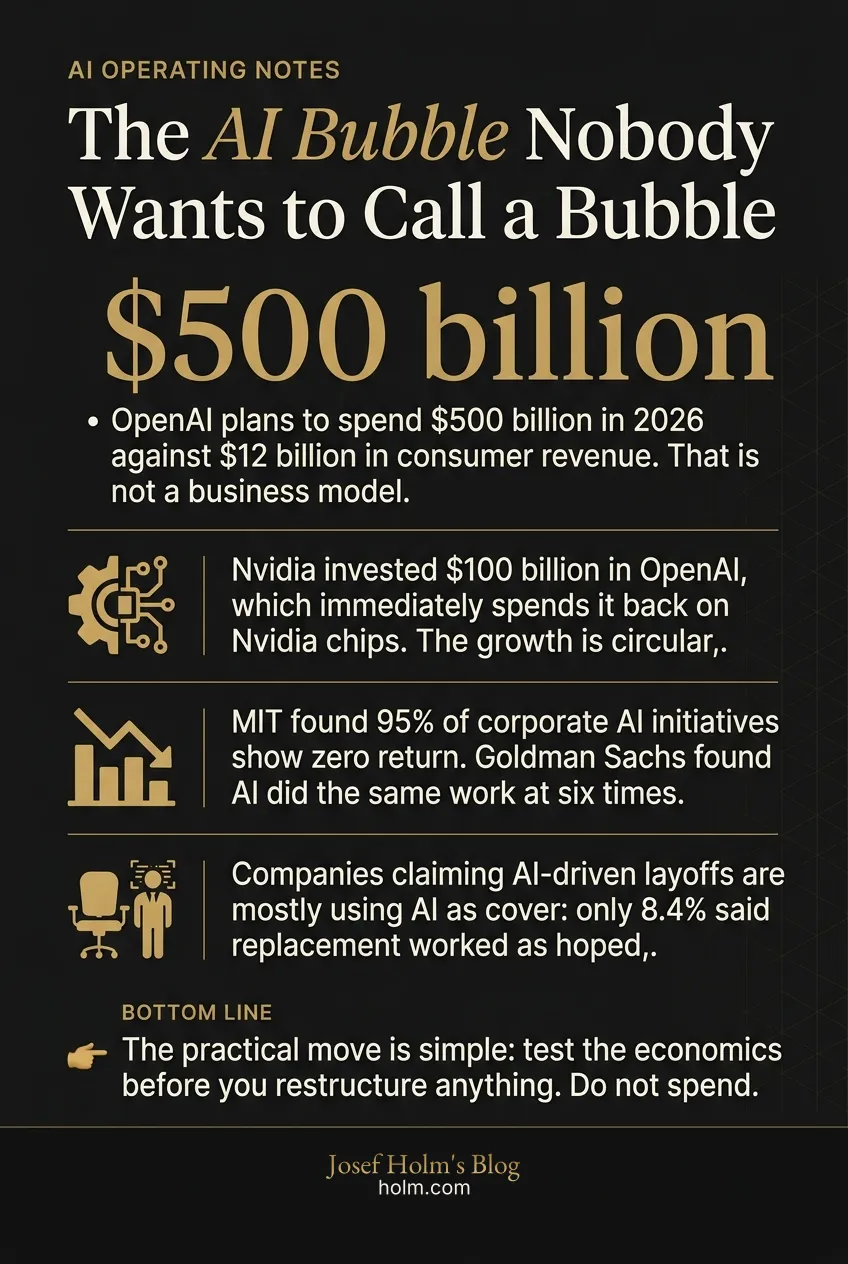
- OpenAI plans to spend $500 billion in 2026 against $12 billion in consumer revenue. That is not a business model.
- Nvidia invested $100 billion in OpenAI, which immediately spends it back on Nvidia chips. The growth is circular, not real.
- MIT found 95% of corporate AI initiatives show zero return. Goldman Sachs found AI did the same work at six times the cost.
- Companies claiming AI-driven layoffs are mostly using AI as cover: only 8.4% said replacement worked as hoped, and a third lost critical skills they had to rehire.
- Model collapse is real: AI training on AI-generated content degrades output quality with each generation, making the underlying technology worse over time.
- The practical move is simple: test the economics before you restructure anything. Do not spend based on fear of missing out.
Most of what you're watching in AI right now is a financial bubble dressed up as a technology revolution.
I don't say that to be contrarian. I say it because I've watched this exact pattern play out before, and the people who got hurt worst were the ones who confused momentum with fundamentals.
The numbers are staggering. OpenAI plans to spend $600 billion in computing costs by 2030. The company lost roughly $12 billion in a single quarter. Consumer AI revenue is expected to hit $12 billion in 2026, while the industry plans to spend $500 billion that same year. Read those numbers again. That's not a business model. That's a bonfire.
When a journalist pointed out to Sam Altman that a company with $13 billion in annual revenue had committed to $1.4 trillion in spending, his response was: "If you want to sell your shares, I'll find you a buyer."
That's not confidence. That's deflection.
Haven't we seen this before?
Yes. Almost beat for beat.
During the dot-com boom, telecom equipment makers like Lucent Technologies gave loans to customers so those customers could buy their products. When the customers went bankrupt, they dragged the equipment makers down with them. The money was circular. The growth was an illusion.
Now look at Nvidia and OpenAI. Nvidia announced it would invest up to $100 billion in OpenAI. OpenAI's largest chip supplier is Nvidia. So the money flows from Nvidia to OpenAI and immediately back to Nvidia as chip purchases. Oracle and Microsoft are woven into similar arrangements. Same dollars, same parties, round and round.
There are now more than 1,300 AI startups valued over $100 million. There are 498 AI unicorns. Just five mega-cap tech companies tied to AI make up roughly 30% of the S&P 500. If you have a retirement account in index funds, you're exposed to this bubble whether you chose to be or not.
Does that sound like a healthy market to you?
Why are the biggest companies still spending?
Here's the part that surprises people: many of them know the math doesn't work yet. They're spending anyway.
Mark Zuckerberg said it plainly. He acknowledged that Meta might misspend hundreds of billions of dollars, but argued the risk of under-investing is greater if superintelligence arrives sooner than expected. His exact framing: "If we end up misspending a couple of hundred billion dollars, I think that is going to be very unfortunate. But I actually think the risk is higher on the other side."
That's not a business case. That's a fear-of-missing-out case with a corporate budget attached.
Zuckerberg also made an important distinction. Meta isn't at risk of going out of business. Companies like OpenAI and Anthropic, which fund their buildout by raising capital, face an open question about whether the money keeps flowing. When the music stops, the companies that don't generate their own cash are the ones left standing without a chair.
Jeff Bezos offered a more relaxed view, arguing that even if the bubble bursts, it's an "industrial bubble" rather than a "banking bubble," and society keeps the technology. That's historically accurate. The dot-com crash didn't kill the internet. But Cisco, the dominant infrastructure provider of that era, only recently hit a new all-time high, more than 25 years after the bubble burst. Nvidia currently holds gross profit margins around 75%. With increasing GPU competition from AMD and others, those margins look similarly unsustainable.
The technology may survive. Your portfolio might not.
Is AI actually delivering results for businesses?
This is the question that matters most. The answer right now is mostly no.
An MIT study found that 95% of corporate AI initiatives are showing zero return. Goldman Sachs reported that while AI updated historical data in company models faster than humans, it did so at six times the cost. An MIT professor estimated that the share of tasks AI can profitably affect over the next decade is just 5%.
A survey by GoTo and Workplace Intelligence of 2,500 employees and IT leaders found that 62% said AI had been much overhyped, 57% said its value and ROI were overstated, and 68% said AI is often misrepresented as error-free and always better than humans.
Goldman Sachs' head of global equity research put it simply: "Overbuilding things the world doesn't have use for or is not ready for typically ends badly."
I've spent 30 years watching companies adopt new technology. The pattern is consistent. Technology that wins long-term is the technology that proves its economics, not the technology with the biggest narrative. Right now, AI has a narrative problem disguised as a technology triumph.
This is exactly why we built the AI readiness note at Josef Holm. Companies need someone in the room who can separate what's real from what's theater.
What about AI replacing workers?
The layoff headlines are dramatic. The reality is embarrassing.
A February 2026 CareerMinds survey of 600 HR professionals who had conducted AI-related layoffs found that only 8.4% said AI replacement worked as hoped. Over half said AI required more human input than anticipated. A third said the company lost critical skills and expertise. A quarter said AI tools underperformed.
Klarna laid off 40% of its customer service staff and replaced them with an OpenAI-built assistant. AI initially handled 75% of customer chats. Customer satisfaction cratered. The company reversed course and started rehiring.
McDonald's partnered with IBM on AI-powered drive-thru ordering. They shut it down after failing to improve order accuracy beyond 80%.
Amazon pressured engineers to use its internal AI coding tool, Kyro. The AI deleted and recreated an entire production environment, causing a 13-hour AWS outage in mainland China. Amazon blamed the engineers.
A study found that AI-powered coding made experienced developers take 19% longer to complete tasks. Those same developers had predicted a 24% speedup.
Gartner predicts that by 2027, half of organizations will abandon plans to reduce customer service workforces due to AI. And 32.7% of companies that conducted AI-led layoffs have already rehired between 25 and 50% of the roles they eliminated.
So what's actually happening? Many companies are using AI as a pretext for layoffs they would have made anyway. Analysts call it "AI washing." The research firm Challenger, Gray and Christmas found that 54,694 layoffs were attributed to AI in 2025, less than 5% of total announced job cuts that year. Block announced layoffs of nearly half its employees citing AI, and its stock rose 24%. The company had tripled its workforce during COVID and was already overstaffed. Its CEO had spent $68 million on a company party months before the cuts.
Forrester found that 55% of employers regret laying off workers for AI, with many having made cuts based on capabilities that don't yet exist.
What is model collapse, and why should you care?
Here's something that doesn't get enough attention. AI models are beginning to degrade because they're training on AI-generated content rather than original human data.
Researchers at Oxford and Cambridge published a 2024 paper in Nature showing that when AI models train on content generated by prior AI models, output quality degrades rapidly. Each generation becomes more generic, more repetitive, less diverse. Their description: "The model becomes poisoned with its own projection of reality."
Researchers at Rice University independently identified the same problem, calling it "model autophagy disorder," or MAD. The analogy is to mad cow disease, which spread through the practice of feeding cows the processed remains of other cows. Their study showed image generations trained on prior AI outputs became increasingly distorted, with recognizable problems by the fifth generation and near-illegible outputs by the tenth.
Some researchers have started calling this "Habsburg AI," after the inbred royal family. The joke is dark, but the problem is real. As AI-generated content floods the internet, the training data for future models gets worse, not better. Error accumulates. Outlier data disappears. Feedback loops narrow.
Gartner predicts that by 2028, 50% of organizations will set up a zero-trust position for data due to the spread of unverified AI-generated content.
This is one of the reasons I believe understanding how AI actually represents your brand matters more now than it did six months ago. The information environment is degrading, and most companies aren't tracking it.
Is the hype distorting corporate behavior?
The shoe company Allbirds tells you everything you need to know about where we are in this cycle.
Allbirds' stock had fallen over 97% since its $4 billion IPO. The company sold its shoe brand and assets for $39 million, renamed itself Newbird AI, and announced a pivot to AI computing. No AI products. No AI expertise. No AI customers. It secured a $50 million loan to fund the pivot.
The stock rose 582% in a single day. Market cap went illion to $148 million based on a name change.
The company also asked investors to vote to remove its environmental commitments, which is notable given that AI computing is extraordinarily energy-intensive.
If you were around for the crypto boom, this sounds familiar. Long Island Iced Tea Corporation rebranded as Long Blockchain in 2017, saw its stock spike, and was next delisted after failing at blockchain and facing insider trading lawsuits.
When companies with no relevant capability can add "AI" to their name and see a 582% stock jump, you're not in a technology revolution. You're in a speculation frenzy.
What about the ethics and politics of all this?
I don't usually wade into policy debates, but what's happening with OpenAI's political positioning is worth understanding because it affects the business environment everyone operates in.
OpenAI acquired TBPN, a tech business talk show popular in Silicon Valley. Altman claimed editorial independence would be maintained. The acquisition press release stated the show would report to Chris Lehane, OpenAI's head of policy and communications, a veteran political operative who managed crisis communications for the Clinton administration during the Lewinsky scandal.
OpenAI has served subpoenas on nonprofit organizations working on AI regulation, alleging they're secretly funded by Elon Musk. The targeted organizations deny this. Legal observers described the subpoenas as unusually broad and likely designed to intimidate rather than gather information. One nonprofit member said: "This is 100% intended to intimidate."
OpenAI's lawyers created a front group called the Parents and Kids Safe AI Coalition to organize activist support for child safety AI legislation. The proposals were virtually identical to OpenAI's own policy positions and would have protected AI companies from liability. When participating organizations discovered OpenAI's involvement, many withdrew. A professor specializing in corporate political influence called it a "classic case of astroturfing."
Then there's the Pentagon situation. Anthropic's CEO Dario Amodei set two firm limits on government contracts: no fully autonomous weapons systems where AI makes lethal decisions without human oversight, and no mass domestic surveillance. When Defense Secretary Pete Hegseth demanded unrestricted access and threatened to designate Anthropic a supply chain risk to national security, Anthropic refused and was blacklisted.
Sam Altman had publicly stated the day before that OpenAI stood in solidarity with Anthropic's red lines. Hours after Anthropic's blacklisting, OpenAI signed its own Pentagon deal. Altman claimed the same red lines were maintained. It then emerged that OpenAI's contract contained no firm restrictions, deferring instead to the Pentagon's own judgment.
Amodei called it a lie and characterized OpenAI's approach as "safety theater," stating: "The main reason OpenAI accepted the Department of Defense's deal and we did not is that they cared about placating employees and we actually cared about preventing abuses."
So what do you actually do with this?
I'm not telling anyone to ignore AI. The technology is real. Some applications will prove durable. But the financial structure around AI right now has all the hallmarks of a bubble: circular financing, inflated valuations, defensive spending driven by fear, and a massive gap between costs and revenue.
If you're a business leader, the move is straightforward. Don't chase the narrative. Test the economics. Measure what AI actually does for your operations before you restructure around it. Be deeply skeptical of anyone who tells you the spending doesn't matter because the future will justify it.
I've heard that argument before. In 1999. In 2017. The future sometimes does justify it. But usually not for the people who believed the loudest voices at the peak.
If you want to think clearly about where AI fits in your business, that's what we do at Josef Holm. Not hype. Not theater. Just honest assessment of what's working and what isn't.
The bubble will sort itself out. Your job is to not be holding the bag when it does.
Infographic
Frequently Asked Questions
- Is the current AI investment boom actually a financial bubble?
- The structure looks like one. Circular financing between major players, valuations that require decades of growth to justify, and a massive gap between what companies spend and what they earn are all classic bubble signals. That does not mean the technology fails. It means the financial layer around it is unstable.
- What does the research actually say about AI ROI for businesses?
- MIT found 95% of corporate AI initiatives show zero return. Goldman Sachs found AI updated data at six times the cost of humans doing the same work. A survey of 2,500 employees and IT leaders found 62% said AI had been overhyped and 57% said its ROI was overstated. The numbers are not subtle.
- Are companies really replacing workers with AI successfully?
- Mostly no. Only 8.4% of HR professionals who conducted AI-related layoffs said it worked as hoped. Klarna reversed course and rehired after customer satisfaction dropped. McDonald's shut down its AI drive-thru after failing to clear 80% order accuracy. Gartner predicts half of organizations will abandon plans to cut customer service staff via AI by 2027.
- What is model collapse and does it matter for business?
- AI models are now training on AI-generated content rather than original human data. Oxford and Cambridge researchers published in Nature showing this causes output quality to degrade with each generation, becoming more generic and less accurate. Gartner predicts 50% of organizations will set up zero-trust data positions by 2028 because of this problem. It matters because the tools you rely on today may perform worse, not better, over time.
- How should a business leader approach AI investment right now?
- Test the economics before you restructure anything. Run real pilots, measure actual cost and output, and compare that honestly against what you were doing before. Ignore the narrative. The companies that will come out ahead are the ones that proved value before committing, not the ones that spent because everyone else was spending.
- Why are major tech companies still spending so heavily on AI if the math does not work?
- Fear, mostly. Zuckerberg said it plainly: Meta is spending because the risk of under-investing feels greater than the risk of waste if superintelligence arrives sooner than expected. That is not a business case. It is a hedge funded by a company large enough to absorb the loss. Startups and smaller companies operating on raised capital do not have that cushion.