The Gaps Are Closing. Are You Standing on One?
Key Takeaways
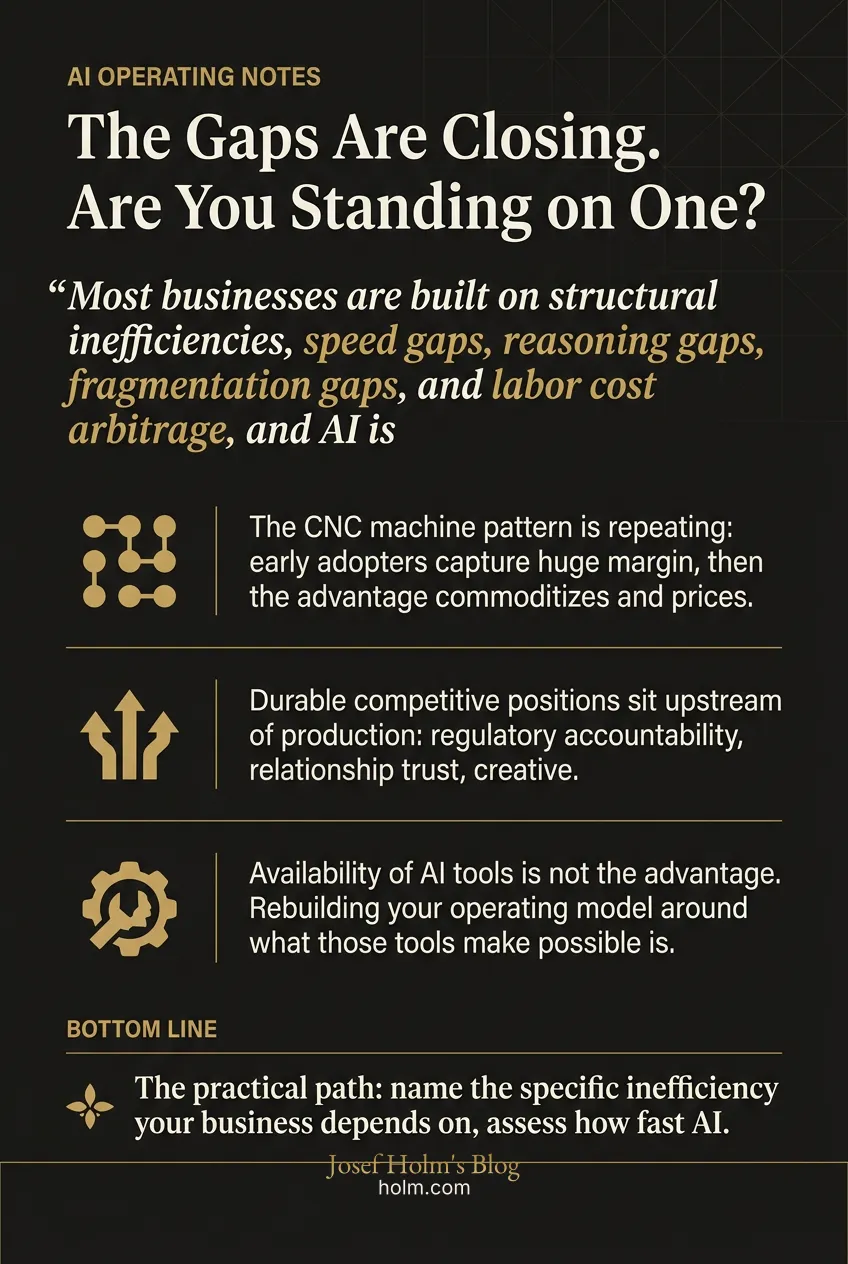
- Most businesses are built on structural inefficiencies, speed gaps, reasoning gaps, fragmentation gaps, and labor cost arbitrage, and AI is closing them in months, not decades.
- The CNC machine pattern is repeating: early adopters capture huge margin, then the advantage commoditizes and prices collapse. The window is real but temporary.
- Durable competitive positions sit upstream of production: regulatory accountability, relationship trust, creative taste, and hard-won domain judgment are harder for AI to close.
- Availability of AI tools is not the advantage. Rebuilding your operating model around what those tools make possible is the gap that actually separates winners from subscribers.
- The practical path: name the specific inefficiency your business depends on, assess how fast AI closes it, and move toward the new gap that opens upstream before the old one finishes closing.
The Gaps Are Closing. Most Companies Don't Even Know Which Ones They're Standing On.
Businesses have been built on inefficiencies for thousands of years. Not bugs. Not market failures. Structural gaps between what something costs to produce and what the market will pay for it.
A law firm bills 10 hours for work that requires 2 hours of thinking and 8 hours of execution. The model works because legal research used to be genuinely expensive. A consulting engagement costs hundreds of thousands of dollars for a board deck. The value was never the slides. It was access to information that was hard to obtain and harder to synthesize. Offshore development teams exist because a San Francisco engineer costs X and a Bangalore engineer costs Y for similar output.
These gaps are the architecture of modern commerce. Entire industries, career paths, and business models exist because certain inefficiencies were too expensive or too invisible to close.
AI is closing them. Not over decades, the way previous technologies did. On the timescale of model releases. Sometimes months. Sometimes weeks.
Here's what most people miss: every time one gap closes, several new ones open somewhere else.
What Kind of Gaps Are We Actually Talking About?
Not all inefficiencies are the same. The ones AI is compressing fall into distinct categories, and understanding the taxonomy matters because it determines how fast your particular position erodes and what you should do about it.
Speed gaps. One system updates slower than reality. A competitor's model updates in real time while yours updates weekly. A support bot resolves issues in seconds while a human team takes 24 hours. A hiring pipeline screens candidates in minutes while a traditional process takes weeks. Each of these is now closable by whoever builds the faster system first.
Reasoning gaps. The information is public. Everyone has it. The gap is how quickly and accurately someone can interpret what it means and act. LLMs process full document context in seconds, consistently, without fatigue or distraction. Any decision that waits for a human to read, synthesize, and recommend has a reasoning gap embedded in it. That gap is compressing fast.
Fragmentation gaps. The same thing is priced differently in different places because no one is looking at all places simultaneously. The consultant who charges for an analysis that synthesizes five publicly available data sources? The value was never in the data. It was in the aggregation. AI now performs that aggregation at near-zero cost. Any intermediary whose value proposition is "I can see the silos you can't" is sitting on a fragmentation gap that won't last.
Discipline gaps. The inefficiency isn't in the market or the information. It's in the human executing on it. Sales teams that know the playbook but don't follow it consistently. Content pipelines that produce erratic quality depending on who's working. Operations teams that drift from protocol under pressure. AI closes this gap not by replacing the human but by enforcing a consistency the human can't maintain alone.
Intelligence arbitrage. For 30 years, the dominant global economic gap was labor. The same work at different costs depending on geography. AI replaces labor arbitrage with intelligence arbitrage. The unit of value shifts from the person-hour to the outcome. One prompt from the right person generates a working system that scales. The same prompt from the wrong person generates a broken one. The company that produces a deliverable in three hours while a competitor takes three weeks holds an intelligence advantage that's a direct function of its best people's ability to use and grow with current models.
Which of these gaps is your business built on? If you can't name it, you won't see the closure coming until someone else has already built a system over it.
Haven't We Seen This Before?
Yes. And the pattern is instructive.
When computer-controlled machining arrived in the 1980s, a shop owner could buy one CNC lathe, hire an operator at 40% of a master machinist's wage, and produce precision parts in 45 minutes that previously required 10 hours of hand-milling. Smart shops hid the machines in the back and kept the machinist out front, charging the old rate for work done at the new cost.
The margin was temporarily staggering. Then everyone acquired CNC machines. Prices collapsed 60 to 80%. The bespoke premium evaporated.
This arc is playing out right now across every knowledge work industry. Agencies, consulting firms, and service providers currently using AI to produce deliverables at a fraction of the old cost while presenting them as bespoke work are in the same position as those early CNC shops. The window is real. It's also temporary.
I've watched this cycle play out across multiple technology shifts over 25 years. The specifics change. The structure doesn't. The people who win long-term are never the ones who exploit the temporary margin. They're the ones who recognize the margin is temporary and build toward what comes next.
Why Isn't This Just a One-Time Disruption?
This is where most of the current conversation about AI gets it wrong. The conventional framing treats AI disruption as a meteor strike. Impact happens. Dust settles. New equilibrium forms. Adjust once and move on.
That's not what's happening.
What's actually occurring is a continuous rotation of exploitable gaps, each opened by a new capability step and each compressing on a shorter timeline than the last. Consider the acceleration just in the past two years:
In 2024, major model releases came every few months. Organizations had many months to absorb each one. In 2025, releases came roughly quarterly and absorption compressed to a couple of months. By early 2026, markets were repricing within hours of leaked draft materials about models that hadn't even shipped yet.
When Anthropic accidentally exposed draft materials about a model called Claude Mythos in March, the software sector ETF fell 3% on the rumor alone. Cybersecurity stocks dropped. Bitcoin pulled back on risk concerns. All before the model was available to anyone.
That's not a one-time disruption. That's a permanent condition of rolling capability releases where the specific inefficiencies defining an industry, a role, or a competitive position get reshuffled with every big model update.
OpenAI reportedly finished pre-training its own next-generation model the same week as the Mythos leak. Sam Altman told employees that "things are moving faster than many of us expected." Both companies are racing toward potential IPOs, which accelerates the cadence further. Google, Meta, and other labs are on similar timelines.
The old model of disruption, transition, equilibrium is broken. There is no equilibrium. There is only the next rotation.
So What's Actually Durable?
If most informational and cognitive gaps are closing on a timescale of quarters, what remains structurally sound?
Some gaps hold up even as AI capabilities accelerate:
- Regulatory moats. Compliance requirements that demand human accountability, licensed judgment, or institutional certification don't disappear because a model can draft the paperwork.
- Relationship-dependent trust. The client who stays because they trust your judgment, not your output, is insulated from pure efficiency competition.
- Physical world logistics. Moving atoms is still hard. AI can improve a supply chain. It can't drive the truck. Yet.
- Genuine creative taste. Knowing what's good, what's right for this audience at this moment, is not the same as generating options. Generation is now cheap. Taste is not.
- Hard-won domain judgment. The pattern recognition that comes from 15 years of seeing things go wrong in specific ways. This is upstream of information retrieval and AI can't shortcut it.
Here's a useful comparison. A law firm's ability to bill for research will collapse faster than a surgeon's clinical judgment. An agency's production cost arbitrage will collapse faster than a therapist's empathy premium. An insurance company's actuarial analysis gap will close fast. A negotiator's relationship equity will persist.
The pattern is consistent: the new durable gap is always upstream of the old one. Closer to judgment, taste, relationships, and systems-level thinking. Further from production, execution, and information retrieval.
This is exactly why we built the AI readiness note the way we did. It's not about whether you're "using AI." It's about whether you've identified which gaps your business depends on and whether those gaps are structural or informational. That distinction determines your strategic position for the next 24 months.
What Happens to the People Inside These Organizations?
Take the junior financial analyst. Currently, the role is roughly 70% data gathering and formatting, 20% analysis, and 10% judgment. AI is collapsing that 70% toward zero.
The naive conclusion is that fewer analysts are needed. The better conclusion is that the role is migrating upstream. The same person, freed from gathering and formatting, can spend 60% of their time on analysis and 40% on judgment. The gap shifts from "who can compile my data" to "who can interpret data in context and make a defensible recommendation."
That's a harder gap to close because it requires domain knowledge, institutional context, and integrative reasoning.
The analyst who deliberately develops upstream skills is positioning for the new gap. The analyst using AI only to compile data faster is running on a treadmill that's about to speed up again.
I see this across every role we work with at Josef Holm. The professionals who are thriving aren't the ones who adopted AI tools first. They're the ones who understood which part of their value was production and which part was judgment, and deliberately shifted their time toward judgment.
The Democratization Trap
Here's a common objection: "If everyone has access to the same AI tools, doesn't the advantage disappear?"
No. And the data is clear on this.
On prediction markets, roughly 94 to 95% of participants lose money, feeding the successful traders. Everyone has access to the same models, the same APIs, the same data. Availability of tooling does not equal meaningful outcome.
In business, everyone has access to Claude. Not everyone has reorganized their workflow, decision-making, feedback loops, and quality systems around what Claude makes possible.
The gap that matters is not "has AI vs. does not have AI." That gap has already closed. What matters now is whether AI was bolted onto an existing process or whether the process was rebuilt around what AI makes possible.
That distinction separates the small percentage of people and companies capturing real value from those who bought a subscription and changed nothing.
This is what we see consistently with the companies we work with through Josef Holm OS. The technology adoption is the easy part. Rebuilding the operating model so the technology actually changes outcomes is the hard part. Most organizations skip the hard part and wonder why the results aren't there.
Three Questions Every Leader Should Be Asking Right Now
If the framework above is correct, and I believe the evidence is overwhelming that it is, then every business leader needs to sit with three questions:
1. What inefficiency is my business model built on?
Name it specifically. Is it information asymmetry? Execution difficulty? Aggregation complexity? Speed of delivery? If you can't name the gap, you can't assess how fast it's closing.
This applies equally to individual careers. Product management, for example, was originally built on the gap that engineers were considered too valuable to attend meetings. That's a real structural origin. Understanding it clarifies what happens when AI changes the equation.
2. How fast can AI close that gap?
Be honest. Most informational and cognitive gaps are closing on a timescale of quarters, not decades. If your competitive position depends on knowing something others don't, or synthesizing information others can't easily access, that position is eroding right now.
If your position depends on regulatory requirements, trust relationships, physical logistics, creative taste, or deep domain judgment, you have more time. But "more time" is not "infinite time."
3. What new gap does the closure create?
This is where the opportunity lives. Every time AI closes one inefficiency, adjacent ones emerge:
- When AI collapses the cost of content production, the gap shifts to distribution and taste.
- When AI collapses the cost of code generation, the gap shifts to system design and integration.
- When AI collapses the cost of legal research, the gap shifts to judgment and client trust.
The new gap is always upstream. Always closer to the human elements that are genuinely hard to replicate. The companies and individuals who identify and move toward those upstream gaps before the downstream ones finish closing are the ones who will own the next cycle.
What the Practical Path Forward Looks Like
For organizations, the work is straightforward even if it isn't easy.
Name the arbitrage your business model is built on. Assess whether it's structural and durable or informational and closing fast. Identify the new opportunities opening as old gaps compress. And critically, distinguish between building toward edges that will compress with the next model release and edges that are genuinely structural.
If you're not sure where to start, that's exactly what we help with. Not with hype about AI transformation. With clear-eyed assessment of which gaps you're standing on and what to do about it.
For individual contributors, the math is stark. The gap between what an AI-extended professional can produce and what a non-expanded professional can produce is currently enormous relative to what the market pays for either. Most salaries and freelance rates still reflect pre-AI productivity assumptions. A professional doing in 3 hours what used to take 30 is capturing surplus.
The short-term option is to capture that surplus quietly. Be the machinist out front while the CNC runs in the back. The durable option is to migrate from being the machinist to being the person who designs and operates the machines.
The window to make that transition voluntarily will not remain open indefinitely. Organizations will eventually cut roles where growth has stalled. Better to move before you're moved.
The World Didn't Get Simpler. It Got Faster.
The world has been built on slowly exploited inefficiencies for thousands of years. The "slowly" part is over.
What replaces it is not a perfectly efficient flat market. It's a highly turbulent market of micro-inefficiencies that are created and closed very quickly. The prediction market bots making hundreds of thousands of dollars in weeks are the clearest visible example of this mechanism. The Mythos leak is a preview of what's coming next.
The only losing move is to assume your current position represents steady state. It doesn't. It can't. Not when the tools that define what's possible are being updated faster than most organizations can absorb the last update.
The practical path forward requires three things: identifying the structural gaps that AI isn't closing, migrating toward judgment, taste, relationships, and systems-level thinking, and building into the intelligence shift rather than being displaced by it.
I've been through enough technology cycles to know that the people who do this work early don't just survive the transition. They define the next era. The ones who wait for certainty are always too late.
The gaps are closing. The question is whether you're standing on one or building toward the next.
Infographic
Frequently Asked Questions
- What kinds of business model gaps is AI closing fastest?
- Speed gaps, reasoning gaps, and fragmentation gaps are closing the fastest. If your value comes from being faster, synthesizing information others could access, or aggregating siloed data, those positions are eroding now. Discipline gaps are also compressing quickly. The slowest to close are the ones tied to regulatory accountability, physical logistics, trusted relationships, and genuine domain judgment built over years.
- How is this AI disruption different from previous technology shifts?
- Previous shifts followed a pattern: disruption, transition, new equilibrium. AI is not following that pattern. Model releases are coming faster than organizations can absorb the last one. Markets are repricing on leaked materials before a model even ships. There is no equilibrium phase. The correct mental model is a continuous rotation of exploitable gaps, each compressing on a shorter timeline than the last.
- If everyone has access to the same AI tools, where does competitive advantage actually come from?
- Access to tooling is already table stakes. The real gap now is whether AI was bolted onto an existing process or whether the operating model was rebuilt around what AI makes possible. Prediction markets show this clearly: everyone has the same models and data, but 94 to 95 percent of participants still lose money. The winning edge is in how the system is built and operated, not in which subscription you bought.
- What should individual professionals do as AI compresses their current role?
- Figure out which part of your work is production and which part is judgment. AI is collapsing the production side fast. The analysts, lawyers, and consultants who are thriving now are the ones who deliberately shifted their time toward interpretation, context, and defensible recommendations. The ones running a subscription but not changing how they work are running on a treadmill that keeps speeding up.
- What gaps are actually durable as AI capabilities keep accelerating?
- Regulatory moats that require licensed human accountability, trust-based client relationships, physical world logistics, genuine creative taste, and pattern recognition built from years of domain experience. These hold up because they are upstream of information retrieval and production execution. The new durable gap is always closer to human judgment and further from output generation.
- How do I identify which gap my business model is actually built on?
- Ask specifically: is our margin coming from information asymmetry, execution speed, aggregation of siloed data, cost arbitrage, or human consistency? If you cannot name it, you will not see the closure coming until someone else has already built a system over it. The AI readiness note at Josef Holm is structured around exactly this question: which gaps are structural and which are informational.