
The AI Labs Just Admitted The Model Can't Ship Itself
Key Takeaways
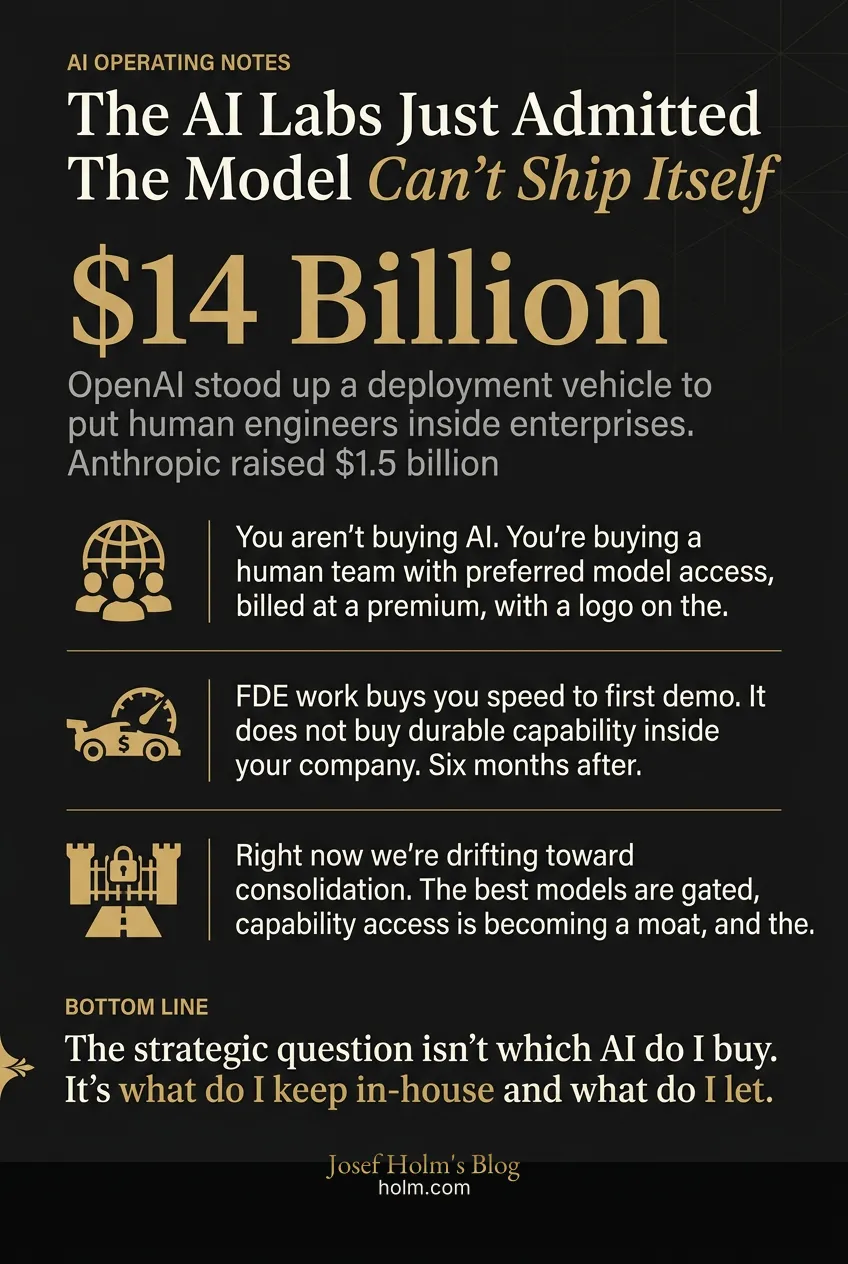
- Anthropic raised $1.5 billion and OpenAI stood up a $14 billion deployment vehicle to put human engineers inside enterprises. If the model could ship itself, none of that would exist.
- You aren't buying AI. You're buying a human team with preferred model access, billed at a premium, with a logo on the invoice that makes the board feel safe.
- FDE work buys you speed to first demo. It does not buy durable capability inside your company. Six months after rotation, nobody internal knows how the system was built and the model underneath has already shifted.
- Right now we're drifting toward consolidation. The best models are gated, capability access is becoming a moat, and the FDE motion is the distribution layer for that moat.
- The strategic question isn't which AI do I buy. It's what do I keep in-house and what do I let someone else own. Same question good operators have always asked. The technology changed. The discipline didn't.
The AI labs just admitted their product can't ship itself
Anthropic raised $1.5 billion with Blackstone and Goldman Sachs to put human engineers inside enterprises. OpenAI countered with a $14 billion deployment vehicle. Read that twice.
The companies selling autonomous AI now sell humans as a service. That's not a side note. That's the confession.
What is a Forward Deployed Engineer, really?
The term comes from the military and got carried into tech by Palantir. You take a pre-trained engineer, drop them inside a client, and have them build the thing on-site. Palantir made it work because their product needed translation into messy enterprise reality. Fine.
So why does Anthropic need it? Why does OpenAI need it?
If the model is the product, the model should ship the product. The fact that the most well-funded AI companies in history are now standing up consulting arms tells you exactly where the technology sits on the maturity curve. The demo works. The deployment doesn't. So they're sending people.
Most executives keep missing this part. You aren't buying AI. You're buying a human team with preferred access to a model, billed at a premium, with a logo on the invoice that makes the board feel safe.
Is this the greatest con in capitalism, or just the obvious next step?
A sharp version of this argument is going around: the labs sold tools that made in-house engineers dependent and slower, then sold the antidote in the form of their own engineers. Sell the disease, sell the cure.
I think that's half right and half too cynical.
The honest read is simpler. Frontier models are powerful but unreliable in production environments. Enterprises don't have the internal muscle to wire them in correctly. Someone has to do the integration work. The labs looked at the gap and decided to capture the margin themselves instead of leaving it to Accenture and Deloitte.
That's not a con. It's a business decision. But it is an admission. The admission is that the technology alone does not produce outcomes. People do. The model is an input.
If you've been listening to keynote narratives about autonomous agents replacing workforces, the FDE motion is the quiet correction. Agents don't deploy themselves. Humans deploy them. And the humans cost a lot.
What actually happens after the FDE leaves?
Here is the pattern I've watched play out across thirty years of enterprise software, long before this current wave.
A specialist team parachutes in. They build something impressive in eight weeks. The demo is clean. The executive sponsor is thrilled. Team rotates out. Six months later the system hits real load, edge cases, model drift, or a vendor change. Nobody inside the company knows how it was built. You call the vendor. They send a new team. The clock restarts.
This isn't unique to AI. It's the consulting cycle. What's new is that the model layer underneath is changing every quarter. So the half-life of any FDE-built system is shorter than the half-life of a Salesforce rollout. You're renting capability, not building it.
I'm not saying don't use outside engineers. I'm saying know what you're actually buying. You're buying speed to first demo. You're not buying durable capability inside your company. Those are different products at different prices.
If you want to understand what durable capability looks like, that's most of what we do at Josef Holm through the operator note and AI readiness note engagements. The work is unglamorous. It's about ownership, not optics.
Which future are we actually heading into?
Two plausible paths, and the gap between them matters.
Path one: consolidation. Software engineering stops being an in-house function at most mid-market companies. Anthropic, OpenAI, and a few others own the model, own the deployment teams, own the integration layer. Their FDEs get tokens at cost. You don't. They can underprice any internal team on any greenfield project. Over a decade, the labs become the default software vendor for everything, the way AWS became the default for compute.
Path two: open access. Top-tier models stay broadly available, open-source keeps pace, and companies retain the ability to build mid-grade software internally. Lab-built software is still better, but the gap is narrow enough that independence is rational for most businesses.
Right now we're drifting toward path one. The best models are gated. Capability access is becoming a competitive moat. The FDE motion is the distribution layer for that moat.
Executives need to think about this now, not in three years. If you outsource your software function to a model lab, you're not outsourcing a vendor relationship. You're outsourcing the thing that determines how fast your company can change. That's a strategic posture, not a procurement decision.
So what should a CEO actually do?
Three things. None of them dramatic.
Stop confusing demos with deployments. When a vendor walks you through a polished prototype built in two weeks, ask who maintains it in month nine. Ask what happens when the underlying model is deprecated. Ask whether your team can read the code. If the answers are vague, you don't have a system. You have a sales artifact.
Build at least one capability in-house. Doesn't matter which one. Pick something narrow and own it end to end. Your team needs the reps. Without internal reps, you can't evaluate vendors, you can't tell good work from theater, and you can't negotiate. The companies that get crushed in the next five years are the ones who outsourced their judgment along with their code.
Treat model access as a strategic input. Same way you'd treat cloud or chip supply. Who has access to what, at what cost, under what terms. This used to be an IT concern. It's now a CEO concern.
If you want a structured way to look at all of this, the implementation notes work we do is built exactly for the moment after the FDE leaves and you need someone who isn't the vendor watching the system.
What about engineers reading this?
If you write code for a living, the FDE label is going to spread fast because the salaries are real and the demand is real. Fine. Update your title. Mirror the job description language. Resume screeners are pattern matchers and you should play the game that exists.
But understand what you're signing up for. FDE work is consulting with a model attached. You'll fly. You'll build fast. You'll rotate. You won't own anything for long. Some people love that life. Some burn out in eighteen months.
The engineers who will compound the most over the next decade aren't the ones memorizing agentic orchestration vocabulary for interviews. They're the ones who actually ship systems that survive contact with real users, real load, and real model changes. That skill is rare. It was rare before AI and it's rarer now.
Memorizing the vocabulary gets you the offer. Shipping the system builds the career. Don't confuse the two.
The honest summary
The FDE boom isn't a sign that AI has arrived. It's a sign that the labs figured out that selling humans is the fastest path to revenue while the autonomous version of their product gets built. Reasonable business move. Also a tell.
If you're running a company, don't read the press releases. Read the job postings. A $14 billion deployment company means the model alone is not enough. It means people are still the bottleneck. It means your strategic question isn't "which AI do I buy" but "what do I keep in-house and what do I let someone else own."
Same questions good operators have always asked. The technology changed. The discipline didn't.
If you want to talk through what that looks like for your business, start here.
Infographic
Frequently Asked Questions
- What is a Forward Deployed Engineer (FDE)?
- An engineer the vendor drops inside your company to build the integration on-site. The term came from the military, got carried into tech by Palantir, and now Anthropic and OpenAI are standing up multi-billion-dollar versions of it. In practice it is consulting with preferred model access attached.
- Why are Anthropic and OpenAI hiring armies of human engineers?
- Because the model alone does not produce outcomes in real enterprises. The demo works, the deployment doesn't, so they're sending people. Anthropic raised $1.5 billion with Blackstone and Goldman. OpenAI stood up a $14 billion deployment vehicle. If the model could ship itself, none of that would exist.
- Is hiring an FDE team a bad idea for my company?
- No, but know what you're buying. You're buying speed to first demo. You are not buying durable capability inside your company. Six months after the team rotates out, nobody internal knows how the system was built, and the model underneath has already shifted. Plan for that day one.
- What should a CEO do about the FDE trend right now?
- Three things. Stop confusing demos with deployments and ask who maintains the system in month nine. Build at least one AI capability in-house so your team has the reps to judge vendors. And treat model access as a strategic input, same as cloud or chip supply. It is a CEO concern now, not an IT one.
- Should engineers take FDE jobs?
- The money is real and the demand is real, so update your title and play the resume-screener game. Just understand the trade. You fly, you build fast, you rotate, you don't own anything for long. Some people love it. Some burn out in eighteen months. The engineers who compound over a decade are the ones who ship systems that survive real users, real load, and real model changes.
- What happens after the FDE team leaves?
- The pattern is thirty years old. Specialist team parachutes in, builds something clean in eight weeks, rotates out. Six months later the system hits real load, edge cases, or a model change. Nobody inside knows how it was built. You call the vendor. They send a new team. The clock restarts. The model layer changes every quarter now, so the half-life is shorter than a Salesforce rollout.