The AI Layoff Story Is Mostly Theater
Key Takeaways
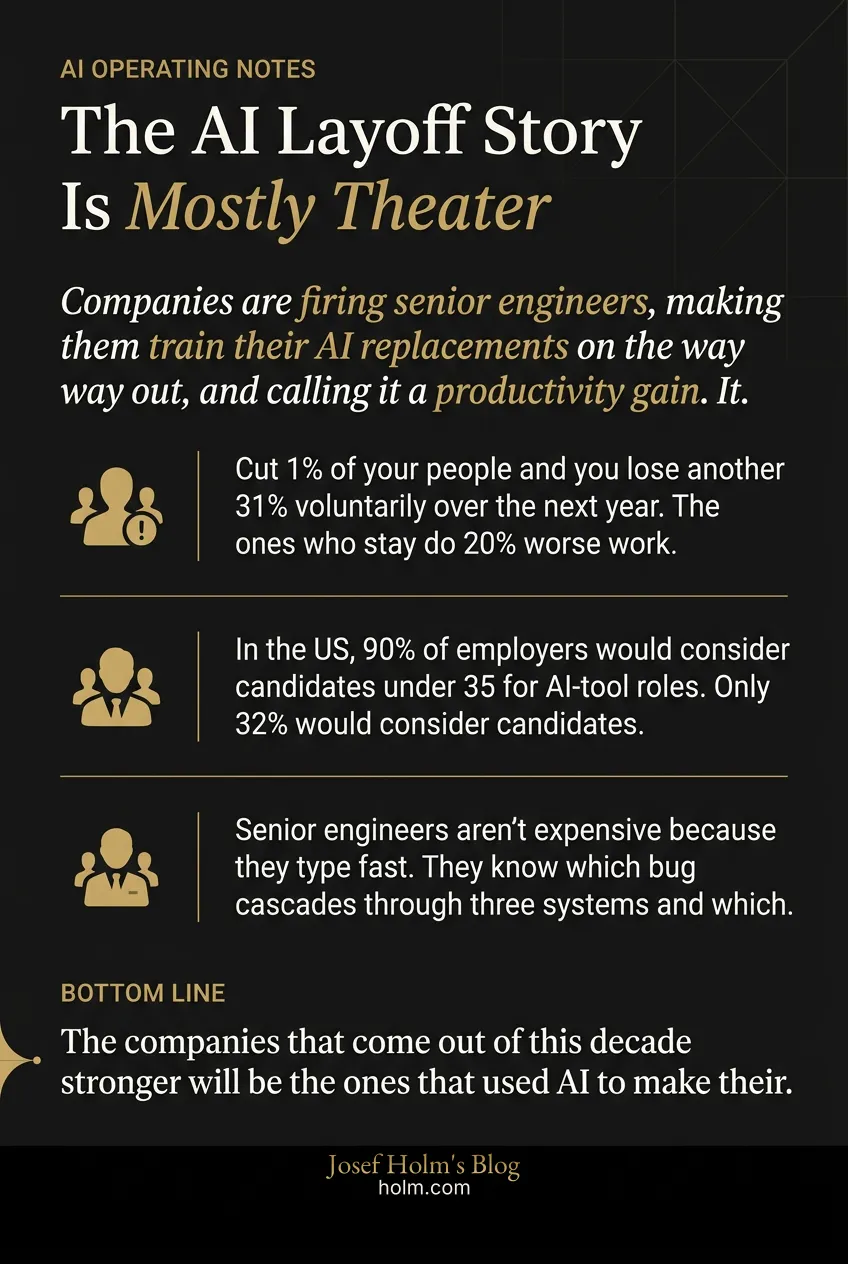
- Companies are firing senior engineers, making them train their AI replacements on the way out, and calling it a productivity gain. It isn't. It's a transfer.
- Cut 1% of your people and you lose another 31% voluntarily over the next year. The ones who stay do 20% worse work. That math never makes the board deck.
- In the US, 90% of employers would consider candidates under 35 for AI-tool roles. Only 32% would consider candidates over 60. AI is the convenient story for a decision that was really about payroll.
- Senior engineers aren't expensive because they type fast. They know which bug cascades through three systems and which 2019 decision still constrains what you can ship. Fire them and that knowledge doesn't transfer to the AI. It just leaves.
- The companies that come out of this decade stronger will be the ones that used AI to make their people more valuable, not more disposable. Pay attention to who's doing which.
The productivity story nobody's telling
Companies are firing senior engineers, making them train their AI replacements on the way out, then calling it a productivity gain. It isn't. It's a transfer. The company pockets short-term margin. The workforce loses institutional knowledge, quality control, and trust. Remaining employees disengage. The numbers on this are already in.
I've watched enough technology cycles to recognize what's going on. This isn't AI transformation. It's cost-cutting with a better narrative. And the people running these decisions are about to learn what every operator eventually learns: you can't fire your way to a better business.
What's actually happening inside these layoffs?
Look at Oracle. A Time investigation and survey of around 200 former employees surfaced a pattern. Older workers were let go, often just before large Restricted Stock Unit vesting dates. 27% of respondents said they had RSUs vesting within 90 days of their layoff. One software manager was four months away from a million dollars in stock options vesting when he was cut.
Before leaving, many were required to train the internal AI tools that would replace them.
Think about what RSUs are supposed to do. They're retention tools. A promise. Stick around, do the work, share in the upside. When companies start pulling people out the door right before vesting, they don't just hurt those individuals. They break the mechanism itself. Every remaining employee now understands that equity isn't a contract. It's a suggestion.
That's not productivity. That's the destruction of a compensation system the tech industry spent thirty years building.
Why do people call AI "easy" when workers describe it as harder?
Here's the gap nobody in the AI marketing circuit wants to talk about.
Oracle employees described internal AI tools that were often not useful and slow to work. Junior engineers used them to generate code that was frequently wrong. Senior engineers spent their time fixing that code. One employee who actually found the tools helpful said he was working harder than he ever had.
"Easy" in this context is a euphemism. It means: do more work in less time for the same pay, and if you can't, we'll find someone who will.
The promised benefit of AI, the part where humans get freed from drudgery, rarely lands with the worker. It lands with the employer. The worker gets compression. The employer gets margin.
Worth being honest about, because the gap between the pitch and the lived reality is where trust dies.
What happens when you remove the people who know how things actually work?
You get code written by juniors with AI, reviewed by nobody qualified to catch the mistakes.
Senior engineers aren't expensive because they type fast. They're expensive because they know which bug will cascade through three systems, which customer won't tolerate a specific kind of outage, which architectural decision from 2019 still constrains what you can ship today.
Fire them, and that knowledge doesn't transfer to the AI. It just leaves.
What you're left with is volume without judgment. More code, less verification. More output, less reliability. A pipeline that no longer grows the next generation of senior engineers, because the mentors are gone.
Two years from now, the companies running this playbook will try to hire back the exact profile they just cut. They'll pay more. And the best people will remember.
Is there real age discrimination happening here?
The data says yes.
A Generation survey of over 2,000 employees and roughly 1,500 hiring managers across the US, France, Ireland, Spain, and the UK found something stark. In the US, 32% of employers said they'd likely consider candidates over 60 for roles using AI tools. 90% would consider candidates under 35 for the same roles. In Europe, 33% versus 86%.
The assumption underneath those numbers is that older workers can't learn AI tools. Lazy assumption. Every worker in their fifties today has already absorbed three or four major technology shifts. Web, mobile, cloud, SaaS. Adapting to AI tools isn't a harder leap.
What's actually happening is simpler. Older workers cost more. They have more use. They push back. AI is the convenient story to explain a decision that was really about payroll.
What does the research say about layoffs themselves?
This is the part most executives skip.
Charlie Trevor at the University of Wisconsin-Madison found that cutting a workforce by 1% leads to a 31% increase in voluntary turnover the following year. A 2002 study from Stockholm University and the University of Canterbury found that after layoffs, employees who stayed showed a 41% decline in job satisfaction, 36% decline in organizational commitment, and 20% decline in job performance.
Read those numbers again.
Cut 1% of your people. Lose another 31% voluntarily over the next year. The ones who remain do 20% worse work. They stop taking on long-term projects. Your highest performers, the ones with the most options, leave first.
This is the productivity math nobody puts in the board deck. The savings on the layoff are real. The damage to the remaining organization is larger, just less visible in next quarter's report.
If you're a CEO running this calculation honestly, layoffs are almost never the productivity win they appear to be. At Josef Holm, the companies we see executing AI well aren't the ones cutting hardest. They're the ones redeploying people into higher-build on work.
Is the legal environment about to shift?
Probably. It already has in one place.
The Hangzhou Intermediate People's Court in China ruled that a tech firm illegally fired a worker who refused a 40% pay cut and demotion when his job was automated. The court's position: companies cannot unilaterally cut salaries or lay off workers due to technological progress.
That's a meaningful precedent. China's planners have signaled they'll prioritize labor market stability given slowing growth and high youth unemployment. Expect similar cases in Europe. The UK, Germany, and France all have stronger baseline labor protections than the US, and the political appetite to use them is rising.
The US will be last. US labor protections are weak, and the political will to strengthen them isn't there yet. The ripple moves eventually, though. Companies making aggressive AI-driven cuts today should assume the legal environment in five years won't look like the one they're operating in now.
What about the younger workers everyone assumes love AI?
They don't. Not the way the narrative suggests.
Gen Z workers are actively resisting AI rollouts in some workplaces. Reports from The New York Times and Vice have documented younger employees collectively deciding not to use AI tools, because they've watched entry-level jobs disappear and they understand the math. If AI does the work a junior used to do, there are no juniors. No juniors means no future seniors. No future seniors means no career.
They're not wrong. The graduate job market for software engineers has contracted sharply. The bottom rung of the career ladder is being pulled up, and the people standing on it can see it happening.
This is a real problem for any company planning a long-term talent pipeline. If the people you'd hire in five years believe your industry is closed to them, they'll go do something else. Then in ten years, you'll have a gap you can't fill.
So what should operators actually do?
A few things.
Stop treating AI as a headcount strategy. It's a capability strategy. The question isn't "how many people can I cut?" It's "what can my team now do that they couldn't do before?" Different questions, different answers. The first shrinks the business. The second grows it.
Be honest about what's working and what isn't. Internal AI tools often don't work as promised. Forcing people to use tools that slow them down, then blaming them when output suffers, is a trust-destroying move. Measure the actual productivity impact. If the tool makes senior engineers spend their time fixing junior AI-generated code, you haven't improved anything.
Protect institutional knowledge like the asset it is. The senior people in your organization aren't a cost line. They're the reason your systems work and your customers stay. Treat them so.
Set a clear mentorship floor. If juniors can't learn from seniors because the seniors are gone, you're choosing not to have a company in ten years.
If you want a clearer read on where AI is actually creating apply in your organization versus where it's creating hidden liability, that's exactly what our AI readiness note is built to find. The pattern we see repeatedly: the companies making the most noise about AI-driven efficiency are often the ones losing the most ground underneath.
The real point
AI will reshape work. That part is true. The current wave of AI-justified layoffs isn't the reshaping, though. It's cost-cutting wearing a better costume.
The companies that come out of this decade stronger will be the ones that used AI to make their people more valuable, not more disposable. The ones that treated institutional knowledge as something to build on, not something to extract and discard. The ones that understood trust compounds, and once broken, it doesn't come back on a quarterly cycle.
The productivity story being sold right now is mostly theater. The real productivity work is quieter, harder, and doesn't show up in a press release about workforce reductions.
Pay attention to who's doing which.
Infographic
Frequently Asked Questions
- Are AI-driven layoffs actually producing productivity gains?
- Mostly no. Cutting 1% of a workforce leads to a 31% jump in voluntary turnover the next year, and the employees who stay show a 41% drop in satisfaction, 36% drop in commitment, and 20% drop in performance. The layoff savings are real. The damage to the rest of the organization is larger and just less visible on the next quarterly report.
- Is it legal to fire workers because AI can do their job?
- It depends on the jurisdiction, and it's changing. A Chinese court ruled that a tech firm illegally fired a worker who refused a 40% pay cut tied to automation. Europe has stronger baseline labor protections than the US and rising political will to use them. The US will be last to shift, but companies making aggressive AI-driven cuts today should assume the legal environment in five years won't look like today's.
- Why do companies cut senior workers before RSUs vest?
- Because it pockets short-term margin. In the Oracle pattern documented by Time, 27% of surveyed former employees had RSUs vesting within 90 days of their layoff. The problem is what it does to everyone still there. Equity stops being a contract and becomes a suggestion, and the retention mechanism the tech industry spent thirty years building starts to break.
- Do younger workers actually want to use AI at work?
- Not the way the narrative suggests. Gen Z workers are collectively refusing AI tools in some workplaces because they've watched entry-level jobs disappear. If AI does the junior work, there are no juniors, no future seniors, no career. They understand the math, and they're not wrong.
- What should operators do instead of using AI as a headcount strategy?
- Treat AI as a capability strategy. Stop asking how many people you can cut and start asking what your team can now do that they couldn't before. Measure the actual productivity impact of internal AI tools instead of assuming they work. Protect institutional knowledge and set a clear mentorship floor, because if juniors can't learn from seniors, you're choosing not to have a company in ten years.
- What does an AI readiness note actually look at?
- It looks at where AI is creating real value in your organization versus where it's creating hidden liability. The pattern we see repeatedly: the companies making the most noise about AI-driven efficiency are often the ones losing the most ground underneath. The audit surfaces that gap before it shows up in turnover numbers or a two-year talent hole.