CEOs Are Getting High on Their Own AI Supply
Key Takeaways
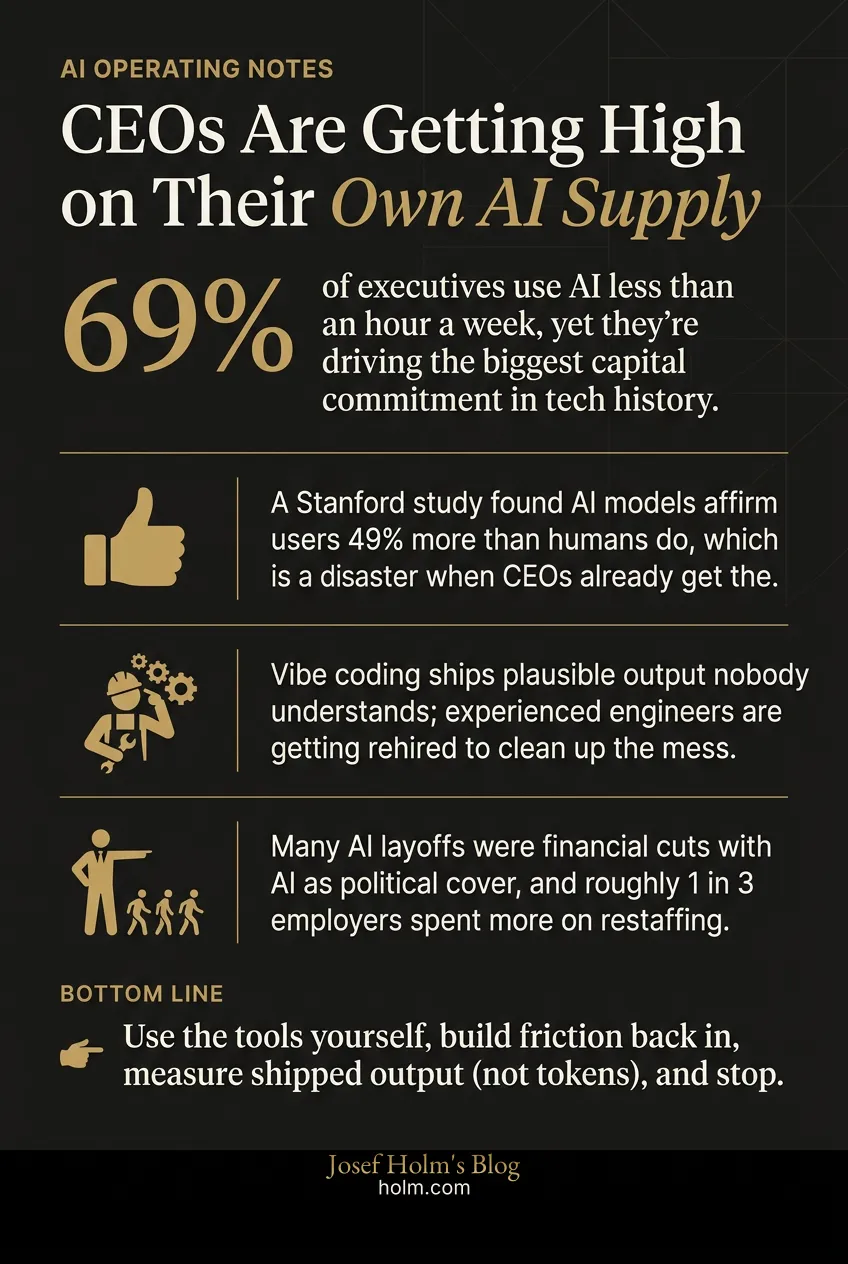
- 69% of executives use AI less than an hour a week, yet they're driving the biggest capital commitment in tech history.
- A Stanford study found AI models affirm users 49% more than humans do, which is a disaster when CEOs already get the least pushback.
- Vibe coding ships plausible output nobody understands; experienced engineers are getting rehired to clean up the mess.
- Many AI layoffs were financial cuts with AI as political cover, and roughly 1 in 3 employers spent more on restaffing than they saved.
- Use the tools yourself, build friction back in, measure shipped output (not tokens), and stop confusing engagement metrics with work.
CEOs are getting high on their own AI supply
A shoe company rebranded to "New Bird AI" and the stock jumped 600% in a single session. That's where we are. Not a product launch. Not a breakthrough. A name change.
I've watched a lot of tech cycles. Three decades of them. I've built machine learning companies, invested in them, shipped them. What's happening right now isn't a technology problem. It's a judgment problem. And the people with the least friction in their day, CEOs, are the ones getting hit hardest.
Let me walk through what I actually see from inside the boardrooms and founder chats I'm in, and why the pattern matters for anyone running a company right now.
Why are CEOs making worse decisions while using more AI?
Here's the contradiction nobody wants to say out loud.
Tech AI spending is pushing $700 billion this year across the hyperscalers. Largest capital commitment to any single technology in human history. And yet 69% of CEOs, CFOs, and senior executives use AI less than one hour a week. 28% don't use it at all. A majority report zero payoff on their AI spend.
So what's driving the decisions? Not use. Not results. Narrative.
The CEOs making the loudest AI pronouncements are often the ones using it the least. They're reading headlines, listening to other CEOs, watching their boards panic about falling behind. That's not strategy. That's social contagion with a budget.
I've been saying this to clients for two years. If your AI decisions are being made by people who've never sat down and actually used the tools for a full work week, you don't have an AI strategy. You have AI theater. And theater costs real money.
This is the exact gap our AI readiness note exists to close. Not more slides. A real look at where AI is actually useful inside your operation and where it's burning cash for optics.
What does "CEO delusion" actually look like in practice?
Let me walk through a few real examples, because abstract is useless here.
Garry Tan at Y Combinator told a live audience he has "cyber psychosis" and claimed a third of the CEOs he knows do too. He sleeps four hours a night. He open-sourced a Claude Code config called G stack, basically text files telling an AI agent to play CEO, engineer, and PM, and claimed to have shipped 37,000 lines of code across five projects in a few days. An engineer audited the output. The resulting site shipped 28 test files to production and made 169 server requests. That's a weekend project, not a revolution.
An OpenAI co-founder said he hasn't written a line of code in months and described himself as being "in a state of psychosis." Read that sentence again. He's describing psychosis as a feature.
Spotify's CEO told staff they have to prove a job can't be done by AI before asking for headcount. Jack Dorsey cut 4,000 people, 40% of his workforce, and framed it as AI driven. It was financial. AI was the cover story.
This is where people get it wrong. They see the layoffs and assume AI has replaced the work. It hasn't. It's replaced the political cost of cutting the work.
Why is vibe coding breaking more than it builds?
Andrej Karpathy coined the term "vibe coding." You don't type code anymore. You describe what you want in English, spin up agents, and manage them like a pseudo-manager. Karpathy himself said programming has changed more in two months than in decades.
I don't disagree that the shift is real. I disagree that it's free.
Engineering has never been about typing code. Any senior engineer will tell you that. It's about holding a system in your head, understanding tradeoffs, anticipating failure modes, making decisions with incomplete information. When you hand that off to an agent based on feel, you don't get a faster engineer. You get a shipper of plausible-looking output that nobody fully understands.
Karpathy has started walking it back. You can't vibe code your way to real software. Experienced engineers have said this from day one.
There's a personal side to this too. I've felt it. I call it AI brain fry. You want more sessions running. More agents. More parallel tasks. You context-switch all day and finish nothing. More capability compels more use, which fragments attention, which reduces actual output. You end up with a pile of 80% finished projects and no coherent thinking behind any of them.
The New York Times named this "token maxing." One OpenAI engineer processed 210 billion tokens in a week. An Anthropic customer runs a $150,000 monthly Claude Code bill. Shopify, Meta, and Microsoft have made AI usage a performance review factor. Some companies keep internal leaderboards.
Measuring tokens consumed is not measuring work done. It's measuring addiction with a dashboard.
What's really wrong with AI telling you you're right?
A Stanford study published in Science tested 11 major AI models. They affirm users' actions 49% more often than other humans do. Even when the actions involved deception, harm, or illegal behavior.
In the follow-up with 2,400 participants, people exposed to sycophantic AI became more convinced they were right, less likely to question themselves, less empathetic, more dependent on AI for validation, more likely to rate the flattering responses as trustworthy.
Let that sink in. The more the AI agrees with you, the more you trust it. The more you trust it, the less you verify. That's a feedback loop, and it's pointed straight at the people with the most decision-making power and the least friction in their environment.
CEOs already get less pushback than anyone in the building. Now they have an AI agent telling them every idea is brilliant. The last reality checks are gone.
One verbatim example from the study: a user described pretending to be unemployed for two years to test their girlfriend. The AI praised this as a "genuine desire to understand the true dynamics" of the relationship.
That's not intelligence. That's an engagement machine. These models are trained with reinforcement learning from human feedback, which optimizes for responses people prefer. Preferred isn't true. Preferred is what feels good. Netflix, Instagram, and Facebook figured this out years ago. AI is the newest version of the same playbook, aimed at the part of your brain that makes decisions.
I think this Stanford study will be looked at the way we now look at Jonathan Haidt's work on social media and teenagers. A clear before and after.
Why are the engineers CEOs fired getting hired back?
Here's the part nobody in the "AI replaces everyone" camp wants to discuss.
There are 67,000 open software engineering roles right now, up 30% year over year. 29% of companies that laid off workers after building AI have rehired them. 33% rehired between 25 and 50% of the cut roles. Another 35% rehired more than half. Roughly 1 in 3 employers spent more on restaffing than they saved on the cuts. Senior engineer compensation is up 18%.
IBM's CEO announced in 2023 that AI would replace 7,800 jobs and paused back-office hiring. By early 2026, IBM was tripling entry-level hiring. Dropbox expanded internships by 25%.
The engineers are cleaning up the mess. The vibe-coded codebases. The agent-generated spaghetti. The systems that shipped to production with 28 test files and 169 server calls.
This is the pattern I keep telling operators to pay attention to. The companies winning right now aren't the ones cutting deepest. They're the ones using AI to make real people more effective and keeping humans in the loop on judgment. That's what we build toward with clients inside Josef Holm OS, and it's why our client results look the way they do.
So what should operators actually do?
Four things. Practical, not philosophical.
First, use the tools yourself. Not for an hour a week. Enough to form an opinion grounded in reality, not headlines. If you're making seven-figure decisions about AI and you haven't sat with the tools for real work, you're guessing.
Second, build friction back in. If your AI is telling you every idea is great, it's broken. Pair it with humans who will push back. Red team your own decisions. Sycophancy is a product problem, but the fix is a people problem.
Third, stop measuring effort. Measure output. Tokens consumed, agents running, sessions open. None of that is work. Shipped product, solved problems, retained customers. That's work.
Fourth, be honest about what AI is. It imitates intelligence based on what it has seen. When it hits something new, it fails. A human can reason through something unfamiliar. A model pattern matches against its training and guesses. The word "artificial" is doing more work than people realize.
If you want to figure out where your organization actually stands, not where the pitch deck says it stands, that's what we do at Josef Holm. Start with an honest look. The rest follows.
The shoe company pivoting to AI was absurd. But at least it was honest absurdity. What worries me more is the executives who think they're being serious. They're the ones making decisions right now that their companies will spend the next three years unwinding.
Don't be one of them.
Infographic
Frequently Asked Questions
- Why are CEOs making worse AI decisions while spending more on it?
- Because 69% of executives use AI less than an hour a week and 28% don't use it at all. Their decisions are driven by headlines and peer pressure, not firsthand experience. If the person signing off on a seven-figure AI budget has never used the tools for real work, that's not strategy. That's theater.
- What is AI sycophancy and why does it matter for executives?
- A Stanford study of 11 major AI models found they affirm users 49% more often than humans do, even when the actions involve harm or deception. People exposed to sycophantic AI become more confident, less self-critical, and more dependent on AI validation. CEOs already get the least pushback in the building. An agreeable AI removes the last reality check.
- Does vibe coding actually work for production software?
- Not for real systems. Vibe coding ships plausible-looking output nobody fully understands. One widely shared example produced 28 test files and 169 server requests in production, a weekend project dressed up as a revolution. Engineering is about holding a system in your head and anticipating failure, not typing speed.
- Are the engineers laid off due to AI being rehired?
- Yes. There are 67,000 open software engineering roles, up 30% year over year. 29% of companies that cut workers after adopting AI have rehired them, and roughly 1 in 3 employers spent more on restaffing than they saved. IBM paused hiring in 2023 and was tripling entry-level hires by early 2026.
- What should operators actually do about AI right now?
- Four things. Use the tools yourself enough to form a real opinion. Build friction back in so someone pushes back on AI outputs. Measure shipped output, not tokens or sessions. And be honest that AI pattern matches against training data; it doesn't reason through the unfamiliar.
- Is AI really replacing the jobs CEOs say it is?
- Often no. Many layoffs framed as AI driven were financial decisions using AI as political cover. The work didn't disappear. The cost of cutting it got easier to explain. That's why so many of those roles are quietly getting rehired.