Five Layers AI Can't Replace No Matter How Good It Gets
Key Takeaways
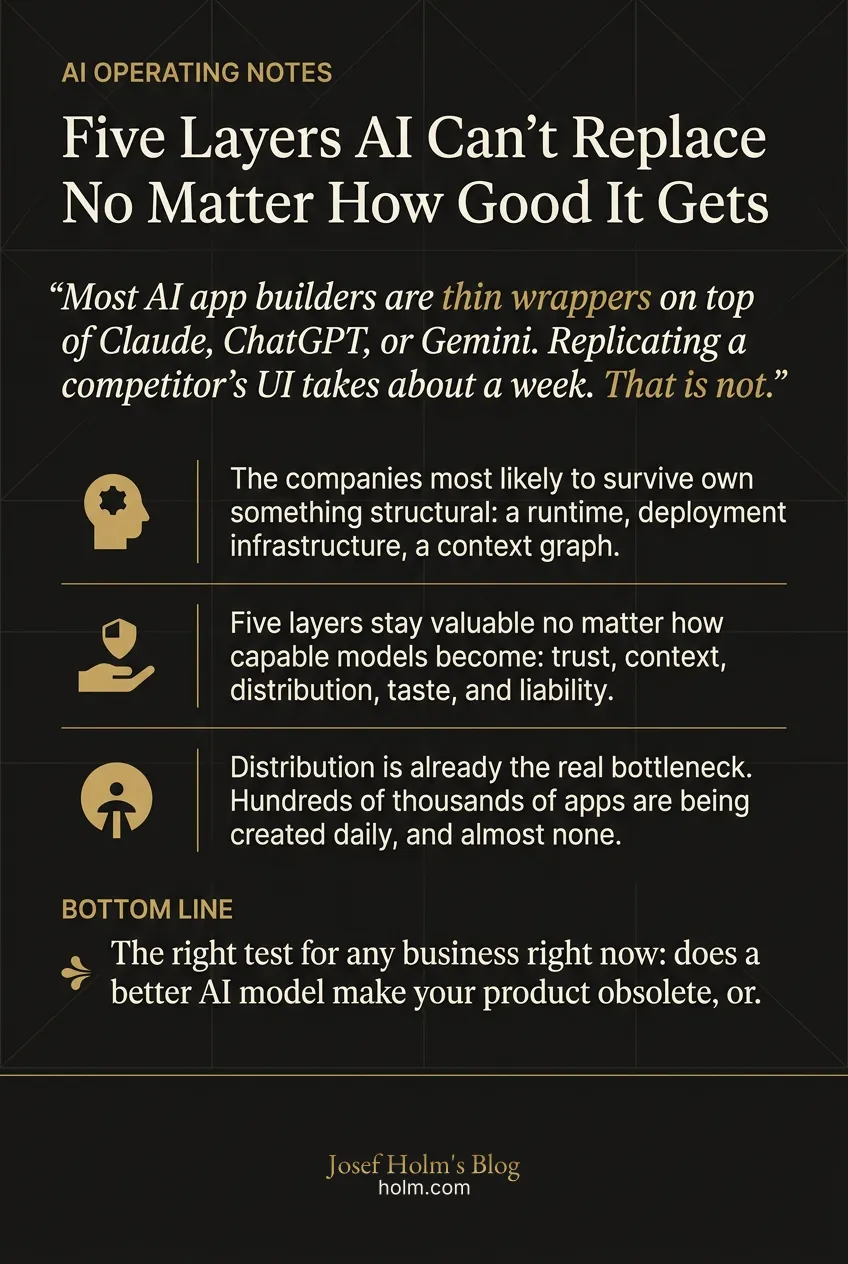
- Most AI app builders are thin wrappers on top of Claude, ChatGPT, or Gemini. Replicating a competitor's UI takes about a week. That is not a moat.
- The companies most likely to survive own something structural: a runtime, deployment infrastructure, a context graph, or a governance layer. Not just a better prompt.
- Five layers stay valuable no matter how capable models become: trust, context, distribution, taste, and liability.
- Distribution is already the real bottleneck. Hundreds of thousands of apps are being created daily, and almost none have validated whether customers actually want them.
- The right test for any business right now: does a better AI model make your product obsolete, or does it make your product more necessary? Build so.
Most AI Companies Are Building on Borrowed Time
Lovable just raised $330 million at a $6.6 billion valuation. Replit has 25 million developers. Vercel's V0 hit 4 million users. Bolt, Shipper, Base44, and a dozen others are all chasing the same pitch: describe your idea, we'll build your business.
Here's the problem. Most of these companies are functionally the same product. Thin wrappers around Claude, ChatGPT, or Gemini, differentiated by UI quirks, tiers, and minor feature variations. The moat for any interface layer built on top of someone else's intelligence is almost nonexistent. With tools like Claude Code and OpenAI's Codex, replicating a competitor's UI takes roughly a week.
That's not a business. That's a feature waiting to be absorbed.
The real story isn't which app builder wins. It's what their struggles reveal about where durable value actually lives when AI commoditizes production itself.
What Separates Survivors from Casualties?
The obvious answer is "train your own model." Replit trained custom code completion models using Databricks. Vercel built a custom autofix model with Fireworks AI. Lovable, with $300 million in annual recurring revenue, has the capital to do the same.
Model training isn't what separates the companies that last from the ones that don't. The companies most likely to endure own something structural that model providers can't replicate.
Replit owns the runtime. The actual compute environment where applications execute. Claude can generate code but can't run it. Vercel owns deployment infrastructure already used in production by OpenAI, Anthropic, Nike, and PayPal. It's an infrastructure company that added an AI front door, not the reverse. Notion owns a massive structured knowledge graph built by roughly 100 million users. Rather than competing on models, it offers a model picker and positions its context layer as the asset every model needs to access.
The pattern holds: AI commoditizes production. The companies that survive own layers that production can't replace.
I've watched this repeat across three decades of technology shifts. The specific technology changes. The structural dynamics don't. Right now, those dynamics point toward five specific layers of value that persist regardless of how capable models become.
What Are the Five Layers That AI Can't Replace?
Trust: Who Do You Believe When Everything Looks Real?
The web is flooding with AI-generated apps, storefronts, services, and content. Many are indistinguishable from one another. Some are outright malicious. When anyone can generate a professional-looking checkout page in seconds, visual legitimacy stops meaning anything.
Companies that become verification layers capture enormous value. Stripe processes over $1 trillion in transactions. Shopify, Apple's App Store review process, Vercel's deployment infrastructure. These aren't convenience layers. They're the reason people feel safe clicking "buy."
Now extend that to the agentic economy. When AI agents autonomously transact on your behalf, booking flights, signing up for services, making purchases, the trust layer is the primary barrier between you and AI-generated scams. Agents will need verified trust signals to operate. Unverified services won't just be risky. They'll be invisible.
Trust becomes a walled garden for responsible web traffic. If you're building something that helps establish whether a service, app, or agent is what it claims to be, you're in a durable position.
Context: The Most Valuable Asset on the Internet Isn't Compute
AI is a general-purpose tool. To be useful, it needs specific data: your company's proprietary information, your customer relationships, your medical records, your meeting notes. Without that context, it's just a very articulate stranger.
Companies that become the authoritative store for context, and that govern where that context gets served, own a choke point through which every agent, model, and workflow must pass.
Notion gets this. Its custom agents, built on top of any available model, derive their power from the user's own workspace data. The same structural logic makes Salesforce durable in CRM, Epic durable in healthcare, and Palantir durable in security. Snowflake and Databricks play here too. Google recently launched a context layer for Maps, which signals it understands exactly what's at stake.
An agent without context is a chatbot. An agent with rich context can function as a capable junior employee. That gap isn't small. It's the difference between a toy and a tool.
This is something we think about constantly at Josef Holm. When we conduct an AI readiness note, the first thing we assess is what context assets a company actually owns, and whether those assets are structured in a way that makes AI useful rather than generic.
Distribution: Building Is Free. Getting Seen Is Not.
Building software is increasingly free. Getting anyone to see it is not. Distribution has always been the real bottleneck, not construction. When supply becomes effectively infinite, curation becomes the scarcest resource.
Existing distribution monopolies, Google Search, Apple's App Store, TikTok, YouTube, Amazon, become more powerful as volume increases. They control where attention flows. AI amplifies their gatekeeping role rather than diminishing it.
What most people are missing is agent discovery. If every business deploys AI agents, there's no established mechanism for agents to find and transact with one another. No agent-native app store. No discovery layer that lets agents identify agent-friendly services. This is a wide-open category.
Think about what agent-compatible commerce actually requires: transaction speed, how easily an agent can understand a service's offerings, how quickly it can make a selection, how simply it can receive a good or service. Almost no businesses are thinking through these requirements right now. Gaps like this don't stay open forever.
Taste: The Only Thing That Can't Be Prompted
When producing software is free, what you choose to produce becomes the entire game. Taste is design sensibility, editorial judgment about what's worth building, and the willingness to be accountable for those choices. AI can assist with it. AI can't replace it. Because taste requires a point of view on how humans do business with humans, and that's not derivable from training data.
The music production analogy is instructive. When GarageBand made production tools cheap and accessible, the flood of music increased dramatically. The producers who thrived weren't the ones with the most expensive studios. They were the ones with the clearest sense of what would connect with an audience.
The same dynamic is hitting software right now. A vibe coder who ships an app in minutes hasn't done the hard part. Figuring out how a product will deeply connect with its intended audience, that's still the hard part. If you can build anything, the question of what to build becomes everything.
In the agentic economy, taste manifests as orchestration quality. The winning agent systems will be those where someone with deep domain expertise has carefully tuned prompts, designed workflows, selected appropriate tools, and made thousands of small editorial decisions about agent behavior. Even as auto-research and self-evolving capabilities develop, the human remains accountable for direction, goals, and conduct.
This is why I believe the people we work with are in a better position than most realize. Operators with domain expertise and good judgment aren't being replaced by AI. They're becoming more valuable because AI needs their taste to produce anything worth using.
Liability: Someone Has to Be Accountable When It Goes Wrong
When an AI-generated financial plan loses money, when an AI-built medical app gives harmful advice, when an AI-generated contract contains a damaging clause, "the AI did it" is not a legal defense. It never will be.
Regulated industries, healthcare, finance, legal, insurance, are inherently liability niches. Professionals in these spaces are fundamentally selling accountability, even when they're using agentic systems to do the work. The better AI gets at sounding authoritative and plausible, the more serious the consequences of its errors, and the more important authentic human accountability becomes.
In the agentic economy, liability becomes a governance layer. AI agents autonomously executing complex workflows, filing documents, moving money, making commitments, require defined boundaries, audited actions, and clear human accountability for outcomes.
Companies positioning themselves as liability guarantors own the governance layer of the future web. Deloitte and McKinsey are repositioning as AI assurance providers. ElevenLabs is offering insurance products for voice agents. Regulated SaaS platforms like Veeva and Elation are building on this foundation. The category ranges from firms doing billions in revenue to small specialized practices, all focused on making agents safer to operate.
How Does This Change What You Should Build?
Here's the test I'd apply to any business right now: what do you own that still matters if AI gets ten times better?
If a better model makes your product obsolete, reposition now. Don't wait. Models will keep improving. That's not a prediction, it's the baseline assumption.
If a better model makes your product more valuable, because you own a piece of the trust layer, the context layer, the liability layer, or the distribution infrastructure, you have a durable foundation.
There's a secondary problem that deserves more attention. The tools generating enormous enthusiasm around creation haven't generated equivalent focus on distribution. With 100,000 or more apps being created daily on platforms like Lovable alone, most will never be discovered. Not because they're bad, but because no one validated whether customers actually wanted the product. Getting an MVP in front of real customers, collecting feedback, confirming product-market fit. That's still irreducibly human work.
The Uncomfortable Truth About Where Value Lives
These five layers, trust, context, distribution, taste, and liability, aren't new concepts. They've always mattered on the web. What AI does is act as a forcing function that makes them matter more, while being structurally unable to replace them.
The model providers own the bedrock intelligence layer. Increasingly valuable, increasingly commoditized relative to each other. The wrapper companies own nothing inherently durable. Most will be acquired or shut down. The infrastructure players own trust and execution. The context owners hold data gravity. The distribution gatekeepers control attention. Human operators provide the taste, judgment, and accountability that make the whole system function.
I've seen enough cycles to know that the companies and operators who position themselves in structural layers early don't just survive the transition. They define the next era. The ones who build on borrowed layers, no matter how impressive the growth numbers look today, are the ones who get absorbed.
The question isn't whether you're using AI. Everyone will be using AI. The question is whether you own something that AI makes more necessary. If you do, you're building in one of the five safe places. If you don't, now is the time to figure out which layer you can credibly claim.
That's the work we help companies do through our AI readiness note. Not hype. Not theory. A clear-eyed assessment of where you stand and what to do about it. If that's a conversation worth having, get in touch.
Infographic
Frequently Asked Questions
- Why do most AI app builder companies lack a durable business model?
- They are thin interfaces on top of Claude, ChatGPT, or Gemini. The underlying model does the work. With tools like Claude Code, a competitor can replicate your UI in roughly a week. That is a feature, not a business. Without owning something structural, like infrastructure, a data layer, or a trust mechanism, there is nothing to defend.
- What does it mean to own the context layer in AI?
- Context is the proprietary data that makes a general-purpose AI useful for a specific situation: your customer records, your company knowledge base, your medical history. Companies that store, govern, and serve that context own a choke point every model and agent must pass through. Notion, Salesforce, Epic, and Palantir are all doing this in different verticals.
- How does liability factor into AI-driven business models?
- When an AI system gives harmful financial, medical, or legal advice, the human or company deploying it is accountable. Regulated industries sell accountability first. As AI agents get better at sounding authoritative, the consequences of errors get more serious, and the value of genuine human accountability goes up, not down. That is the governance layer of the future web.
- Is distribution really harder than building software with AI?
- Yes. Building is increasingly free. Getting anyone to see what you built is not. Existing distribution gatekeepers, Google, Apple, Amazon, TikTok, become more powerful as supply increases. There is also no established discovery mechanism for AI agents to find and transact with one another. That gap is a real business opportunity right now.
- What is taste in the context of AI and software development?
- Taste is the judgment about what is worth building and how it should work for the people who will use it. AI can assist with execution but cannot supply a point of view on what will connect with a real audience. In agentic systems, taste shows up as orchestration quality: the thousands of small decisions about prompts, workflows, tools, and agent behavior that determine whether a system is useful or not.
- How should a company assess whether its AI strategy is durable?
- Ask one question: if AI gets ten times better, does your product become obsolete or more valuable? If a better model makes you irrelevant, reposition now. If a better model makes your trust layer, context store, distribution infrastructure, or liability position more valuable, you have something worth building on. That is the core assessment we run in an AI readiness note.