The Hidden Tax of AI Fragmentation
Key Takeaways
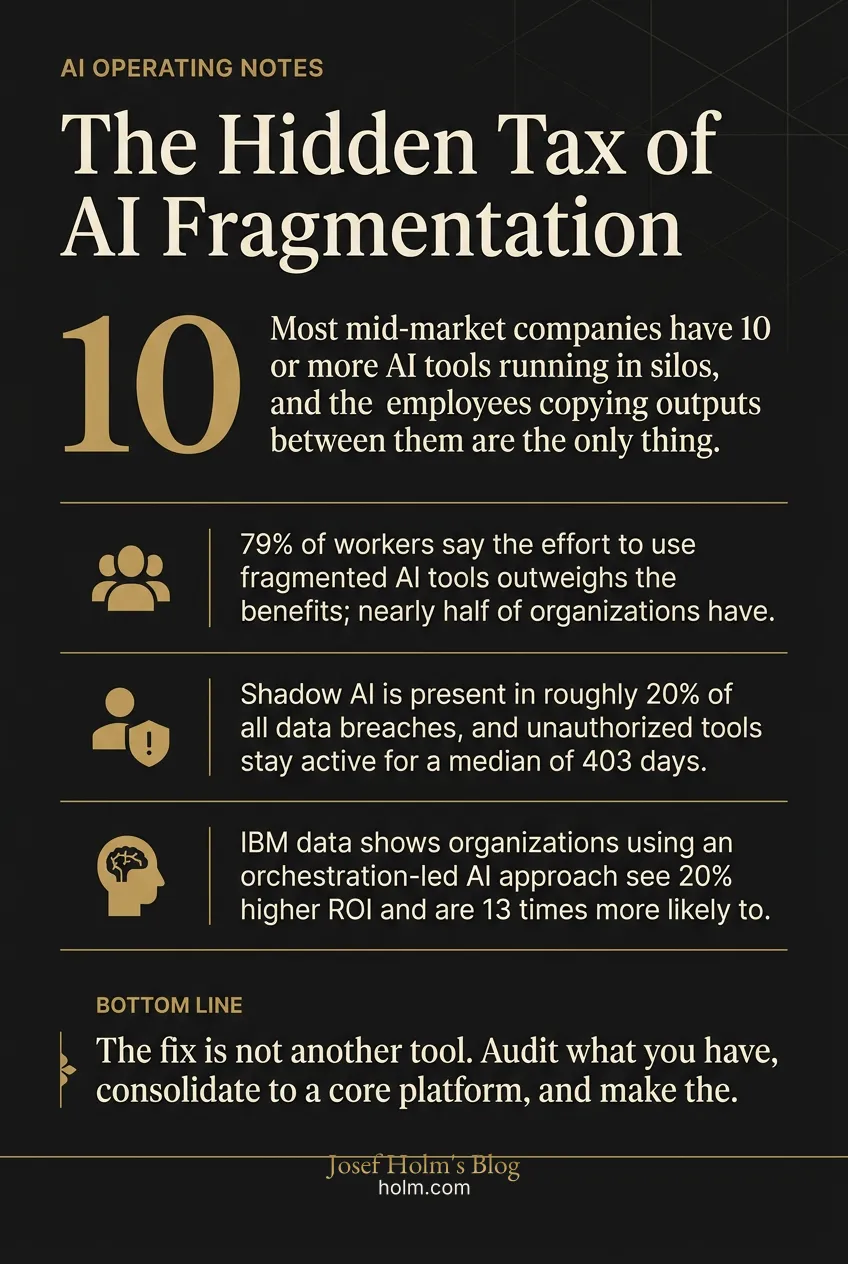
- Most mid-market companies have 10 or more AI tools running in silos, and the employees copying outputs between them are the only thing holding it together.
- 79% of workers say the effort to use fragmented AI tools outweighs the benefits; nearly half of organizations have already abandoned at least one tool in the past year.
- Shadow AI is present in roughly 20% of all data breaches, and unauthorized tools stay active for a median of 403 days before anyone detects them.
- IBM data shows organizations using an orchestration-led AI approach see 20% higher ROI and are 13 times more likely to scale successfully.
- The fix is not another tool. Audit what you have, consolidate to a core platform, and make the approved path the easiest path for employees.
Most mid-market companies didn't plan to build a mess. They planned to move fast. And now they're sitting on a dozen AI subscriptions, three overlapping workflows, and a security exposure they haven't even found yet.
That's the actual state of AI adoption for most companies in the 50 to 500 employee range. Not a strategy. A pile-up.
I've watched this pattern play out across every major technology cycle for 30 years. New capability arrives. Departments grab whatever tools they can. Nobody coordinates. And then 18 months later, leadership is staring at a budget line that grew 4x with no clear return. The only difference this time is speed. AI tools proliferate faster than any software category before them, which means the damage compounds faster too.
What does AI fragmentation actually look like inside a company?
It doesn't look like chaos. That's the problem. It looks like progress.
Marketing has its AI writing tool. Sales has a meeting summarizer. Engineering is running code assistants. HR bought something for resume screening. Customer support is using a chatbot from a vendor nobody in IT approved.
Each one of these tools, in isolation, seems reasonable. But collectively they create what I call a "human glue" problem. Your people become the integration layer. They're copying outputs from one tool, reformatting them, pasting them into another system, and manually bridging gaps that should not exist.
The data backs this up. According to research from Moveworks, 22% of workers lose two or more hours every week just to tool fatigue and context switching. Over a year, that's 2.5 wasted workweeks per employee. For a 200-person company, that's 500 workweeks evaporating annually. Not into productive work. Into friction.
What should concern every CFO is this: the AI Sprawl research from Sprawl.work found that 79.3% of workers say the effort required to use their fragmented AI tools actually outweighs the benefits. Nearly 45% of organizations have already abandoned at least one AI tool in the past year because it didn't integrate and didn't deliver real value.
You're not getting productivity gains. You're funding productivity theater.
Why does this keep happening?
Because the buying decision is decentralized and the consequences are centralized.
Department heads buy tools to solve their immediate problems. That's rational behavior at the individual level. But nobody is looking at the aggregate picture. Nobody is asking whether the company is paying three different vendors for the same underlying language model capability. Nobody is tracking total API costs across departments.
IBM's Orchestrating AI at Scale report puts a number on this blindness: only 18% of organizations maintain a complete inventory of their AI tools and assets. Eighteen percent. The other 82% are operating without a map.
IBM also found that roughly half of the enterprise value generated by AI is being lost to what they call "preventable irregularities." Duplicated efforts, inconsistent decisions, uncoordinated deployments. Think about what that actually means. You're investing in AI to gain an edge, and half the value is leaking out through organizational cracks.
For mid-market companies where every dollar of growth capital matters, this isn't a minor inefficiency. It's a strategic failure.
What about the security risk nobody wants to talk about?
This is where fragmentation goes from expensive to dangerous.
When employees hit friction with approved tools, or when no centralized tool exists, they do what any resourceful person would do. They find something that works. They paste customer data into ChatGPT. They feed proprietary code into a public model. They upload financials to get a quick summary.
This is Shadow AI. And it's not theoretical.
Analysis of IBM's 2025 Cost of a Data Breach data by Kiteworks found that breaches involving Shadow AI cost organizations an average of $670,000 more than standard security incidents. Shadow AI is now present in roughly 20% of all data breaches. And 97% of AI-related breaches occurred in organizations that lacked proper AI access controls.
Here's the detail that should keep IT directors up at night: according to Reco AI, unauthorized AI tools remain active in corporate environments for a median of 403 days before security teams even detect them. That's over 13 months of unmonitored data exposure.
For a mid-market company subject to HIPAA, GDPR, or SOC 2 requirements, a Shadow AI breach isn't just expensive. It can be existential.
So what's the actual fix?
The instinct is to buy another tool to manage all the tools. Resist that instinct.
The real fix is a mindset shift. Stop treating AI as a collection of point solutions and start treating it as infrastructure. The same way you wouldn't let every department run its own email server, you shouldn't let every department run its own AI stack.
IBM's research shows that organizations using an orchestration-led approach to AI see 20% higher ROI and are 13 times more likely to successfully scale their AI initiatives. That's not a marginal improvement. That's the difference between AI as a cost center and AI as a competitive advantage.
Here's what this looks like in practice:
First, find out what you actually have. Run a Shadow AI audit. Use SaaS management platforms and network monitoring to identify every AI application, API, and embedded agent operating in your environment. You can't fix what you can't see, and the IBM data says 82% of companies can't see their full picture.
Second, consolidate ruthlessly. Stop paying for five tools that each do 20% of what one platform could do. Invest in a centralized AI capability that integrates with your existing core systems: your CRM, ERP, and internal databases. The goal is to eliminate the human glue problem entirely.
Third, build governance that people will actually follow. This doesn't mean a 40-page policy document nobody reads. Give employees access to a sanctioned, capable AI environment so they never feel the need to go rogue. The best security policy is one where the approved path is also the easiest path.
Where does this leave mid-market leaders?
I've been saying for a while that the companies who win this cycle won't be the ones with the most AI tools. They'll be the ones with the most coherent AI strategy. That distinction matters more than most leaders realize right now.
At Josef Holm, we built our AI readiness note specifically for this moment. Not to sell you more technology. To help you see clearly what you have, what's redundant, what's exposed, and what a unified approach actually looks like for your specific operation.
The mid-market companies that will define the next decade are doing something counterintuitive right now. They're slowing down on tool acquisition and speeding up on integration and alignment. They're turning a fragmented mess into a system that compounds.
The hidden tax of AI fragmentation is real. It shows up in your SaaS budget, your lost productivity hours, and your undetected security exposure. But it's fixable, if you're willing to treat AI like the infrastructure decision it actually is rather than a shopping spree.
The best time to consolidate was six months ago. The second best time is now.
Infographic
Frequently Asked Questions
- What is AI fragmentation and why does it hurt mid-market companies?
- AI fragmentation is what happens when departments buy tools independently with no central coordination. You end up with overlapping capabilities, integration gaps, and employees manually bridging systems that should talk to each other. For a 200-person company, research suggests this can cost over 500 productive workweeks per year in friction alone.
- What is Shadow AI and what is the actual security risk?
- Shadow AI is when employees use unauthorized AI tools, typically because approved tools are too limited or too frustrating. They paste customer data or proprietary code into public models. IBM breach data shows Shadow AI adds an average of $670,000 to breach costs, and unauthorized tools stay active for over 13 months before detection. For companies under HIPAA, GDPR, or SOC 2, that exposure can be existential.
- How do I know if my company has an AI sprawl problem?
- Start by asking whether you have a complete inventory of every AI tool, API, and embedded agent running in your environment. IBM research found that 82% of organizations cannot answer that question. If you have no central inventory, no cross-department usage policy, and no governance framework, you have a sprawl problem, even if it looks like progress from the outside.
- What is the right way to fix AI fragmentation without disrupting operations?
- Three steps: first, run a Shadow AI audit to find everything running in your environment. Second, consolidate tools that duplicate capability and invest in a platform that integrates with your core systems (CRM, ERP, internal databases). Third, build governance that gives employees a sanctioned AI environment that is capable enough that they never feel the need to go around it.
- Does consolidating AI tools actually improve ROI?
- Yes, measurably. IBM's research shows organizations that take an orchestration-led approach to AI see 20% higher ROI and are 13 times more likely to scale their AI initiatives successfully. The gain comes from eliminating duplicated costs, closing integration gaps, and stopping the value leakage that comes from uncoordinated deployments.
- What is an AI readiness note and when should a company do one?
- An AI readiness note is a structured assessment of everything your company is running: what tools exist, what they cost, where they overlap, and where security gaps live. Josef Holm built this specifically for mid-market companies that have been acquiring tools faster than they have been building strategy. The right time to do one is before the next budget cycle, not after a breach.