General AI Gets Attention. Specialized AI Gets Results.
Key Takeaways
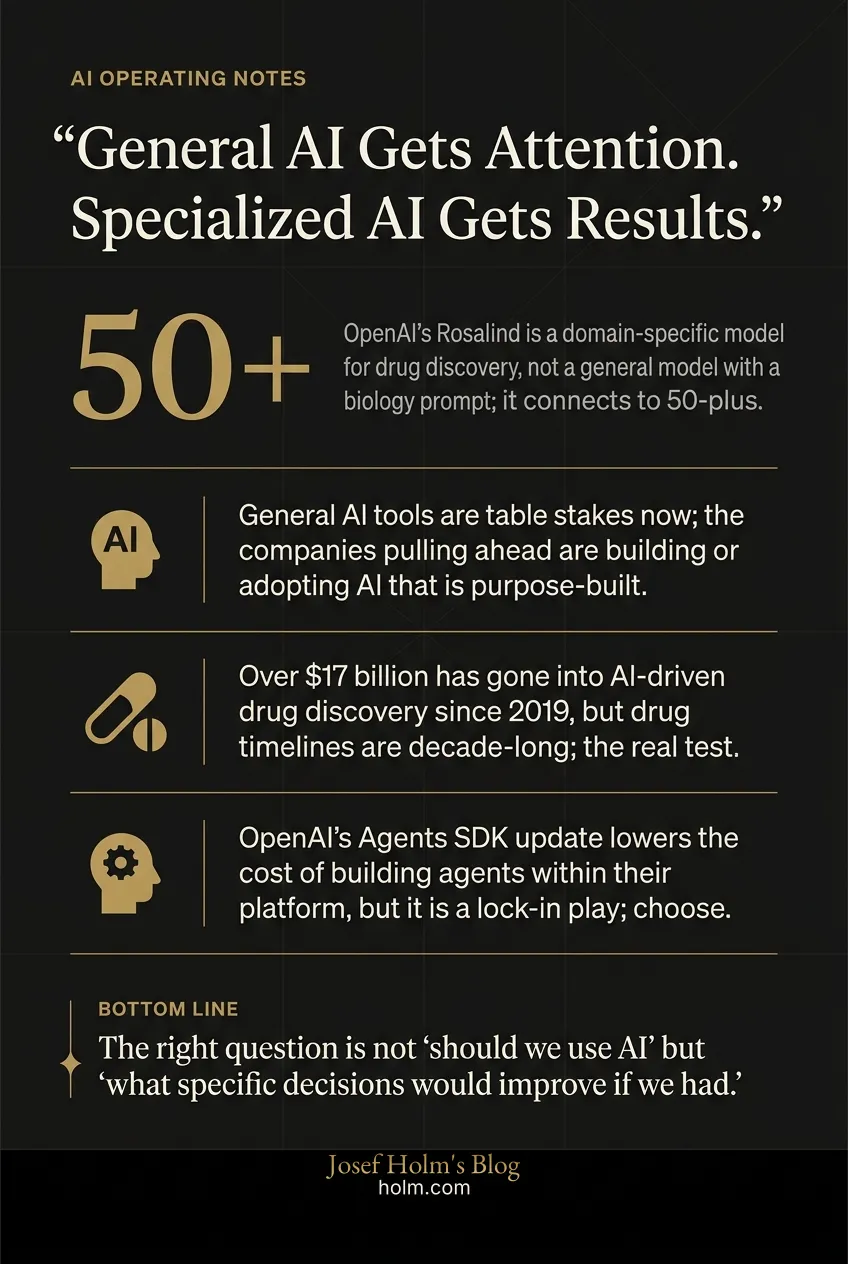
- OpenAI's Rosalind is a domain-specific model for drug discovery, not a general model with a biology prompt; it connects to 50-plus scientific tools and already outperforms human experts above the 95th percentile on real data.
- General AI tools are table stakes now; the companies pulling ahead are building or adopting AI that is purpose-built for their specific domain and connected to their actual data.
- Over $17 billion has gone into AI-driven drug discovery since 2019, but drug timelines are decade-long; the real test is whether AI is producing better candidates faster at the front end, and early benchmarks say yes.
- OpenAI's Agents SDK update lowers the cost of building agents within their platform, but it is a lock-in play; choose your infrastructure architecture deliberately, not by default.
- The right question is not 'should we use AI' but 'what specific decisions would improve if we had better synthesis of the information we already have.' That reframe changes everything.
The Real Signal in OpenAI's Life Sciences Push
Most of the AI conversation right now is about chatbots, code generation, and who has the best reasoning benchmark. OpenAI just made a move that tells you where the actual value is heading.
They released Rosalind, a purpose-built model for life sciences and drug discovery. Not a general model with a biology prompt. A model designed from the ground up for biochemistry, genomics, protein engineering, and translational medicine. It connects to over 50 scientific tools and data sources through a research plug-in for Codex, and it's already being used by Amgen, Moderna, Thermo Fisher Scientific, Novo Nordisk, and the Allen Institute.
Pay attention to this. Not because it's flashy, but because of what it signals about where AI creates real economic value versus where it just creates noise.
Why does a specialized AI model matter more than a better general one?
I've watched three decades of technology cycles, and the pattern holds every time. General-purpose tools get all the attention early. Specialized tools create all the value later.
Drug discovery is a perfect example. Moving from initial target discovery to regulatory approval in the US currently takes 10 to 15 years. Most of that time is front-loaded. Researchers spend years just figuring out what's worth testing, sifting through mountains of literature, experimental results, databases, and evolving hypotheses before a single meaningful trial begins.
Rosalind is built to compress that early phase. It synthesizes evidence, generates hypotheses, plans experiments, and handles multi-step research tasks across molecules, proteins, genes, biological pathways, and disease systems. In evaluations using real, unpublished RNA sequence data from Dynotherapeutics, the model's best outputs ranked above the 95th percentile of human experts for prediction tasks and around the 84th percentile for sequence generation.
Those aren't toy benchmarks. That's performance against working scientists on real data.
Here's what most people miss: the value isn't in replacing researchers. It's in changing what a researcher can accomplish in a given week. Compress the hypothesis generation and evidence synthesis phase by even 30%, and that compounds across every downstream step in the pipeline. The math gets interesting fast.
Is this actually working, or is it another hype cycle for pharma?
Fair question. Since 2019, more than $17 billion has been invested into AI-driven drug discovery. No AI-developed drugs have reached large-scale clinical trials yet. That's the honest picture.
But I think people are framing this wrong. The absence of an approved drug isn't evidence that AI isn't working inside the pipeline. Drug development operates on decade-long timescales. Investments from 2019 to 2022 are still working through early-stage research. What matters now is whether the tools are producing better candidates faster at the front end.
The benchmarks suggest Rosalind is doing exactly that. On BixBench, which tests real-world bioinformatics and data analysis tasks, it outperforms other models with published scores. On LabBench 2, covering literature retrieval, sequence manipulation, and experimental design, it beats GPT-4.5 on 6 out of 11 tasks.
More importantly, OpenAI isn't releasing this to the public. It's a research preview through a trusted access program, restricted to qualified organizations with strict controls around governance and safety. When a company restricts access to proven institutions rather than chasing adoption numbers, they're improving for credibility. That tells you something about their seriousness here.
What should business leaders take from this if they're not in pharma?
The pattern Rosalind represents matters far beyond life sciences. General AI gets you general results. The companies pulling ahead are the ones building or adopting AI that's purpose-built for their specific domain.
This is something we see constantly in our work at Josef Holm. When we conduct an AI readiness note for a client, the first thing we look at isn't what AI tools they're using. It's whether those tools are actually matched to the decisions they need to make. Most aren't.
The Rosalind approach connects a specialized model to domain-specific tools, databases, and workflows. That's the architecture that produces results. Not a general chatbot with a clever prompt, not a dashboard that summarizes things you already know. An orchestration layer that moves across your actual systems and combines insights in ways your team couldn't do manually.
If you're a mid-market operator trying to figure out where AI fits, here's the mental model that matters. Stop asking "should we use AI?" Start asking "what specific decisions would improve if we had better synthesis of the information we already have?" That reframe changes everything about how you evaluate your options.
What about the cybersecurity model?
OpenAI also released GPT-4.5 Cyber, a model built specifically for defensive security work. Some standard content restrictions have been relaxed for verified security professionals, allowing them to analyze compiled software directly without source code, identify vulnerabilities, and investigate threats.
Same principle, different domain. General models are deliberately restricted from doing deep security analysis because those capabilities could be misused. A specialized model with verified access controls can be more capable precisely because it's more restricted in who can use it.
The access model here is worth noting. OpenAI is using identity verification and a tiered access program rather than limiting it to a handful of partners. This contrasts with Anthropic's approach, where their comparable capability reportedly hasn't been publicly released due to safety concerns, with access limited to a small closed group including AWS, Apple, Google, Microsoft, and CrowdStrike.
OpenAI's bet is that democratized access with verification beats restricted access with exclusivity. I think they're right about this for defensive work specifically. The attackers don't wait for permission. Defenders shouldn't have to either.
The numbers back it up. Through Codex Security, OpenAI has contributed to fixing more than 3,000 critical and high-severity vulnerabilities, and over 1,000 open-source projects have received free security scans through their Codex for Open Source program.
What does the Agents SDK update mean for enterprise teams?
The third release, updates to OpenAI's Agents SDK, is the least dramatic of the week. It may also be the most consequential for enterprise operators.
The update adds a model-native apply for agents to work across files and tools directly on a computer, a sandbox environment for execution, and configurable memory and orchestration systems. Previously, developers had to build and manage all of this infrastructure themselves. That was a real friction point.
This is OpenAI making it easier to build within their platform. That's good for speed. It's also a lock-in play, and being honest about that matters. Companies that prefer provider-agnostic architectures will find this tightly integrated approach less appealing.
The practical question for any leadership team evaluating this: does the speed advantage of a tightly integrated platform outweigh the flexibility cost of being tied to one provider? There's no universal answer. It depends on your team's capabilities, your timeline, and how much you trust any single provider's roadmap over the next few years.
This is exactly the kind of decision where an independent perspective matters. It's why we built Josef Holm OS to help teams think through these trade-offs without the bias of a vendor relationship.
The bigger picture most people are ignoring
The week's news also included a serious incident: an alleged attack on Sam Altman's home involving a Molotov cocktail, followed by an attempted break-in at OpenAI's headquarters. The suspect was found with documents calling for violence against AI executives and investors.
I'm not going to sensationalize this. But it matters as context. AI has moved well beyond a technical conversation. It's shaping public perception, policy debates, and now personal safety. Altman's response was measured: "There needs to be a shift toward less aggressive rhetoric and more constructive discussion."
He's right. And it connects to something I think about a lot.
The gap between what AI is actually doing, compressing drug discovery timelines, fixing security vulnerabilities, improving research workflows, and what the public conversation focuses on, existential risk, job replacement, culture war positioning, is enormous. That gap is dangerous. Not because the concerns aren't real, but because the conversation has become so disconnected from practical reality that it's producing fear without understanding. Fear without understanding leads to bad policy and worse decisions.
So what do you actually do with this?
If you're running a business, here's what this week from OpenAI should clarify.
Specialization is the path to value. General AI tools are table stakes now. The competitive advantage comes from AI that's built for your specific domain, connected to your actual data, and embedded in your real workflows.
Access models matter as much as capabilities. How a tool is deployed, who can use it, what controls exist: these decisions shape outcomes more than raw performance benchmarks do.
The infrastructure layer is consolidating fast. Whether you like it or not, the major providers are making it easier to build within their systems and harder to stay agnostic. Make that choice deliberately, not by default.
If you're not sure where your organization stands on any of these, that's exactly what the AI readiness note is designed to answer. Not with theory. With a clear-eyed assessment of where you are, what's working, and what to do next.
The companies that win the next five years won't be the ones that adopted AI first. They'll be the ones that adopted the right AI for their specific problems. Rosalind is OpenAI showing they understand that distinction. The question is whether you do too.
Infographic
Frequently Asked Questions
- What is OpenAI Rosalind and what does it do?
- Rosalind is a specialized AI model built from the ground up for life sciences and drug discovery. It handles biochemistry, genomics, protein engineering, and translational medicine. It connects to over 50 scientific tools and data sources, synthesizes research evidence, generates hypotheses, and plans multi-step experiments. It is not a general model with a biology prompt. It is purpose-built for the domain.
- How does Rosalind perform compared to human researchers?
- In evaluations using real, unpublished RNA sequence data from Dynotherapeutics, Rosalind's best outputs ranked above the 95th percentile of human experts for prediction tasks and around the 84th percentile for sequence generation. On BixBench, it outperforms other models with published scores. On LabBench 2, it beats GPT-4.5 on 6 out of 11 tasks. These are tests against working scientists on real data, not toy benchmarks.
- Has AI actually produced any approved drugs yet?
- No. Since 2019, over $17 billion has been invested in AI-driven drug discovery and no AI-developed drugs have reached large-scale clinical trials. But drug development runs on decade-long timelines. Investments from 2019 to 2022 are still moving through early-stage research. The more useful question is whether AI is producing better candidates faster at the front end of the pipeline. Current benchmarks suggest it is.
- What should non-pharma business leaders take from the Rosalind announcement?
- The model Rosalind represents applies to any industry. General AI gives you general results. The companies pulling ahead are adopting AI that is purpose-built for their specific domain, connected to their actual data, and embedded in their real workflows. Stop asking whether to use AI. Start asking which specific decisions would improve if you had better synthesis of the information you already have.
- What is GPT-4.5 Cyber and who can use it?
- GPT-4.5 Cyber is a specialized model built for defensive security work. Some standard content restrictions are relaxed for verified security professionals, allowing them to analyze compiled software without source code, identify vulnerabilities, and investigate threats. Access requires identity verification through a tiered program. It is more capable than the general model precisely because it is restricted to verified users.
- What does the OpenAI Agents SDK update mean for enterprise teams?
- The update adds a model-native layer for agents to work across files and tools on a computer, a sandbox for execution, and configurable memory and orchestration. Previously, developers built and managed all of that infrastructure themselves. This lowers the speed cost of building agents within OpenAI's platform. It is also a lock-in play. The key decision for any leadership team is whether the speed advantage outweighs the flexibility cost of being tied to one provider's roadmap.