The OpenClaw Moment Explained
Key Takeaways
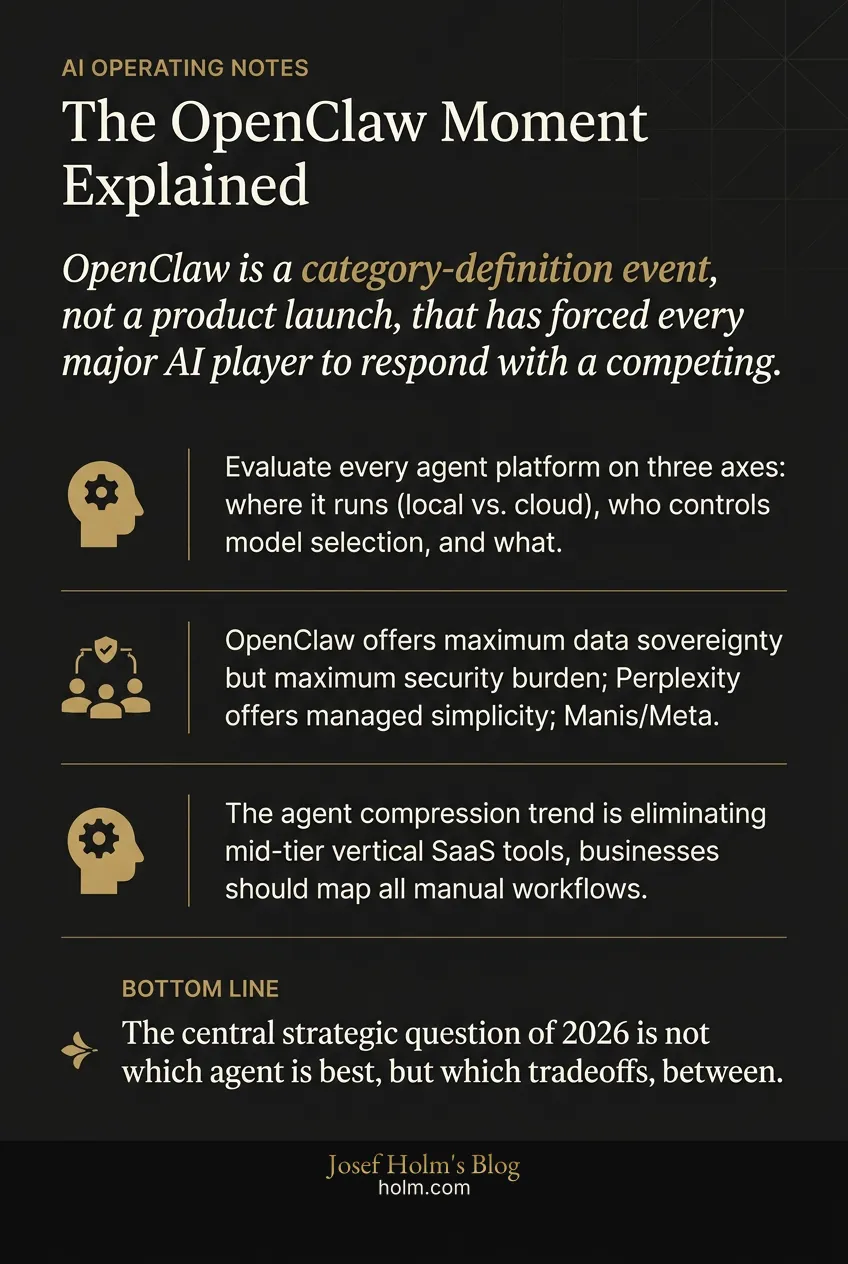
- OpenClaw is a category-definition event, not a product launch, that has forced every major AI player to respond with a competing architecture within weeks.
- Evaluate every agent platform on three axes: where it runs (local vs. cloud), who controls model selection, and what interface behavior it assumes from your team.
- OpenClaw offers maximum data sovereignty but maximum security burden; Perplexity offers managed simplicity; Manis/Meta trades data for low friction; Anthropic Dispatch bets on safety; Lovable bets on depth in a narrow vertical.
- The agent compression trend is eliminating mid-tier vertical SaaS tools, businesses should map all manual workflows now to identify which can be delegated and which represent defensible human-in-the-loop moats.
- The central strategic question of 2026 is not which agent is best, but which tradeoffs, between control, safety, cost, and capability, align with your operational reality and margin goals.
So What Exactly Is the OpenClaw Moment, and Why Should You Care?
Let's be blunt. The last time something this consequential happened in AI, ChatGPT had just landed and every executive on the planet scrambled to figure out what a large language model meant for their P&L. That was roughly two years ago. Now we have OpenClaw, and the scramble looks different this time because the stakes are operational, not theoretical.
OpenClaw is not just another product launch. It is a category definition event. When a product lands with 250,000 GitHub stars and every major technology company on earth responds within days, you are not watching a product cycle. You are watching an infrastructure layer crystallize. And the way that layer shakes out will shape how your business delegates work, manages data, and protects margins for the next decade or two.
The media wants you to follow two stories: who is winning the copycat race, and how badly the security holes could burn you. Both stories are real. Neither story is sufficient. The actual story is strategic, and it requires you to understand the distinct bets each major player is making, what those bets trade away, and which tradeoffs align with your operational reality.
Why Does Every Major Company Have a Different Answer to the Same Problem?
Because they occupy different positions. And position dictates strategy.
Nvidia built Nemo Claw. Jensen Huang compared OpenClaw to Linux, which tells you everything about how Nvidia sees the moment: a foundational layer that will generate demand for their hardware for years. OpenAI acqui-hired Peter and is racing toward its own launch. Meta spent $2 billion acquiring Manis and immediately pivoted it toward OpenClaw-style functionality. Lovable, which reached over $300 million in ARR and was the most copied AI product of 2025, announced expansion into general-purpose agent execution. Open-source forks are multiplying at speed: ZeroClaw rewrote the codebase in Rust, Moltus targets enterprise Rust deployments, Open Fang pitches itself as an agent operating system, and Nanobot out of Hong Kong stripped the entire thing down to 4,000 lines of code.
The parallel to Linux and Android is instructive and precise. When a product defines a category clearly enough, every weakness in its rollout becomes a startup thesis. The original is messy and powerful. The network forms in the gaps.
For business leaders watching this unfold, the lesson is straightforward: stop reacting to each announcement in isolation. Start evaluating each one against a consistent framework.
What Framework Should I Actually Use to Evaluate These Products?
Forget the simple control spectrum the media keeps pushing. It sounds clean. It leads to bad decisions. Three axes matter, and they matter independently of each other.
Axis 1: Where Does the Agent Run?
Local, cloud, or hybrid. This is not an abstract architectural question. It determines your data privacy posture, your security surface area, and who is accountable when something goes wrong. If you are in a regulated industry or handling sensitive customer data, this axis alone eliminates half the options on the market.
Axis 2: Who Orchestrates the Intelligence?
Single model, multi-model put to work, or model-agnostic. This determines your cost structure, output quality ceiling, and degree of vendor lock-in. If you let the platform pick the model, you are outsourcing a decision that directly affects the quality of every output your agent produces. If you insist on picking yourself, you need the technical bench to make that choice wisely.
Axis 3: What Is the Interface Contract?
Messaging app. Desktop app. Phone. This is the axis most executives ignore and the one that most directly predicts adoption. Your teams have habits. Those habits are stubborn. A brilliant agent architecture that requires people to change how they communicate will fail slower than a mediocre one that meets them where they already live.
These three axes give you a coordinate system. Every agent product occupies a specific point in that space. Once you map it, the noise falls away.
How Do the Major Players Actually Compare?
OpenClaw: Maximum Sovereignty, Maximum Burden
OpenClaw runs locally on the user's machine with their own API keys. Fully modular. Any LLM, any messaging platform (Telegram, WhatsApp, Signal, Slack), any component swappable. The core thesis is data sovereignty and user control.
The operational burden is real. Researchers have found over 30,000 publicly exposed instances with weak or missing authentication. The skills registry suffered a supply chain attack with over 800 compromised skills documented. If you deploy OpenClaw, you own your security posture entirely. There is no vendor to call.
For organizations with strong engineering teams and strict data governance requirements, this is the right answer. For everyone else, it is a liability dressed up as freedom. Not suitable for non-technical users. Period.
Margin implication: Low direct cost, high indirect cost in engineering time and security overhead. Your margin gain depends entirely on whether you already have the infrastructure team to support it.
Perplexity Computer: Delegate Everything, Trust the Platform
This is the opposite end of the spectrum. Runs entirely in the cloud. You describe an outcome, and the system decomposes it into subtasks autonomously. Perplexity claims capability for very long-running tasks, including multi-month operations. per month.
Perplexity controls model selection and orchestration. You must trust the platform with your data. In response to the gravitational pull of OpenClaw's sovereignty argument, Perplexity also launched a local hard-drive option for users who want more data security. The tension is visible and unresolved. When your product enters a category after product-market fit has already been established by someone else, you end up contorting your positioning to cover ground that was never yours to begin.
Best suited for: Knowledge workers and enterprise teams who want outcome-level work and are willing to trade control for managed infrastructure. If your manual workflows involve research synthesis, long-running analytical projects, or multi-step document generation, this model collapses dozens of human hours into a single delegation prompt.
Margin implication: Predictable cost at $200 per month per seat. The margin question is whether the output quality at that price point justifies removing human labor from the loop. For high-volume knowledge work, the math works quickly.
Manis and Meta: Distribution Above All Else
Manis was the fastest company to reach $100 million. Meta paid $2 billion for it. The strategic rationale is transparent: capture the agent moment and keep users inside the Meta environment where monetization can follow at scale. Manis uses a mix of local Meta models and undisclosed third-party models.
The trust question is interesting. Before the acquisition, the concern was about data flowing to Chinese ownership. Now the concern is about Meta's own data practices. The shape of the anxiety changed. Its intensity did not.
Best suited for: Consumers and small businesses who want agent capability without technical setup and who are already comfortable operating within Meta's system. If your team lives in WhatsApp or Instagram for customer communication, this is the path of least behavioral resistance.
Not suitable for: Developers wanting model flexibility. Enterprises with data privacy concerns. Anyone whose compliance team would object to Meta having access to operational workflows.
Margin implication: Lowest barrier to entry. The cost is not financial. It is informational. You are paying with data access, and whether that cost is acceptable depends on your industry, your customers, and your tolerance for platform dependency.
Anthropic Dispatch: Safety as Strategy
Anthropic built Dispatch to let you message Claude from your phone and drive activity on your desktop via a co-work terminal with a dispatch interface. There is also a Telegram option for Claude Code. The pitch is simple: OpenClaw has safety concerns, and Claude is the secure, single-threaded alternative.
No multi-model routing. No simultaneous agent instances. Anthropic is treating OpenClaw's disintermediation pressure as a brand reinforcement opportunity rather than a threat. That is a bold bet. It only works if enough users value safety and simplicity over power and flexibility.
Best suited for: Non-technical professionals already using Claude who want a simpler, safer path to agentic workflows. Think legal teams, compliance officers, executives who want to automate personal workflows without touching infrastructure.
Not suitable for: Anyone who needs complex multi-model orchestration or wants to run parallel agent processes. The ceiling here is low by design.
Margin implication: Minimal operational burden. The tradeoff is capability ceiling. You automate simple workflows cheaply and safely, but you hit walls fast on anything complex.
Lovable: Going Deep When Everyone Else Goes Wide
Lovable's trajectory is fascinating. A vibe coding tool that crossed $300 million ARR. On March 19, 2026, it announced expansion beyond website building into general-purpose complex execution. The challenge is structural: Lovable's interface was built around human-typed prompts, and the market is moving toward agent-first, human-initiated agentic workflows.
Lovable must hold a large devoted user base while evolving toward a higher level of abstraction. That is an exceptionally difficult product management problem. The bet is depth over breadth: competing on specific capability that no general-purpose agent can replicate, rather than trying to be everything.
Margin implication: If your business runs on rapid prototyping and deployment of web applications, Lovable's depth could collapse weeks of development into hours. Outside that vertical, the value proposition thins rapidly.
Where Do All These Bets Land on the Same Map?
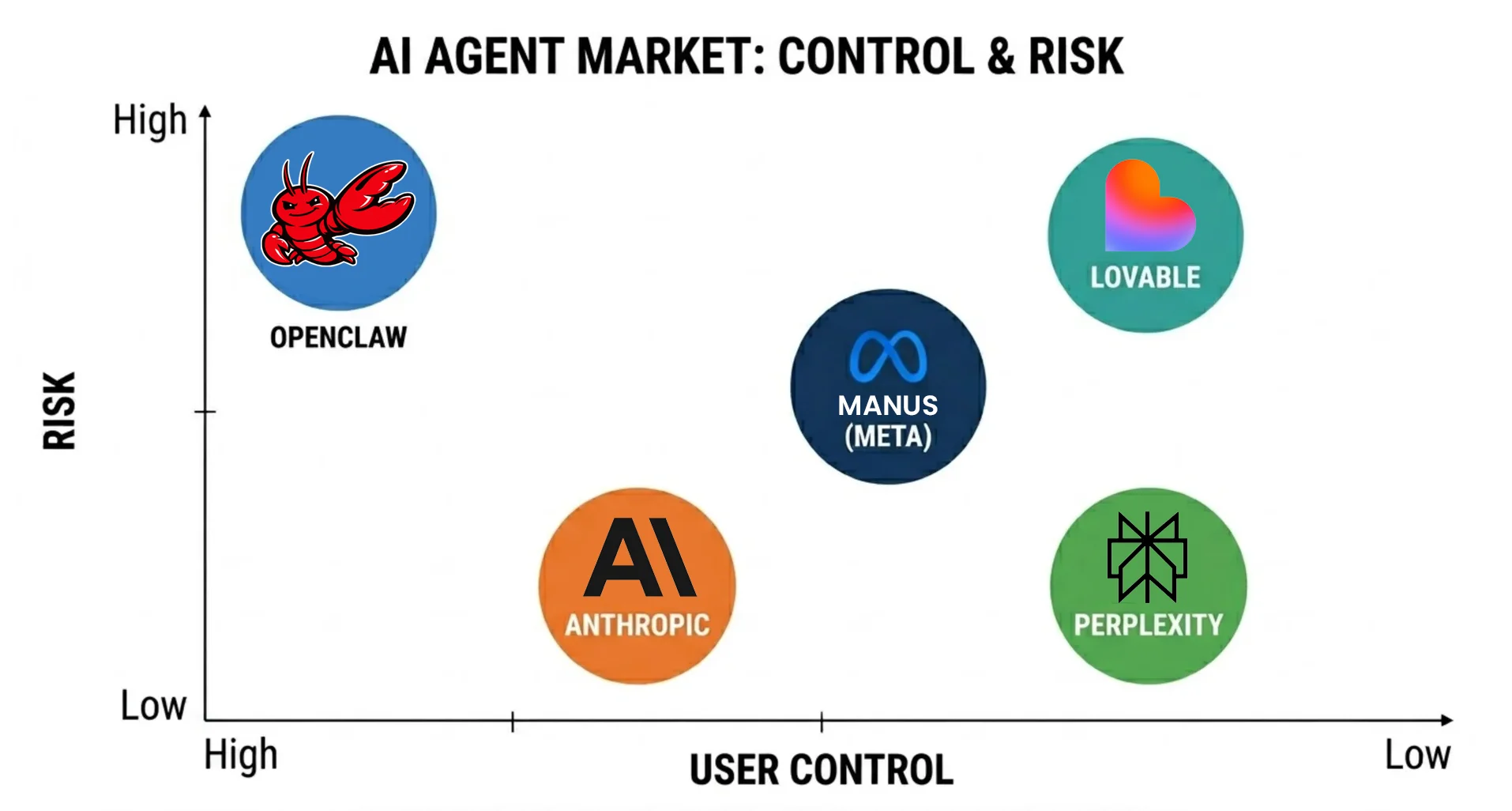
Plot them on two axes: technical complexity and risk on one side, user control on the other.
OpenClaw sits at the maximum on both. Maximum flexibility. Maximum risk. Maximum operational burden. If you can handle it, nothing else gives you this much power.
Perplexity occupies the opposite corner. Low technical risk, low user control. Professional-grade managed infrastructure for people who want results without architecture decisions.
Manis lands in the middle on both axes, with data privacy as a third dimension that pulls it in uncomfortable directions depending on your perspective.
Dispatch from Anthropic sits at low technical complexity with moderate user control. It is positioned for the technically literate professional who is not a developer.
Lovable occupies its own island: very low technical complexity, high user control, but narrowly scoped.
The essential insight is that OpenClaw set the terms. It defined the axes. It staked out the maximum sovereignty position. Every other player is now competing on a graph that OpenClaw drew. That is what category definition looks like. And that is why this is the most large inflection point since ChatGPT.
What Is the Core Thesis for 2026, and What Does It Mean for My Business?
Agents are compressing the interface layer. Every vertical tool you use today (app builders, analytics platforms, document generators, scheduling systems, CRM workflows) is under pressure to collapse into a single conversational agent. This is not speculation. It is the observable direction of every major product announcement in 2026.
The products that survive this compression will do one of two things. They will go deep enough to possess specific capability unavailable anywhere else. Or they will become general enough to serve as a default delegation layer.
The middle is death. Tools that are good but not top-tier, not general enough for general-purpose use, will get absorbed or abandoned. If your current tech stack is full of mid-tier vertical tools, start planning their replacement now. The window for graceful migration is measured in quarters, not years.
For your manual workflows, the question is stark: which ones can you delegate to an agent today, and which ones require a human in the loop for reasons of judgment, compliance, or customer trust? Map every workflow against those two categories. The ones you can delegate represent direct margin expansion. The ones you cannot represent your competitive moat, and you should be investing in making them better, not cheaper.
How Should I Evaluate the Next Agent Product That Launches?
Three questions. Ask them every time.
Where does it run? If you handle sensitive data, if you operate in a regulated industry, if your customers care about where their information lives, this question eliminates options fast. Do not compromise on this axis for convenience.
Do you care who picks the model? If output quality is a differentiator for your business, you need control over model selection. Delegating that to a platform means accepting whatever quality and cost tradeoffs they refine for, which may not align with yours.
What does the interface assume about you? Be brutally honest here. Will your team actually change their communication habits to use a new tool? If the answer is no, pick the agent that meets them in the messaging platform they already use. If that option does not exist today for your preferred platform, wait a week. The pace of development makes that a reasonable expectation, not a joke.
What Is Really at Stake Here?
How agents evolve in 2026 will shape commerce for the next 10 to 20 years. That is not hyperbole. It is the structural consequence of a technology that can autonomously execute complex multi-step workflows at a fraction of the cost and time of human labor.
The central question is not which agent is best. The central question is how we delegate agentic trust. Which companies and platforms are you willing to trust with your data and your workflows? What are you willing to trade away in exchange for convenience, safety, or capability? These are not technical questions. They are strategic ones with decade-long consequences.
Understanding the bets behind each product gives you a lens that the horse-race narrative and the security-panic narrative cannot provide. The horse race tells you who is ahead today. The security story tells you what could go wrong. Neither tells you which tradeoffs align with your operational reality, your margin goals, and the workflows you need to automate in the next six months.
That alignment is the only thing that matters. Everything else is noise.
Infographic
Frequently Asked Questions
- What is OpenClaw and why is it big?
- OpenClaw is an AI agent platform that has been described as a category-definition event, comparable to the launch of ChatGPT. It accumulated 250,000 GitHub stars and prompted rapid competitive responses from Nvidia, OpenAI, Meta, Perplexity, Anthropic, and Lovable. Its core thesis is data sovereignty, running locally on a user's machine with full modularity, which has set the terms for how the entire industry frames AI agent architecture.
- How does OpenClaw compare to Perplexity Computer?
- OpenClaw runs locally and gives users maximum control, but requires strong engineering teams to manage its security posture. Perplexity Computer is the opposite: a fully cloud-managed platform /month where Perplexity controls model selection and orchestration. OpenClaw suits organizations with strict data governance; Perplexity suits knowledge workers who want outcome-level delegation without managing infrastructure.
- Is Anthropic Dispatch safe for non-technical enterprise users?
- Yes. Anthropic Dispatch is specifically designed for technically literate professionals who are not developers, such as legal teams, compliance officers, and executives. It offers a simpler, safer path to agentic workflows via phone and desktop with no multi-model routing or parallel agent instances. The tradeoff is a low capability ceiling, it handles simple workflow automation well but hits limits quickly on complex, multi-step tasks.
- What happened when Meta acquired Manis?
- Meta acquired Manis for $2 billion and pivoted it toward OpenClaw-style agent functionality. The strategic rationale was to capture the agent moment and retain users inside Meta's monetization system. The acquisition shifted the primary data-trust concern from Chinese ownership to Meta's own data practices, but the intensity of that concern among enterprise and regulated-industry users remained high.
- How should a business leader evaluate any new AI agent product?
- Ask three questions: Where does the agent run, local, cloud, or hybrid, and does that match your data privacy and compliance requirements? Who controls model selection, and does delegating that to the platform risk output quality you can't afford to lose? What does the interface assume about your team's habits, and will they actually adopt it without a behavioral change mandate? These three axes cut through marketing noise and expose the real tradeoffs.
- What does the AI agent space mean for SaaS tools in 2026?
- Agents are compressing the interface layer, putting pressure on every vertical SaaS tool, from analytics platforms to CRM workflows, to be absorbed into general-purpose conversational agents. Tools that survive will either go deep enough to offer unique, irreplaceable capability in a specific vertical, or become broad enough to serve as a default delegation layer. Mid-tier tools that are neither top-tier nor general-purpose face absorption or abandonment, and businesses should plan migrations in quarters, not years.