Josef Holm's Blog
Personal essays and notes on technology, AI, company building, investing, and the lessons that stay useful.
Your Content Calendar Is Not an Acquisition Plan
A content calendar coordinates publication. Customer acquisition is a different job, and AI is making the confusion more expensive, not less.
Why an AI Prototype Is Not a Company
AI made prototypes cheap. It did not make reliable products, trusted distribution, or durable companies cheap. What founders keep skipping.
What Stripe Saw Before It Paid $7.5B for a Router
Stripe paid 6x in ninety days for OpenRouter and told investors the base case changed. What a firm sitting under $2T in payment flow saw first.

Why 96% of Your AI Bill Is Rereading Old Tokens
One operator moved 3.77B tokens in a day. 3.59B were reused input. Why AI bills climb when usage feels flat, and the operator move that flips it.
US AI Dominance is Over: Here's Why
DeepSeek, Kimi, Qwen, GLM, and MiniMax share a country. Not a price, license, or use. Why bundling them into one decision costs operators money.
The AI Context War Just Started, and Most Firms Will Lose
OpenAI slowed. Apple, Anthropic, and OpenAI now race on context, not intelligence. AI Fragmentation is why mid-market firms cannot compete.
The Agent That Runs the Other Agents
The smartest AI agent in your stack is worth nothing if it cannot tell the others what changed. The loop above the loops is the only one that.
The Two-Year AI Liability Vacuum Just Closed
Munich ruled Google owns what its AI says. Mississippi sanctioned lawyers for AI briefs. If AI output leaves your firm, you own it.
Anthropic Caught Throttling Claude Fable 5
Anthropic's Fable 5 walkback exposed a supplier-risk category most AI contracts never priced. What operators should change before the next one.
Klarna Saved $60M and Lost the Thing That Mattered
Klarna's AI did the work of 853 people and saved $60M. Then they started rehiring. Why intent engineering is the AI discipline almost nobody has.

When the Customer Is an AI Agent, Not a Human
The internet's customer is shifting from human to AI agent. Two internets are forming. The firms that only build for the first one will disappear.
87% Of Consultants Got Worse At Their Job With AI
Harvard tracked 244 BCG consultants using AI. 87% got measurably worse at the job while feeling faster. The pattern most mid-market firms are buying.
The AI Confidence Problem Has a Price Tag
Mid-market firms are running AI on public models. The output feels sharp. The judgment underneath it is getting worse. Here's what it costs.
Five Ways AI Use Is Getting People Fired Right Now
Shadow AI, hallucination laundering, zombie agents. Five failure modes ending careers at mid-market firms this quarter, not in 2028.
The Federal Org Chart Is Now Your Problem
The UAE federal government published its five-track Agentic AI rollout. In 24 months your firm will transact with it. Here's what that means.
Why Sullivan and Cromwell Filed Fake Citations
Sullivan and Cromwell's hallucinated citations were not a prompt failure. They were a project-room failure. Here is the fix operators can run this quarter.
The UAE Government is Buying Judgment. Why is the Private Sector Only Buying Software?
The UAE federal government signed a partnership to train 80,000 employees as Agentic AI experts. Mid-market operators are running the opposite play.
The UAE Agentic AI Mandate Has a 24-Month Clock
The UAE mandated 50% of federal services on Agentic AI by April 2028, and Dubai extended it to the private sector. Most mid-market firms misread it.
Your AI Prompt Library Is Already a Museum Piece
Frontier models broke your prompt library. The skill now is briefing AI like a senior partner, and most mid-market firms have no one who owns it.
The AI Token Bill Nobody Wants on the Page
Frontier AI tokens are getting more expensive, not cheaper. What that does to a mid-market P&L, and the move when the cost curve isn't on your side.
The AI Fight Isn't About Models. It's the Wrapper.
A COO had eleven AI tools and no owner. The fight isn't which model wins. It's the rollout layer that wraps around them. Six components, named.
Karpathy's Four AI Problems Are Your Firm's Too
Karpathy named four problems with current LLMs. A CLAUDE.md file fixed them. Your firm has the same four problems running unconstrained across every team.
The Prove-It Economy Lands at the Partner's Desk
DIFC wealth firms are losing mandates before the first meeting because an agent averaged them out. Truth layer, decision layer, one map.
Why 40% of Agentic AI Projects Will Be Killed by 2027
Gartner says 40% of agentic AI projects will be shut down by 2027. The tech isn't the problem. The investment logic is. Here's how to fix it.
The SaaSpocalypse: Stop Selling Shovels, Sell Holes
The S&P Software Index fell 13% in a day. Seat is dying. The next decacorns won't sell tools. They'll sell finished work.
AI Confidentiality for Regulated Firms After Hepner
Hepner moved AI confidentiality from theory to discovery. The four surfaces where AI breaks confidentiality and the four-artifact fix for regulated firms.
Data Sovereignty for DIFC Firms Running AI
Where AI breaks data sovereignty inside regulated UAE and DIFC firms, and the four-artifact framework that installs the line LPs and regulators can read.
What Is Shadow AI? A Managing Partner's Read on the Risk Sitting Inside Your Firm
The firm thought it ran 2 AI tools. The real number was 27. What Shadow AI is, why it threatens regulated firms, and the governance line that fixes it.
The AI Labs Just Admitted The Model Can't Ship Itself
Anthropic raised $1.5B and OpenAI stood up $14B to put humans inside enterprises. The FDE boom is a confession, not a victory lap. Here's what to do.
Talk Like a Caveman: The Claude Code Skill That Cuts Tokens by 65%
A 19-year-old's open-source Caveman skill strips fluff from Claude Code output and cuts tokens 65%. Why brevity actually makes models smarter.
Why AI Agents Need Meaning, Not More Access
Computer use is a bridge. The real moat is the semantic layer: what the agent understands once it gets there. Here is how to tell the two apart.
Your AI Agents Are Brilliant Goldfish
Most AI agents in production have no memory, no identity, no audit trail. The fix isn't a smarter model. It's an operating system underneath.
You're Wasting 40% of Your AI Time on Copy-Paste
Most teams burn 30 to 40 percent of AI time being human glue between tools. The fix isn't a smarter model. It's prompts, skills, plugins, MCPs.
What an AI Native Business Actually Looks Like
AI as a tool plateaus in weeks. AI as the layer your company runs on compounds. Here is what changes, and the playbook to get there.
The Real Reason Google Gave Gemma 4 Away
Google didn't release Gemma 4 out of generosity. The AI market split into two tiers, and Google is the only lab that can win in both.
Why AI Agents Made You Middle Management
Today's AI agents have the capability but not the intuition. Here's why managing them feels like a second job, and what real proactivity looks like.
Half of US Companies Just Fired the Wrong Managers
Management is three jobs bundled into one title. Only one is automatable. Most 2025 layoffs are about to hit a wall in 18 months. Here's why.

The UAE Just Bet the Country on Compute
Abu Dhabi locked in 5 gigawatts, a million NVIDIA chips, and a $30B campus. Why compute is the new oil and most countries will be customers, not operators.
Your Brand Is Being Judged Before the Click
AI assistants give one answer, not ten links. If your brand isn't in it, you lost the buyer before they ever visited your site. Here's the new job.
Stop Vibe Coding: 22 Claude Code Hacks to Build Apps 10x Faster
Most developers run Claude Code at 20% of its capability. 22 hacks to stop vibe coding, manage context, hook tests, and actually ship production code.
The AI Layoff Story Is Mostly Theater
AI-justified layoffs aren't productivity. They're cost-cutting in costume. The numbers on what it does to the remaining workforce are already in.
Why AI Recommends Your Competitor Instead of You
AI visibility is binary. You're recommended or invisible. Why SEO metrics miss it, why smaller brands win, and how the gap compounds month over month.

How Much of Your Last Two Weeks Actually Needed You
Run a ten day audit. Tag every item Theater, Commodity, On the Line, or Durable. The T plus C number is the fraction of your week on thin ice.
AI Didn't Fail at Your Company. It Fragmented.
Most mid-market AI efforts didn't fail. They scattered into six disconnected tools with no owner. Here's the Monday morning fix.
What a AI leadership Actually Does, and When You Need One
A decision framework for mid-market operators evaluating a AI leadership (AI leadership). What the role does, when you need one, when you don't, and how to engage one correctly.
CEOs Are Getting High on Their Own AI Supply
69% of executives use AI less than an hour a week, yet they're driving the loudest AI decisions. That's not strategy. That's theater with a budget.
The $67B Hallucination Killing Enterprise AI
95% of custom enterprise AI projects fail. Hallucinations B in 2024. Here is why the model isn't the problem, and what actually fixes it.
Meta's Keyloggers Aren't About Productivity
Meta is recording employee screens to feed its AI, not to measure work. Here's what the surveillance shift means for every operator right now.
Most Businesses Are Invisible to AI Agents
AI agents can't find messy, gated, or unstructured data. Here's what it takes to make your systems agent readable before your competitors do.
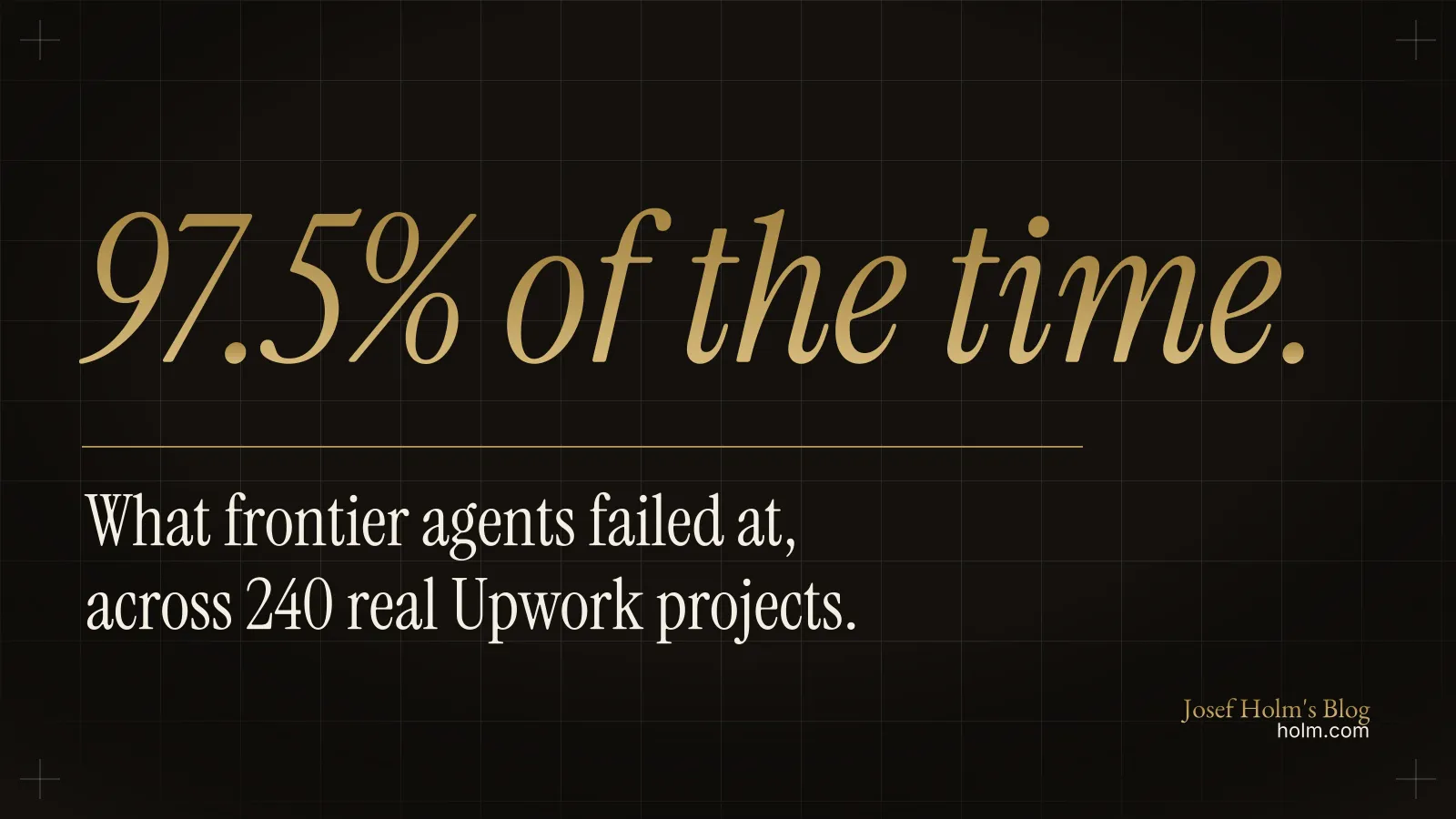
Why AI Agents Fail 97.5% of Real Client Work
Frontier agents fail 97.5% of real Upwork jobs while acing benchmarks. The missing variable is context, and only humans can encode it.
Five Layers AI Can't Replace No Matter How Good It Gets
AI commoditizes production. The companies that survive own something structural. Here are the five layers that stay valuable as models improve.
Your AI Activity Can Be Used Against You In Court
A federal court ruled AI prompts aren't private. Here's what the Hepner case means for every leader using AI tools on sensitive work.
What AI Productivity Claims Are Actually Selling
The AI replacement narrative serves capital, not workers. Here is what the token leaderboards and productivity claims are really doing, and what to do instead.
The AI Bubble Nobody Wants to Call a Bubble
Circular financing, 95% ROI failure rates, and a 582% stock jump from a name change. Here is what the AI spending numbers actually tell you.
The Hidden Tax of AI Fragmentation
Most mid-market companies are funding productivity theater. Here is what AI sprawl actually costs and how to fix it before it compounds.
18 Claude Code Token Hacks in 18 Minutes
98.5% of Claude Code tokens go to rereading history. Here are 18 practical ways to fix context waste before it kills your allocation.
When Free AI Gets Good Enough to Hurt You
DeepSeek V4 isn't the story. The cost floor dropping again is. Here's what business leaders need to think through before next week.
The Vendor Gap That Exposed Claude Mythos
Anthropic's restricted AI model got accessed through a contractor portal, not a hack. Here's what that means for every company building on AI.

YouTube Targets AI Deepfakes with Expanded Likeness Detection Tool
YouTube built identity protection for celebrities. Your brand is next. Here's what business leaders should do before the deepfake problem hits home.
Why the Big 4 AI Pitch Fails Mid-Market Companies
Big 4 firms sell enterprise AI to mid-market companies. Wrong size, wrong model, wrong math. Here is what actually works for $50M-$1B companies.
General AI Gets Attention. Specialized AI Gets Results.
OpenAI's Rosalind shows where AI creates real value: domain-specific models built for your actual decisions, not general tools with clever prompts.
World Models That Quietly Make You Dumber
Most world models automate information routing but accidentally replace judgment. Here is how each architecture breaks and what to build instead.
Your SEO and Paid Teams Are Costing You Both
Google's AI already treats your site as one system. Most companies still run SEO and paid as silos. Here's what that split is costing you.
Your AI Is Fast. Your Infrastructure Is Not.
Infinite model speed yields only 2-3x gains. The bottleneck is not the model. It is every human-built tool around it. Here is what to fix first.
Why AI Agents Fail Without Organizational Intent
Models aren't your problem. Most AI investments fail because no one told the AI what the company actually wants. Here's what that fix looks like.
Your Team Is Too Big to Ship Anything Right
Most companies fix meetings with tools. The real fix is team size. Here's the math on why five people outperform twenty in the AI era.
LinkedIn Is Scanning Your Browser in Secret
LinkedIn scans 6,000+ browser extensions per visit, matches results to your name and employer, and sends data to third parties. Here is what it means for your business.
Old Work Habits Are Making You Slow
AI flipped the cost of execution. The eight habits that made you successful are now the bottleneck. Here is what to change and why.
AI Frees Your Best People to Leave
Solo founders are outperforming entire teams with AI. Here is what that means for your retention strategy and org design.
AI Agents Are Breaking Microsoft GitHub
AI agents are flooding GitHub with code at 14x last year's volume. Here's what that means for platform economics, reliability, and your software stack.
AI and Cybersecurity: The Speed Has Changed
Anthropic restricted its most capable AI model because it's too dangerous to release. Here's what that means for your security posture right now.

The Gaps Are Closing. Are You Standing on One?
AI is closing the inefficiencies most businesses are built on. Learn which gaps are durable and how to position before the next model release.
The Agent Infrastructure Stack Is Forming Now
Six layers of agent infrastructure are being built right now. Most leaders can't see them. Here's what each layer does and why it matters.
The Anthropic 94% AI Automation Headline Is a Sales Pitch
Anthropic claims 94% of coding jobs face AI automation. Their own data shows 33%. That 61-point gap is what you actually need to understand.
The AI Perception Gap Is Costing You Deals
AI answers your buyers before they reach you. If it gets your brand wrong, you lose deals you never knew existed. Here is how to find and fix the gap.
Is Your Business Invisible to AI Agents?
AI agents are deciding what to buy. If your data isn't structured and readable, your business won't make the list. Here's what to fix and how fast.
9 Reasons AI Initiatives Stall and How to Fix Them
Most AI failures are organizational, not technical. Here are 9 patterns that stall AI adoption and the specific fix for each one.
Claude Code: What the Source Code Reveals
The leaked Claude Code source shows 85 commands, a full agent runtime, and a permission engine. Most users access maybe 10% of it. Here is what to fix.
AI Rebuilt Next.js in a Week for $1,100
Cloudflare rebuilt Next.js with AI in a week for $1,100. Here is what that actually means for software, platform strategy, and your business.
Why Mid-Market AI Integrations Still Fail in 2026
Most mid-market AI projects fail before launch in 2026. Learn why tool-first thinking destroys capital and how a workflow-first approach delivers ROI in weeks.
AI Roadmap for UAE Real Estate Margins
90% of UAE real estate AI projects fail. Learn the workflow-first approach driving 3x-5x ROI across property management, compliance, and leasing.

5 AI Fixes for UAE Property Margin Bleed
78% of UAE property firms face staffing shortages. Discover 5 operational bottlenecks draining SME margins and where AI automation stops the bleeding.
"AI Agent" Has 4 Meanings. Most Teams Pick the Wrong One.
Most teams waste months building the wrong AI agent. Learn the four distinct agent types and how to choose the right architecture for your problem.
The AI Divide: Why Only 5% of Companies Are Actually Profiting from AI
Most enterprise AI investments return nothing. Discover the 7 deadly mistakes, hidden costs, and what disciplined AI adoption actually looks like.
Why Most AI Integrations Fail Before They Start
Mid-market AI integrations fail due to tool-first thinking. Learn how a workflow-first, boutique advisory approach drives ROI in weeks, not years.

WhatsApp AI Cuts Dispatch Time by 97%
How a Dubai property firm eliminated 1,200 hours of manual work and cut dispatch times from 24 hours to 45 minutes using WhatsApp AI automation.
The OpenClaw Moment Explained
OpenClaw is redefining AI agents. Compare OpenClaw, Perplexity, Manis, Anthropic Dispatch, and Lovable to find the right fit for your business.