
The UAE Just Bet the Country on Compute
Key Takeaways
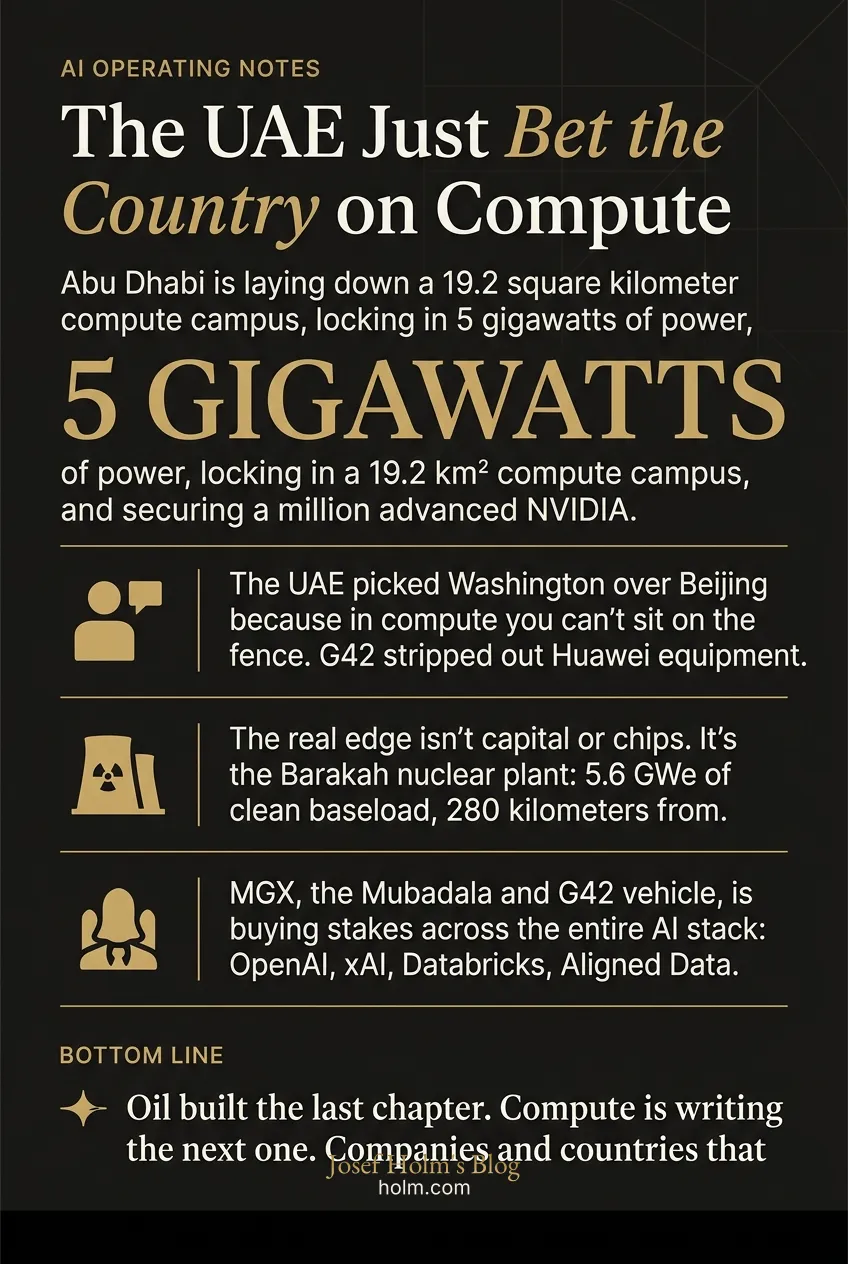
- Abu Dhabi is laying down a 19.2 square kilometer compute campus, locking in 5 gigawatts of power, and securing a million advanced NVIDIA chips while most governments are still drafting white papers.
- The UAE picked Washington over Beijing because in compute you can't sit on the fence. G42 stripped out Huawei equipment and cut ties with ByteDance to get inside the American security perimeter.
- The real edge isn't capital or chips. It's the Barakah nuclear plant: 5.6 GWe of clean baseload, 280 kilometers from the AI zone, on dedicated lines. You can build a data center in 18 months. You can't build a nuclear plant in 18 months.
- MGX, the Mubadala and G42 vehicle, is buying stakes across the entire AI stack: OpenAI, xAI, Databricks, Aligned Data Centers, and around $7 billion into U.S. Stargate itself. The UAE isn't just hosting compute. It's an owner of the global stack.
- Oil built the last chapter. Compute is writing the next one. Companies and countries that understand this in the next 24 months will set the rules. Everyone else will live by them.
The UAE stopped pretending it's a swing state in the AI race. It picked a side, wrote a check most countries can't write, and started pouring concrete.
That's the story. The rest is detail.
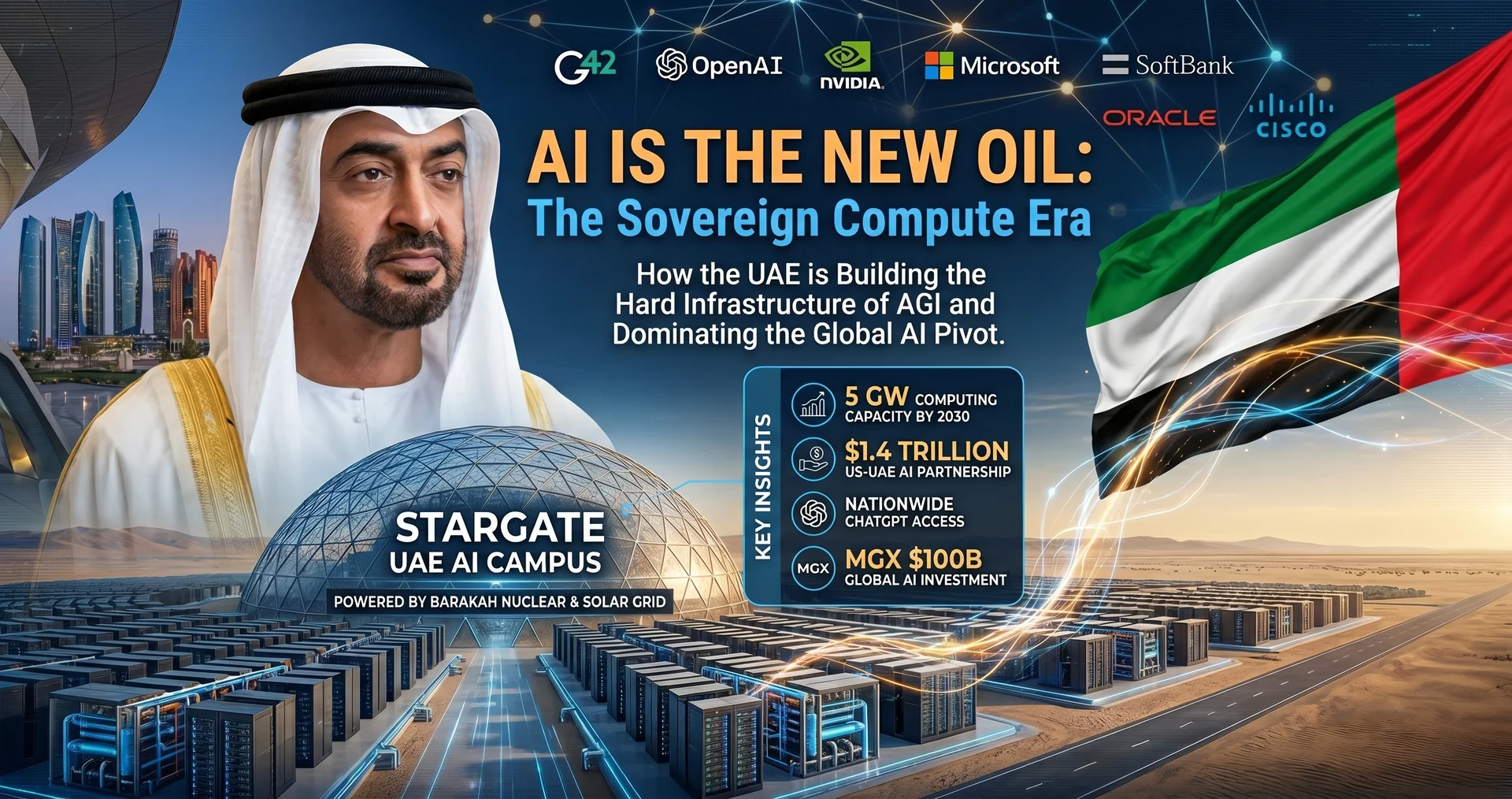
While most governments are still drafting AI white papers and arguing about what "responsible deployment" means, Abu Dhabi is laying down a 19.2 square kilometer compute campus in the desert, locking in 5 gigawatts of power, and securing a million advanced NVIDIA chips. This isn't strategy by committee. It's a country making a bet at industrial scale.
I've watched a lot of national tech strategies come and go. Most are theater. This one isn't.
Why does this matter beyond the Gulf?
Because the floor of the global economy is being rebuilt, and most leaders haven't noticed.
For a hundred years, geopolitical power was tied to who controlled oil. The next hundred will be tied to who controls compute. Not software. Not models. The physical capacity to run them. Power, silicon, cooling, latency, and the regulatory ground underneath all of it.
Here's what most people miss. Software is mobile. You can write it anywhere. But a gigawatt of nuclear baseload sitting 280 kilometers from a million GB300 chips is not mobile. That's a geographic moat. Once it's built, it stays built.
The UAE understood this earlier than almost everyone else. While Europe debated, the Emirates broke ground.
What is Stargate UAE actually doing?
A $30 billion AI campus in Masdar City. Five gigawatts by 2030. Over a million advanced AI accelerator chips. The first 200MW cluster goes live in Q3 2026.
The consortium tells you everything about how this works in practice:
- G42 holds 60% and runs the build
- OpenAI holds 20% and provides the models
- NVIDIA holds 12% and supplies the silicon
- Oracle holds 8% and runs the cloud architecture
- Cisco handles security and networking
- SoftBank provides the financial backbone
This isn't a state project pretending to be a partnership. Every player has skin in the game and a clear job. The UAE provides land, power, capital, and regulatory speed. The Americans bring the technology stack. Capital flows both directions.
That last point is the one most analysts miss.
Why did the UAE pick Washington over Beijing?
Because in compute, you can't sit on the fence. The Americans made that clear, and the UAE listened.
G42 publicly divested from Chinese hardware. Stripped Huawei equipment out of its data centers. Cut capital ties with ByteDance, Honor, and xFusion. The CEO said it plainly: "We cannot work with both sides. We can't."
That's not a diplomatic statement. That's a business decision. To get NVIDIA's most advanced chips, you have to be inside the American security perimeter. The UAE chose the chips.
In return, Washington and Abu Dhabi signed a $1.4 trillion technology investment framework, with roughly 500,000 advanced NVIDIA chips flowing annually to the Emirates through 2030. That volume is enormous. It comes with physical chip trackers, dual-use export controls, and dynamic threat assessments tied to ongoing intelligence cooperation.
This is the new model. Compute access is now a function of alliance posture. If you want frontier silicon, you accept frontier oversight.
Where does the capital come from, and where does it go?
MGX is the answer most people overlook. It's the joint venture between Mubadala and G42, and it's quietly buying foundational stakes across the entire AI stack.
OpenAI's $6.6 billion round at a $157 billion valuation. xAI's $6 billion round. Databricks' $10 billion raise at $62 billion. A $40 billion consortium acquisition of Aligned Data Centers alongside BlackRock's GIP. A $30 billion AI infrastructure fund with BlackRock and Microsoft targeting up to $100 billion in deployment.
Then around $7 billion into the U.S. Stargate project itself.
Read that again. Emirati sovereign capital is helping fund American domestic AI infrastructure. The same infrastructure that protects U.S. national security. That's how deep the integration runs. The UAE isn't just hosting compute. It's an owner of the global stack.
For operators trying to understand where the next decade of enterprise AI capacity actually comes from, this is the map. I wrote about how this reshapes commercial strategy in our work on the AI readiness note, because most companies still plan as if compute is infinite and neutral. It's neither.
What gives the UAE its real edge?
Energy. Not capital. Not chips. Energy.
The Barakah Nuclear Energy Plant provides 5.6 GWe of clean baseload power. It already covers about 25% of the country's electricity. It sits 280 kilometers from the AI zone, connected by dedicated transmission lines. No multi-year grid interconnection queue. No permitting purgatory.
That's the part U.S. and European hyperscalers can't replicate quickly. You can build a data center in 18 months. You can't build a nuclear plant in 18 months. The UAE made that decision a decade ago and is now collecting the dividend.
Add a planned 1.5 GW solar array, utility-scale battery storage, and natural gas turbines for bridging power, and you get a grid designed for AI workloads from the ground up. Stable, redundant, carbon-conscious, and matched to actual demand curves.
Compare that to OpenAI pausing its UK Stargate plan because of European energy costs and regulation. Same company. Same ambition. Different physics on the ground.
What about the threats nobody wants to talk about?
Concentrated compute is a target. That's the cost of being the host.
The UAE reported defending against 500,000 to 700,000 cyberattack attempts per day in early 2026. AI-powered phishing campaigns rose 32% in Q1. Deepfake disinformation operations are now standard. Two AWS data centers in the UAE and one in Bahrain were physically targeted in strikes linked to regional conflict.
This is the new reality. Data centers are frontline infrastructure. The line between civilian and military compute is blurring fast, because modern militaries run on the same commercial GPUs everyone else uses. If you can't compartmentalize the workloads, the whole facility becomes a legitimate target under conflict doctrine.
For business leaders, the takeaway is straightforward. Where your AI workloads physically run is now a security question, not just a procurement question. We've been having this conversation with operators across the Josef Holm OS platform for two years. It's no longer hypothetical.
What does this mean for the rest of us?
A few things matter here.
First, the geography of AI is consolidating faster than most boards understand. By 2030, a small number of compute hubs will dominate global inference. Abu Dhabi will be one. Texas will be another. Most countries will be customers, not operators.
Second, sovereign AI is no longer a slogan. The UAE built the Jais 2 model, a 70-billion parameter Arabic LLM, trained end-to-end on Cerebras hardware. They proved you can develop frontier capability outside the NVIDIA supply chain. That matters for every nation that doesn't want its culture filtered through someone else's foundation model.
Third, the macro impact is real. AI could add $320 billion to the Middle Eastern economy by 2030. The UAE alone expects a 14% boost to its GDP from AI integration. That isn't a forecast pulled from a deck. It's the result of physical infrastructure already under construction.
So what should operators do with this?
Stop treating AI infrastructure as background plumbing. It's foreground strategy.
If you're a CEO or board member, you need to know where your inference runs, who controls that geography, and what happens to your operations if that geography becomes contested. If you're a founder, think hard about which compute axis you're building on top of, because the answer will shape your fundraising, your customers, and your defensibility.
The UAE figured out that compute is the next oil. They're not waiting for permission. They're building.
Companies and countries that understand this in the next 24 months will set the rules. Everyone else will live by them.
If you want to understand what this shift means for your specific operating model, that's the conversation we have every day at Josef Holm. The infrastructure is being built right now. The strategic window for adapting to it is shorter than most people think.
Oil built the last chapter. Compute is writing the next one. The pen is already moving.
Infographic
Frequently Asked Questions
- What is Stargate UAE?
- A $30 billion AI campus in Masdar City, Abu Dhabi. Five gigawatts of power by 2030, over a million advanced AI accelerator chips, and a first 200MW cluster going live in Q3 2026. The consortium includes G42, OpenAI, NVIDIA, Oracle, Cisco, and SoftBank, each with a clear role and skin in the game.
- Why did the UAE cut ties with Chinese tech?
- To get NVIDIA's most advanced chips, you have to be inside the American security perimeter. G42 divested from Chinese hardware, stripped out Huawei equipment, and cut capital ties with ByteDance, Honor, and xFusion. The CEO said it plainly: you can't work with both sides. The UAE chose the chips.
- What gives the UAE its real edge in AI infrastructure?
- Energy. The Barakah Nuclear Energy Plant provides 5.6 GWe of clean baseload power, 280 kilometers from the AI zone, on dedicated transmission lines. You can build a data center in 18 months. You can't build a nuclear plant in 18 months. That decision was made a decade ago and is now paying off.
- Why does this matter for business leaders outside the Gulf?
- By 2030, a small number of compute hubs will dominate global inference. Most countries will be customers, not operators. Where your AI workloads physically run is now a security question, not just a procurement question. If you don't know which compute axis you're building on, you're already behind.
- What is MGX and why does it matter?
- MGX is the joint venture between Mubadala and G42. It's taken stakes in OpenAI, xAI, Databricks, Aligned Data Centers, and the U.S. Stargate project itself. Emirati sovereign capital is now helping fund American domestic AI infrastructure. The UAE isn't just hosting compute. It's an owner of the global stack.
- What are the security risks of concentrated AI compute?
- The UAE reported defending against 500,000 to 700,000 cyberattack attempts per day in early 2026. AI-powered phishing rose 32% in Q1. Two AWS data centers in the UAE and one in Bahrain were physically targeted in strikes tied to regional conflict. Concentrated compute is a target. That's the cost of being the host.