
What a AI leadership Actually Does, and When You Need One
Key Takeaways
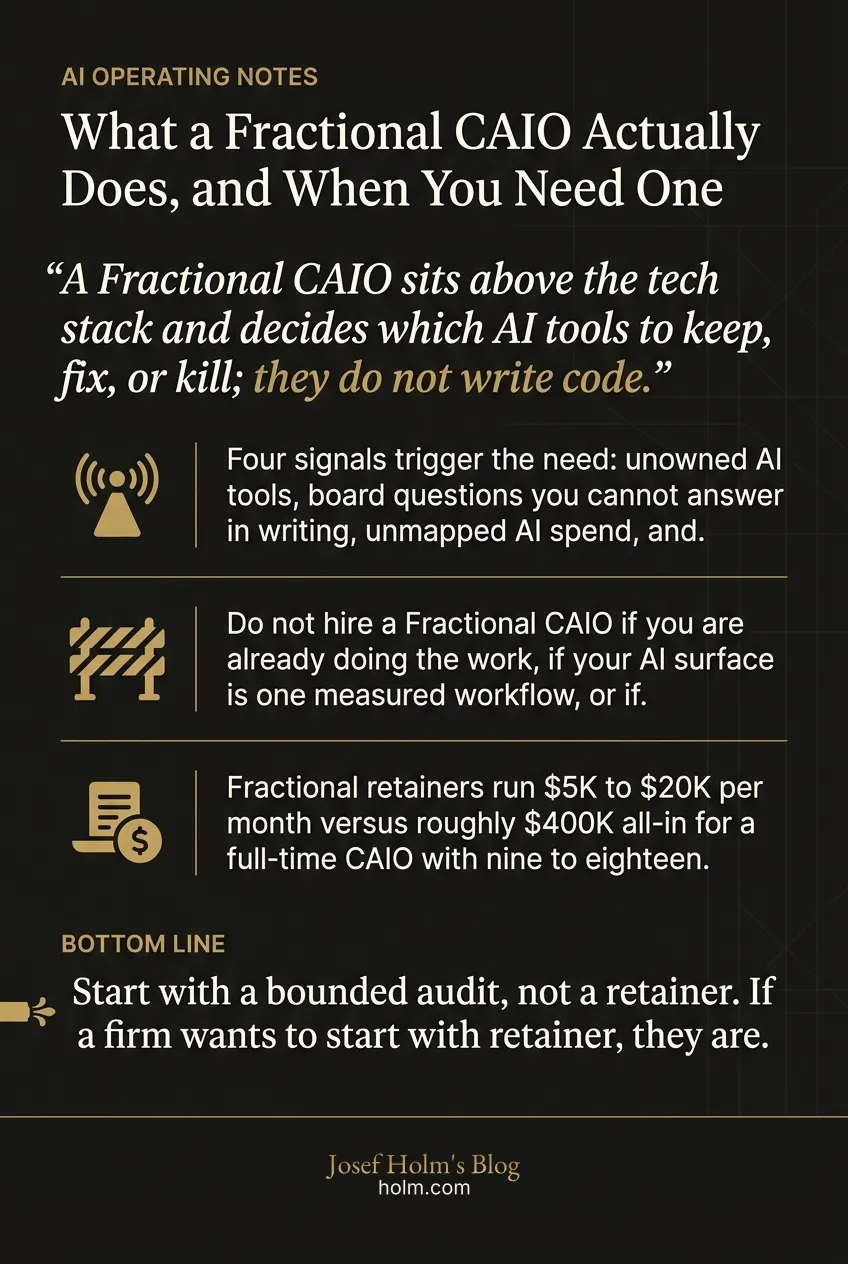
- A AI leadership sits above the tech stack and decides which AI tools to keep, fix, or kill; they do not write code.
- Four signals trigger the need: unowned AI tools, board questions you cannot answer in writing, unmapped AI spend, and rogue sub-team procurement. Two at once means act.
- Do not hire a AI leadership if you are already doing the work, if your AI surface is one measured workflow, or if your executives will not act on what gets surfaced.
- Fractional retainers run $5K to $20K per month versus roughly $400K all-in for a full-time CAIO with nine to eighteen months to ramp.
- Start with a reader note, not a ongoing work. If a firm wants to start with ongoing work, they are selling you their learning curve.
Most CEOs I work with don't go looking for a AI leadership. They get handed the search by their CFO, who spotted six figures in AI subscriptions across the org and asked who owned it. Or by their board, who asked at the last meeting what the AI strategy was and got a ninety-second answer that moved nobody. Or by an internal audit that found tenant data being pasted into ChatGPT for translation work.
The search starts because something specific broke. Then the founder Googles "AI leadership" and lands in a market that's still forming. Different firms mean different things by it. Some sell AI consulting on ongoing work. Some sell fractional CTO services with the AI label glued on top. Some sell governance frameworks. Most don't actually do what the title implies.
Here's what the role is, when mid-market operators need one, when they don't, and how to engage one without paying for someone else's learning curve.
What does a AI leadership actually do?
Define the role by the work, not the title.
A AI leadership sits on the operating layer above the tech stack. They decide which AI tools the business keeps, which it fixes, and which it kills. They own the governance cadence around AI use. Every new vendor pitch gets stress-tested before it hits the budget. They report up to the board on AI spend, governance, and operational impact in a single one-pager that doesn't apologize for itself.
What they don't do: write code, deploy tools themselves, or sit inside the daily build. That's the Fractional CTO job. Different role, different layer.
The simplest test? If the question is "should we?" you need a AI leadership. If the question is "how do we ship?" you need a Fractional CTO or an integration team.
The work compounds across four buckets.
Decision quality. When the head of operations finds a new AI tool and wants to pilot it, the CAIO stress-tests the proposal against the existing operating roadmap. Does this compound with what's already running? Does it create new data exposure? Does it solve the right problem? Most pitches die at this gate, which is exactly the point.
Governance cadence. Quarterly reviews of every AI deployment in the business. What's compounding. What's stalled. What should be retired. Where the next opportunity sits. Documented, owned, dated.
Risk surface. Where confidential client data is being pasted into consumer AI tools. Where automations built by people who left are still running. Where sub-teams run their own subscriptions outside policy. The CAIO surfaces these before they appear in an external audit or a regulator filing.
Board-readable reporting. A one-page document the CEO can take to the board that shows AI spend, governance posture, and operational impact in language a non-technical board chair can interpret.
That's the job. Everything else is consulting under a different label.
When do you actually need one?
Four signals. Any two showing up at the same time is the trigger.
Signal 1: Multiple AI tools running with no single owner. Sales has its own ChatGPT subscription. Marketing has Copilot. Operations has a chatbot the website vendor sold them. Finance has a forecasting tool. Nobody can produce a written inventory of every AI tool in the business this week.
Signal 2: The board is asking questions you can't answer in writing. Not "are we using AI," that's easy. Real question: "Which workflow has AI moved by a measurable amount in the past two quarters?" If the answer is a story rather than a number, the board will ask again. The second time, it's a confidence vote.
Signal 3: AP flagged AI spend nobody can map to outcomes. This is usually the trigger event. The CFO sees AED 80K, AED 200K, sometimes AED 500K in AI subscriptions across the entity, asks who owns the spend, and the answer is fragmented across five teams, none of whom can produce ROI numbers.
Signal 4: Sub-teams are buying tools the COO doesn't know about. Heads of sub-functions are making AI procurement decisions inside their own departments. Each individual decision looks defensible. The aggregate is unmanaged spend with unmeasured exposure.
When two of these show up at the same time, you need senior AI decision capacity in the room. The question is whether to hire it full-time or fractionally.
When do you absolutely not need one?
Three signals where bringing in a AI leadership is the wrong call.
You're a single owner-operator who is technically literate and AI-current. If you can produce the AI inventory yourself, decide what to keep, fix, or kill, and you've already done it, the role is your role. A AI leadership would replace work you're doing well.
AI is one tool used carefully by one team with measured outputs. If your AI surface is one workflow, with one owner, and you can name the metric it moves, fragmentation isn't your problem yet. Solve a different problem first.
No executive willingness to act on what a CAIO would surface. This is the most common reason engagements fail. The AI leadership surfaces three workflows that should be killed, two that should be fixed, and one that should be invested in. If the CEO doesn't want to kill the workflows that should be killed, the engagement is theater. Don't start.
How does this compare to the alternatives?
Full-time CAIO. Total comp at the senior end runs $300K to $500K USD plus equity, six to twelve months to recruit, three to six months to ramp. Right answer for businesses where AI is a year-round operating function with enough decisions per week to fill a calendar. Wrong answer for most mid-market firms whose AI surface generates one big decision per week.
Fractional CTO. Sits at the tech layer, not the operating layer. If you don't have engineering leadership, hire one. They're not a CAIO substitute. The two roles coexist. One doesn't replace the other.
AI consulting ongoing work. Time-boxed engagement that delivers recommendations and exits. Useful for one-time strategy questions. Not useful when the work is ongoing decision-making about new tools, new vendors, and new exposures.
Doing nothing. A real option. If the AI surface is small and the cost is low, the cheapest move is to wait. The risk: small surfaces become large surfaces faster than most leaders expect, because sub-teams keep adding tools.
What does the engagement actually look like?
The cadence runs roughly the same across every well-structured AI leadership engagement.
Month 1. Inventory. Every AI tool, subscription, pilot, and feature in the business written down, with the data each one touches, the owner accountable for it, and the cost. This is the bounded entry point. At Josef Holm, it's called the AI readiness note, and it runs 2 to 6 weeks.
Month 2. Classification. Every tool and workflow gets categorized keep, fix, or kill. Each kept item gets the operating-layer access it needs. Each fixed item gets the data, context, or intent it was missing. Each killed item gets cancelled and the savings redirected. Every item carries an owner, a metric, and a review date.
Month 3 onward. Standing cadence. Quarterly operating review across the entire AI surface. Monthly working session with the executive sponsor. Ad-hoc calls when a new vendor pitch lands or a workflow stalls. From here the CAIO's job is to keep the operating layer healthy and the decisions sharp.
A typical cadence is one to two days a month of CAIO time inside your operation. Some engagements run hotter when the surface is changing fast. Most stabilize.
What does it actually cost?
A full-time CAIO at the senior end of the US market is a $400K all-in commitment per year, before equity. Recruitment takes six to twelve months. Ramp takes three to six months. Total time to operating capacity: nine to eighteen months and roughly $500K spent before the role pays back.
AI leadership retainers in the US and EU markets typically run $5,000 to $20,000 per month. Annual cost: $60K to $240K. Time to operating capacity: weeks, not months.
At Josef Holm, the structure is deliberately bounded. The essay is the AI readiness note at AED 55,000 (Standard tier). That delivers the inventory, the keep/fix/kill classification, and the operating roadmap. From there, most engagements continue into an ongoing operator note relationship, which is Josef Holm's branded version of the AI leadership engagement. for the ongoing relationship is quoted in the audit readout and depends on operating surface, number of entities, and cadence.
The math that matters: a AI leadership that kills two unsanctioned subscriptions in month one usually pays for itself before the audit closes.
What's the right way to engage one?
The mistake most operators make is hiring the AI leadership before doing the audit. The CAIO arrives, spends the first three months doing the inventory, charges ongoing work the entire time, and you've paid full ongoing work rate for what should have been a reader note project.
Flip the sequence. Run the audit as a reader note first. Get the written inventory, the classification, and the roadmap. Then decide whether the ongoing CAIO relationship makes sense based on what the audit found. If the audit surfaces enough operating surface to warrant ongoing capacity, continue. If it doesn't, you have the plan and you exit cleanly with no ongoing work drag.
That's the principle behind how Josef Holm's engagements work. The audit is fixed-scope, bounded, time-boxed. After the readout, you choose one of four paths: continue into an ongoing operating partner relationship, hire integration support, run the plan internally, or do nothing. The audit pays for itself either way.
If you're shopping for a AI leadership and the firm you're talking to wants to start with a ongoing work, walk away. They're selling you their learning curve. Find someone who'll do the audit first.
When should you start?
If two of the four signals above are present in your business right now, the question isn't whether to engage senior AI decision capacity. It's how.
Start with a reader note. Decide whether to continue from there based on what's surfaced. If you want to compare against your operation, the AI readiness note is the entry point, and the application page is where that conversation starts.
Don't hire a ongoing work to tell you what you already half-know. Buy the inventory. Then decide.
Infographic
Frequently Asked Questions
- What does a AI leadership actually do?
- They sit on the operating layer above your tech stack and decide which AI tools to keep, fix, or kill. They own governance cadence, stress-test new vendor pitches, surface risk exposure, and deliver board-readable reporting on AI spend and impact. They do not write code or deploy tools; that is a Fractional CTO's job.
- When do I actually need a AI leadership?
- Watch for four signals: multiple AI tools running with no single owner, board questions you cannot answer in writing, AP flagging AI spend nobody can map to outcomes, and sub-teams buying tools the COO does not know about. When two show up together, you need senior AI decision capacity in the room.
- How is a AI leadership different from a Fractional CTO?
- Different layer, different job. A Fractional CTO sits at the tech layer and answers 'how do we ship?' A AI leadership sits at the operating layer and answers 'should we?' They coexist. One does not replace the other.
- What does a AI leadership cost?
- US and EU retainers typically run $5,000 to $20,000 per month, or $60K to $240K per year. Compare that to a full-time CAIO at roughly $400K all-in before equity, plus nine to eighteen months to reach operating capacity. At Josef Holm, the entry point is the AI readiness note at AED 55,000.
- When should I not hire a AI leadership?
- Three cases: you are a technically literate owner-operator already doing the work; AI is one tool used carefully by one team with measured outputs; or your executive team will not act on what a CAIO surfaces. The third is the most common reason engagements fail.
- What is the right way to engage a AI leadership?
- Start with a reader note, not a ongoing work. Get the inventory, the keep/fix/kill classification, and the roadmap as a fixed-scope project. Then decide whether ongoing CAIO capacity makes sense. If a firm insists on ongoing work from day one, walk away. They are selling you their learning curve.