What AI Productivity Claims Are Actually Selling
Key Takeaways
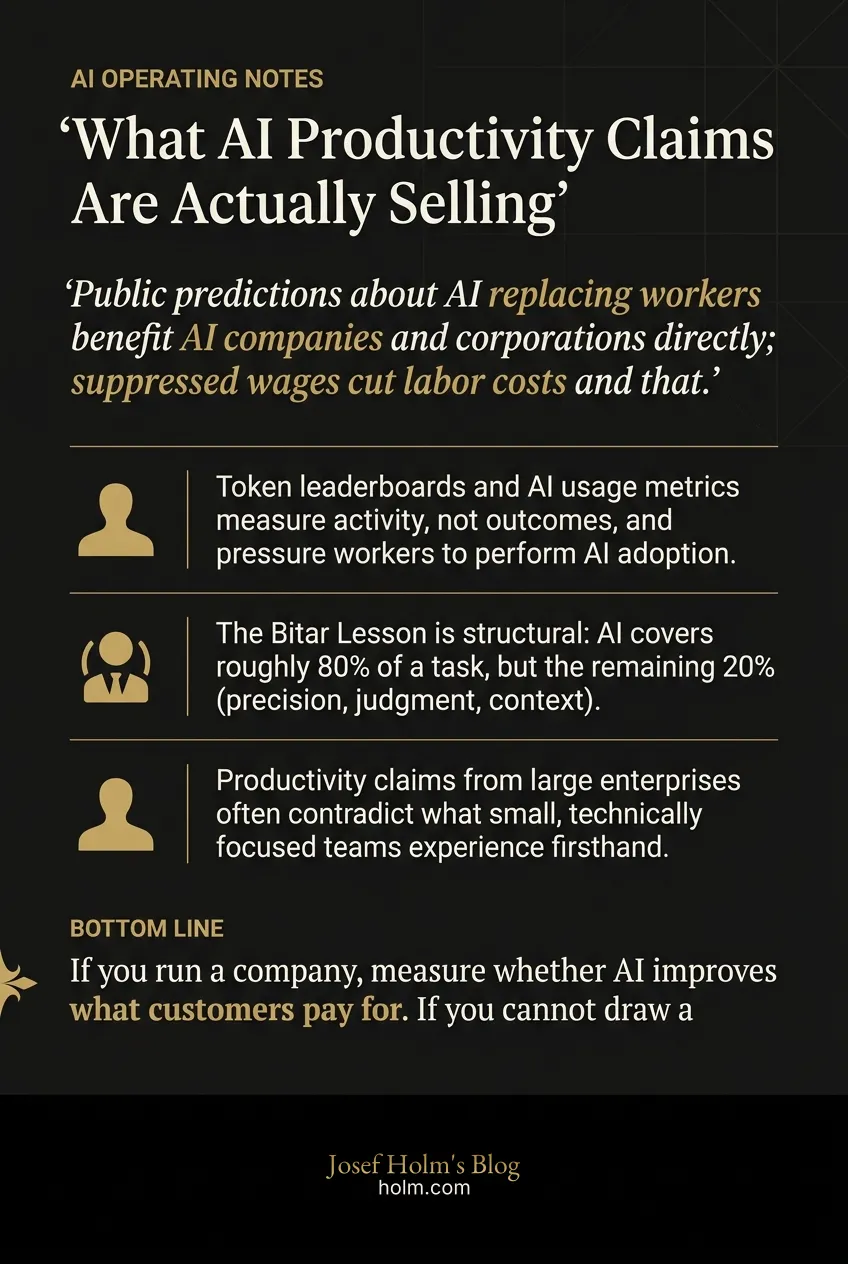
- Public predictions about AI replacing workers benefit AI companies and corporations directly; suppressed wages cut labor costs and that money flows back into AI spending.
- Token leaderboards and AI usage metrics measure activity, not outcomes, and pressure workers to perform AI adoption rather than produce quality work.
- The Bitar Lesson is structural: AI covers roughly 80% of a task, but the remaining 20% (precision, judgment, context) is where most business value lives, and models cannot reliably deliver it.
- Productivity claims from large enterprises often contradict what small, technically focused teams experience firsthand, which should make everyone more skeptical of the narrative.
- If you run a company, measure whether AI improves what customers pay for. If you cannot draw a clear line from AI usage to customer value, you are funding theater.
Most of what you hear about AI replacing workers isn't a prediction. It's a negotiating tactic.
When a CEO of an AI company goes on a podcast and says millions of jobs will disappear in the next few years, that statement isn't neutral. It's not a forecast based on internal data. It's a message designed to land in a specific way, in boardrooms and in the minds of workers who are deciding whether to ask for a raise this quarter.
I've watched this pattern across three technology cycles. The hype always serves someone. The question is who, and what it costs everyone else.
Who benefits when workers believe they're about to be replaced?
The logic isn't complicated. You just have to trace it.
AI executives publicly predict mass job displacement. Workers hear this and get nervous. Nervous workers don't negotiate hard. They accept flat wages, stay quiet, and perform gratitude for still having a seat.
Suppressed wages save corporations real money. Some estimates put the labor cost reduction at 30% over the coming years if the narrative holds. Where does that savings go? Straight into AI spending, which flows directly back to the companies whose executives made the predictions in the first place.
This is a self-reinforcing loop. AI companies, corporate buyers, and investors all benefit from maintaining the story that AI is working, whether or not it actually is. The only group that doesn't benefit is the workforce absorbing the pressure.
I'm not saying every AI executive is cynically manipulating markets. Some genuinely believe what they're saying. But belief and incentive are pointing in the same direction here. That should make everyone more skeptical, not less.
If AI is so productive, why can't the small teams figure it out?
Here's a detail that deserves more attention than it gets. Dax, the founder of Open Code, has said publicly that many companies claim AI is making them more productive while his own small, nimble startup can't figure out how to make it work effectively.
Think about that. A focused technical team, building in the AI space itself, can't reliably extract the productivity gains that Fortune 500 companies with 80,000 employees across 40 time zones claim to be getting.
Something doesn't add up. Either the big companies have cracked something that the people closest to the technology haven't, or the productivity claims are performative. I know which one I'd bet on.
What I see in practice, working with companies across sectors at Josef Holm, is that AI hasn't reduced workload. It's shifted it. Workers now manage what amounts to a second job: reviewing AI output, cleaning up generated code, catching errors, compensating for things the model got almost right but not quite. They're doing this while being paid the same or less, and being told they should be grateful for the "productivity tool."
What happens when you measure AI usage instead of outcomes?
One of the more troubling developments I've seen is the rise of what's being called "token budgets" inside companies. Facebook reportedly runs an internal token leaderboard, ranking employees by how many AI tokens they consume.
This is the kind of metric that looks smart in a board deck and destroys quality on the ground.
The person at the top of that leaderboard is almost certainly reviewing zero actual code. There's an inverse relationship between leaderboard ranking and the quality of work being produced. But the metric exists because it satisfies two audiences at once: investors who want proof the company is "AI-first," and managers who've always wanted a way to track knowledge worker output.
Previous attempts at this failed. Lines of code was a terrible metric. Screen monitoring was invasive and unreliable. Token consumption is the new version of the same bad idea. It feels modern. It feels quantifiable. And it's just as misleading as everything that came before it.
Nvidia's Jensen Huang has said that employees who aren't spending $250,000 per year on tokens aren't being productive. That's not a productivity standard. That's a consumption target dressed up as a performance expectation. It pressures workers to perform AI usage rather than produce quality work.
When you measure activity instead of outcomes, you get more activity and worse outcomes. This isn't new. But the AI framing makes it feel new, which is why people aren't pushing back hard enough.
Why does precision break the AI productivity story?
There's a concept making the rounds that captures something real. Some are calling it "the Bitar Lesson," a deliberate play on the well-known "Bitter Lesson" from AI research. The principle is simple:
The more precision you need, the less useful AI is.
This isn't a temporary limitation waiting to be solved by the next model release. It's structural.
Large language models approximate language. Language approximates intent. That approximation is then used to approximate a final output, whether that's code, writing, analysis, or design. Each layer introduces a gap. The gaps compound.
So in practice, AI can get you roughly 80% of the way through a task. But that 80% was always the easy part. The remaining 20%, the precise, high-stakes, judgment-dependent work, stays with humans. And that last 20% is where most of the value lives.
This is why I keep telling the executives I work with through our AI readiness note process: don't plan your headcount around what AI demos can do. Plan it around what your business actually requires, which is almost always precision, context, and judgment that models can't reliably deliver.
Better models will push the 80% line a bit further. They won't eliminate the gap. Organizations that plan as if the gap doesn't exist will spend the next three years cleaning up the mess they made while believing the demos.
Why isn't anyone pushing back?
The bullish AI narrative is running uncontested right now because it serves capital interests on every side. AI companies get investment. Corporations get a labor suppression tool. Investors get a growth story. Media gets clicks.
Workers don't have a unified counter-narrative. The few voices raising questions get labeled "anti-technology" or "falling behind," which is itself part of the pressure mechanism.
I expected my own skeptical assessments from earlier this year to age poorly as the technology advanced. Instead, more people are arriving at similar conclusions. The gap between what's promised and what's delivered isn't closing. It's becoming harder to ignore.
This doesn't mean AI is useless. It means the current story about AI is unreliable, and decisions made on unreliable stories produce unreliable results.
So what should you actually do?
If you're running a company, here's the practical version.
Stop measuring AI adoption. Start measuring whether AI is improving the things your customers actually pay for. If you can't draw a clear line from AI usage to customer value, you're spending money on theater.
Don't build your workforce plan around AI replacing roles. Build it around what your business needs to do well, then figure out where AI helps and where it doesn't. The answer will be more specific and less dramatic than the headlines suggest.
Be honest internally about what's working. The companies that will win over the next five years aren't the ones consuming the most tokens. They're the ones focused on quality, customer needs, and deliberate execution, areas where AI provides limited help and can actively mislead if over-relied upon.
And if you're a worker being told your job is about to disappear: look at who's saying it, and ask what they sell. The answer usually explains the prediction.
The companies I work with through Josef Holm are building real operational clarity around these questions. Not hype-driven AI strategies. Not token leaderboards. Actual assessments of where AI fits, where it doesn't, and what to do about it.
That's the work that matters. Everything else is noise with a business model.
Infographic
Frequently Asked Questions
- Is AI actually replacing workers at the scale executives claim?
- Not at the scale being advertised. The displacement narrative serves specific financial interests: it suppresses wage negotiations, justifies AI spending, and feeds investor growth stories. Watch who is making the prediction and what they sell. That usually explains the forecast.
- What is the Bitar Lesson and why does it matter for business planning?
- The Bitar Lesson states that the more precision a task requires, the less useful AI becomes. AI can get you roughly 80% of the way through most tasks. The remaining 20%, the precise, high-stakes, judgment-dependent work, stays with humans. That last 20% is where most business value lives. Plan your workforce around that reality, not around demo performance.
- What is wrong with measuring AI productivity through token consumption?
- Token consumption measures activity, not quality. The employee generating the most tokens is likely reviewing the least actual work. It pressures people to perform AI usage rather than produce good outcomes. It is the same bad idea as measuring lines of code, just with a modern label on it.
- How should a company actually measure whether AI is working?
- Measure whether AI improves the specific things your customers pay for. If you cannot draw a clear, direct line from AI usage to customer value, you are spending money on appearances. Stop tracking adoption rates and start tracking outcomes that matter to the business.
- Why are large enterprise AI productivity claims hard to trust?
- Because small, technically sharp teams building in the AI space itself cannot reliably replicate those gains. If the people closest to the technology cannot extract the productivity improvements, the claims coming from 80,000-person organizations with 40 time zones of complexity deserve serious scrutiny.
- What should workers do when told AI will replace their jobs?
- Ask who is saying it and what they sell. AI executives predicting mass displacement have direct financial incentives for workers to feel replaceable. That does not make the technology irrelevant, but it does mean the prediction is not neutral. Treat it so.