
WhatsApp AI Cuts Dispatch Time by 97%
Key Takeaways
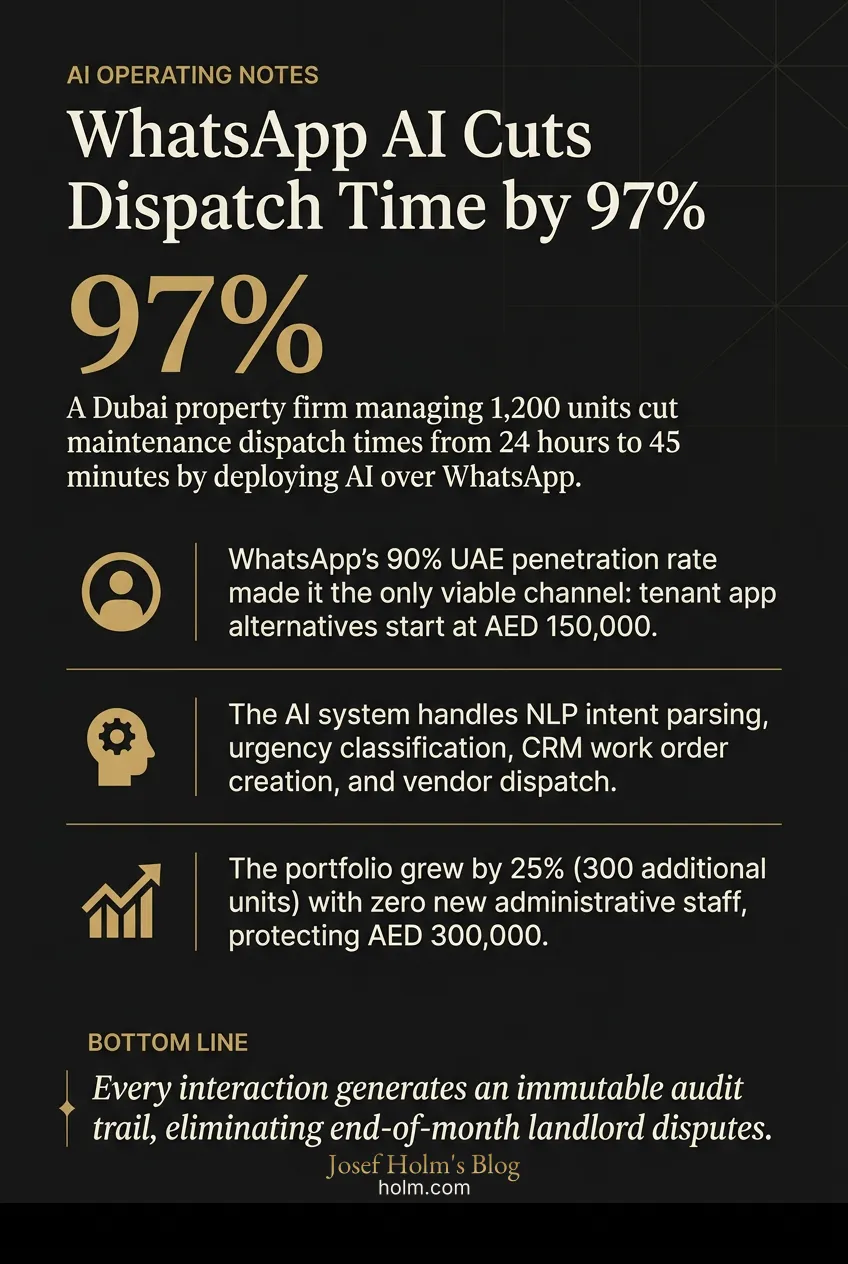
- A Dubai property firm managing 1,200 units cut maintenance dispatch times from 24 hours to 45 minutes by deploying AI over WhatsApp, achieving 96.8% faster response without a single new hire.
- WhatsApp's 90% UAE penetration rate made it the only viable channel: tenant app alternatives to build and routinely see 40% abandonment before first use.
- The AI system handles NLP intent parsing, urgency classification, CRM work order creation, and vendor dispatch automatically, leaving property managers only the one-click approval decision.
- The portfolio grew by 25% (300 additional units) with zero new administrative staff, protecting AED 300,000 to AED 500,000 in annual fixed costs that would have funded three coordinators.
- Every interaction generates an immutable audit trail, eliminating end-of-month landlord disputes and keeping the firm perpetually ready for RERA and Mollak compliance reviews.
The Daily Reality Nobody Talks About
Picture this. It's 2:47 AM in Dubai. A tenant's AC unit dies. The bedroom temperature climbs past 40°C within the hour. A WhatsApp message fires off to the property manager. Then another. Then a voice note in Arabic. Then a photo of condensation pooling on the floor.
By morning, that single message sits buried under 47 others from tenants across 1,200 units. The property manager arrives at the office, opens WhatsApp, and begins the grind: reading each message, interpreting complaints written in four different languages, manually typing structured tickets into a CRM, calling vendors for quotes, emailing landlords for cost approvals, then circling back to update tenants who've already sent follow-up messages asking why nobody responded.
This isn't a hypothetical. This was the operating reality of a mid-sized Dubai property management firm before Josef Holm stepped in. Staff were burning 60% of their workday acting as "human routers," manually shuttling unstructured information between tenants, vendors, landlords, and internal systems. Average vendor dispatch times had ballooned to a full 24 hours. The firm was weeks away from hiring three additional administrative coordinators just to keep the lights on.
The fix wasn't a new app. It wasn't a portal. It was something far more counterintuitive.
Why Is Dubai's Property Market Uniquely Pressured Right Now?
The numbers tell a story of extraordinary growth colliding with structural constraints. Dubai recorded 530,000 rental contracts in 2025 alone, the highest figure on record. Population growth exceeding 5% for consecutive years pushed the city past four million residents, with 17.55 million overnight visitors adding further demand pressure.
But here's the tension most people miss.
The Dubai Smart Rental Index, rolled out by the Dubai Land Department in early 2025, placed an effective ceiling on landlords' ability to raise rents arbitrarily. The AI-powered index calculates fair rent ranges using real transaction data, building classifications, and community-level metrics. Landlords must provide 90 days' notice before any increase. In many mid-tier areas, rents actually declined, with certain villa types dropping more than 12% and some apartment categories falling as much as 13%.
When top-line revenue gets capped by regulation, where does profit come from? It comes from the bottom line. From operational discipline. From doing more with less.
Property management fees typically land between 5% and 10% of annual rental value in Dubai, with flat-fee packages sometimes ranging to AED 5,000 for standard apartments. That's a razor-thin margin within which firms must absorb tenant screening, rent collection, Ejari registration, marketing, and the single most labor-intensive function of all: maintenance coordination.
Meanwhile, rental defaults in Dubai more than doubled over a recent 12-month period. Late payments surged by 300%. Tenant retention became the only reliable lever for protecting landlord income, and lease renewals accounted for 62% to 70.1% of all contracts in 2024 and 2025. Replacing a single tenant costs between $7,000 and $42,000 when you factor in lost rent, commissions, marketing, and unit preparation.
So what determines whether a tenant renews? Maintenance response time. Specifically, 72% of high-end tenants cite unresolved maintenance as the primary reason for non-renewal. Tenants who receive acknowledgment within one hour renew at 89%. Those who wait days? Just 54%.
Speed isn't a nice-to-have. It's the financial engine of the entire operation.
What Happens When You Tell Tenants to Download Another App?
Faced with collapsing dispatch times and a communication backlog that threatened to swallow the business, the firm did what most companies do. They consulted a traditional software vendor. The recommendation was predictable: build a bespoke tenant portal application.
On paper, it sounds reasonable. Give tenants a dedicated platform to submit structured maintenance requests. Clean data in, clean data out.
The reality is far uglier.
Custom real estate app development in Dubai for a basic tenant app and climbs past AED 1,100,000 for anything with real intelligence baked in. A moderate management app with maintenance portals and rent tracking runs AED 220,000 to AED 370,000, takes six to nine months to build, and carries ongoing annual maintenance costs of AED 20,000 to AED 75,000. For a firm already operating on thin margins, that's a massive capital bet on an unproven tool.
But the money isn't even the biggest problem. The biggest problem is that nobody will use it.
This is where "app fatigue" enters the conversation. Studies show 65% of digitally active users find forced app downloads frustrating. A full 40% will abandon an interaction entirely rather than install unfamiliar software. A tenant might submit a maintenance request two or three times a year. Asking them to find an app store, download proprietary software, create an account, remember a password, and authenticate a login for something they'll barely use is a guaranteed path to single-digit adoption rates.
What happens when tenants refuse the app? They revert to exactly what they were doing before. They send a WhatsApp message. They call the office. The firm has now spent a quarter million dirhams on software that collects dust while the original problem persists unchanged.
Josef Holm recognized this pattern immediately and advised against the custom app. The reasoning was grounded in a simple but powerful operational philosophy: don't force users to change their habits. Make their existing behavior infinitely expandable.
Why WhatsApp? Because It Already Won.
WhatsApp commands a 90% penetration rate across the UAE population. That's not a preference. That's infrastructure. It's how people order food, confirm meetings, negotiate business deals, and complain about broken air conditioners.
Data from the region shows 90% of all business conversational support messages are transmitted via WhatsApp. When surveyed, Middle Eastern consumers consistently rank messaging apps as their most requested communication channel with brands, particularly in service industries requiring real-time updates. The platform supports asynchronous communication, multilingual input, and instant multimedia sharing. A tenant can snap a photo of a burst pipe and send it in three seconds without leaving the app they already have open.
For the 1,200 tenants managed by this firm, WhatsApp wasn't just a messaging tool. It was their primary interface with daily life in Dubai.
The strategic decision was clear. Don't build a new destination. Build intelligence on top of the destination that already exists. By deploying AI directly over the existing WhatsApp Business API, the firm achieved something no bespoke app could deliver: 100% tenant adoption from day one. Zero friction. Zero onboarding. The tenant sends a message exactly as they always have. The difference is what happens on the other side.
How Does AI Actually Handle a Maintenance Request on WhatsApp?
This is where the Josef Holm intervention gets technically interesting. The system architecture transformed a simple messaging interface into an automated dispatch and triage center. Here's what happens in the seconds after a tenant sends a message like "The AC is blowing hot air and there is a massive leak in the ceiling."
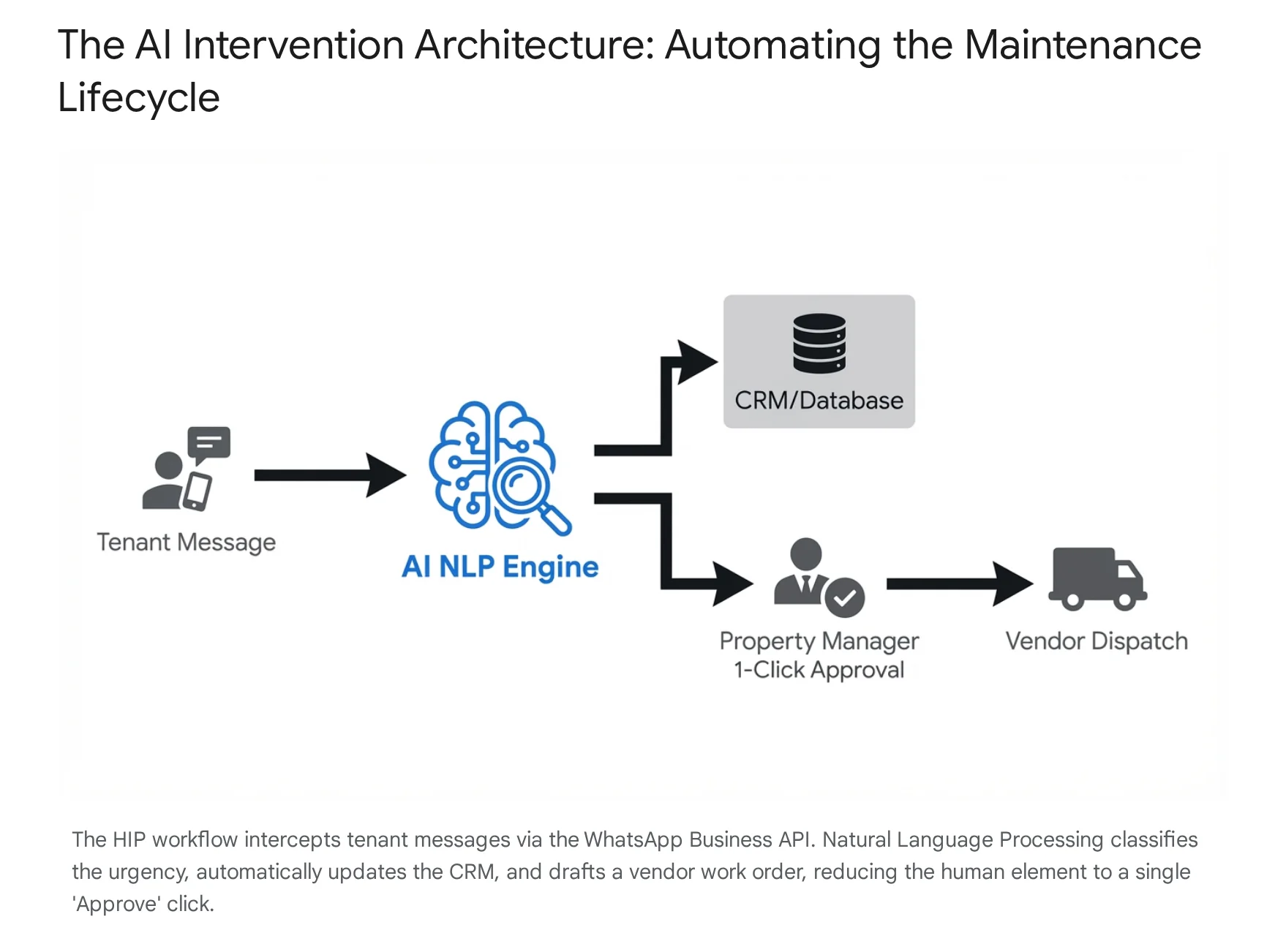
Ingestion and intent recognition. The message hits the WhatsApp API and gets routed to an NLP engine instead of a human inbox. The algorithms parse syntax, semantics, and keywords to identify the core intent and extract entities: location, asset type, perceived severity. The system handles colloquialisms, multilingual inputs, urgency markers, and the misspellings that are endemic to casual messaging.
Automated urgency classification. Not all requests carry the same weight. The AI applies predefined decision logic and real-time data analysis to assign priority scores within seconds. A dripping guest bathroom faucet gets a different classification than water coming through the ceiling. The system cross-references the parsed request against safety criteria and historical operational data, eliminating the human bias, fatigue, and inconsistency that plague manual triage.
Work order generation and CRM integration. Once categorized, the AI interfaces directly with the firm's property management CRM. It drafts a complete vendor work order, logs it against the specific tenant profile and unit, and appends any photos or videos the tenant sent via WhatsApp. No human touches the CRM. No manual data entry occurs. The database becomes a real-time reflection of portfolio health, updated autonomously.
The one-click approval. The system selects the appropriate vendor from the firm's approved list, flags estimated costs based on historical data or pre-agreed rate cards, and sends a structured notification to the property manager. Instead of spending an hour assembling the logistics of a single repair, the manager receives a fully assembled diagnostic dossier. They review the AI's logic, check the cost estimate, and click "Approve." The vendor gets dispatched instantly. The tenant receives an automated WhatsApp confirmation with a scheduled arrival time.
The entire loop closes in minutes. What previously consumed hours of fragmented, error-prone manual coordination now executes with surgical precision while the property manager focuses on decisions that actually require human judgment.
What Were the Hard Numbers?
The commercial results tell the story more convincingly than any architectural diagram.
1,200 hours of manual data entry eliminated annually. Not reduced. Eliminated. Every minute previously spent translating WhatsApp messages into CRM tickets evaporated.
Average dispatch time collapsed from 24 hours to 45 minutes. That's a 96.8% acceleration in operational velocity. In a city where an AC failure at noon can make an apartment uninhabitable by sunset, the difference between 24 hours and 45 minutes isn't incremental improvement. It's the difference between a tenant who renews and one who leaves.
The portfolio grew by 300 units with zero new hires. A 25% expansion in operational scope, absorbed entirely by the AI system. The three administrative coordinators the firm was preparing to onboard were never hired, protecting approximately AED 300,000 to AED 500,000 in annual fixed costs that would have gone to salaries, visas, insurance, and workspace overhead.
End-of-month landlord disputes were eliminated. Every interaction generates an immutable, timestamped audit trail. When a landlord questions a maintenance deduction, the property manager produces the complete lifecycle of the ticket in seconds: the tenant's original message, attached photos, the AI's urgency classification, the vendor's quote, the landlord's explicit approval click, and the completion confirmation.
Properties running AI-automated maintenance responses report 34% higher lease renewal rates according to commercial real estate sector models. When retaining a single high-value tenant avoids AED 42,000 or more in turnover costs, multiply that preservation across 1,500 units and the financial impact becomes enormous.
Does AI Replace Property Managers or Free Them?
This question deserves a direct answer. It frees them.
Before the intervention, property managers were reactive firefighters drowning in administrative noise. After deployment, those same people redirected their energy toward proactive tenant relations, complex lease negotiations, detailed owner reporting, and aggressive portfolio expansion strategies. Industry benchmarks suggest automated scheduling and dispatch allow facility teams to increase daily job completion rates by up to 37% without additional staffing. The Josef Holm intervention confirmed those benchmarks in a live Dubai environment.
The AI handles what humans shouldn't be doing. Humans handle what AI can't. That's the division of labor that actually works.
What About Regulatory Risk and Legal Disputes?
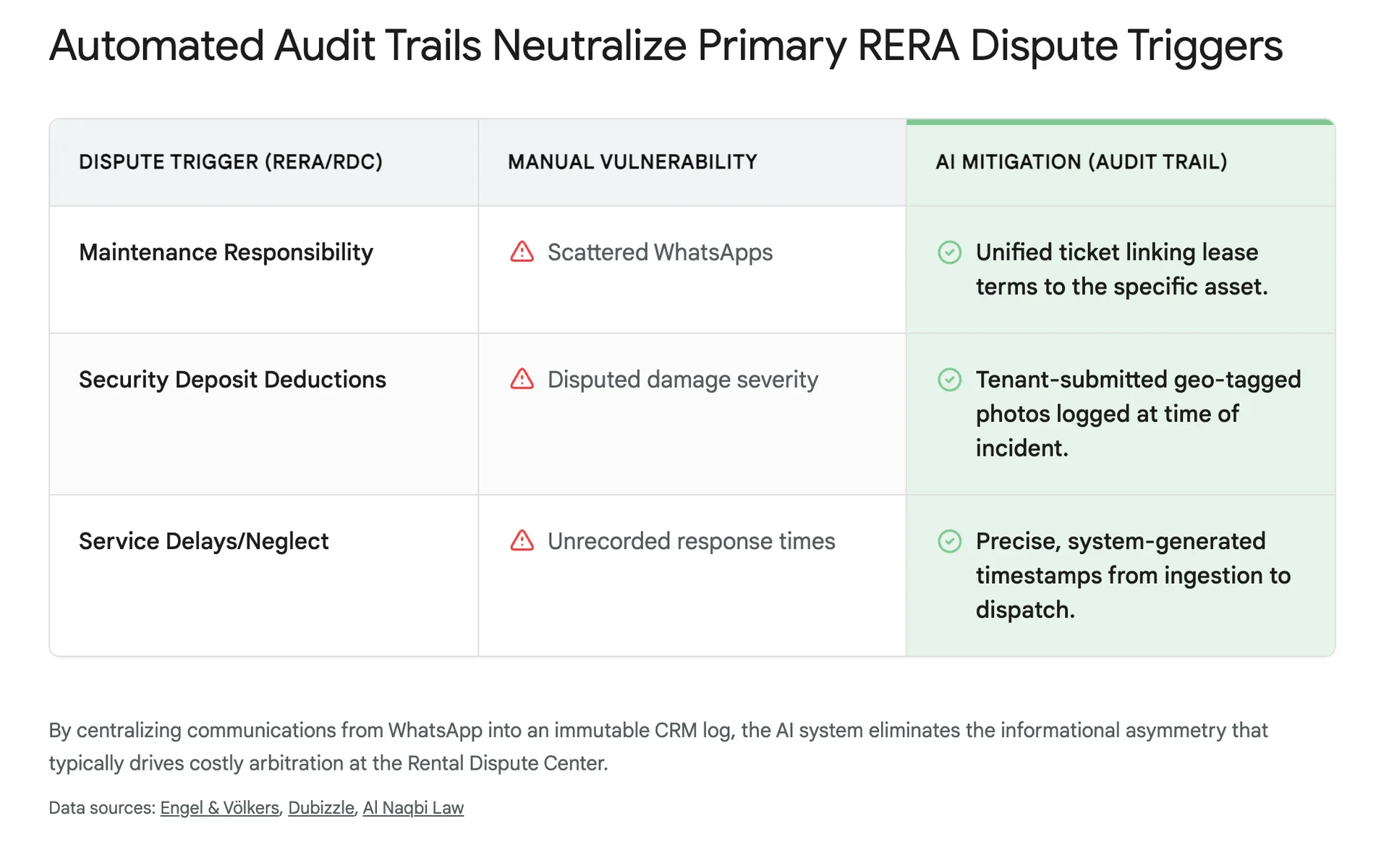
Dubai's regulatory framework, governed by RERA and the Rental Dispute Center, demands rigorous documentation. A big portion of rental disputes stems from disagreements over maintenance responsibilities, repair timeliness, and security deposit deductions.
In a manual WhatsApp environment, critical communication scatters across personal devices and unrecorded phone calls. When a tenant claims they reported a leak weeks before structural damage occurred, reconstructing a chronological history becomes nearly impossible. The property manager scrambles through chat archives, email threads, and hazy recollections.
The AI workflow generates a clean audit trail by default. Every tenant message is timestamped. Every urgency classification is logged. Every landlord approval is recorded with a digital signature. Every vendor dispatch and completion confirmation enters the permanent record automatically.
This isn't just convenient. It's legal armor. The firm stays perpetually audit-ready for RERA and Mollak compliance reviews, and the informational asymmetry that previously fueled expensive arbitration proceedings simply ceases to exist.
What Comes Next for Property Management in the Middle East?
The PropTech sector across the Middle East is currently valued at $610 million with 189 active firms and expanding rapidly. The direction is clear: the industry is moving away from monolithic applications toward modular, API-driven workflows that integrate directly into consumer behavior patterns.
The next frontier fuses NLP with predictive IoT analytics. Advanced facilities in the UAE are already deploying vibration and thermal sensors that flag HVAC anomalies weeks before catastrophic failure. When those predictive signals connect to the NLP dispatch workflows described here, the model shifts from reactive to fully autonomous. A sensor detects a failing water pump. The system drafts the work order. The AI triages and dispatches the vendor. The repair happens before the tenant even notices a problem, let alone sends a WhatsApp message.
In a market defined by intense competition, rising tenant expectations, and regulatory constraints that cap revenue growth, AI isn't a theoretical advantage anymore. It's the baseline requirement for staying in business. Firms that continue scaling headcount linearly alongside portfolio growth will watch their margins compress until the math stops working entirely.
The firms that thrive will be the ones that decoupled their administrative overhead from their portfolio size. That built intelligence into the channels their tenants already use. That turned coordination chaos into expandable precision.
The WhatsApp message is coming whether you're ready or not. The only question is what happens after it arrives.
-
If your property management operation is still running on manual coordination and you want to understand what an AI readiness note would reveal about your specific workflow bottlenecks, reach out to the team at Josef Holm. The conversation starts where your tenants already are.
Infographic
Frequently Asked Questions
- How did AI reduce property maintenance dispatch times in Dubai?
- By deploying an NLP engine over the WhatsApp Business API, the system automatically parses tenant messages, classifies urgency, generates CRM work orders, and dispatches pre-approved vendors without any human data entry. This compressed average dispatch time from 24 hours to 45 minutes, a 96.8% improvement.
- Why is WhatsApp better than a custom tenant app for property management?
- WhatsApp already has 90% penetration across UAE residents, meaning tenants use it daily without any onboarding. Custom tenant apps to build, take six to nine months to develop, and studies show 40% of users will abandon an interaction rather than install unfamiliar software. WhatsApp AI achieves 100% adoption from day one.
- What does an AI property management workflow actually automate?
- The workflow automates intent recognition from multilingual messages, urgency classification, work order creation in the CRM, vendor selection from approved lists, cost estimation, landlord approval notifications, vendor dispatch, and tenant confirmation messages. The only human touchpoint is a one-click manager approval before dispatch.
- How does AI help property managers comply with RERA regulations in Dubai?
- The AI workflow generates a timestamped, immutable audit trail for every tenant interaction, urgency classification, landlord approval, vendor dispatch, and completion confirmation. This eliminates the documentation gaps that fuel RERA disputes and positions firms for immediate compliance review without scrambling through scattered chat archives.
- Can a property management firm grow its portfolio without hiring more staff using AI?
- Yes. The firm profiled in this case study expanded its managed portfolio by 300 units (a 25% increase) without adding a single administrative coordinator, avoiding an estimated AED 300,000 to AED 500,000 in annual fixed staffing costs. AI absorbed the coordination volume that would otherwise require linear headcount growth.
- How does maintenance response speed affect tenant renewal rates in Dubai?
- The data is stark: tenants who receive acknowledgment within one hour renew at an 89% rate, while those who wait days renew at just 54%. Since 72% of high-end tenants cite unresolved maintenance as their primary reason for not renewing, and replacing one tenant costs between $7,000 and $42,000, fast dispatch is the single most important financial lever in property management.